Plan G
Covers the standardized gaps available to newly eligible beneficiaries except the Medicare Part B deductible. A high-deductible version may also be offered.
Six Medigap essentials
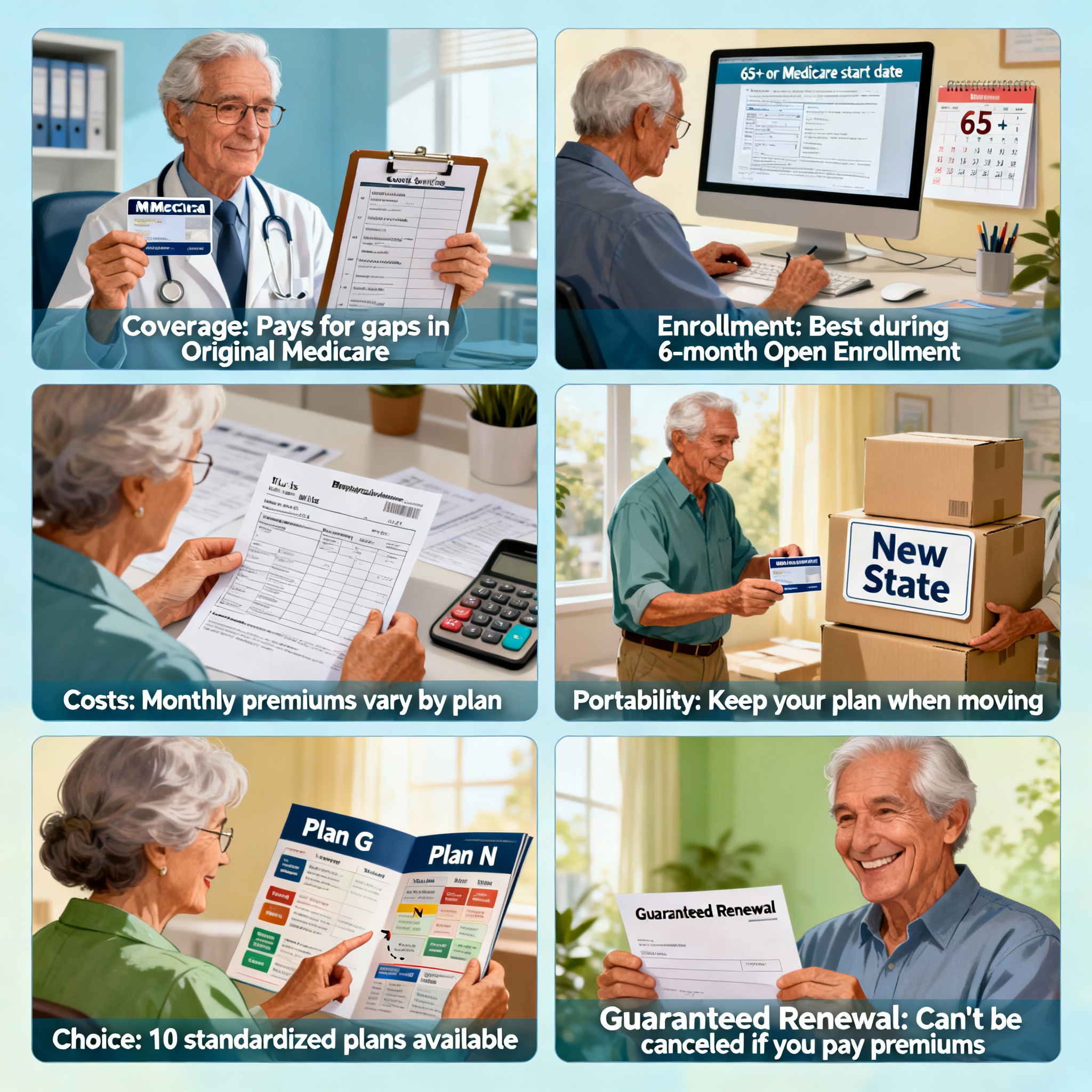
These six facts about your Medicare Supplement plan explain how Medigap works with Original Medicare, why plan letters matter, when enrollment protections apply, and which costs or services remain your responsibility.
Medigap is private insurance designed to supplement Medicare Part A and Part B. It is not a replacement for Original Medicare, a Medicare Advantage plan, or prescription drug coverage. Understanding those boundaries can prevent enrollment mistakes and make plan comparisons more meaningful.
If you are searching for Medicare Supplement information near me, start with the rules that apply nationwide and then check your state’s additional protections. State law can affect under-65 access and opportunities to change policies, while premiums and insurer availability vary by location.
Use the Blake Insurance Group form to compare Medicare Supplement, Medicare Advantage, and Part D considerations. The supplied Wellcare destination is for that carrier’s Medicare options and is not a Medigap application.
Availability, eligibility, underwriting, plan design, and premiums must be confirmed for the applicant.Original Medicare remains the primary coverage. When Medicare recognizes a covered service, it determines the approved amount and pays its share. The Medicare Supplement policy then pays according to its standardized benefits. If Medicare does not cover a service, Medigap generally does not make that excluded service covered.
This coordination is why a beneficiary generally needs Medicare Part A and Part B before buying Medigap. It is also why Medigap cannot pay the cost sharing of a Medicare Advantage plan. Medicare Advantage is an alternative way to receive Part A and Part B benefits; Medigap is supplemental coverage for Original Medicare.
Standard Medigap usually follows Original Medicare rather than using its own provider network. A beneficiary can generally use doctors and hospitals nationwide that accept Medicare. Medicare SELECT is an exception because it may require designated providers or facilities for full supplemental benefits.
Before scheduling care, confirm that Medicare covers the service and that both the facility and individual clinician participate in Medicare. Acceptance of Medicare assignment is a separate question that can matter for plans that do not cover Part B excess charges.
The table below previews all six facts. The sections that follow explain how each affects plan selection, enrollment, and total cost.
| Topic | General rule | What to confirm |
|---|---|---|
| 1. Coordination | Medigap supplements Original Medicare and generally pays only after Medicare processes a covered service. | Part A and Part B status, Medicare coverage rules, provider participation, and assignment. |
| 2. Standardization | In most states, every policy with the same letter has the same basic medical benefits. | Compare identical letters; Massachusetts, Minnesota, and Wisconsin standardize differently. |
| 3. Enrollment timing | The federal Medigap Open Enrollment Period is a one-time six-month period beginning at age 65 or older with Part B. | Part B effective date, state rights, guaranteed-issue event, and application deadline. |
| 4. Switching | Medicare’s fall enrollment period does not create a general right to switch Medigap without underwriting. | Written approval, effective dates, state switching protection, and free-look overlap. |
| 5. Premiums | Benefits are standardized within a letter, but premiums and pricing methods can differ. | Same-letter quotes, rating method, discounts, underwriting, and rate history. |
| 6. Boundaries | Modern Medigap does not include Part D and generally excludes routine dental, vision, hearing, and long-term care. | Separate Part D, non-Medicare services, travel benefits, and individual policy ownership. |
In most states, plan letters are standardized benefit designs—not company ratings. One insurer’s Plan G provides the same basic medical benefits as another insurer’s Plan G. The correct sequence is to choose the benefit design first and then compare companies selling that same letter.
Covers the standardized gaps available to newly eligible beneficiaries except the Medicare Part B deductible. A high-deductible version may also be offered.
Uses cost sharing for certain office and emergency-room visits and does not cover Part B excess charges. It covers many other major standardized gaps.
Pay percentages of several standardized benefits and include annual out-of-pocket limits that are adjusted over time.
Plan A contains the core standardized Medigap benefits. Other plan letters add different combinations of the Part A deductible, skilled-nursing-facility coinsurance, foreign-travel emergency coverage, and other gaps. Plan M pays part of the Part A deductible. Medigap Plan D is a medical supplement letter and should not be confused with Medicare Part D prescription drug coverage.
Massachusetts, Minnesota, and Wisconsin standardize Medigap differently, so their benefit names and structures require state-specific comparison. In every state, insurer differences can still include premium, rating method, discounts, service, application handling, and future rate changes.
Plan C and Plan F have eligibility restrictions. In general, they are not available to people who became newly eligible for Medicare on or after January 1, 2020. Someone eligible for Medicare before that date may still be able to apply depending on the insurer, underwriting, and applicable rights. Existing policyholders are not required to cancel those plans merely because they are closed to newly eligible buyers.
Plan G can suit someone who prefers broader standardized cost sharing after paying the annual Part B deductible. Plan N can suit someone willing to accept its visit copayments and possible Part B excess-charge exposure in exchange for a different premium. The decision should compare the actual premium difference with anticipated provider use and the availability of doctors who accept Medicare assignment.
Neither Plan G nor Plan N automatically covers routine dental, routine vision, hearing aids, custodial long-term care, or retail prescription drugs. Medigap generally pays only when Original Medicare recognizes the service and determines its share. A service Medicare excludes does not become covered simply because the beneficiary owns a supplement.
The federal Medigap Open Enrollment Period lasts six months and begins the first month a person is at least 65 and enrolled in Medicare Part B. During this protected window, an insurer cannot refuse to sell any Medigap policy it offers or charge more because of pre-existing health problems. This period does not repeat annually.
If someone delays Part B because of qualifying employer coverage, the Medigap window generally begins when Part B later becomes effective. The Medicare Initial Enrollment Period, Part B Special Enrollment Period, and Medigap Open Enrollment Period are related decisions, but they are not the same legal window.
Federal law generally does not require insurance companies to sell Medigap policies to beneficiaries under 65 who have Medicare because of disability or End-Stage Renal Disease. State law can provide broader access. Depending on the state, an under-65 beneficiary may have a protected enrollment window, access to only certain standardized policies, access through a designated mechanism, or no required private-policy availability until age 65.
Under-65 premiums can also differ from premiums offered to applicants eligible because of age. A state rule requiring an insurer to issue coverage does not necessarily require the same premium as an age-65 policyholder. Verify the state rule, eligible plan designs, insurer participation, rating approach, application deadline, and requested effective date before relying on a quote.
Federal plan-letter limits still matter. Plans C and F generally cannot be sold to someone newly eligible for Medicare on or after January 1, 2020, even if a state gives that person an under-65 purchasing right. A beneficiary eligible for Medicare before that date may still qualify for those plan letters, subject to state law, insurer availability, underwriting, and any protected enrollment right.
Before applying, record the reason for Medicare entitlement, Part A and Part B dates, any Social Security or Medicare eligibility notice, ESRD status, desired benefits, prior creditable coverage, ZIP code, and requested effective date. Contact the State Insurance Department or SHIP for a current explanation of rights because under-65 rules differ materially across states.
A person already receiving Medicare because of disability or ESRD receives the federal six-month Medigap Open Enrollment Period upon reaching 65 while enrolled in Part B. During that period, the beneficiary can buy any Medigap policy sold to age-65 applicants in the state without denial or higher pricing because of health problems.
Someone who already owns an under-65 policy should not assume its premium or terms automatically change at 65. Compare the policies available to age-65 applicants, coordinate the replacement effective date, and do not cancel existing coverage until the new policy is issued and reviewed. State switching rights may provide later opportunities, but the federal age-65 window deserves careful attention.
Medicare Annual Open Enrollment from October 15 through December 7 applies mainly to Medicare Advantage and Part D choices. It does not create a general federal right to buy or change Medigap without health questions. This distinction matters before someone drops an existing supplement or leaves Medicare Advantage expecting guaranteed access to a new policy.
After the protected period, a company may use medical underwriting unless the applicant has a guaranteed-issue or state-specific enrollment right. It may ask health questions, review permitted medical or prescription information, decline the application, or charge a different premium. Do not cancel current coverage merely because an application has been submitted. Wait for written approval, verify the effective date, and review the issued policy.
There is no general federal birthday rule or annual Medigap open enrollment. Some states allow existing policyholders to change coverage around a birthday or policy anniversary, while others provide different or narrower protections. The permitted replacement may be limited to the same benefits, equal or lesser benefits, a particular insurer, or a defined application period.
Before switching, verify whether the rule applies to the current policy, which replacement designs qualify, when the application must be received, and whether health-status underwriting is prohibited. A Medicare Advantage or Part D election window is not by itself proof of a Medigap purchasing right.
Specific events can create federal guaranteed-issue rights. Examples may include certain employer or union coverage ending, a Medicare Advantage plan leaving Medicare or the service area, a Medigap insurer becoming bankrupt, or use of a Medicare Advantage trial right. The policies available and application deadline depend on the event. Many federal rights allow an application beginning 60 days before coverage ends and continuing through 63 days afterward, but the exact rule must be verified for the person’s situation.
Even when a policy must be issued, coverage for a pre-existing condition may be delayed for a limited time in some circumstances. Prior creditable coverage can reduce or eliminate a waiting period. Original Medicare continues paying its share of covered services, but the beneficiary may owe the portion the supplement has not begun covering. Ask the insurer to explain the waiting-period decision and creditable-coverage calculation in writing.
When switching policies, the buyer generally receives a 30-day free-look period after the new Medigap policy begins. Both premiums must be paid during the overlap. Do not cancel the old policy until the new policy has been issued, reviewed, and accepted because a canceled policy may not be recoverable and a later application may require underwriting.
Modern Medigap policies are guaranteed renewable as long as the policyholder pays premiums and follows the contract. Guaranteed renewable does not mean the price is permanently fixed. It means the company generally cannot terminate the individual policy merely because the insured develops health problems or submits claims.
A single national Medigap price would be unreliable. Premiums can vary by plan design, insurer, state, ZIP code or rating area, age, tobacco status, household or payment discounts, rating method, application date, and medical underwriting when permitted. Quotes should be compared using identical applicant information, the same plan letter, and the same effective date.
| Question | Why it matters | What to record |
|---|---|---|
| How is the policy rated? | Attained-age, issue-age, and community or no-age-rated methods treat age differently and can affect premiums over time. | The stated rating method, any automatic age-bracket increases, and other factors that may drive future changes. |
| Does underwriting apply? | Health history can affect approval or price outside open enrollment and guaranteed issue. | The protected right, application answers, and written approval before replacement. |
| Standard or high deductible? | A high-deductible policy has a period in which the insured pays eligible cost sharing before Medigap begins paying. | The current annual deductible and which expenses count toward it. |
| Is there a discount? | Household or payment-method discounts may have conditions or end later. | The qualification rules and full premium without the discount. |
| What is the rate history? | Past increases do not guarantee future results but add context to a starting premium. | Current rate, recent approved changes when available, and renewal month. |
| Is it Medicare SELECT? | Medicare SELECT may require designated hospitals or providers for full supplemental benefits. | Network rules, emergency exceptions, and non-network responsibility. |
Total cost includes the Medigap premium, the Medicare Part B premium, any uncovered Medicare deductible, and a separate Part D premium when drug coverage is selected. Dental, vision, hearing, long-term care, and non-Medicare services may require separate planning. Attained-age policies can increase automatically as the insured enters older age brackets; issue-age policies use age at purchase; community-rated policies do not use an individual’s age. Any method can still experience other permitted rate changes, so compare more than the first premium.
Modern Medicare Supplement policies do not include outpatient prescription drug coverage. A beneficiary who wants drug coverage generally considers a separate Part D plan and coordinates its effective date with Original Medicare and Medigap. Drug formularies and pharmacy networks belong to Part D—not the supplement.
Medigap also generally does not cover routine dental care, routine vision care, eyeglasses, hearing aids, custodial long-term care, or private-duty nursing. Some insurers may advertise non-insurance extras, but those extras are not part of the standardized Medigap medical benefits and should not be confused with insured coverage.
A Medigap policy covers one person. Spouses need separate policies, applications, and premiums even when they choose the same company and plan letter. Any household discount must be confirmed; it does not turn two individual contracts into family coverage.
Standard Medigap generally does not use a provider network. It follows Original Medicare, so a beneficiary can generally use doctors and hospitals nationwide that participate in Medicare. This can matter for people who divide time between states, live in rural communities, relocate temporarily, or travel to a regional or academic medical center. Medicare SELECT is the important exception because it may require designated providers for full supplemental benefits.
Broad access does not guarantee that every clinician accepts Medicare, accepts Medicare assignment, offers a nearby appointment, or provides a Medicare-covered service. Confirm both the facility and individual clinician, ask about Medicare participation and assignment status, and verify that Medicare recognizes the service before assuming the supplement will pay.
Snowbirds and people who spend part of the year away from their permanent home should compare domestic access as well as premium. A standard Medigap policy follows Original Medicare within the United States, but prescription coverage is handled separately through Part D and may use a pharmacy network. Keep permanent and seasonal address information accurate and check medical providers and pharmacies in each location.
Care outside the United States is different from care in another state. Some standardized plan letters include limited foreign-travel emergency coverage, subject to a deductible, percentage, lifetime limit, and timing rules. It is not comprehensive international insurance, and Part D generally does not cover drugs purchased outside the United States. International travelers should read the policy’s exact foreign-travel provision.
Beneficiaries who use Indian Health Service, tribal health programs, or urban Indian health services should ask how Original Medicare billing, referrals, prescriptions, and outside specialty care coordinate. Eligibility for tribal health services is separate from Medicare. A Medigap policy generally responds only after Medicare recognizes a covered service, so billing status and the referral path matter.
State Health Insurance Assistance Programs provide free, unbiased, one-on-one Medicare counseling. SHIP counselors can explain Original Medicare, Medigap, Medicare Advantage, Part D, enrollment rights, appeals, and assistance programs. State Insurance Departments regulate Medigap insurers and can help with licensing information, state-specific rights, and policy complaints. Medicare.gov and 1-800-MEDICARE can help locate the appropriate state resources.
Medigap supplements Original Medicare. Medicare Advantage is a private-plan way to receive Part A and Part B benefits. A person cannot use Medigap to pay Medicare Advantage premiums, deductibles, or copayments. Selling a Medigap policy to someone who remains enrolled in Medicare Advantage is generally prohibited unless the person is returning to Original Medicare.
Standard Medigap follows Original Medicare nationwide. Medicare Advantage may use service areas, provider networks, referrals, and prior authorization.
Medigap requires separate Part D planning. Many Medicare Advantage plans include Part D, subject to the plan’s formulary and pharmacy network.
Medigap adds a premium to reduce Original Medicare cost sharing. Medicare Advantage uses plan-specific premiums and cost sharing up to an annual medical limit.
A Medicare Advantage disenrollment opportunity does not always create a right to buy any Medigap policy. Before leaving, identify whether the person has a trial right or another guaranteed-issue protection, which plan letters are available, and the application deadline. Align the Medigap, Original Medicare, and Part D effective dates to prevent gaps.
Be ready with Medicare effective dates, current coverage, ZIP code, desired plan letters, prescription information, and any notice supporting a guaranteed-issue right.
Submitting a request does not enroll you in a policy or guarantee approval of a Medigap application.In most states, yes. The basic medical benefits within a standardized plan letter are the same regardless of the insurer. Premiums, rating methods, discounts, service, and rate changes can differ. Massachusetts, Minnesota, and Wisconsin standardize policies differently.
No. Medigap supplements Original Medicare and cannot pay Medicare Advantage premiums or cost sharing. A person returning to Original Medicare must coordinate the Medicare Advantage termination and Medigap effective date.
No. A Medigap policy covers one individual. Spouses need separate applications, policies, and premiums even when they select the same insurer and benefit design.
It depends on the state. Federal law generally does not require insurers to sell Medigap to people under 65 with Medicare due to disability or ESRD. Some states require access to certain policies or create other protections.
Not automatically. Medicare Annual Open Enrollment does not create a general federal Medigap switching right. Outside the one-time Medigap Open Enrollment Period, a guaranteed-issue event, or an additional state protection, medical underwriting may apply.
No modern Medigap policy includes outpatient prescription drug coverage. A beneficiary generally considers a separate Part D plan and should coordinate its effective date with Original Medicare and Medigap.
Standard Medigap generally follows Original Medicare and can be used with providers nationwide that accept Medicare. Medicare SELECT is different and may require designated providers or facilities for full supplemental benefits.
Every state has a State Health Insurance Assistance Program offering free, unbiased counseling. Medicare.gov and 1-800-MEDICARE provide official federal information, and the State Insurance Department can explain state Medigap rules or receive policy complaints.
Medicare disclaimer: We do not offer every plan available in your area. Any information we provide is limited to those plans we do offer in your area. Please contact Medicare.gov, 1-800-MEDICARE (1-800-633-4227), or your State Health Insurance Assistance Program to get information on all of your options.
Blake Insurance Group LLC is an independent insurance agency. It is not connected with or endorsed by the United States government, the federal Medicare program, any State Insurance Department, or any State Health Insurance Assistance Program.
This page is general educational information. Insurer and plan availability, underwriting, premiums, discounts, standardized amounts, effective dates, and eligibility can vary by state and may change. Confirm current information through official insurer documents and applicable federal and state rules before applying or replacing coverage.
Wellcare and other company or product names are trademarks of their respective owners. Their use is for identification and education and does not imply government endorsement. The supplied Wellcare destination is a separate carrier-related website and may be a marketing link.




