Cheap Supplemental Insurance Plans: 2026 Buyer’s Guide
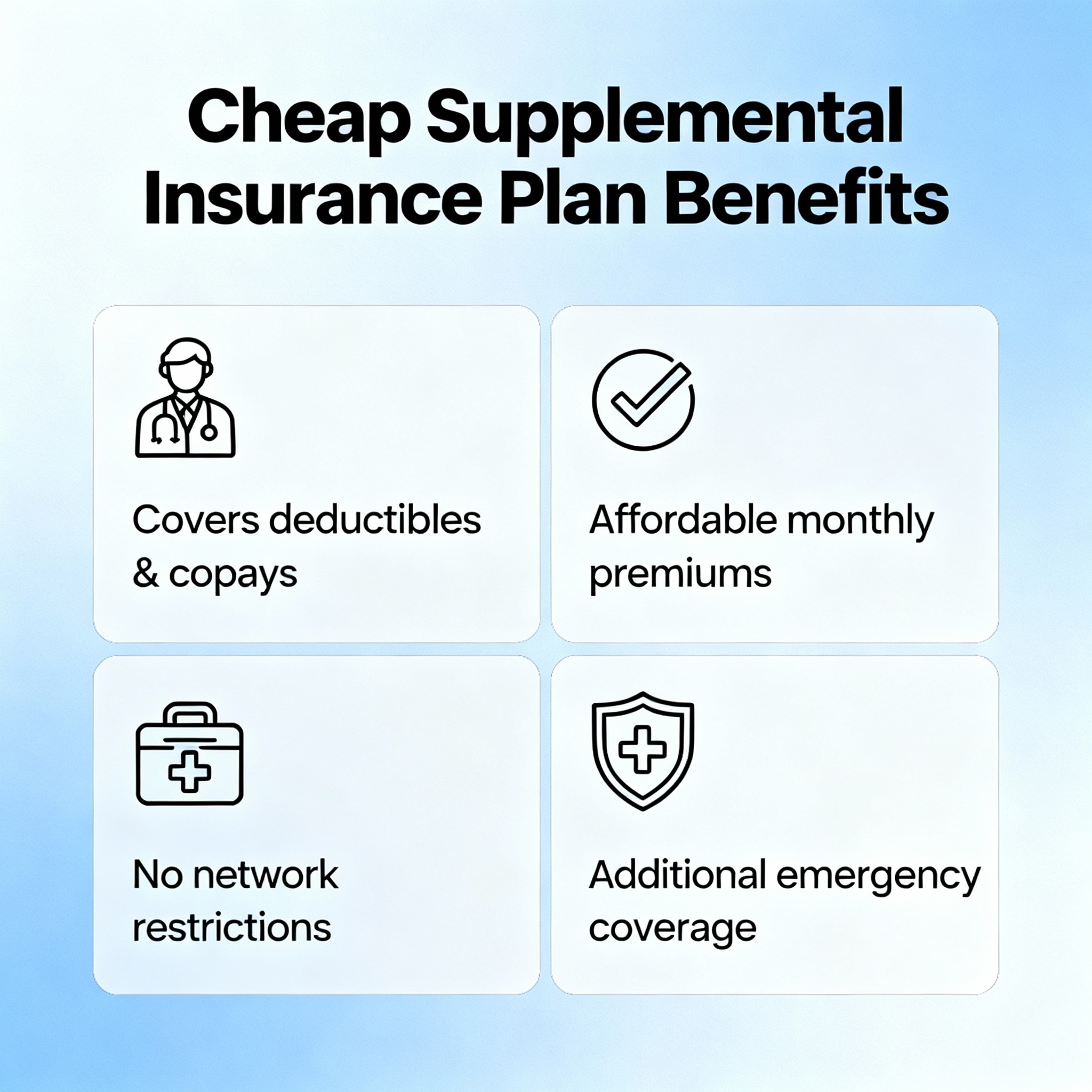
Cheap supplemental insurance plans should be judged by more than the smallest monthly premium. An affordable plan is one whose total cost fits the household budget and whose benefits address a documented exposure—such as a high medical deductible, unpaid time away from work, a covered hospital stay, accidental injury, a qualifying critical illness, routine dental care, or vision expenses. Paying less for a plan that is unlikely to respond is not a real saving.
Begin with comprehensive medical coverage. Before buying another policy, check eligibility for an employer plan, Marketplace premium tax credits, cost-sharing reductions, Medicaid, CHIP, Medicare, or another qualifying option. HealthCare.gov reports important 2026 changes, including expanded Health Savings Account eligibility for all Bronze and Catastrophic Marketplace plans. A tax-advantaged savings strategy may address predictable deductibles and copays more efficiently than adding a narrow policy, depending on eligibility and personal circumstances.
Supplemental insurance remains limited. Hospital indemnity, accident, and critical-illness policies pay only according to their definitions, schedules, exclusions, waiting periods, and maximums. Federal fixed-indemnity notices applying since 2025 emphasize that this coverage is not comprehensive medical insurance. Dental insurance, vision benefits, and Careington discount memberships operate differently again. A Careington discount plan is not insurance; members pay participating providers at negotiated discounted rates.
“Cheap” describes price, not guaranteed value. Product availability, issued benefits, underwriting, networks, exclusions, membership terms, and effective dates depend on the applicant, state, ZIP code, provider, and selected contract.
Cheap supplemental insurance plan quick facts
Use these distinctions to decide which category deserves a closer policy review.
| Issue | Practical meaning | What to verify |
|---|---|---|
| Lowest premium is not lowest cost | A narrow plan can leave most of an expense unpaid even when its monthly price is small. | Annual premium, likely benefits, exclusions, maximums, and remaining household exposure. |
| Comprehensive coverage comes first | Supplemental coverage cannot replace major medical protection from high-cost illness or injury. | Employer and Marketplace options, financial assistance, network, drugs, deductible, and out-of-pocket maximum. |
| Buy for a defined gap | Affordable planning starts with a specific risk rather than a bundle of attractive-sounding benefits. | Hospital exposure, income interruption, accident risk, dental work, vision costs, or another measurable need. |
| Benefits may be fixed | A hospital or accident plan may pay a stated amount regardless of the actual provider charge. | Daily versus lump-sum benefit, admission rules, service limits, and claim documentation. |
| Networks change value | Dental, vision, and discount-plan savings can depend on participating providers and negotiated fees. | Current provider participation, procedure price, out-of-network terms, and frequency limits. |
| Enrollment is not activation | A quote or completed online screen does not itself prove active coverage or membership. | Approval, first payment, effective date, policy or membership documents, and ID information. |
Types of lower-cost supplemental plans to compare
The word “supplemental” covers several unrelated product designs. One plan may pay cash to the insured, another may reimburse or pay a provider under dental policy terms, and another may only unlock a negotiated discount. Compare the benefit mechanism before comparing premiums.
| Plan type | Primary purpose | Important review point |
|---|---|---|
| Hospital indemnity | May pay stated benefits for a covered hospital admission, confinement day, intensive care stay, or listed service. | Admission definition, observation status, day limits, benefit schedule, and preexisting-condition provision. |
| Accident insurance | May pay scheduled cash benefits for listed accidental injuries, tests, treatment, transport, or follow-up care. | Covered accident, treatment deadline, activity exclusions, benefit schedule, and claim records. |
| Critical illness insurance | May pay a lump sum or percentage after a first covered diagnosis meeting the policy definition. | Definitions for cancer, heart attack, stroke, recurrence, survival, and aggregate maximum. |
| Dental insurance | May cover preventive, basic, and major dental services according to network and policy terms. | Waiting periods, deductible, annual maximum, procedure class, missing-tooth clause, and orthodontia. |
| Vision insurance or benefits | May provide exam coverage and allowances or copays for lenses, frames, or contacts. | Frequency limits, retail allowance, upgrades, contact-lens election, and provider network. |
| Dental discount membership | May provide negotiated discounts from participating providers without paying an insurance claim. | The member pays the discounted fee; verify the dentist, service price, membership fee, and cancellation terms. |
| Specified-disease coverage | May focus benefits on a named disease category or covered diagnosis. | Pathology requirements, diagnosis date, exclusions, benefit percentages, and one-time versus repeat payment. |
| Bundled supplemental options | May combine several limited-benefit features or make multiple products available in one shopping path. | Identify which benefits belong to which policy, premium, insurer, network, and effective date. |
A cash-benefit policy, dental policy, vision benefit, and discount membership have different obligations. The contract—not the category label—determines what is payable.
A four-step strategy for affordable supplemental protection
1. Optimize comprehensive medical coverage first
Review employer coverage and apply through the appropriate Marketplace to learn whether the household qualifies for premium tax credits or cost-sharing reductions. For 2026, HealthCare.gov states that all Bronze and Catastrophic Marketplace plans are Health Savings Account eligible, and some other plans may qualify. An HSA can help pay eligible deductibles, copays, coinsurance, and certain dental and vision costs with tax advantages, subject to eligibility and federal rules. Compare that option before committing the same monthly dollars to a narrow supplemental policy.
2. Calculate the uncovered financial gap
List the medical plan deductible, coinsurance, in-network out-of-pocket maximum, prescription exposure, and likely dental or vision expenses. Add nonmedical costs such as unpaid leave, transportation, lodging, childcare, meals, and household bills. Subtract emergency savings, paid leave, disability benefits, HSA funds, and reliable family support. The remainder is the gap a supplemental plan would need to address.
3. Compare savings with insurance
Some predictable expenses are better funded through savings. Routine eye exams, replacement glasses, cleanings, and small dental procedures may not justify a separate policy for every household. Insurance can be more useful for uncertain events that would materially disrupt finances. Compare the annual premium with the plan’s realistic benefit under several scenarios instead of assuming any reimbursement makes the purchase worthwhile.
4. Read the benefit trigger before buying
A fixed-indemnity plan pays according to a schedule, not necessarily according to the provider bill or the amount left after health insurance. Federal rules require prominent consumer notices for fixed-indemnity excepted-benefit coverage so buyers do not mistake it for comprehensive insurance. For dental and vision coverage, evaluate networks, deductibles, allowances, waiting periods, frequency limits, and annual maximums. For a Careington membership, remember that the member pays the participating provider directly at the negotiated rate.
Ways to lower cost without buying the wrong plan
Affordability improvements should preserve the benefit most important to the household. Use this framework before reducing coverage or adding multiple small policies.
| Budget decision | Potential saving | Risk to avoid |
|---|---|---|
| Choose one priority gap | Avoids paying for overlapping bundles or low-priority riders. | Leaving the largest financial exposure unaddressed. |
| Use an HSA when eligible | Provides tax advantages and funds that roll over for eligible expenses. | Assuming every health plan is HSA eligible or using funds for nonqualified expenses. |
| Compare annual cost | Reveals membership fees, premiums, deductibles, and likely out-of-pocket costs. | Choosing by a small weekly or monthly number without totaling the year. |
| Select a realistic benefit | A smaller targeted amount may cost less than the largest available option. | Buying too little to matter or more than the budget can sustain. |
| Verify the network first | Can reduce dental and vision prices and avoid unexpected out-of-network charges. | Relying on an outdated directory or assuming a provider accepts every plan. |
| Review waiting periods | Helps avoid paying for coverage that cannot address an immediate planned service. | Replacing a plan and restarting limitations without recognizing the gap. |
| Remove duplicate riders | Reduces premium for benefits already provided through work or another policy. | Canceling a valuable benefit before confirming the replacement. |
| Recheck at renewal | Identifies rate changes, provider changes, unused benefits, and new household needs. | Keeping an unsuitable plan merely because payment is automatic. |
Avoid stacking policies until the household can explain what each premium buys. If two plans pay for the same event, compare whether the combined benefit justifies both costs. Do not cancel an existing policy until replacement coverage is approved, paid, reviewed, and confirmed effective.
What affects the price of cheap supplemental insurance?
There is no responsible national “average” premium for every household. Cost can change by state, ZIP code, product type, age, benefit amount, dependent tier, tobacco status when used, underwriting class, optional riders, and billing frequency. Dental and vision pricing can also reflect network and benefit design. Compare the same benefit structure before deciding one quote is cheaper.
| Factor | Why it matters | Comparison step |
|---|---|---|
| Age and household tier | Rates commonly vary by applicant age and whether coverage is individual, couple, parent-child, or family. | Quote every person who needs protection and compare the same tier. |
| Benefit amount | Higher lump sums, daily amounts, allowances, or maximums generally cost more. | Choose an amount connected to a documented financial gap. |
| Product design | Hospital, accident, critical illness, dental, vision, and discount products use different pricing structures. | Compare only products intended to address the same need. |
| Health underwriting | Some insurance products ask health questions or apply eligibility standards. | Answer completely; do not omit symptoms, advice, treatment, or medications. |
| Tobacco status | Some products use tobacco status in eligibility or rating. | Follow the application definition and disclose use accurately. |
| Optional riders | Added benefits can increase premium and introduce separate limits. | Confirm the rider solves a real gap and read its exclusions. |
| Network and annual maximum | Dental or vision value depends on negotiated fees and how much the plan will pay. | Model expected services with the current network and maximum. |
| Rate and renewal terms | Premium may change by age, class, policy anniversary, or approved rate action. | Ask how renewal works and whether benefits can change. |
Compare annual—not merely monthly—cost. Add premium or membership fees, deductibles, copays, coinsurance, noncovered services, and likely out-of-network charges. Then compare that total with realistic benefits for the events you are trying to address. A plan that pays a large benefit only for a narrow event may be less useful than a smaller, broader design—or vice versa—depending on the household.
Licensed service states for supplemental plan guidance
Blake Insurance Group provides remote guidance in the states listed below. A producer license does not mean every insurer, policy, discount program, or provider network is offered in every state or ZIP code. The enrollment platform must confirm the applicant’s state, product eligibility, and current terms.
| Region | Licensed states | Comparison focus |
|---|---|---|
| Southwest | Arizona, New Mexico, Oklahoma, and Texas | Compare state-approved benefits, household budget, provider access, and cash-benefit needs. |
| Southeast | Alabama, Florida, Georgia, North Carolina, South Carolina, Tennessee, Virginia, and West Virginia | Check product eligibility, dental and vision networks, benefit schedules, and waiting periods. |
| Midwest | Illinois, Iowa, Kansas, Michigan, Nebraska, Ohio, and South Dakota | Coordinate employer benefits, HSA strategy, dependents, and predictable dental expenses. |
| Northeast | New Jersey, New York, and Pennsylvania | Review state-specific forms, premiums, network rules, renewability, and consumer notices. |
| West | California and Washington | Confirm product availability carefully because state rules and discount-program access can differ. |
Online service can help someone searching for cheap supplemental insurance plans near me compare options without relying on one local advertisement. Enter the correct residence, ZIP code, household details, and requested applicants. Provider directories can change, so confirm participation directly with the provider before scheduling care.
Compare affordable supplemental plans online
Prepare each applicant’s state, ZIP code, date of birth, household relationship, desired benefit, current medical coverage, preferred dentists or eye-care providers, and health or tobacco information if requested. The three paths below serve different purposes; they should not be treated as interchangeable.
- Define the gap: decide whether the priority is hospitalization, accidental injury, critical illness, dental care, vision care, or provider discounts.
- Compare equal designs: keep benefit amounts, household tier, network, and optional riders consistent when comparing price.
- Read the limitations: review waiting periods, preexisting-condition provisions, exclusions, maximums, and renewability.
- Verify providers: confirm current participation with the dentist, vision provider, or other applicable network.
- Confirm activation: retain the approval, effective date, payment receipt, policy or membership documents, and claim instructions.
Each link opens a separate provider platform. Products, underwriting, fees, networks, availability, and enrollment steps differ.
Important Careington discount plans are not insurance. Starting any application does not guarantee eligibility, establish an effective date, or activate benefits.
Cheap supplemental insurance plan FAQs
Does supplemental insurance replace major medical coverage?
No. Hospital indemnity, accident, critical illness, dental, and vision products provide limited benefits and should not be used as substitutes for comprehensive health insurance.
How does hospital indemnity insurance pay?
It may pay stated amounts for covered admissions, confinement days, intensive care, or listed services. Payment follows the policy schedule and may be unrelated to the actual hospital charge.
Does every heart attack, stroke, or cancer diagnosis qualify?
No. Critical illness benefits require the diagnosis to meet the issued policy’s definition, timing, documentation, exclusion, and survival provisions.
Is a Careington dental discount plan insurance?
No. It is a discount membership. Members pay participating providers directly at negotiated rates, and the program does not pay an insurance claim.
What should I check in a dental insurance plan?
Review the provider network, deductible, preventive/basic/major percentages, waiting periods, annual maximum, missing-tooth provision, orthodontia, and out-of-network rules.
Can I enroll in supplemental coverage outside Marketplace Open Enrollment?
Many supplemental products use their own year-round application rules, but availability and effective dates vary. They do not create eligibility to enroll in comprehensive Marketplace coverage.
Can supplemental benefits be taxable?
Tax treatment depends on who paid the premium, whether payment was pre-tax or after-tax, and how the benefit is structured or used. Consult a qualified tax adviser.
When does online enrollment become active?
Coverage or membership begins only after applicable eligibility steps are completed, required payment is accepted, and the provider confirms the effective date.
Independent agency: Blake Insurance Group LLC is an independent insurance agency and is not affiliated with or owned by any insurer or quote-platform provider.
Licensing: Blake Nwosu, National Producer Number 16944666. Insurance guidance is limited to states in which the producer is appropriately licensed.
Limited-benefit notice: Supplemental insurance is not comprehensive major medical insurance and does not replace minimum essential or comprehensive coverage. Benefits are governed solely by the issued policy, including definitions, exclusions, waiting periods, maximums, renewability, and claim requirements.
Discount-plan notice: Careington discount programs are not insurance. Members pay participating providers directly at discounted rates. Discounts, providers, fees, membership terms, and cancellation rights are governed by the selected program documents.
Quote notice: The online paths are separate. A quote, application, or shopping result does not guarantee approval or activate benefits. Blake Insurance Group may receive compensation if an eligible product is purchased through a supplied path.
Tax notice: No statement on this page is tax advice. Benefit tax treatment depends on individual facts, premium source, and applicable law.
Trademarks: UHOne®, UnitedHealthcare®, Ameritas®, Careington®, and other names or marks belong to their respective owners. References are for identification and do not imply agency ownership.




