Medicare Advantage: 2027 Planning and Comparison Guide
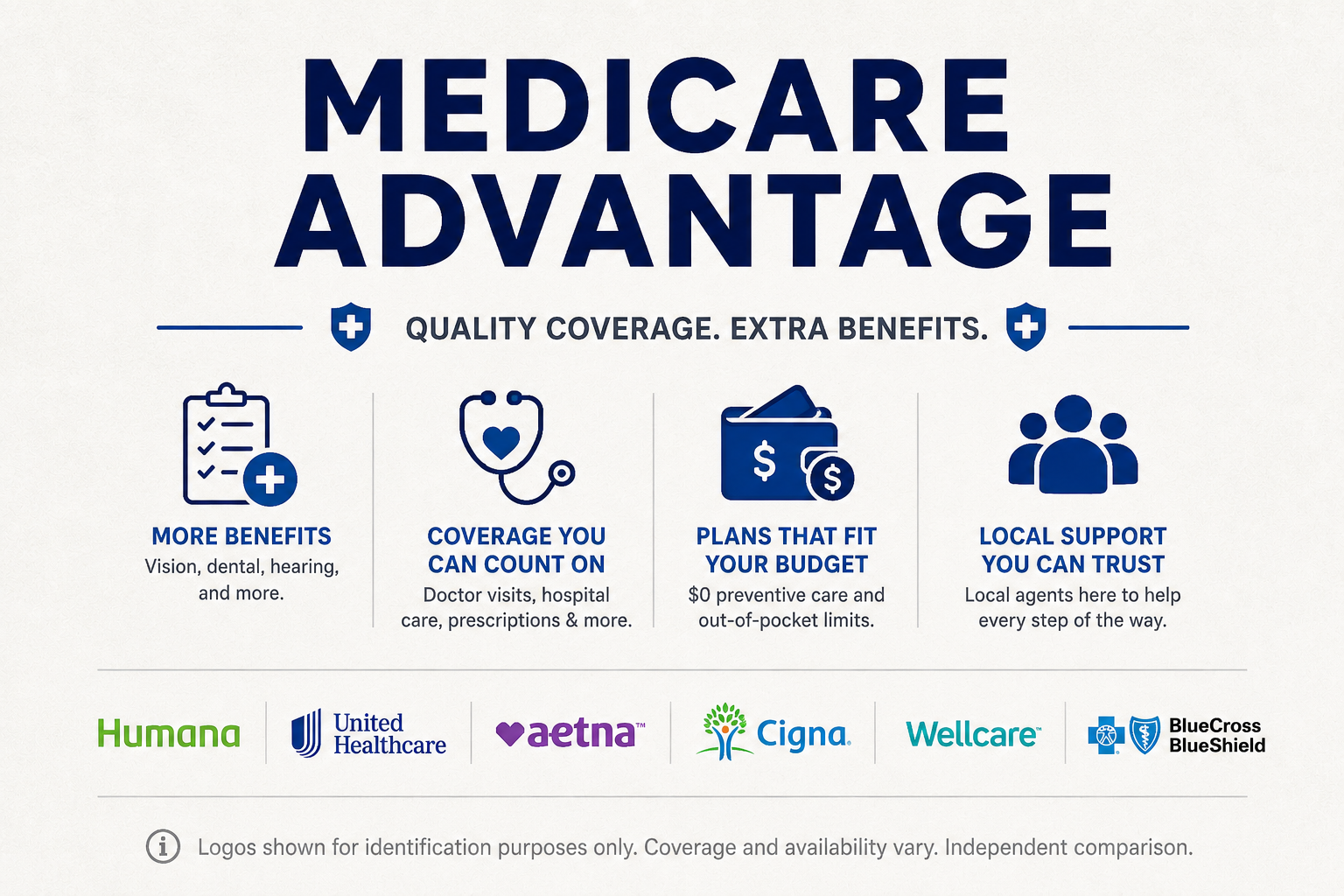
Medicare Advantage, also called Medicare Part C or an MA plan, is another way to receive Medicare Part A and Part B benefits. Medicare-approved private insurance companies offer the plans and must follow Medicare rules. Many plans include Part D prescription coverage and may provide supplemental benefits that Original Medicare does not cover, but every plan has its own service area, network, costs, drug list, utilization rules, and eligibility requirements.
The right way to evaluate Medicare Advantage for 2027 is to start with your county and health-care needs, then compare exact plans. A national advertisement cannot tell you whether a local plan includes your doctors, covers your prescriptions at a preferred pharmacy, fits your travel pattern, or produces a reasonable total annual cost. The carrier name alone is not enough because one company may offer multiple plans with different rules in the same area.
Medicare Advantage quick facts for 2027 planning
| Topic | General rule | Plan-specific verification |
|---|---|---|
| Medicare status | You remain in Medicare and receive Part A and Part B benefits through the Medicare Advantage plan. | Plan service area, enrollment status, effective date, and continued Part A and Part B eligibility. |
| Basic eligibility | You generally need Medicare Part A and Part B and must live in the plan’s service area. | Special Needs Plan criteria, lawful-presence rules, election period, and any plan-specific eligibility. |
| Medical coverage | The plan must cover medically necessary services that Original Medicare covers, subject to Medicare and plan rules. | Network, referral, prior authorization, cost sharing, covered settings, and continuity procedures. |
| Prescription coverage | Many Medicare Advantage plans include Part D, but not every plan does. | Formulary, tier, deductible, restrictions, preferred pharmacy, mail order, and specialty pharmacy. |
| Member costs | You generally continue paying the Part B premium and may also owe plan premiums and cost sharing. | Medical and drug deductibles, copays, coinsurance, out-of-network costs, and medical maximum out of pocket. |
| Supplemental benefits | A plan may offer dental, vision, hearing, fitness, transportation, food, utility, or over-the-counter benefits. | Eligibility, network, covered items, frequency, limits, expiration, prior authorization, and unused amounts. |
| Annual changes | Organizations can change offerings, costs, networks, formularies, and benefits for a new year under Medicare rules. | Annual Notice of Change, Evidence of Coverage, provider directory, formulary, and enrollment notices. |
Medicare Advantage is not the same as a Medicare Supplement policy. Medigap works with Original Medicare to help pay certain Medicare cost sharing. Medicare Advantage replaces Original Medicare’s administration through a private plan. A person cannot use Medigap to pay Medicare Advantage copays, and it generally is illegal to sell a Medigap policy to someone who will remain enrolled in Medicare Advantage.
How Medicare Advantage works
After enrollment takes effect, the Medicare Advantage plan becomes the primary source for covered Part A and Part B services. Members usually present the plan identification card instead of relying on the red, white, and blue Medicare card for routine claims. Keep the Medicare card in a secure place because you remain enrolled in Medicare and may need the information later.
Plans must cover Medicare-covered emergency and urgently needed care, and they must cover the medically necessary services included under Original Medicare. They can use plan networks, prior authorization, referrals, clinical criteria, preferred sites of care, and other administration allowed under Medicare rules. A plan may cover a service but require that it be obtained from a participating provider or approved before treatment.
Medicare Advantage versus Original Medicare
Original Medicare generally allows a beneficiary to use any doctor or hospital that accepts Medicare nationwide. It does not include broad outpatient prescription coverage, so a person may add a standalone Part D plan. It also has no annual limit on what the beneficiary pays for covered Part A and Part B services, although Medigap, Medicaid, employer, union, or retiree coverage may help with costs.
Medicare Advantage uses a defined plan structure and often a provider network. Plans have an annual medical maximum out of pocket for covered Part A and Part B services. Many include Part D and may add supplemental benefits. In exchange, the member must follow the plan’s network, referral, authorization, and service-area rules. Premiums and Part D drug spending do not simply count toward the medical maximum.
Common Medicare Advantage plan types and eligibility
Health Maintenance Organization plans
An HMO generally requires members to receive nonemergency care through its network, with exceptions for emergency care, urgent care, and qualifying out-of-area dialysis. Some HMOs require a primary care provider or referral before specialist care. An HMO point-of-service feature may cover a defined set of out-of-network services at higher cost, but that feature must be confirmed in the exact plan.
Preferred Provider Organization plans
A PPO has a network and generally allows members to obtain covered care outside that network at a higher cost. Out-of-network access is not unlimited: a provider must still agree to treat the member, coverage rules still apply, and the plan may use a separate combined in-network and out-of-network medical limit. Verify both plan coverage and provider acceptance before scheduled care.
Special Needs Plans
Special Needs Plans limit enrollment to people who meet defined criteria. Dual Eligible SNPs serve qualifying people with Medicare and Medicaid. Chronic Condition SNPs serve people with eligible severe or disabling chronic conditions. Institutional SNPs serve qualifying people who live in an institution or need an institutional level of care. All SNPs include Part D, but networks, care coordination, Medicaid integration, and eligibility verification differ.
Private Fee-for-Service and Medical Savings Account plans
A Private Fee-for-Service plan determines payment terms that providers must accept before treating a member, unless a provider has a contract with the plan. Provider willingness should be checked before each nonemergency service. A Medicare Medical Savings Account plan combines a high-deductible health plan with a medical savings account funded according to program rules. An MSA does not include Part D, so a member who wants drug coverage can join a standalone Medicare drug plan.
| Plan structure | Provider access | Prescription approach | Key question |
|---|---|---|---|
| HMO or HMO-POS | Usually emphasizes network care; POS may permit defined out-of-network services. | Part D usually must be included if drug coverage is wanted. | Are my doctors, hospitals, and facilities in the exact plan network, and are referrals required? |
| PPO | Network care generally costs less; covered out-of-network care may cost more. | Part D usually must be included if drug coverage is wanted. | What are the in-network and combined limits, and will my out-of-network provider accept the plan? |
| SNP | Depends on whether the SNP uses an HMO or PPO structure. | All SNPs include Part D. | Do I meet the qualifying criteria, and how does the plan coordinate my condition or Medicaid coverage? |
| PFFS | A provider must accept the plan’s payment terms unless contracted. | May or may not include Part D, depending on the plan. | Will each provider accept the plan before the service is performed? |
| MSA | Generally no network, but providers must accept Medicare and agree to treat the member. | Does not include Part D; standalone drug coverage can be added. | Can I manage the high deductible and account rules before coverage begins? |
Compare doctors, prescriptions, costs, and plan rules
Doctors, hospitals, and facilities
Search the exact plan’s provider directory, then confirm participation with the plan and provider. Ask the office to check the full plan name and identifiers rather than whether it broadly “takes” the insurance company. Verify the individual clinician, practice location, medical group, hospital, laboratory, imaging center, rehabilitation facility, skilled nursing facility, home-health agency, and durable medical equipment supplier.
For planned surgery, verify the surgeon, facility, anesthesia group, radiology group, pathology group, rehabilitation provider, and follow-up care. One participating physician does not guarantee that every professional involved in an episode is in network. Network status can change, so recheck before important scheduled services.
Prescription drugs and pharmacies
Use the exact drug name, strength, dosage form, quantity, and refill frequency. Review whether each drug is covered, the formulary tier, deductible treatment, copay or coinsurance, prior authorization, step therapy, quantity limit, specialty-pharmacy requirement, and preferred alternatives. Compare the same list at pharmacies you would actually use.
A pharmacy may be in network without being preferred, so member cost can differ by location. Check preferred retail, standard retail, mail order, and specialty channels. If a drug is not covered or a restriction creates a problem, ask about formulary exceptions, coverage determinations, transition fills, appeals, and clinically appropriate alternatives.
Total annual cost
A low plan premium does not mean low total cost. Beneficiaries generally continue paying the Part B premium and may owe a plan premium, medical or drug deductibles, copays, coinsurance, prescription expenses, noncovered charges, and permitted out-of-network costs. Income-related Medicare adjustments, Extra Help, Medicaid, employer benefits, and other assistance can change the calculation.
- Routine year: Estimate premiums, regular office visits, labs, imaging, therapy, supplies, and prescriptions.
- Moderate-use year: Add urgent care, emergency care, specialist testing, outpatient surgery, rehabilitation, or a new high-cost medicine.
- High-use year: Model an inpatient stay, ambulance, skilled nursing, repeated therapy, infusion treatment, or progress toward the medical maximum.
Prior authorization and referrals also have practical costs. Ask which services require approval, who submits the request, how long approval remains valid, how active treatment is handled after a plan change, and how organization determinations and appeals work. The lowest estimated dollars may not be the best fit if access rules create unacceptable disruption.
Supplemental benefits, travel, and coverage limitations
Medicare Advantage plans may offer benefits beyond Original Medicare, including dental, vision, hearing, fitness, transportation, meals, food, utility, or over-the-counter support. These benefits are not standardized across plans. A headline allowance can have restrictions involving eligibility, participating vendors, approved items, benefit periods, carryover, expiration, prior authorization, frequency, and unused funds.
Some supplemental benefits are limited to members who meet particular clinical, social, or program requirements. An advertised benefit may not be available to every member of the plan. Ask what documentation is required, who makes the eligibility decision, how often eligibility is reviewed, and whether the benefit is tied to a specific chronic condition.
Travel and living in more than one place
Emergency and urgently needed services are not the same as nationwide routine-care access. Ask how the plan covers emergency care, urgent care, out-of-area dialysis, follow-up after an emergency, routine appointments, refills, telehealth, and out-of-network services. A PPO may provide more out-of-network flexibility than an HMO, but costs and provider acceptance still require verification.
People who spend part of the year in another state should ensure the permanent residence reported to Medicare is correct and that the plan serves that address. Confirm access near both locations before enrolling. International coverage is usually limited; an individual plan may offer a defined emergency or urgently needed benefit, but it is not a substitute for reviewing travel medical or evacuation needs.
When to enroll, switch, or leave Medicare Advantage
You can join, switch, or leave a Medicare Advantage plan only during an election period that permits the requested change. You generally need both Part A and Part B, must live in the service area, and must meet applicable lawful-presence and plan eligibility rules. A Special Needs Plan adds its qualifying criteria.
Initial Enrollment Period
People new to Medicare have an Initial Enrollment Period connected to when Medicare begins. The precise dates and effective date depend on when Part A and Part B start. If Part A already began and Part B begins later, a separate initial opportunity may apply. Confirm the individual timeline rather than assuming every person has the same window.
Annual Enrollment Period
Medicare Open Enrollment runs from October 15 through December 7. During this period, eligible beneficiaries can make permitted Medicare Advantage and Part D changes. A plan request received by December 7 generally takes effect January 1. You can reconsider a choice during the period, but the last valid request generally determines coverage for the new year.
Medicare Advantage Open Enrollment Period
The Medicare Advantage Open Enrollment Period runs from January 1 through March 31 for people already enrolled in Medicare Advantage. It generally allows one change to another Medicare Advantage plan or a return to Original Medicare, with the opportunity to join a standalone drug plan when allowed. It is not a general first-time Medicare Advantage enrollment period for everyone using Original Medicare.
Special Enrollment Periods
Specified events can create a Special Enrollment Period, including certain moves, loss of coverage, plan changes, institutional status, Medicaid changes, or Extra Help eligibility. The event determines the permitted action, deadline, proof, and effective date. An agent should not invent an event or use an election period that does not match the beneficiary’s situation.
Annual review checklist
- Confirm your residential ZIP code, county, and Part A and Part B status.
- Read the Annual Notice of Change and current Evidence of Coverage.
- Record the full plan name, type, contract number, and plan benefit package number.
- Verify every important doctor, group, hospital, facility, and supplier.
- Review every medication by dose, form, quantity, tier, restriction, and pharmacy.
- Compare routine, moderate, and high-use annual cost scenarios.
- Understand referrals, prior authorization, appeals, and continuity of care.
- Confirm extra-benefit eligibility, limits, vendors, frequency, and expiration.
- Check travel, out-of-area, telehealth, and prescription-refill rules.
- Save the application receipt and verify acceptance and effective date.
If you search for Medicare Advantage help near me, focus on state licensing, plan-specific verification, carrier scope, and reliable follow-through rather than office distance alone. An independent agency may represent multiple organizations but not every plan in your county.
Use Medicare Plan Compare to review current local choices and estimated prescription costs. General program information is available at Medicare.gov.
The Blake Insurance Group form requests assistance and does not enroll you. The separate Wellcare pathway is limited to Wellcare options and does not compare every carrier or plan.
Frequently asked questions
Is Medicare Advantage the same as Original Medicare?
It is another way to receive Medicare benefits
You remain in Medicare, but a private Medicare-approved plan administers Part A and Part B benefits. The plan may use networks, referrals, prior authorization, and plan-specific cost sharing. Many plans include Part D and supplemental benefits.
Can I keep all my doctors with Medicare Advantage?
Provider participation depends on the exact plan
Do not rely on the carrier name alone. Verify each clinician, practice address, medical group, hospital, facility, supplier, and pharmacy with the exact plan. Network status can change, and out-of-network rules differ by plan type.
Do all Medicare Advantage plans include prescription coverage?
No, although many plans include Part D
All Special Needs Plans include Part D, but other Medicare Advantage structures can differ. HMO and PPO members who want drug coverage generally must choose a plan that includes it. An MSA does not include Part D, so eligible members can add a standalone drug plan.
Does Medicare Advantage have an out-of-pocket limit?
Plans limit annual member spending for covered Part A and Part B services
The exact medical maximum and which costs count depend on the plan. Premiums, Part D prescription spending, noncovered services, and certain other amounts do not simply count toward the medical maximum. A PPO may have separate in-network and combined limits.
Can I use Medigap with Medicare Advantage?
No, Medigap does not pay Medicare Advantage cost sharing
Medigap is designed to work with Original Medicare. If you leave Medicare Advantage, access to Medigap can depend on protected enrollment rights, state rules, timing, and underwriting. Review those rights before making the change.
Does the Wellcare button compare every Medicare Advantage plan?
No, the supplied pathway is Wellcare-only
The link is not Medicare.gov and does not compare every organization. Use it only to explore Wellcare options after confirming the correct 2027 plan year, county, eligibility, election period, providers, prescriptions, costs, and benefits. The Blake form requests help but is not enrollment.