
Surety Bond vs Insurance (2026): What Changes, Who Is Protected, and Why Many Businesses Need Both
Searching for a surety bond near me often leads people into an insurance comparison they did not expect. The terms are related, but a surety bond is not the same thing as standard business insurance. In 2026, this distinction still causes delays for contractors, licensed professionals, service businesses, and owners trying to satisfy a filing requirement quickly.
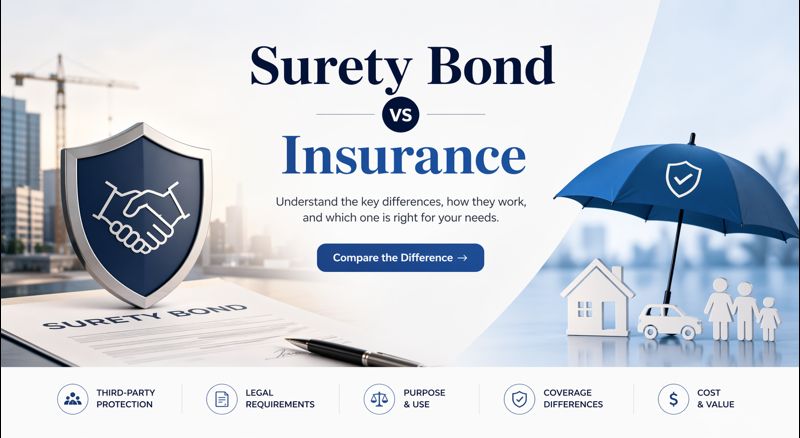
The cleanest way to think about it is this: a surety bond is generally a guarantee tied to an obligation, while insurance is generally protection against covered loss. A bond is often required by a government agency, court, lender, or project owner. Insurance is usually bought to protect the insured business, person, or property from covered claims or losses. That difference changes who benefits, how underwriting works, what a claim means, and whether reimbursement can come back to the party that bought the bond.
Many businesses do not choose between one or the other. They need both. A contractor may need license or contract bonds to stay compliant and general liability insurance to protect against bodily injury or property damage claims. A business handling cash or property may need commercial crime or fidelity protection while also carrying bond requirements tied to licensing or project performance. The smartest buying strategy is requirement first, protection second, then build the full risk stack around the real exposure.
How a surety bond differs from insurance in plain English
A surety bond is usually purchased because another party requires assurance that you will perform a duty, follow a law, complete a project, or pay what is owed. Insurance is usually purchased because you want protection against covered financial loss or liability. That one difference explains most of the confusion between the two.
- Bond requirement: usually comes from a third party such as a state agency, court, or project owner.
- Insurance need: usually comes from your own loss exposure, contractual insurance requirements, or operational risk.
- Bond focus: guarantee of compliance, performance, payment, or another obligation.
- Insurance focus: transfer of covered loss exposure such as liability, property loss, crime, or other insured events.
- Big warning: a surety bond does not replace general liability, commercial property, workers compensation, or other core business insurance.
Quick facts: what buyers should verify before they apply
Before you request a quote, confirm whether you are trying to satisfy a filing requirement or protect against loss. That single question usually tells you whether you are starting in a surety lane, an insurance lane, or both.
| Topic | Surety bond | Insurance | Why it matters |
|---|---|---|---|
| Main purpose | Guarantees a specific obligation will be met | Protects against covered loss or liability | The products are built for different outcomes |
| Who usually requires it | Government agency, project owner, court, lender, or obligee | The insured business or person, sometimes driven by contracts or lender rules | The source of the requirement points you to the right path |
| Who is primarily protected | The obligee or claimant tied to the bonded obligation | The insured, subject to policy terms and limits | This is the biggest practical difference |
| What triggers a claim | Failure to comply, perform, pay, or satisfy the bonded duty | A covered loss event or liability claim under the policy | Claims are evaluated very differently |
| Important warning | A paid claim may come back to the principal for reimbursement | Coverage is governed by the policy form, conditions, exclusions, and limits | Price alone does not tell you the true financial consequence |
Side-by-side comparison: surety bond vs insurance
Use this table when you need a fast, practical way to explain the difference to an owner, project manager, compliance team, or client.
| Category | Surety bond | Insurance | Smart move before applying |
|---|---|---|---|
| Why it exists | To guarantee a duty, filing, payment, or performance obligation | To provide financial protection for covered losses or claims | Read the actual requirement notice first |
| Common examples | License bonds, permit bonds, court bonds, bid bonds, performance bonds, payment bonds | General liability, commercial property, workers compensation, crime, professional liability, auto | Do not substitute one product for the other without checking the requirement |
| Underwriting focus | Bond type, amount, credit, obligation details, business profile, form acceptance | Loss exposure, operations, claims history, property values, payroll, vehicles, or revenue depending on line | Prepare the information tied to the exact product you are buying |
| What happens after a claim | The surety evaluates the bonded obligation and may seek reimbursement from the principal if it pays a valid claim | The carrier evaluates whether the claim is covered under the policy form and pays according to policy terms if it is | Understand the financial consequence, not just the premium |
| Best first question | “What exact bond is required, by whom, and in what amount?” | “What loss exposure am I trying to protect against?” | This question usually prevents the wrong application |
Claims: why buyers feel the difference after something goes wrong
The biggest misunderstanding in this topic is the assumption that a surety bond functions like general business insurance. It does not. When a surety claim is filed, the focus is the bonded obligation. When an insurance claim is filed, the focus is whether the event fits the policy language and coverage grant. That difference affects cash flow, compliance, and how a business should view the product it is buying.
| Step | Surety bond | Insurance | Why it matters |
|---|---|---|---|
| Problem occurs | A regulator, court, project owner, or claimant alleges the bonded obligation was not met | The insured suffers or is accused of a covered loss event, damage, or liability claim | The event triggering the claim is different from the start |
| Review begins | The surety reviews the bond form, facts, and obligation | The carrier reviews coverage, conditions, exclusions, and facts of loss | Documentation and wording matter in both lanes |
| Financial result | If a valid claim is paid, the principal may owe reimbursement to the surety | If the loss is covered, payment is made according to the policy terms | This is why a bond should not be treated as a substitute for insurance |
| Best prevention move | Meet the bonded obligation exactly and maintain filing accuracy | Carry the right policies, limits, endorsements, and loss-control practices | Buying correctly up front usually saves more than chasing the cheapest price |
When businesses need both a surety bond and insurance
In real operations, the answer is often not “bond or insurance.” It is “bond and insurance.” A business can have a perfect bond filing and still be exposed to everyday losses that the bond does not cover. It can also have strong insurance and still be unable to operate legally or win a contract if the required bond is missing.
| Business situation | Why a surety bond may be needed | Why insurance may still be needed | Smart move |
|---|---|---|---|
| Licensed contractor or regulated business | License or permit bond may be required to operate legally | General liability, workers compensation, and other coverage still protect the business from covered claims | Handle the bond filing and insurance program as two separate needs |
| Public or private project work | Bid, performance, or payment bond may be required by the project owner | Insurance may still be required for liability, auto, property, or professional exposures | Review contract insurance requirements and bond wording together |
| Service businesses entering client premises | Some clients may require bonding language or proof of bond | General liability and crime-related coverages may still be needed for actual loss exposure | Match the client’s wording instead of guessing at the product type |
| Court or fiduciary matter | A court bond or fiduciary-related bond may be mandatory | Separate insurance may still be needed for professional or operational risk | Verify the court order or requirement notice exactly |
| Business with employee dishonesty exposure | A bond may satisfy a contract or public requirement | Crime or fidelity-related insurance can address different dishonest-act loss exposure | Do not assume the bond handles internal loss exposure |
Bond help by city and state
Bond requirements can vary by state, city, agency, court, and project owner. The fastest path is to bring the exact requirement notice, bond amount, and obligee name before you start the application. We keep the comparison practical so you can identify the right bond lane and avoid using insurance language where a specific surety form is required.
| State | Common metro clusters | What we help verify |
|---|---|---|
| Arizona | Phoenix, Tucson, Mesa, Chandler, Glendale | Bond type, obligee details, filing instructions, and application readiness |
| Texas | Dallas–Fort Worth, Houston, Austin, San Antonio, El Paso | License and contract bond comparison support before purchase |
| Florida | Miami, Orlando, Tampa, Jacksonville, Fort Lauderdale | Requirement-first bond shopping and quote-path review |
| California | Los Angeles, San Diego, Riverside, Sacramento, San Jose | Application prep and exact-form matching |
| Other licensed states | AL, NY, OH, NC, VA, GA, OK, NM, IA, KS, MI, NE, SC, SD, WV | Requirement review and bond quote preparation |
Get a surety bond quote online
Before you apply, gather the exact bond requirement, obligee name, bond amount, legal name of the applicant, filing deadline, and any form or instruction notice you received. If you are also reviewing insurance, keep those requirements separate so you do not mix a bond filing issue with a coverage question. That simple prep usually reduces delays and helps you compare the right product on the first pass.
Have the requirement notice, obligee name, bond amount, and filing deadline ready before you apply.
Related topics
Surety bond vs insurance FAQs (2026)
Is a surety bond the same as insurance?
No. A surety bond generally guarantees that a specific obligation will be met, while insurance generally protects against covered losses or liability claims. They solve different problems and are often purchased for different reasons.
Who is protected by a surety bond?
A surety bond generally protects the obligee or claimant tied to the bonded obligation, not the principal in the same way an insurance policy protects the insured. That is why a bond should not be treated as a substitute for business insurance.
Can a surety bond claim come back to the business that bought the bond?
Often yes. If the surety pays a valid claim, the principal may be expected to reimburse the surety. That reimbursement feature is one of the clearest differences between bonds and standard insurance coverage.
Do contractors and businesses often need both a bond and insurance?
Yes. A contractor may need a license or contract bond to meet legal or project requirements and still need general liability, workers compensation, auto, or other insurance to protect against covered operational losses.
What should I gather before requesting a surety bond quote?
Bring the exact requirement notice, obligee name, bond amount, legal business or personal name, filing deadline, and any official bond form or instructions. The cleaner the requirement details, the faster the application usually goes.
Independent agency: Blake Insurance Group LLC is an independent insurance agency and is not affiliated with any single insurance company.
Licensing: Licensed insurance producer (NPN 16944666).
Important: Bond availability, premium, underwriting, form acceptance, renewal terms, and claim handling vary by bond type, jurisdiction, obligee, carrier, and applicant profile.
Reminder: A surety bond is not a substitute for general liability, property, workers compensation, or other business insurance unless a specific coverage form clearly says otherwise.
Trademarks: All product and company names are trademarks™ or registered® trademarks of their respective holders. Use of them does not imply affiliation or endorsement.




