Telematics Car Insurance Review (2026): How Usage-Based Auto Insurance Really Works, Who Saves, and Who Should Skip It
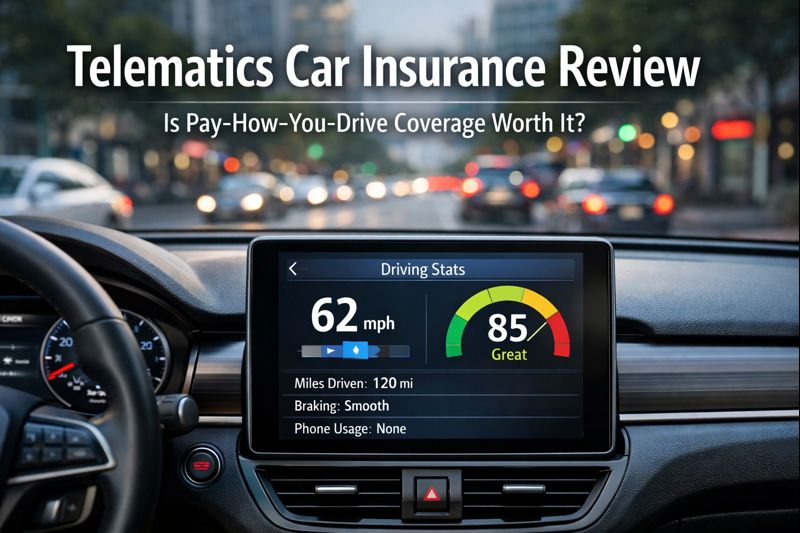
Telematics car insurance sounds simple: download an app, let the insurer measure your driving, and get rewarded if your driving habits look safer than average. In practice, telematics is a little more nuanced. These programs — often called usage-based insurance or driving-behavior insurance — usually look at some mix of mileage, braking, acceleration, speed patterns, phone distraction, and time of day. The pitch is straightforward: if you drive less, drive smoother, and avoid riskier patterns, you may earn a better rate than you would get from traditional rating factors alone.
In 2026, telematics is no longer a niche feature. Major carriers continue to promote it through app-based or device-based programs because it can personalize pricing and encourage safer behavior. That does not mean it is automatically a smart move for every driver. Some people do very well with telematics because their driving is calm, low-mileage, and predictable. Others enroll, only to realize their commute, late-night schedule, heavy stop-and-go traffic, or phone-use habits work against them. The best way to think about telematics is not “good or bad.” It is “good for the right driver profile.”
If you are searching for telematics car insurance near me, focus less on the brand name and more on whether your real driving life — commute, work schedule, family routines, mileage, and phone habits — matches the type of behavior these programs usually reward.
Quick facts: what telematics usually means in real life
These programs vary by insurer and state, but most follow the same basic logic: measure how and how much you drive, then use that information to influence your discount or renewal pricing.
| Topic | What it usually means | Why it matters |
|---|---|---|
| Telematics / UBI | Auto insurance pricing tied partly to measured driving data | Can reward drivers whose real-world habits look safer than average |
| App or plug-in device | Most programs use a mobile app, a connected device, or both | The setup method affects ease of use, accuracy, and how trips are tracked |
| Behavior scoring | Often looks at braking, acceleration, mileage, distraction, and driving time patterns | Some daily routines are naturally more telematics-friendly than others |
| Participation discount | Many carriers offer an initial discount or participation benefit | The initial savings may not match the long-term result after renewal data is used |
| Renewal effect | Your actual driving results may influence future pricing | The biggest question is not whether you save at sign-up, but whether you still like the program after real data is collected |
How telematics car insurance actually works
Most telematics programs ask you to either connect through a smartphone app or, less commonly today, use a plug-in device that connects to your vehicle. From there, the insurer measures selected driving signals over a set period or on an ongoing basis. Different carriers emphasize different metrics, but the general idea is the same: the insurer wants a clearer picture of how risky or safe your driving looks in the real world instead of relying only on age, ZIP code, vehicle type, claims history, and similar traditional rating factors.
In practical terms, telematics often rewards drivers who avoid hard braking, harsh acceleration, distraction events, very high mileage, and riskier driving hours. Programs may also provide feedback in the app so you can see what hurt or helped your score. That can be useful if you like measurable habits and want to coach yourself into better driving behavior. It can also be frustrating if you feel the app misreads a passenger trip, confuses phone movement, or punishes you for normal city traffic that is hard to avoid.
Another thing many drivers miss is that telematics is not exactly the same at every insurer. Some programs focus more on mileage, some on behavior, some on both, and some states place limits on how the results can affect your premium. That is why two drivers with similar habits can get noticeably different experiences depending on which carrier they choose and where they live.
Telematics program comparison: what to look for before you enroll
| Feature | Why it matters | Good fit | Possible downside |
|---|---|---|---|
| App-based tracking | Easy to start and common with major carriers | Drivers comfortable using their phone as the main tracking tool | Can create frustration if trips are misclassified or phone-use measurement feels too strict |
| Mileage sensitivity | Low-mileage drivers often have more upside in usage-based models | Remote workers, retirees, occasional drivers, and short commuters | High-mileage commuters may not get the best result |
| Driving-time sensitivity | Many programs care about when you drive, not just how you drive | Drivers with daytime routines and predictable schedules | Late-night workers, service workers, and shift-based commuters may be penalized by lifestyle patterns |
| Behavior feedback | Some drivers like seeing trip scores and behavior coaching | Drivers who want a data-driven way to improve habits | Can feel intrusive if you simply want a passive discount |
| Participation discount | May provide savings at sign-up before full program data is used | Drivers who want to test the program with some upfront value | Initial savings do not guarantee the same result later |
Who should consider telematics car insurance — and who should skip it
The best telematics customer is usually not just a “good driver” in the general sense. It is a driver whose daily pattern matches what the program wants to see. That difference matters. A careful parent running constant school pickups in traffic may be safer in real life than a lower-mileage remote worker, but telematics may still favor the lower-mileage pattern more strongly.
Privacy, fairness, and the tradeoffs nobody should ignore
The biggest non-price issue with telematics is data comfort. These programs work because the insurer receives real driving information. For some people, that is a fair trade: share more data, get a chance at more personalized pricing. For others, the arrangement feels too intrusive, especially when phone movement, trip classification, or route/timing data becomes part of the picture. Neither reaction is wrong. It comes down to how comfortable you are with the exchange.
There is also a fairness question. Telematics can reward safe habits, but it can also reflect structural realities you do not fully control. Shift work, childcare routines, urban stop-and-go traffic, or high-mileage work patterns may look worse to an app even if you are a conscientious driver. That does not mean telematics is flawed across the board. It just means drivers should judge it against their real life, not against a marketing promise built for an ideal user.
What actually changes telematics savings or results
| Factor | How it affects outcomes | Practical takeaway |
|---|---|---|
| Mileage | Lower annual driving often improves telematics value | Low-use vehicles often deserve a closer look at these programs |
| Braking and acceleration | Smoother trip behavior usually helps | Driving style matters, especially in the first measurement window |
| Time of day | Riskier-hour driving can reduce upside | Schedule can matter almost as much as skill |
| Phone distraction events | App-based programs often care about phone handling while driving | Hands-free and low-interaction habits may matter more than you expect |
| Carrier and state rules | Programs do not work the same way in every market | Always review the terms instead of assuming all telematics programs behave alike |
Telematics is usually most valuable when your lifestyle already fits the scoring model. It is much harder to “game” a program than to simply have the right driving profile from the start.
Compare standard auto quotes and decide if telematics belongs in the mix
The smartest way to shop is to compare the base auto pricing first, then decide whether a telematics program makes sense for your driving style. Some drivers are better off using telematics as a savings lever. Others are better off keeping the quote simple and avoiding app-based monitoring entirely. Your best move depends on how you actually drive, not on the marketing label.
The best telematics result usually starts with the right base auto quote, then adds telematics only if your driving profile fits the program.
Telematics car insurance FAQs (2026)
Is telematics car insurance worth it?
It can be, especially for low-mileage, smooth, predictable drivers. It is less attractive for drivers with long commutes, high-mileage routines, frequent late-night trips, or strong privacy concerns.
Can telematics raise my rate?
Depending on the carrier and state, poor telematics results can reduce the value of the program or affect renewal pricing. The exact outcome depends on the insurer’s rules where you live.
Do telematics programs only track miles?
Usually no. Many programs look at a mix of mileage and driving behavior, such as braking, acceleration, distraction, and time-of-day patterns.
Is app-based telematics better than a plug-in device?
App-based systems are often easier to start, but the best option depends on what the insurer uses and how comfortable you are with smartphone-based tracking versus a dedicated vehicle device.
Who should avoid telematics?
Drivers who dislike trip tracking, have unavoidable high-risk timing patterns, or suspect their daily routine will score poorly may prefer standard auto pricing without a usage-based program.
Related topics
Independent agency: Blake Insurance Group LLC is an independent insurance agency and is not affiliated with any single insurance company.
Licensing: Licensed insurance producer (NPN 16944666).
Important: Telematics program features, discounts, eligibility, state availability, privacy terms, and renewal impacts vary by insurer and location. Review the carrier’s program details before enrolling.
Trademarks: Snapshot®, Drivewise®, Drive Safe & Save®, SmartRide®, and other insurer/program names are trademarks or registered trademarks of their respective owners. Use of those names does not imply ownership or endorsement by Blake Insurance Group LLC.




