American Home Shield Review (2026): Plans, Service Fees, Coverage Limits, Exclusions, and How to Compare Real Value
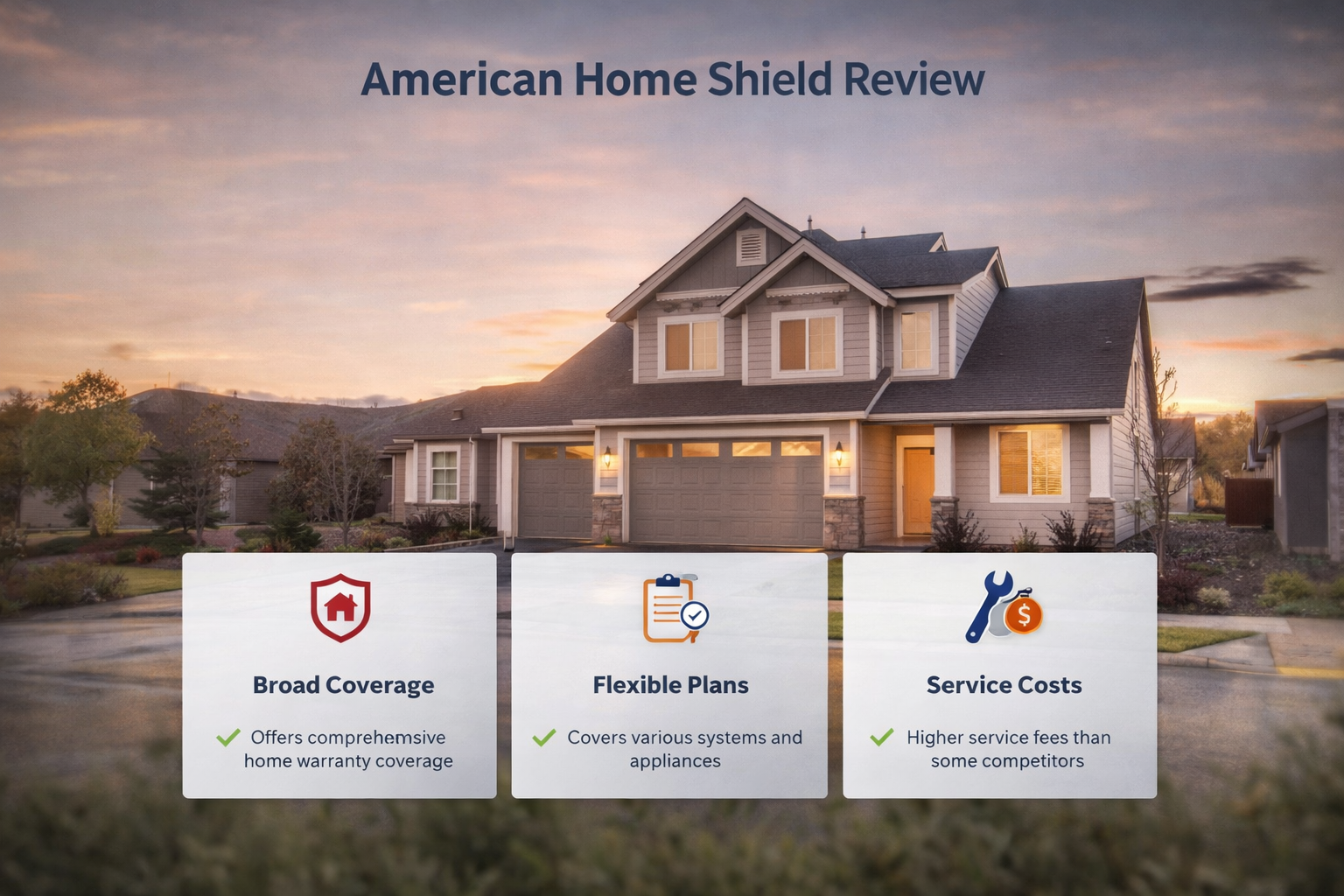
Shopping for an American Home Shield review near me should start with the contract, not the commercial. The real value of any home warranty depends on how the plan handles service fees, covered-item limits, exclusions, refrigerant rules, roof leak protection, and the repair-versus-replacement process. In 2026, American Home Shield still stands out because it offers a simpler plan lineup than many competitors and markets generous headline limits on its upper-tier plans. The smarter question is whether those features match your house, your repair expectations, and your tolerance for contract rules.
American Home Shield is one of the most recognized names in the home-warranty category, and that brand familiarity matters to many homeowners. But recognition alone does not make a plan right for every house. A good review has to separate what the company markets well from what the agreement actually does. That includes the service fee you choose, the per-system and per-appliance limits, the total plan limit, optional add-ons, excluded conditions, and what costs can still fall back on the homeowner even during an approved claim.
On the positive side, American Home Shield currently advertises broad protection tiers, no stated limit on the number of service requests, high total agreement-term limits on Gold and Platinum plans, and some premium features on ShieldPlatinum such as roof leak repair coverage, unlimited AC refrigerant, and one HVAC tune-up per agreement term. It also states that older home systems and appliances can still be covered without an inspection or maintenance records. On the caution side, those selling points still sit inside a service contract, which means charges for non-covered items, exclusions, item caps, and claim-handling rules still matter just as much as the plan name.
How to review American Home Shield the right way
Most weak home-warranty decisions happen because people compare monthly price first and only read the service agreement after something breaks. That reverses the order that matters. A home warranty is an operational contract. The real test is what happens after the air conditioner stops cooling, the dishwasher dies, or a roof leak starts. You need to know how diagnosis works, which service fee applies, what the plan will pay, what is excluded, and what non-covered charges can still show up on the job.
- Start with the plan tier: ShieldSilver, ShieldGold, and ShieldPlatinum do not solve the same problem.
- Check the service fee you select: American Home Shield lets members choose a service fee, which affects monthly cost and claim math.
- Review the item limits: current public plan pages show $5,000 per covered HVAC system on Gold and Platinum, with higher appliance limits on Platinum.
- Read non-covered charge language: service fees and charges for non-covered items may still apply even when a claim starts as a covered item issue.
- Compare contract fit to your house: older homes, older appliances, and deferred maintenance situations need a more disciplined review.
Coverage overview: what American Home Shield is really offering in 2026
American Home Shield markets coverage for major home systems and appliances, and its current plan pages emphasize strong top-line numbers. That can be useful, but buyers should look one layer deeper. The key comparison points are the total agreement-term limit, HVAC limit, appliance limit, whether roof leak repair is included, how refrigerant is handled, and which charges remain outside the core coverage promise.
| Coverage feature | What it usually includes | What to verify | Why it matters |
|---|---|---|---|
| Systems coverage | Heating, air conditioning, electrical, plumbing, and other major home-system categories | Per-system caps, excluded components, and charges for non-covered items | System claims are often the biggest reason homeowners buy a warranty |
| Appliance coverage | Major in-home appliances such as kitchen and laundry equipment | Appliance limit by plan, excluded parts, and what counts as covered wear and tear | Appliance limits are one of the biggest differences between Gold and Platinum |
| Service fee structure | A member-selected fee paid when requesting service | The fee you choose and how it changes your monthly plan cost | The service fee directly affects whether small claims are worth filing |
| Roof leak repair | Included on ShieldPlatinum with a current $1,000 repair limit | What is considered covered roof leak repair and what remains excluded | This is a premium-tier feature that can separate Platinum from lower plans |
| Refrigerant handling | Gold and Silver sample agreement language historically limits refrigerant by pound, while Platinum markets unlimited AC refrigerant | Your plan version, state agreement, and exact refrigerant wording | Refrigerant cost can materially change an HVAC claim outcome |
| Member perks | Video chat with repair experts, discounts, and on Platinum one HVAC tune-up per agreement term | Which perks apply to the plan you quote and whether they matter to you | Perks can be useful, but they should not outweigh the contract fundamentals |
American Home Shield plans: how ShieldSilver, ShieldGold, and ShieldPlatinum compare
American Home Shield currently promotes three main homeowner plan tiers. ShieldSilver is the leaner entry point focused on essential systems. ShieldGold expands to both systems and appliances, with a current $50,000 total agreement-term limit, $5,000 per covered HVAC system, and $2,000 per covered appliance. ShieldPlatinum keeps the $50,000 total agreement-term limit and $5,000 HVAC limit, but raises covered appliance protection to $4,000 per appliance and adds roof leak repair, unlimited AC refrigerant, and one free HVAC tune-up per agreement term. That creates a real tier separation, not just a marketing one.
| Plan lane | Usually best for | Current strengths | Watch-outs |
|---|---|---|---|
| ShieldSilver | Homeowners mainly focused on essential systems at a lower entry price | Lean starting point for system-focused protection | Does not provide the same appliance value or premium extras as upper tiers |
| ShieldGold | Buyers who want systems and appliances without paying for every top-tier extra | $50,000 total limit per agreement term, $5,000 per HVAC system, $2,000 per covered appliance | Appliance cap is materially lower than Platinum |
| ShieldPlatinum | Homeowners who want the richest mainstream AHS plan | $50,000 total limit, $5,000 HVAC limit, $4,000 per covered appliance, roof leak repair, unlimited AC refrigerant, HVAC tune-up | Higher premium only pays off when the added features fit the house |
| Base plan + add-ons | Homes with a few specialty concerns not solved by plan tier alone | Can tailor coverage without fully overbuying | Add-on value depends on the specific item and contract language |
Plan names, pricing, service-fee choices, and state agreement wording can change. Always match the live quote and your state-specific agreement to the house you want to protect.
Service fees, exclusions, and limits: where the real value gets decided
This is the section many buyers skip and the section that matters most after a breakdown. American Home Shield explains that there are two core pricing components: the monthly plan cost and the service fee you choose when you sign up. That means the cheaper-looking monthly option may not be the cheaper option once you start using the plan. The agreement also warns that service fees and charges for non-covered items may apply. In other words, a claim can still involve out-of-pocket cost even when the covered item itself qualifies for service.
| Contract factor | What to check | Why it changes value | Smart buying move |
|---|---|---|---|
| Service fee | The member-selected fee tied to each service request | This changes both your monthly price and your per-claim cost | Choose the fee based on how likely you are to file claims, not just the lowest monthly premium |
| Per-item limits | HVAC, appliance, and specialty-feature caps by plan | These limits determine how useful the contract is on expensive repairs | Compare your likely claim categories against the current published caps |
| Exclusions | Non-covered conditions, components, or damage scenarios | Many disputes trace back to excluded conditions buyers did not study | Read exclusions before assuming an older or neglected item will be covered |
| Charges for non-covered items | Access, code upgrades, modifications, disposal, or uncovered parts and labor | An approved claim can still leave the homeowner with extra cost | Ask what costs commonly remain outside the contract on bigger jobs |
| State agreement differences | The exact homeowner agreement for your state | Some coverage details vary by state and agreement version | Use the sample agreement as a framework, then confirm your actual issued contract |
| Complaint history and expectations | Customer complaints, BBB profile, and pattern of dissatisfaction themes | Brand size and complaint volume both affect how a review should be read | Use complaint trends to set realistic expectations, not to replace contract review |
Who American Home Shield may fit best in 2026
American Home Shield can make strong sense for homeowners who want one of the most established brands in the category and who value a clearer three-tier plan structure. It may fit especially well for households with older systems and appliances, since AHS states it can cover older items without an inspection or maintenance records. It may also appeal to homeowners who like the idea of choosing a service fee and want access to a richer upper tier with stronger appliance limits and HVAC-related benefits.
| Buyer type | Usually a better fit when | Main upside | Main caution |
|---|---|---|---|
| Older-home owner | You want contract-based backup on aging systems and appliances | AHS publicly says age alone does not block coverage | Older equipment still raises the importance of exclusions and non-covered charges |
| Tier-conscious shopper | You want a simple Silver, Gold, Platinum structure instead of a crowded plan menu | Easier first-pass comparison across tiers | Simpler lineup does not remove the need to read the agreement carefully |
| HVAC-sensitive homeowner | You care heavily about air-conditioning exposure and refrigerant handling | Platinum’s HVAC-related perks and unlimited AC refrigerant stand out | The premium only makes sense if the feature set matches your risk |
| Realistic contract buyer | You understand that service contracts have fees, exclusions, and item limits | More likely to use the plan in a way that aligns with how it is designed | Unrealistic expectations are still the fastest route to disappointment |
Common American Home Shield comparison use cases
Home warranty shoppers are not all trying to solve the same problem. Some are buying peace of mind after moving into a home with older systems. Others are comparing AHS against competitors because they want stronger appliance coverage or better HVAC protection. Some only care about service-fee math. The best review process is to match the plan to the property and your claims expectations, not to assume a well-known brand automatically means the best fit.
| Use case | Examples | What we optimize for |
|---|---|---|
| Older-home budgeting | Homes with aging HVAC, water heaters, kitchen appliances, or laundry equipment | Coverage realism, plan-tier fit, and non-covered-cost expectations |
| Premium-tier shopping | Buyers deciding whether Platinum is worth it over Gold | Appliance cap math, roof leak value, and refrigerant handling |
| Service-fee comparison | Shoppers weighing monthly price versus per-claim cost | Total yearly cost, not just headline premium |
| Brand-vs-brand review | AHS compared with other major home-warranty companies | Limits, exclusions, operational differences, and claims expectations |
| HVAC-focused buyer | Homeowners whose biggest concern is air conditioning or heating failure | System cap review and refrigerant-related contract value |
Get an American Home Shield quote
The best way to shop American Home Shield is to quote it with a checklist in hand. Start with the plan tier that seems closest to your house, compare the service-fee choice, read the current covered-item limits, and then review the exclusions and charges for non-covered items before you enroll. That is the difference between buying a recognizable brand and buying a contract that actually fits the property.
Use the quote as a starting point, then compare service-fee choice, plan limits, exclusions, and non-covered charges before you commit.
Related topics
American Home Shield FAQs (2026)
Is American Home Shield insurance?
No. American Home Shield sells home warranty service contracts, not homeowners insurance. Homeowners insurance addresses covered perils like fire, storm damage, theft, or liability. A home warranty is designed around certain repair or replacement situations involving covered systems and appliances after normal wear and tear breakdown.
Does American Home Shield let you choose a service fee?
Yes. American Home Shield explains that members choose a service fee when signing up. That choice affects both the monthly plan cost and what you pay when you request service, so it should be part of your plan comparison from the start.
What are the current American Home Shield Gold and Platinum limits?
American Home Shield currently markets a $50,000 total limit per agreement term on ShieldGold and ShieldPlatinum. It also currently lists $5,000 per covered HVAC system on both plans, $2,000 per covered appliance on ShieldGold, and $4,000 per covered appliance on ShieldPlatinum.
Does American Home Shield cover older systems and appliances?
American Home Shield currently states that older home systems and appliances can be covered without an inspection or maintenance records. That does not eliminate exclusions or item limits, so the contract still needs to be reviewed carefully before purchase.
Why can a home warranty claim still cost money even when approved?
Because the service fee still applies and charges for non-covered items may also apply. Depending on the job, access, modifications, code upgrades, disposal, or excluded parts and labor can still create out-of-pocket cost for the homeowner.
Independent agency: Blake Insurance Group LLC is an independent agency and is not affiliated with any single warranty company.
Licensing: Licensed insurance producer (NPN 16944666).
Important: Home warranty plans are service contracts. Coverage categories, service-fee choices, item limits, roof leak protection, refrigerant rules, exclusions, contractor assignment, and charges for non-covered items vary by state, agreement version, and plan design and can change.
Review note: This page is an informational shopping and comparison guide. Final coverage is controlled by the issued agreement, endorsements, and the provider’s current terms.
Brand note: American Home Shield and related marks are trademarks or registered trademarks of their respective owners. Use of the name here does not imply affiliation or endorsement.




