Home insurance • High-value homes
High-Net-Worth Home Insurance: Coverage for High-Value Homes
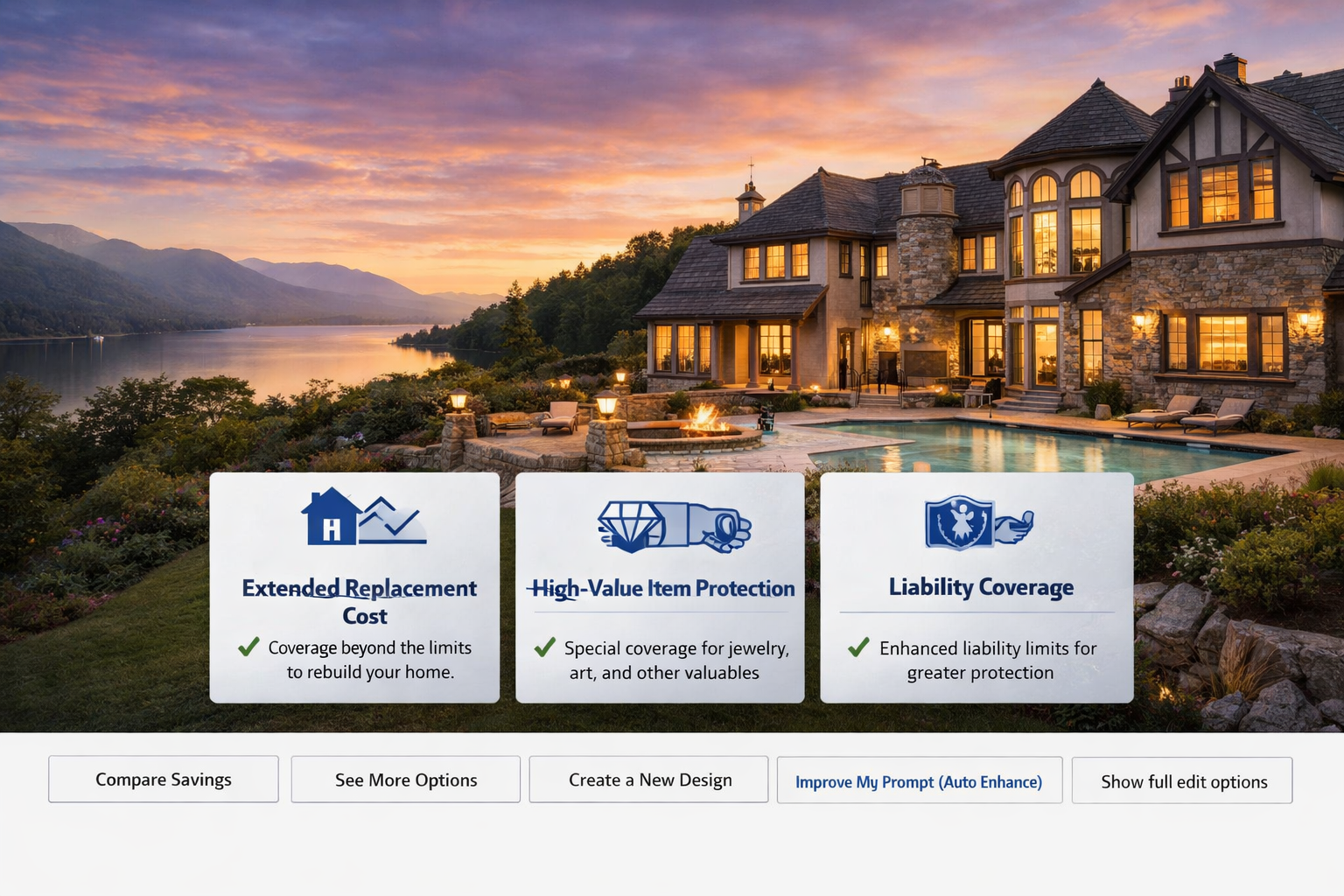
High-net-worth home insurance is designed for higher-value homes and the people who own them, with broader coverage than a standard homeowners policy. It typically offers higher limits, more generous rebuilding terms, broad coverage for valuables, and service such as risk consultations. It also requires more careful underwriting and a closer look at liability exposure.
This guide explains what sets high-value policies apart and how to compare them.
Compare high-value home insurance quotes
Tell us about your drivers and vehicles, and a licensed agent will follow up with options available to us. Submitting the form does not bind coverage.
If the form does not load, call 888-387-3687, Monday through Friday, 9:00 to 5:00, or email info@blakeinsurancegroup.com.
How high-value policies differ
| Feature | Standard policy | High-value policy (typical) |
|---|---|---|
| Dwelling settlement | Replacement cost up to the limit | Extended or guaranteed replacement cost |
| Cash settlement | Usually must rebuild for full payment | Option offered by some carriers |
| Valuables | Low sublimits unless scheduled | Broad scheduled or blanket coverage |
| Water backup | Optional endorsement | Often included or with higher limits |
| Service | Standard claims | Risk consultations and dedicated claims service |
General comparison; coverage varies by carrier and policy.
Who writes high-value homes
High-value homes are commonly written by carriers with private client units and by specialty insurers. Availability has tightened in wildfire and coastal areas, where some owners use excess and surplus lines carriers. An independent agent can compare carriers available to them; direct carriers must be quoted separately.
Liability and umbrella coverage
Wealth increases the risk of being targeted by lawsuits. High-value households often carry personal umbrella or excess liability limits of several million dollars, plus coverage for household employees, rental properties, and watercraft. Make sure underlying limits meet the umbrella insurer's requirements.
Valuables and collections
Jewelry, art, wine, and collectibles usually need scheduled or blanket coverage with appraisals. See valuable items insurance.
Rebuilding cost, replacement cost, and actual cash value
The most important number on a homeowners policy is the dwelling limit, and it should reflect what it would cost to rebuild your home, not what the home would sell for. Market value includes land and location, which do not burn down; rebuilding cost depends on square footage, construction type, finishes, local labor, and building-code requirements.
- Replacement cost pays to repair or rebuild with materials of like kind and quality, without a deduction for age.
- Extended replacement cost adds a cushion, often 25% or 50% above the dwelling limit, for price spikes after a regional disaster.
- Actual cash value subtracts depreciation, which can leave a large gap, especially for roofs.
- Ordinance or law coverage helps pay for upgrades required by current building codes during a rebuild.
Ask any insurer how it estimated your rebuilding cost, and review that estimate after renovations.
What to check on any homeowners quote
- Dwelling coverage based on the cost to rebuild, not the market value, plus extended replacement cost if offered.
- Roof settlement terms, such as replacement cost versus actual cash value, and any separate wind or hail deductible.
- Water backup, service line, and ordinance or law coverage, which are often optional.
- Personal property at replacement cost and limits on jewelry, firearms, and electronics.
- Liability limits high enough to meet an umbrella insurer's requirements.
See our home insurance comparison guide for more.
Common exclusions and coverage gaps
Every homeowners policy has exclusions and limits. The ones that surprise homeowners most often are:
- Flood. Excluded from standard policies; available through the National Flood Insurance Program and private flood insurers. See flood insurance.
- Earthquake and earth movement. Usually excluded; available as an endorsement or separate policy in many states.
- Wear, tear, and maintenance. Gradual leaks, rot, and deterioration are generally not covered.
- Sewer or drain backup. Often excluded unless you add a water-backup endorsement.
- Mold. Frequently limited or excluded.
- Business property and activities. Home businesses may need separate coverage.
- Valuables. Jewelry, firearms, and collectibles often have low sublimits unless scheduled.
What affects your home insurance price
Home insurance prices vary widely between insurers for the same house, because each company weighs risk differently. Common factors include:
- Location, including exposure to wind, hail, wildfire, and crime, and distance to a fire station and hydrant.
- Rebuilding cost, construction type, and the age and condition of the roof, plumbing, and electrical systems.
- Your claims history and the property's claims history.
- Deductibles, including separate wind, hail, or hurricane deductibles.
- Protective devices such as monitored alarms, water-leak sensors, and impact-resistant roofing.
- In many states, a credit-based insurance score.
Because insurers file rates at different times, comparing quotes at renewal can reveal large differences.
Ways to lower your home insurance premium
- Compare several insurers with the same dwelling limit and deductibles.
- Raise the all-perils deductible to an amount you could pay without strain, and understand any separate wind or hurricane deductible.
- Bundle home with auto where the combined total is lower than separate policies.
- Ask about protective-device discounts for monitored alarms, smart water shutoffs, and leak sensors.
- Update the roof and ask about impact-resistant or fortified roof credits where offered.
- Avoid small claims that you could pay yourself, since claims history affects future pricing.
- Do not cut the dwelling limit below rebuilding cost to save money; underinsurance can be costly after a large loss.
How to file a home insurance claim
- Stay safe and prevent further damage. Make reasonable temporary repairs, such as tarping a roof or shutting off water, and keep receipts.
- Document everything. Take photos and video before cleanup, and list damaged items.
- Report the claim promptly through the insurer's app, website, or phone line.
- Meet the adjuster and share your documentation and contractor estimates.
- Review the estimate line by line, and ask how depreciation and recoverable depreciation work on your policy.
- Keep records of every conversation, and ask your state insurance department for help if a dispute cannot be resolved.
Switching home insurers without a gap
Switching home insurers is usually straightforward, but a few details matter. Start the new policy on the same day the old one ends so there is no gap. If your premium is paid through a mortgage escrow account, send the new declarations page and mortgagee clause to your lender, and confirm that the lender pays the new insurer and stops paying the old one. Cancel the old policy in writing and ask for any prorated refund. If you switch mid-term, check for short-rate cancellation fees.
Umbrella coverage on top
Personal umbrella insurance adds liability protection above your home and auto limits, usually in $1 million increments. Most umbrella insurers require minimum underlying limits on both policies, and many offer better pricing when home and auto are with them. If you have significant assets or a teen driver, price an umbrella as part of any home and auto comparison. See our umbrella insurance page.
How to check any insurer before you buy
Before you buy from any company, take a few minutes to check it:
- License. Confirm the insurer is licensed in your state through the state insurance department's company lookup.
- Complaints. The NAIC's Consumer Insurance Search shows complaint counts and a complaint index for each company, where 1.00 is the expected level for the company's size.
- Financial strength. Ratings from agencies such as A.M. Best describe an insurer's ability to pay claims.
- Legal name on the quote. Large groups write policies through several companies with different rates and rules. Make sure you know which one issues your policy.
- Claims process. Ask how claims are reported, whether there is a preferred repair-shop program, and how quickly adjusters respond after storms.
How we approached this review
We built this review from public sources rather than test purchases or claims we filed ourselves. That approach has limits, so it helps to know what we looked at and what we did not:
- What we reviewed: the company's own website and policy descriptions, its press releases and investor materials where available, state availability statements, and independent reporting.
- What we compared: how the product is bought and serviced, how it is priced, which coverages it offers, and the trade-offs that matter for different kinds of drivers or households.
- What we did not do: assign star ratings, publish prices of our own, or claim personal claims experience. Prices are individual, and claims experiences vary widely from one customer to the next.
Products, states, and terms change. Before you buy, confirm current details with the company and read the policy documents, which control over any summary, including this one.
High-value homes in wildfire and coastal areas
Insurers have become more selective about high-value homes in wildfire-prone and hurricane-exposed areas. Underwriters may ask about defensible space, ember-resistant vents, roof class, sprinkler systems, distance to fire hydrants, and wind mitigation features. Some private client carriers offer wildfire defense services that may dispatch crews to apply fire retardant when a fire threatens. If standard high-value capacity is unavailable, excess and surplus lines insurers, sometimes combined with a state FAIR Plan and difference-in-conditions coverage, may fill the gap.
What you need for a home insurance quote
These details help produce accurate quotes.
- Property details. Address, year built, square footage, roof age and material, and major updates.
- Current declarations page. To match limits and deductibles.
- Claims history. Any property claims in the past five years.
- Valuables list. Jewelry, art, or collections that may need scheduled coverage.
- Mortgage or lease details. Lender or landlord requirements.
High-net-worth home insurance FAQs
What is high-net-worth home insurance?
Homeowners insurance designed for high-value homes, with broader coverage and higher limits.
What is guaranteed replacement cost?
Coverage that pays to rebuild even above the dwelling limit, where offered.
Do I need appraisals for valuables?
Usually for scheduled items.
Is it more expensive?
Premiums are higher, but coverage is broader.
Do I need an umbrella?
Most high-value households carry one.
Who writes high-value homes?
Carriers with private client units and specialty insurers.
What about wildfire areas?
Options have tightened; an agent can help find capacity.
Can I bundle autos and collections?
Many high-value carriers offer combined programs.
Related guides
Important information
Independent agency. Blake Insurance Group LLC is an independent insurance agency. Licensed insurance producer NPN 16117464. Licensed states: AZ, AL, TX, CA, NY, OH, FL, NC, VA, GA, OK, NM, IA, KS, MI, NE, SC, SD, WV, IL, NJ, PA, TN, and WA. Which insurance companies we can quote depends on our current appointments, the product, and your state. Mentioning a company on this page does not mean we represent it.
Legal requirements. State requirements summarized here are general information as of October 2026 and can change. This page is not legal advice; confirm current rules with your state's insurance regulator or motor vehicle agency.
Availability. Coverage, prices, discounts, and eligibility vary by insurer, state, and applicant, and are subject to underwriting. The issued policy controls.
Your next step
Request a quote, and a licensed agent will compare options available to us using the coverage you choose.




