Temporary Medical Coverage • National Guide • Updated 2026
Short-Term Health Insurance (2026): Compare Temporary Coverage, Costs, Limits, and ACA Alternatives
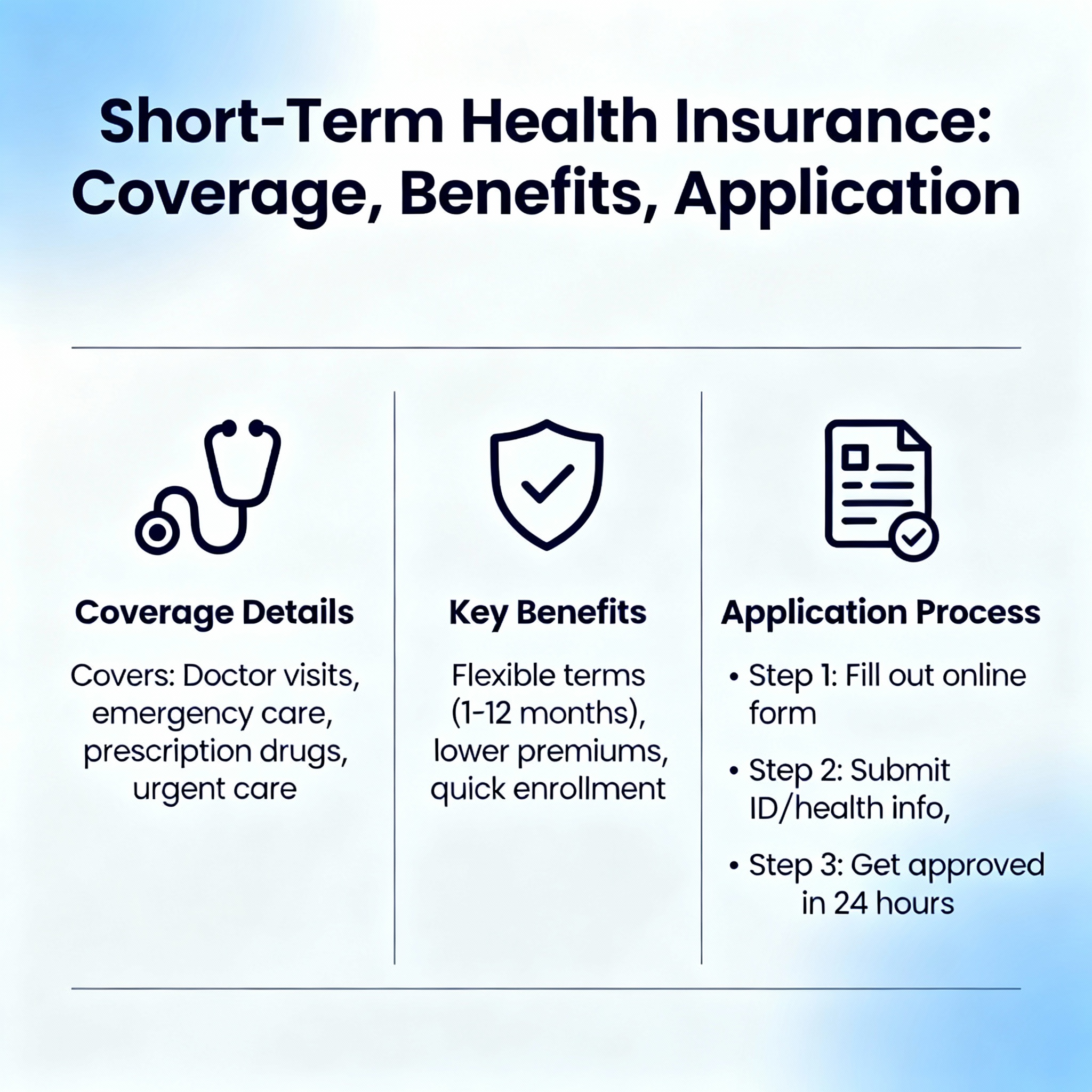
Short-term health insurance can provide temporary medical coverage when you have a clearly defined gap, but it does not offer the same protections as an Affordable Care Act plan. It may be considered when you are between jobs, waiting for employer benefits, retiring before Medicare eligibility, or outside the Marketplace enrollment window without a qualifying event.
If you are searching for short-term health insurance near me, begin with the reason for the gap rather than the monthly premium. A plan that starts quickly may still exclude a condition you already have, limit prescription benefits, use a deductible that applies differently than expected, or leave certain services outside the policy. The right comparison examines eligibility, coverage dates, provider access, exclusions, benefit limits, and worst-case out-of-pocket exposure.
Blake Insurance Group helps residents in its licensed states review temporary coverage alongside comprehensive alternatives. This page explains how short-term limited-duration insurance works in 2026, why federal duration rules require careful explanation, what plan documents deserve close attention, and what information to gather before requesting a quote. Plan availability and contract terms depend on state law, the applicant, residential ZIP code, insurer filings, and the options displayed when the application is submitted.
Quick facts for short-term health insurance shoppers
Short-term medical insurance is designed to bridge a temporary break between more permanent forms of coverage. It is generally not subject to the federal individual-market protections that apply to ACA-compliant major medical plans. That distinction affects eligibility, pre-existing conditions, required benefits, premium assistance, renewability, and what happens when coverage ends.
| Planning point | Short-term medical | Why it matters |
|---|---|---|
| Primary purpose | Temporary protection during a defined coverage gap. | It should have a clear start date, end date, and transition plan. |
| Eligibility | Medical questions and underwriting may apply; approval is not guaranteed. | Health history can affect whether coverage is offered and how claims are treated. |
| Pre-existing conditions | Commonly excluded or limited under the contract’s definition and look-back rules. | Ongoing or recently treated conditions may create significant uncovered exposure. |
| ACA protections | Not ACA-compliant comprehensive major medical coverage. | Do not assume all essential health benefits or ACA cost protections apply. |
| Premium assistance | Marketplace premium tax credits do not apply to short-term coverage. | Compare the ACA plan’s net premium after any eligible savings. |
| Availability | Plan choices, terms, and networks can vary by state, ZIP code, and applicant. | The live quote and issued policy control—not a general website summary. |
When temporary medical coverage may—or may not—fit
A reasonable candidate is typically a generally healthy person who needs coverage for a known, limited period and understands the contract’s exclusions. Even then, short-term coverage should be compared with every realistic comprehensive option. Losing job-based coverage, moving, getting married, having a child, or experiencing another qualifying event may open a Special Enrollment Period for an ACA plan. Medicaid and CHIP applications are available throughout the year for people who qualify.
Situations that usually point away from short-term coverage
Temporary insurance is generally a poor substitute when you need predictable, comprehensive benefits. Look closely at ACA, employer, COBRA, Medicaid, or CHIP options if any of the following apply:
- You have a chronic diagnosis, symptoms under evaluation, recent treatment, or a planned procedure.
- You are pregnant, planning pregnancy, or need maternity and newborn benefits.
- You use ongoing or high-cost prescriptions and need a dependable formulary.
- You receive regular mental health, substance-use-disorder, therapy, rehabilitation, or specialist services.
- You want guaranteed issue, coverage for pre-existing conditions, ACA essential health benefits, or ACA annual out-of-pocket protections.
Do not omit information or guess when completing an application. Medical underwriting answers must be accurate and complete. A quick approval does not turn an excluded condition into a covered one, and an identification card alone does not establish that every service will be paid.
Federal and state short-term duration rules in 2026
Duration is one of the most confusing parts of shopping for temporary health insurance because the federal definition and the law of the applicant’s state must be read together. States may impose tighter limits, apply a different state-law definition, require particular disclosures, or make conventional short-term plans unavailable. Agency licensing in a state does not mean a short-term product is offered there.
A 2024 federal rule changed the federal definition for policies sold or issued on or after September 1, 2024. Under that definition, the initial contract term could not exceed three months and the total coverage period, including renewals and extensions, could not exceed four months. The rule also treated certain sequential policies from the same issuer or controlled group as renewals or extensions when calculating duration.
In August 2025, the federal Departments of Labor, Health and Human Services, and the Treasury announced that they did not intend to prioritize enforcement of violations tied to the 2024 definition while considering further rulemaking. They encouraged states to consider a similar enforcement approach and indicated that a state could apply its own short-term insurance definition. This means the four-month figure remains important regulatory history, but it is not a reliable promise of the precise term a consumer will see in every state during 2026.
Use the coverage dates displayed in the current quote, application, outline of coverage, policy, and any renewal documents. Confirm whether the offering is one contract, a renewal, a new medically underwritten contract, or a multi-term arrangement. Also ask what happens to a condition that first appears during one term. If a later policy requires a new application, a condition that developed during the earlier policy may be treated as pre-existing under the later contract.
Build the exit plan before the temporary plan starts
Write down the date your permanent coverage should begin, the enrollment deadline for that coverage, and the person or organization responsible for the transition. If you are waiting for an employer plan, obtain the eligibility and effective dates in writing. If you expect to use the Marketplace, confirm whether Open Enrollment or a qualifying life event will be available. If you are approaching Medicare, prepare for the appropriate Initial Enrollment Period rather than assuming the short-term plan can be extended.
Short-term medical vs. ACA Marketplace coverage
These options solve different problems. Short-term medical focuses on a temporary gap and can be available outside the annual Marketplace enrollment window, subject to underwriting. An ACA Marketplace plan is comprehensive individual major medical coverage with guaranteed issue, coverage for pre-existing conditions, required essential health benefits, and possible income-based financial assistance.
| Feature | Short-term medical | ACA Marketplace plan | Decision question |
|---|---|---|---|
| When you can apply | Generally available throughout the year, subject to product availability and approval. | Annual Open Enrollment or an eligible Special Enrollment Period. | Do you have a qualifying event that makes comprehensive coverage available now? |
| Health underwriting | Medical questions and underwriting commonly apply. | No medical underwriting for eligibility or premium based on health status. | Could recent or ongoing care affect approval or claim coverage? |
| Pre-existing conditions | Often excluded or limited as defined by the policy. | Covered under ACA protections. | Are you receiving care, taking medication, or monitoring symptoms? |
| Covered benefits | Benefits vary; maternity, prescriptions, mental health, preventive care, or other services may be limited or excluded. | Covers the ten categories of essential health benefits, subject to plan terms and network rules. | Which services do you realistically expect to use? |
| Financial assistance | No Marketplace premium tax credits or cost-sharing reductions. | Eligible households may receive premium tax credits; eligible Silver-plan enrollees may receive cost-sharing reductions. | What is the ACA net premium and total cost after eligible savings? |
| End of coverage | Temporary coverage ends on the contract date; renewal or replacement is not guaranteed. | Generally renewable annually if the plan remains available and eligibility requirements are met. | What coverage will begin immediately after the temporary policy ends? |
For 2026, the standard HealthCare.gov Open Enrollment window ran from November 1, 2025, through January 15, 2026. The recurring federal-platform schedule is November 1 through January 15, although state-based Marketplace deadlines may differ. Outside the applicable window, a Special Enrollment Period usually requires a qualifying life event or another qualifying circumstance. Because eligibility details matter, do not assume that voluntarily ending a policy or allowing short-term coverage to expire will qualify you.
How to compare costs, exclusions, and claim exposure
A premium comparison is incomplete. The lower-priced option may shift more risk to you through a high deductible, per-cause deductible, coinsurance, separate copays, excluded services, a policy maximum, or a cap on a particular service. Calculate what could happen in a realistic emergency rather than comparing only what leaves your bank account each month.
| Contract item | What to verify | Why it can change your cost |
|---|---|---|
| Deductible structure | Whether the deductible applies per person, per term, per cause, or in another way. | You could owe more than one deductible depending on the contract. |
| Coinsurance and copays | Your percentage or fixed payment and when it begins. | A hospital claim can produce substantial cost even after the deductible. |
| Policy and service limits | Maximum benefits, daily limits, visit limits, and caps for specific care. | Charges above a stated limit remain your responsibility. |
| Network rules | Participating doctors, hospitals, urgent care locations, and out-of-network treatment. | Nonparticipating care may be unpaid or reimbursed less favorably. |
| Prescription benefits | Whether the plan pays benefits, offers only discounts, uses a formulary, or excludes prescriptions. | Regular medication costs can quickly outweigh premium savings. |
| Pre-existing definition | The look-back period, symptoms language, treatment language, and claim-review provisions. | A condition can be excluded even if it was not formally diagnosed before enrollment. |
| Cancellation and refund rules | How to cancel, required notice, and whether unused premium is refundable. | You need a clean transition when permanent coverage starts. |
Model a realistic bad month
Use one scenario across every plan: an emergency-room visit followed by imaging, a specialist consultation, and a brief hospital admission. Add the premium, deductible, coinsurance, copays, noncovered charges, and any amount above a benefit cap. Then repeat the comparison using an ACA plan’s net premium and in-network cost-sharing. This does not predict your claim, but it exposes differences that a monthly-premium comparison hides.
Also verify whether federal surprise-billing protections apply to the coverage you are considering. Short-term limited-duration insurance is not treated the same as comprehensive coverage for every federal consumer protection. Ask how emergency services, facility-based clinicians, and out-of-network charges are handled under the actual contract.
Licensed service areas and state-by-state availability
Blake Insurance Group’s licensed footprint covers the states listed below. This table describes where the agency may assist with insurance inquiries; it is not a promise that short-term medical coverage is offered in every listed state or ZIP code. An applicant’s residence can affect the products displayed, provider networks, benefit designs, available effective dates, and permissible contract duration.
| Region | Licensed states | Required availability check |
|---|---|---|
| Southwest and South Central | Arizona, New Mexico, Oklahoma, Texas | Enter the residential ZIP code and verify the current term, network, and application eligibility. |
| Southeast | Alabama, Florida, Georgia, North Carolina, South Carolina, Tennessee, Virginia, West Virginia | Confirm whether a short-term product is offered and compare it with Marketplace or employer coverage. |
| Midwest and Plains | Illinois, Iowa, Kansas, Michigan, Nebraska, Ohio, South Dakota | Review the applicable state definition, approved duration, renewal structure, and provider access. |
| Northeast and West | California, New Jersey, New York, Pennsylvania, Washington | Do not assume conventional short-term coverage is available; review state-permitted comprehensive alternatives. |
Before enrolling, search the plan’s current provider directory and confirm participation with the provider’s billing office. Directory listings can change, and a medical practice may participate at one location or under one tax entity but not another. Verify the exact physician, facility, plan name, and network—not merely the insurance company’s brand.
What to gather and how to request a short-term quote
A complete comparison is easier when you prepare the dates and medical-use details before opening a quote. The application will determine the information formally required, but the following preparation helps you compare options consistently.
- Define the gap. Record the last day of current coverage, requested effective date, and confirmed start date of the next comprehensive plan.
- List the applicants. Gather names, dates of birth, sex as requested by the application, residential state and ZIP code, and tobacco-use information for everyone seeking coverage.
- Prepare accurate health information. Review diagnoses, symptoms, treatments, surgeries, hospital care, pending tests, and medications for the periods addressed by the application.
- Identify essential providers and prescriptions. Write down exact doctor, hospital, pharmacy, and medication names so you can verify networks and benefits.
- Compare alternatives. Check whether job loss, a move, marriage, birth, or another event creates an ACA Special Enrollment Period; compare COBRA when available.
- Read before paying. Review the outline of coverage, exclusions, deductible structure, coinsurance, caps, effective date, termination date, and cancellation rules.
Submitting information or viewing prices does not create coverage. Coverage begins only after the application is approved, all required conditions are satisfied, the initial premium is paid, and the insurer confirms the effective date. Save copies of the application, payment confirmation, policy, identification card, and cancellation instructions.
Related health insurance resources
Use these Blake Insurance Group resources to review broader online health quotes, supplemental coverage, and travel medical insurance.
Frequently asked questions about short-term health insurance
Is short-term health insurance the same as an ACA Marketplace plan?
No. Short-term medical is temporary, medically underwritten coverage that is generally exempt from many federal individual-market requirements. An ACA Marketplace plan provides comprehensive major medical coverage, covers pre-existing conditions, includes essential health benefits, and may qualify for income-based premium tax credits or cost-sharing reductions.
How long can a short-term health plan last in 2026?
The exact term depends on state law, product availability, and the evolving federal enforcement environment. The 2024 federal definition generally set a three-month initial limit and a four-month total limit for newer coverage, but federal departments announced a non-enforcement posture in August 2025 while reconsidering that definition. Rely on the current quote, application, and issued contract for the actual available term.
Does short-term coverage include pre-existing conditions?
Short-term plans commonly exclude or limit pre-existing conditions according to contract definitions and look-back provisions. The exclusion can involve prior diagnoses, treatment, medication, or symptoms. Review the actual wording carefully. ACA-compliant plans cannot deny benefits or charge more because of a pre-existing condition.
Can temporary coverage start the next day?
Some options may offer a next-day requested effective date after approval, but that is not guaranteed. The effective date depends on product availability, completed underwriting, the selected date, payment, and insurer confirmation. Do not cancel existing coverage until the new effective date is confirmed.
Will short-term coverage ending qualify me for a Marketplace Special Enrollment Period?
Do not assume it will. Loss or expiration of coverage that is not qualifying health coverage may not create a Special Enrollment Period. Build your transition around Open Enrollment, a separate qualifying life event, employer eligibility, Medicare, Medicaid, CHIP, or another confirmed coverage path.
Should I compare COBRA before choosing a short-term policy?
Yes, when COBRA is available. COBRA may cost more because you can be responsible for the full group premium and an administrative charge, but it generally continues the same job-based coverage and can preserve ongoing treatment and provider access. Compare premium, benefits, accumulated deductible credit, prescriptions, and the length of your gap.
Can I cancel a short-term plan when my new coverage begins?
Cancellation procedures vary by contract. Confirm the required notice, cancellation effective date, automatic-payment process, and any premium-refund terms before enrolling. Submit cancellation through the required channel and retain written confirmation.




