Small Business Insurance in New York (2026): Fast COIs, Contract-Ready Coverage, and Clean Quotes
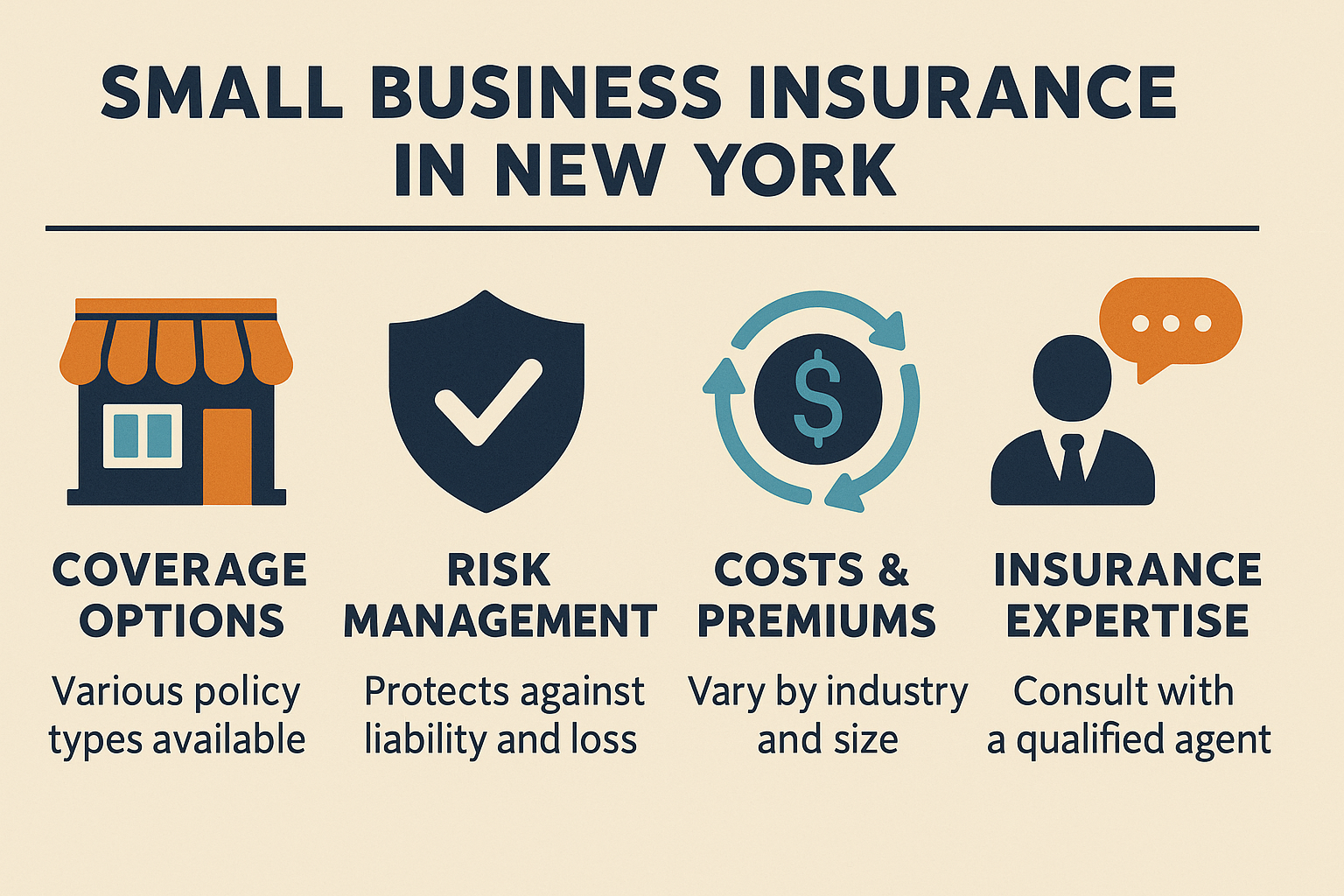
If you need small business insurance near me in New York, you usually need two things at the same time: a policy that fits your actual operations and a COI that passes compliance on the first try. This page shows the coverage stack most NY businesses use in 2026 and how to quote it correctly.
New York business insurance shopping gets messy when quotes aren’t built the same way. One quote includes additional insured and waiver of subrogation, another doesn’t. One quote assumes no subcontractors, another assumes subcontractors are 80% of payroll. One carrier includes hired/non-owned auto exposure, another excludes it. The result is a comparison that looks like “price shopping” but isn’t. Our approach is contract-first: we define your required limits and endorsements, then quote the carriers that fit your class and risk profile so the comparison is real.
Whether you run a storefront in Manhattan, a contractor crew in Queens, a consultant practice in Brooklyn, a food business on Long Island, or a small operation upstate, the baseline is the same: General Liability for third-party injury/property damage, a BOP when you have property and income exposure, Workers’ Comp if you have employees (and sometimes by contract even when you mostly use subs), Commercial Auto or HNOA when vehicles enter the picture, and specialty coverages like E&O, Cyber, EPLI, and Umbrella when your contracts or risk level demand it.
Quick facts (New York)
| Item | Summary |
|---|---|
| COIs that pass | COI wording must be backed by real endorsements (Additional Insured, Waiver of Subrogation, Primary & Noncontributory when required). |
| Core coverages | GL, BOP (when you have property/income exposure), Workers’ Comp, Auto/HNOA, plus E&O/Cyber/EPLI/Umbrella as needed. |
| Contractor add-ons | Additional insured (ongoing + completed ops), waiver, primary/noncontributory, per-project aggregate, higher limits, and sometimes umbrella. |
| Fast quoting | Clean operations details + accurate payroll/revenue + contract requirements = fewer re-quotes and faster binding. |
| Start online | Start my quote and upload the insurance requirement page from your lease or contract. |
Pro move: send the “Insurance Requirements” page of your lease/vendor contract upfront. That is the fastest way to get compliant COIs and avoid last-minute endorsements.
Coverage snapshot: what NY small businesses review in 2026
Use this as your baseline so quotes are comparable and COIs match contracts.
| Coverage | What it protects | NY notes |
|---|---|---|
| General Liability (GL) | Third-party injury/property damage; premises/operations; products/completed ops | Contract wording matters: AI/WOS/PNC requirements must be supported by endorsements |
| Business Owners Policy (BOP) | GL + business property + business income (interruption) | Best for locations with equipment/inventory; add endorsements like equipment breakdown or spoilage when relevant |
| Workers’ Compensation | Employee injuries and related costs | Class accuracy drives audits; review owner inclusion/exclusion rules and subcontractor arrangements |
| Commercial Auto | Liability + physical damage for business-owned vehicles | If you deliver, haul tools, or travel between job sites, vehicle use classification and driver lists must be accurate |
| Hired & Non-Owned Auto (HNOA) | Liability when employees drive personal cars for work or you rent vehicles | Common gap: assuming personal auto protects the business—HNOA is built to protect the entity |
| Professional Liability (E&O) | Claims alleging mistakes, missed deadlines, or professional negligence | Important for consultants, creatives, tech/IT, marketing, real estate-adjacent, and many service firms |
| Cyber Liability | Data breach, ransomware, funds-transfer fraud, cyber BI | Often required by vendor contracts—especially if you store client data or process payments |
| EPLI | Employment practices claims (harassment, discrimination, wrongful termination) | Becomes more relevant once you hire and grow; confirm limits and defense costs structure |
| Umbrella / Excess | Extra limits above GL/Auto/Employers’ Liability | Common for large projects, venues, municipalities, and higher-risk operations |
GL vs BOP: which fits your New York business?
If you have a location, equipment, or inventory, a BOP is often the cleaner foundation. If you only need liability to satisfy a contract, GL can be enough.
| Item | General Liability (GL) | BOP (GL + Property + Business Income) | Who it fits |
|---|---|---|---|
| Third-party injury/damage | Yes | Yes | All businesses |
| Your business property | No | Yes (contents, equipment, tenant improvements; plan-specific) | Retail, food, studios, offices with equipment or inventory |
| Business interruption | No | Yes (for covered losses; plan-specific) | Locations where downtime = lost income |
| Best use | Meet basic contract/lease liability requirements | Bundle core protections for a location-based business | Choose BOP when you’d buy GL + property anyway |
Pricing & underwriting: what drives NY business insurance quotes
New York carriers price based on more than an industry label. Underwriters want a clean story: what you do, where you do it, how you manage risk, and whether your contracts require special endorsements. Cleaner inputs produce better outcomes: fewer re-quotes, smoother audits, and faster COIs.
| Factor | Impact on price | What to prepare |
|---|---|---|
| Industry & operations | Higher-hazard operations rate higher than low-risk offices and clerical work | Describe services, tools/equipment, subcontractor use, and any high-hazard work clearly |
| Location & contracts | COI wording and endorsements can change carrier fit and cost | Provide the insurance requirement page for landlord, venue, GC, or vendor onboarding |
| Payroll & staffing | Drives Workers’ Comp and Employers’ Liability exposure | Estimated payroll by class; owner vs employee breakdown; 1099/sub relationships |
| Claims history | Losses affect eligibility, premium, deductibles, and required controls | Loss runs if available and a brief explanation of changes made after each claim |
| Property values | Higher contents/build-out values increase premium | Inventory/equipment values, tenant improvements, and any protective devices (alarms/sprinklers) |
COIs & endorsements playbook (NY): get compliant the first time
In New York, most “insurance problems” are actually documentation problems. Landlords, GCs, venues, and vendors want proof that your policy supports specific wording. Here’s how to get compliant without back-and-forth:
- Send the requirement page: do not paraphrase it—upload the page that lists limits and wording.
- Standardize your baseline: set GL limits and any required endorsements before requesting multiple COIs.
- Use correct legal names: certificate holder and insured names must match contracts exactly.
- Confirm which AI form: ongoing ops vs completed ops (or both) depending on the contract.
- Renewal discipline: keep track of renewal dates so COIs don’t expire mid-project.
Fastest COIs happen when we have the holder name/address + the exact contract wording.
Small business insurance “near me” in New York: metros we support
We help New York businesses across the city, suburbs, and upstate communities with quotes, compliance-ready endorsements, and fast certificates. Networks and underwriting vary by class and location, so we keep inputs accurate and quote only the carriers that fit.
| Metro / region | Examples of nearby cities | What we optimize for |
|---|---|---|
| New York City | Manhattan, Brooklyn, Queens, Bronx, Staten Island | Landlord/venue COI wording, AI/WOS/PNC endorsements, fast certificate turnaround |
| Long Island | Hempstead, Freeport, Huntington, Islip | Contract-ready GL/BOP plus auto/HNOA for deliveries and service routes |
| Westchester & Lower Hudson | Yonkers, White Plains, New Rochelle, Mount Vernon | Property + business income planning and vendor onboarding documentation |
| Upstate metros | Buffalo, Rochester, Syracuse, Albany | Main-street packages, workers’ comp class accuracy, audit readiness |
Get a New York small business quote (and COIs)
Start your quote online and include the details that make underwriting faster: operations description, revenue, payroll breakdown, subcontractor use, locations, and the insurance requirement page from your lease or contract. We’ll align the baseline to your needs and help you avoid re-quotes and COI rejections.
Coverage is not bound until you approve final terms and the insurer issues the policy.
New York small business insurance FAQs (2026)
Can you add Additional Insured and Waiver of Subrogation for my NY contract?
Yes. Many NY leases and vendor contracts require Additional Insured wording (ongoing and/or completed ops), Waiver of Subrogation, and sometimes Primary & Noncontributory wording. We build the policy to support the contract and then issue COIs that match.
How fast can I get a COI?
Often within minutes after binding, especially when we have the exact certificate holder name/address and the required wording from your contract. Correct inputs prevent reissues.
What’s the difference between GL and a BOP?
GL covers third-party injury and property damage. A BOP bundles GL with business property and business income coverage (for covered losses). If you have a location with equipment or inventory, a BOP is often the stronger foundation.
Do I need Workers’ Comp if I mostly use 1099 contractors?
New York rules and job-site requirements can be strict. Some contracts still require proof of Workers’ Comp even when you use subcontractors. We review your staffing model and contracts so you stay compliant and avoid site-access problems.
Can you meet landlord and GC insurance requirements?
Yes. Send the insurance section of your lease or contract. We match limits and endorsements (AI, waiver, primary/noncontributory, per-project aggregate when needed) and deliver compliant COIs for landlord, GC, and vendor compliance departments.
Related topics
Independent agency: Blake Insurance Group LLC is an independent insurance agency and is not affiliated with any single insurer.
Licensing: Licensed insurance producer (NPN 16944666).
Important: Carrier availability, underwriting, class codes, endorsements, limits, deductibles, audits, fees, and pricing vary by insurer and business profile and may change. This page is general information, not legal advice. Policy documents govern coverage.
Trademarks: All product and company names are trademarks™ or registered® trademarks of their respective holders. Use of them does not imply affiliation or endorsement.




