SR-22 Insurance Arizona (2026): Filing Rules, Non-Owner Options, Reinstatement Steps, and How to Keep Your Driving Privilege Active
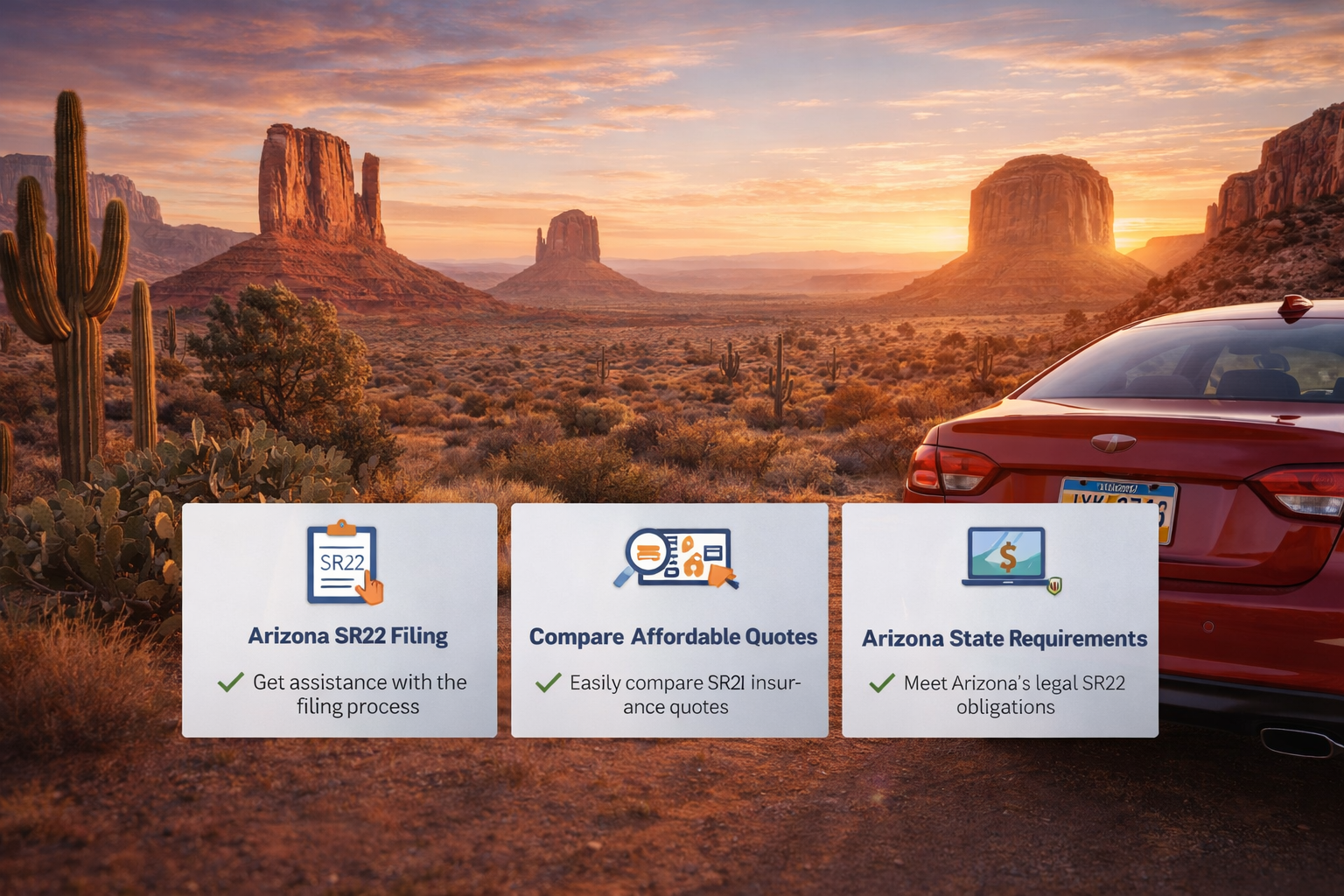
If you need SR-22 insurance in Arizona, the most important thing to know is that an SR-22 is not a separate insurance policy. It is a certificate filed by your insurer to show Arizona Motor Vehicle Division that you carry the required liability insurance and future proof of financial responsibility. The filing itself is simple. The part that causes trouble is choosing the wrong policy type, letting coverage lapse, or assuming every Arizona SR-22 case follows the exact same timeline.
In Arizona, many drivers need an SR-22 after a suspension, DUI-related issue, implied-consent suspension, insurance law violation, or another reinstatement matter. In many cases the requirement runs for three years, but Arizona MVD also makes clear that each case can differ and some judgment-related situations follow a different timeline. That is why the strongest approach is to match the policy to your situation from the start, keep it active without interruption, and verify your requirement with MVD if anything on your record looks unclear.
What SR-22 insurance means in Arizona—and what it does not mean
Arizona uses the SR-22 as proof of future financial responsibility. That means your insurance company files the certificate directly with MVD to show that the required liability coverage is in force. For most Arizona private-passenger drivers, the state liability minimum is 25/50/15: $25,000 bodily injury per person, $50,000 bodily injury per accident, and $15,000 property damage. The SR-22 does not replace your policy. It rides on top of an eligible auto policy or non-owner policy.
Many drivers hear “SR-22 insurance” and assume they need a special high-risk package with every coverage option added. That is not how the filing works. What matters first is getting the correct policy type. If you own and drive a vehicle, you generally need an owner policy with the SR-22 attached. If you do not own a vehicle but still need to satisfy Arizona’s filing requirement, a non-owner SR-22 may be the more accurate route. Picking the wrong version can delay reinstatement or create cleanup work later.
Arizona SR-22 rules: the practical version most drivers actually need
The reason people run into trouble with SR-22 filings is usually not the filing fee. It is misunderstanding timing, lapse rules, or eligibility. Arizona MVD outlines when future financial responsibility may be required and what happens when the proof fails to stay active. That makes continuity the real priority.
| Rule area | What it means | Why it matters | Best move |
|---|---|---|---|
| Who may need it | Drivers dealing with certain suspensions, DUI-related matters, insurance law violations, or other reinstatement issues | Your filing need is tied to the violation on record | Match the policy to the exact MVD requirement |
| Common filing length | Three years is common for many Arizona SR-22 cases | Stopping early can restart your problem | Keep the filing active until the requirement is officially over |
| Lapse reporting | Your insurer notifies MVD if the policy cancels or lapses | MVD may suspend driving privileges immediately | Do not let the policy cancel for nonpayment or rewrite gaps |
| Minimum liability | Arizona requires 25/50/15 minimum liability for standard private passenger compliance | The filing has to sit on qualifying coverage | Confirm limits before binding |
| End of requirement | MVD removes the requirement when your required period is complete | Canceling too soon can create a new suspension issue | Wait until the requirement is actually cleared |
Owner SR-22 vs non-owner SR-22 in Arizona
The filing type matters almost as much as the fact that the filing exists. If you own a car, your SR-22 usually belongs on an owner auto policy. If you do not own a car but need future financial responsibility on file, a non-owner SR-22 is often the cleaner fit. Non-owner coverage is generally designed for drivers who need liability protection while occasionally driving vehicles they do not own, not for covering a car kept at home or regularly available for their use.
| Filing type | Usually fits | Main advantage | Watch-out |
|---|---|---|---|
| Owner SR-22 | Drivers who own a registered vehicle and need the filing attached to active auto insurance | Built for normal vehicle ownership and reinstatement needs | Must match the vehicle ownership situation accurately |
| Non-owner SR-22 | Drivers who do not own a vehicle but still must satisfy Arizona future financial responsibility requirements | Lets you meet the filing requirement without insuring a personal vehicle | Not appropriate if you own a car or have regular access to one in a way the carrier excludes |
| Rewritten replacement policy | Drivers who had a lapse and need to re-establish proof quickly | Can restore the filing path after cancellation | Gaps can trigger fees, delays, and another suspension issue |
What really affects Arizona SR-22 insurance cost
The SR-22 form itself is usually not the expensive part. The bigger price driver is the underlying violation and overall risk profile. A DUI, prior lapse, at-fault accidents, tickets, age, ZIP code, vehicle type, and requested liability limits will influence premium more than the certificate fee. That is why the best quote process is not chasing the smallest filing charge. It is comparing the full policy structure while making sure the filing is added correctly.
| Cost factor | How it affects price | What to review | Smart move |
|---|---|---|---|
| Violation type | DUI-related issues and major violations usually increase premiums more than the filing itself | Reason for suspension or reinstatement | Quote multiple carrier options |
| Policy type | Owner and non-owner policies price differently | Whether you own a car and how you use vehicles | Choose the accurate policy form from the start |
| Coverage level | Higher liability limits cost more but can protect you better | Budget vs asset protection | Do not assume minimum limits are always the best long-term choice |
| ZIP code and driver profile | Where you live and your driving history still shape rates | City, claims history, age, and vehicle details | Use current Arizona garaging and driver information |
Arizona reinstatement steps: how to keep the process from dragging out
Most drivers want one thing from an SR-22: to get back on the road legally and keep it that way. The clean process is straightforward. First, confirm whether you need an owner or non-owner filing. Next, start the policy with the SR-22 attached. Then make sure the insurer files it electronically with Arizona MVD. After that, handle any required reinstatement fees and keep the policy active until MVD clears the requirement. If a lapse happens, Arizona may require you to re-establish proof and pay an additional suspension-related fee before you are fully back in compliance.
- Confirm the requirement: know whether your issue is a suspension, DUI-related revocation timeline, insurance law violation, or another matter.
- Choose the correct policy type: owner if you own a vehicle, non-owner if you do not and the carrier/MVD scenario fits.
- Have the insurer file electronically: do not assume the quote alone satisfies MVD.
- Handle remaining reinstatement items: this may include fees or additional compliance steps tied to your record.
- Never let the policy lapse: this is where many Arizona SR-22 problems restart.
Arizona SR-22 help in Phoenix, Tucson, Glendale, Mesa, Chandler, and beyond
SR-22 insurance in Arizona is statewide, but local driving patterns and underwriting still vary by metro area. Phoenix-area drivers may be comparing daily commuting and dense traffic exposure. Tucson drivers may want a simple reinstatement path with minimum downtime. Glendale, Mesa, Chandler, Scottsdale, Peoria, Surprise, and Gilbert shoppers often want the fastest route to a compliant filing without paying for coverage that does not fit their actual situation.
| Metro or region | Nearby cities | Most common SR-22 need |
|---|---|---|
| Phoenix Metro | Phoenix, Glendale, Mesa, Chandler, Scottsdale, Peoria | Fast owner-policy filing and reinstatement support |
| East Valley | Gilbert, Tempe, Queen Creek, Apache Junction | Policy rewrites after lapse and clean filing setup |
| Tucson Area | Tucson, Oro Valley, Marana, Sahuarita | Budget-focused SR-22 quotes with correct policy matching |
| Northern Arizona | Flagstaff, Prescott, Prescott Valley, Cottonwood | Owner vs non-owner guidance and liability review |
Get Arizona SR-22 quotes built for your actual filing need
The best SR-22 quote is the one that satisfies Arizona MVD, fits your ownership situation, and stays affordable enough to keep active for the entire required period. Start with the correct filing type, current Arizona garaging details, and accurate driver information. That gives you a more usable result than rushing into the first policy you see.
Use your exact Arizona address, vehicle ownership status, and reinstatement need when you compare policies.
Related topics
Arizona SR-22 insurance FAQs (2026)
Is SR-22 insurance a separate type of auto policy?
No. In Arizona, the SR-22 is a certificate filed by your insurer to prove qualifying liability coverage is in force. It is attached to an eligible policy rather than sold as a stand-alone insurance product.
How long do I usually need an SR-22 in Arizona?
Three years is common for many Arizona cases, but MVD also notes that each case can differ and some judgment-related situations follow different timelines. Verify your exact requirement when needed.
Can I get a non-owner SR-22 in Arizona?
Yes, if you do not own a vehicle and your situation fits the carrier and Arizona filing requirement, a non-owner SR-22 can be the appropriate path. It is not meant to replace coverage for a vehicle you own.
What happens if my Arizona SR-22 policy lapses?
Your insurer must notify MVD if the policy cancels or lapses. Arizona may suspend your driving privilege again until you re-establish proof and complete any required reinstatement steps.
What liability limits do I need for Arizona SR-22 compliance?
Arizona’s standard private-passenger minimum liability requirement is 25/50/15. Your SR-22 filing must sit on qualifying coverage that meets the state requirement for your situation.
Independent agency: Blake Insurance Group LLC is an independent insurance agency and is not affiliated with any single insurance company or Arizona state agency.
Licensing: Licensed insurance producer (NPN 16944666).
Important: SR-22 requirements, filing periods, reinstatement steps, policy eligibility, and pricing vary by violation type, driver history, ownership status, carrier, and MVD record details.
Trademarks: All company and product names are trademarks™ or registered® trademarks of their respective holders. Use of them does not imply affiliation or endorsement.




