
Neptune Flood vs Selective Flood Insurance (2026): Private Flood Coverage, NFIP-Backed Protection, Limits, Pricing, and Claims
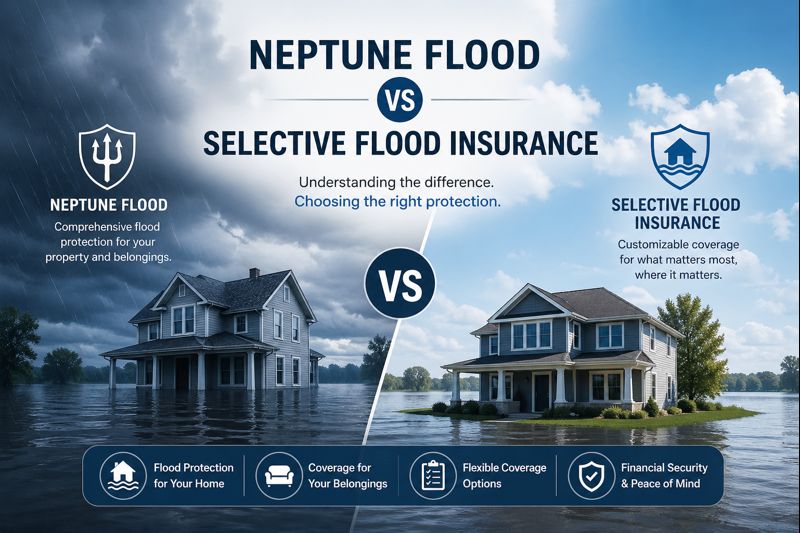
Comparing Neptune Flood vs Selective Flood Insurance in 2026 is really a comparison between two different flood insurance paths: private flood insurance and NFIP-backed flood coverage. If you are searching for flood insurance near me, the best choice is not always the cheapest premium. The better question is which policy structure protects the actual rebuilding cost of your home, your personal belongings, your temporary living needs, and your lender requirements.
Neptune Flood is a private flood insurance option known for fast digital quoting, property-level underwriting, higher available residential limits, and optional coverage features that can go beyond many standard flood policies. Selective Flood Insurance is commonly associated with traditional National Flood Insurance Program servicing through the Write Your Own program, where coverage follows more standardized federal flood policy rules, limits, and forms. Both can be useful, but they are not interchangeable.
The most important differences usually show up in five areas: coverage limits, waiting period, additional living expense protection, contents valuation, and how much flexibility you have to insure higher-value homes. A homeowner with a standard mortgage requirement may be comfortable with an NFIP-backed policy. A homeowner with a larger home, finished basement, expensive contents, detached structures, or a desire for broader recovery support may want to compare Neptune’s private flood path first.
Quick facts: Neptune Flood vs Selective Flood Insurance
Use this quick-facts table as the starting point before you compare premium. Flood insurance should be reviewed by total risk, not only by the monthly or annual cost. A lower premium can become expensive if the policy limit is too low, the contents coverage is weaker than expected, or the waiting period does not match your closing, renewal, or storm-season timeline.
| Category | Neptune Flood | Selective Flood Insurance | Why it matters |
|---|---|---|---|
| Coverage path | Private flood insurance | Traditional NFIP-backed flood insurance servicing path | The policy rules, flexibility, and claim structure can be very different |
| Residential building limits | Higher private limits may be available for eligible properties | NFIP residential building limits are more standardized | Higher-value homes may need more than standard flood limits |
| Contents coverage | Private contents options may offer more flexibility | NFIP-backed contents limits follow federal program structure | Furniture, electronics, appliances, and personal belongings can add up quickly |
| Waiting period | Often shorter, with exceptions for closings or qualifying rollovers | NFIP policies commonly have a standard 30-day waiting period unless an exception applies | Timing matters when buying a home, renewing coverage, or approaching storm season |
| Best overall fit | Homeowners wanting broader private options and higher limits | Homeowners wanting a familiar NFIP-backed structure | The better fit depends on property value, lender rules, risk profile, and coverage needs |
How Neptune Flood and Selective Flood Insurance work
Flood insurance can be confusing because two policies may both say “flood insurance” but operate under different rules. Neptune is a private flood insurance marketplace and underwriting platform. Its value proposition is built around modern risk modeling, fast quote technology, and private policy features that may provide higher limits or extra protection for eligible homes.
Selective Flood Insurance is generally understood in the flood marketplace as a National Flood Insurance Program Write Your Own carrier path. Write Your Own carriers sell and service federal flood insurance policies under NFIP rules. That means the policy form, maximum residential limits, waiting period rules, claims framework, and many coverage restrictions are tied to the federal program rather than a fully private policy design.
This distinction matters because your home may need more than a basic flood policy. If your property has a finished basement, high reconstruction cost, detached structures, pool exposure, or personal property that exceeds standard limits, private flood coverage may be worth comparing. If your primary goal is satisfying a lender requirement with a familiar federal structure, an NFIP-backed option may be easier to understand.
Neptune Flood vs Selective Flood Insurance comparison table
This side-by-side table shows how the two flood insurance paths usually compare. Final eligibility, price, and policy terms depend on the property address, flood zone, underwriting guidelines, elevation, prior claims, occupancy, lender requirements, and selected coverage options.
| Feature | Neptune Flood | Selective Flood Insurance | How to evaluate it |
|---|---|---|---|
| Policy type | Private flood insurance | NFIP-backed flood insurance through a Write Your Own servicing path | Decide whether you need private flexibility or standardized federal structure |
| Residential building limit | Higher limits may be available for eligible homes | Standard NFIP residential building limits apply | Compare the limit against your actual estimated rebuild cost |
| Personal property / contents | Private contents options may be broader and more flexible | Contents coverage follows NFIP form and limit rules | Estimate furniture, electronics, appliances, clothing, and valuables realistically |
| Temporary living expenses | May be available depending on policy form and options | NFIP-style policies generally do not work like homeowners loss-of-use coverage | Ask what happens if the home is unlivable after a covered flood |
| Basement contents | Private options may offer broader basement-related protection | Basement coverage can be limited under NFIP rules | Important for finished basements, storage, mechanicals, and lower-level living areas |
| Detached structures | May offer options for unattached structures | Federal policy rules control how detached structures are handled | Review sheds, garages, workshops, pool houses, and guest structures separately |
| Waiting period | Often shorter, with possible no-wait scenarios for qualifying closings or rollovers | Commonly 30 days unless a program exception applies | Timing matters before storm season, closing dates, and renewal deadlines |
| Quote experience | Fast online quote path | More traditional servicing and NFIP policy workflow | Choose the path that lets you review clear limits and deductibles before binding |
| Best fit | Homeowners wanting higher limits, private flexibility, and broader recovery features | Homeowners wanting a familiar NFIP-backed policy or lender-recognized federal structure | Match the policy to your home value, lender, and realistic claim scenario |
Coverage details that matter most after a flood
Flood insurance should be chosen based on what happens after water damages the home. The question is not only “What is the premium?” The better question is “What would this policy actually pay for after a major covered flood, and where would I still be out of pocket?”
Neptune can be attractive when a homeowner wants higher building limits, more contents flexibility, and the possibility of added protection for temporary living expenses, basement contents, detached structures, pool repair or refill, and contents valuation options. These features can be especially important for higher-value homes, coastal homes, properties with large finished areas below grade, and homeowners who do not want to rely on a separate savings account during a displacement.
Selective’s NFIP-backed path can still make sense when the homeowner wants a traditional federal flood policy structure, needs to satisfy a standard lender requirement, or has a property that fits comfortably within the NFIP’s residential limits. However, the standardized nature of NFIP coverage means homeowners need to understand what is not covered, how basements are treated, whether temporary living costs are included, and how contents losses are settled.
| Coverage detail | Why it matters | Question to ask before binding |
|---|---|---|
| Building limit | Flood rebuilding costs can exceed standard policy caps | Is the limit close to the real reconstruction cost of the home? |
| Contents limit | Furniture, appliances, and electronics can be expensive to replace | Would the contents limit cover a realistic room-by-room inventory? |
| Loss settlement | Replacement cost and actual cash value can produce different claim outcomes | How are contents and building items valued after a covered flood? |
| Temporary living expenses | A flooded home may be unlivable while repairs are completed | Does the policy help with hotel, food, or displacement costs? |
| Basement restrictions | Lower-level rooms often have special flood limitations | What basement items are covered and what is excluded? |
| Detached structures | Garages, sheds, and other structures may need separate review | Are unattached structures covered, limited, or excluded? |
| Waiting period | Coverage may not begin immediately after purchase | When does the policy become effective, and does an exception apply? |
Pricing and claims: why two flood quotes can look completely different
Flood insurance pricing is property-specific. A home’s elevation, foundation type, distance to water, prior loss history, flood zone, rebuilding cost, occupancy, and mitigation features can all affect the quote. That is why two neighboring homes can receive very different premiums, even if they appear similar from the street.
Neptune’s private model may produce strong pricing for homes that its underwriting views favorably. It may also allow the homeowner to build a policy around higher limits or broader options. That is useful when the risk is not simply “Do I need flood insurance?” but “How much flood insurance do I need to recover properly?”
Selective’s NFIP-backed path can feel more predictable because the policy structure is standardized. But standardized does not automatically mean better or worse. It means the homeowner should compare the known program limits and rules against the actual value of the property and the claim scenario they are trying to protect against.
| Review point | Neptune Flood angle | Selective / NFIP-backed angle | Smart move |
|---|---|---|---|
| Premium | Private underwriting may be competitive for eligible properties | Pricing follows federal program methodology and policy rules | Compare premium only after matching limits and deductibles |
| Deductible | May offer flexible deductible choices by policy design | Deductible options are tied to NFIP policy structure | Ask how the deductible applies to building and contents |
| Claims communication | Private claims handling and digital workflows may appeal to some homeowners | Traditional claims handling under NFIP policy requirements | Review reporting steps before a storm happens |
| Large losses | Higher limits may help with larger or more expensive homes | Standard limits can create coverage gaps for expensive homes | Estimate a worst-case covered flood loss, not just a minor water event |
| Mortgage acceptance | Private policy should be reviewed against lender requirements | NFIP-backed policies are widely familiar to lenders | Confirm lender acceptance before canceling or replacing existing coverage |
Which flood insurance option is the better fit?
There is no one-size-fits-all winner. Neptune may be the better fit for homeowners who want a modern private flood quote, higher limits, shorter waiting period options, and broader recovery features. Selective may be the better fit when the homeowner prefers a familiar NFIP-backed policy path or when the lender, property, or underwriting situation points toward a traditional federal flood policy.
- Your home value exceeds standard flood policy limits.
- You want broader private coverage options.
- You are comparing additional living expense protection.
- You want a faster online quote experience.
- You need to evaluate basement, contents, pool, or detached-structure exposure.
- You prefer a traditional NFIP-backed structure.
- Your home fits comfortably within standard program limits.
- Your lender is most comfortable with a federal flood policy pathway.
- You want a familiar servicing route for an existing flood policy.
- You are prioritizing standardization over private customization.
A practical way to decide is to run the Neptune quote, compare the same building and contents limits as closely as possible, then review what the Selective/NFIP-backed path would cover and exclude. Once the limits, deductible, waiting period, and loss settlement are aligned, the better value becomes much easier to see.
Flood insurance comparison help by state and property type
Flood risk is not limited to coastal homes. Inland rain, flash flooding, drainage failures, monsoon storms, hurricanes, snowmelt, and overflowing washes can all create losses. Blake Insurance Group helps homeowners compare flood insurance options across licensed service areas, with special attention to homes near rivers, coastal zones, desert washes, low-elevation neighborhoods, new construction, and lender-required flood zones.
| Property / region type | Examples | What we compare |
|---|---|---|
| Coastal and hurricane-exposed homes | Gulf, Atlantic, and coastal communities | Building limits, wind-vs-flood separation, contents, and displacement costs |
| Inland flood zones | River corridors, lake-adjacent homes, low-lying neighborhoods | Lender requirements, elevation impact, waiting periods, and deductible structure |
| Desert and flash-flood areas | Arizona, New Mexico, and storm-drainage-sensitive areas | Monsoon risk, wash proximity, low-risk assumptions, and private quote opportunities |
| Higher-value homes | Custom homes, larger homes, finished basements, luxury finishes | Whether standard limits are enough and whether private flood limits are needed |
| Rental and investment homes | Single-family rentals, seasonal properties, short-term rentals | Occupancy rules, contents needs, lender compliance, and claim recovery planning |
Get a Neptune Flood quote and compare your real numbers
Flood insurance should be quoted at the address level. Your best option depends on the property’s flood exposure, replacement cost, lender requirement, selected deductible, desired contents limit, and whether you need private add-ons. Start with the Neptune quote path, then compare the result against any existing NFIP-backed or Selective-serviced policy you already have.
Before replacing an existing flood policy, verify lender acceptance, effective date, waiting period, and whether there would be any gap in coverage.
Related topics
Neptune Flood vs Selective Flood Insurance FAQs (2026)
Is Neptune Flood better than Selective Flood Insurance?
Neptune may be better for homeowners who want private flood flexibility, higher available limits, a faster quote path, and optional coverage features that may go beyond a standard NFIP-backed policy. Selective may be better for homeowners who prefer a traditional NFIP-backed policy structure or need a familiar lender-recognized federal flood path.
What is the biggest difference between Neptune and Selective Flood?
The biggest difference is policy structure. Neptune is a private flood insurance option, while Selective is commonly associated with NFIP-backed flood insurance servicing through the Write Your Own program. That difference affects limits, waiting periods, coverage flexibility, claims handling, and policy rules.
Can private flood insurance replace an NFIP policy?
In many cases, yes, but you should confirm the private policy meets your lender’s requirements before replacing an existing NFIP policy. You should also check the effective date, waiting period, cancellation timing, and whether any coverage gap could occur.
Why might a homeowner choose Neptune Flood?
A homeowner may choose Neptune when they want higher private limits, a fast online quote experience, optional coverage features, and a policy design that may better match a higher-value home or broader recovery needs.
Why might a homeowner choose Selective Flood Insurance?
A homeowner may choose Selective when they want an NFIP-backed policy pathway, are comfortable with standardized federal flood policy limits, or prefer a more traditional flood insurance servicing structure.
Does flood insurance cover temporary housing after a flood?
Some private flood policies may include temporary living expense coverage or offer it through policy options. NFIP-backed flood policies generally do not function like a homeowners policy’s loss-of-use benefit, so this is an important difference to verify before buying.
Should I compare flood insurance only by premium?
No. Premium is only one part of the decision. Compare building limits, contents limits, deductibles, waiting periods, basement restrictions, detached-structure rules, claim settlement, and lender acceptance before deciding.
Independent agency: Blake Insurance Group LLC is an independent insurance agency and is not affiliated with Neptune Flood, Selective, the National Flood Insurance Program, FEMA, or any single insurance company.
Licensing: Licensed insurance producer (NPN 16944666).
Important: Flood insurance coverage, pricing, eligibility, waiting periods, underwriting approval, lender acceptance, deductibles, claims handling, and policy terms vary by property address, flood zone, insurer, program rules, and selected coverage options.
Program note: NFIP-backed policies follow federal flood insurance rules and limits. Private flood insurance may offer broader or different coverage, but it must still be reviewed against lender requirements and the homeowner’s risk profile.
Trademarks: All product and company names are trademarks™ or registered® trademarks of their respective holders. Use of them does not imply affiliation, sponsorship, endorsement, or approval.





Reviews are loaded from Google when you click “View reviews.”