Insurance company review • Connected-vehicle car insurance
GM Insurance Review: How Connected-Car Insurance Works
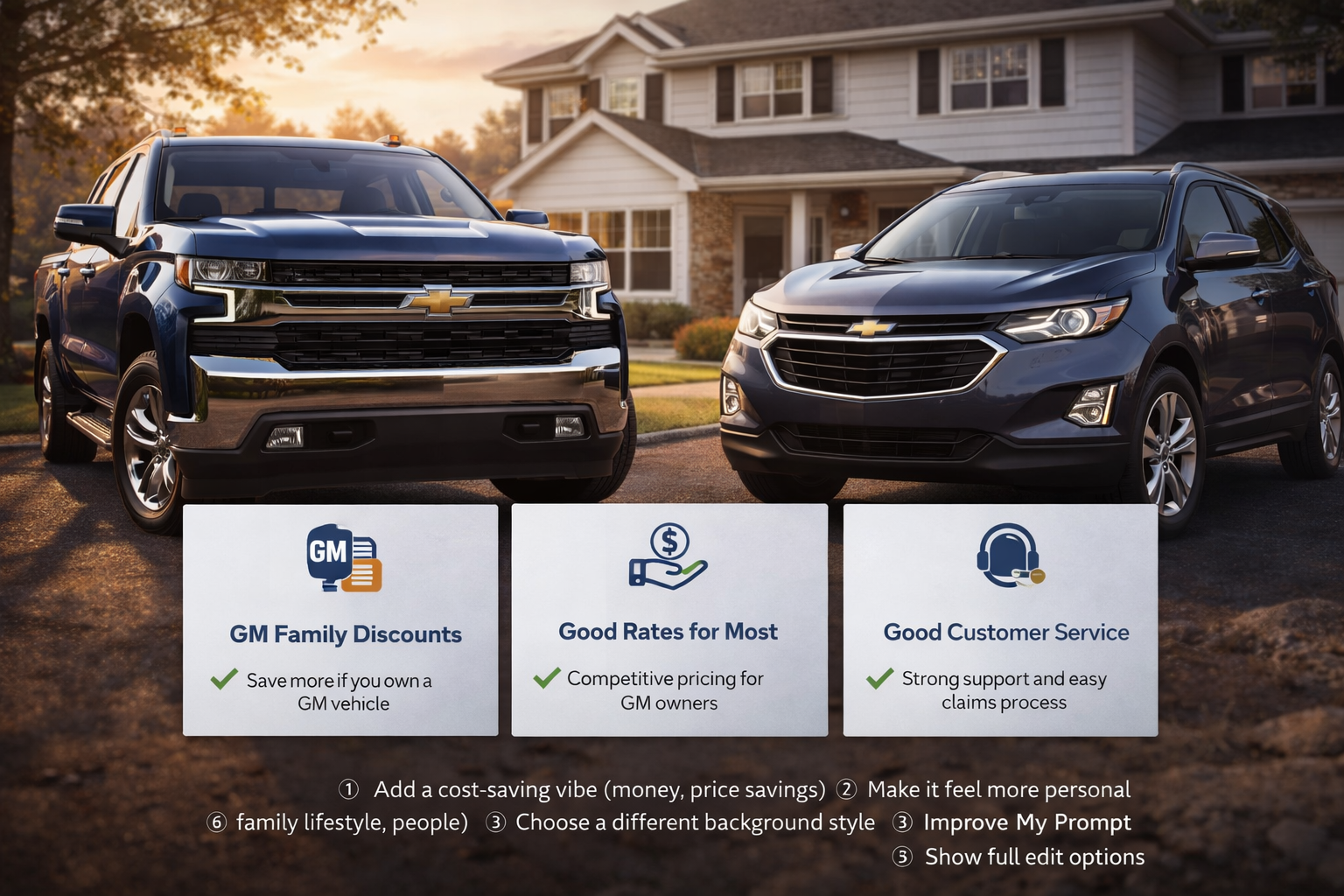
This GM Insurance review explains how General Motors' car insurance program works for owners of GM vehicles. GM Insurance, formerly OnStar Insurance, uses driving data from connected GM vehicles, such as distance driven, time of day, speed, and seatbelt use, to help price coverage for drivers who opt in. As of March 2026, GM Authority reported it was available in about 20 states.
Below we cover how the program uses vehicle data, where it is available, the privacy questions to ask, and how to compare a GM Insurance quote with other options. Blake Insurance Group is an independent agency; we are not affiliated with General Motors or GM Insurance.
Compare your GM Insurance quote
Tell us about your drivers and vehicles, and a licensed agent will compare the options available to us. Submitting the form does not bind coverage.
If the form does not load, call 888-387-3687, Monday through Friday, 9:00 to 5:00, or email info@blakeinsurancegroup.com.
How GM Insurance works
Most insurers price car insurance using your driving record, vehicle, location, and other approved factors. GM Insurance adds data from the vehicle itself. For drivers who opt in, connected GM vehicles can share information about how and when the car is driven, which can then be used to rate the policy. Careful, low-mileage drivers may benefit; drivers with frequent hard braking, high speeds, or late-night driving may not.
Because the program depends on connected-vehicle features, it is built for GM vehicles with active connectivity. Ask how the program treats non-GM vehicles in the same household, since many families own more than one brand.
Pros and cons
| Potential pros | Potential cons |
|---|---|
| Pricing can reflect your actual driving | Risky driving patterns may increase cost |
| No separate app or plug-in needed for GM vehicles | Requires sharing vehicle data with GM |
| Integrated with the vehicle and GM ecosystem | Available in a limited number of states |
| Can be convenient for single-brand GM households | Mixed-brand households may need another insurer for other vehicles |
Based on our review of public information. Your experience may differ.
Privacy questions to ask
Connected-car data has drawn regulatory attention in recent years, including scrutiny of how automakers share driving data with insurers and data brokers. Before enrolling in any vehicle-data insurance program, ask:
- Exactly which data points are collected, and how often?
- Is the data used only for this policy, or shared with other companies?
- Can I opt out of data sharing and still keep the policy?
- How long is the data stored, and can I request it be deleted?
- Can my data be used to raise my premium at renewal?
Get answers in writing and read the privacy notice that applies to your state.
How we reviewed GM Insurance
We reviewed GM Insurance the way we would want a client to evaluate any insurance shopping service or insurer. We did not purchase a policy or receive compensation from GM Insurance for this review. Our process:
- Public disclosures. We read the company's own descriptions of how it works, who it is, how it is paid, and what it does with your data.
- Licensing. We looked for the licensed entity behind the service, since only licensed insurers and agencies can sell insurance.
- Independent reporting. We checked recent coverage by trade and consumer publications where available.
- Consumer fit. We considered who is likely to benefit and what trade-offs a typical driver should understand.
We do not assign star ratings. Your best option depends on your drivers, vehicles, address, and coverage needs.
Coverage terms to check on any quote
Data-based pricing does not change what coverage you need. Compare these terms on every quote.
| Coverage | What it pays for | What to match |
|---|---|---|
| Bodily injury liability | Injuries you cause to others | Per-person and per-accident limits, such as 100/300 |
| Property damage liability | Damage you cause to others' property | Same limit on both quotes, such as $100,000 |
| Uninsured/underinsured motorist | Your injuries when the at-fault driver lacks enough coverage | Same limits; ideally equal to your liability limits |
| Collision | Damage to your car from a crash | Same deductible |
| Comprehensive | Theft, fire, hail, flood, animal strikes, glass | Same deductible; note any glass option |
| Medical payments or PIP | Medical costs for you and passengers | Same limit; PIP rules depend on your state |
| Rental and roadside | Transportation during repairs; towing | Same daily and total limits |
Limits shown are examples, not recommendations. State minimum requirements differ.
GM Insurance vs. other usage-based programs
Many insurers offer driving-data programs that use a phone app or plug-in device. GM's approach uses the vehicle's built-in connectivity instead. The underlying idea is the same: price more closely to how you drive. The practical differences are which data is collected, whether it is continuous or for a trial period, and whether the program can raise your rate. Our guide to usage-based insurance compares how these programs work and the questions to ask.
How your state affects your quote
Car insurance is regulated state by state, which affects any company comparison:
- Minimum liability limits differ widely. State minimums are often far below what a serious accident costs, so many drivers choose higher limits.
- No-fault states require personal injury protection, which changes how injury claims are paid.
- Rating factors differ. Some states limit or ban the use of credit-based insurance scores, gender, or occupation in pricing.
- Uninsured motorist rules differ. Some states require it; others require insurers to offer it and let you reject it in writing.
- Company availability differs. A company's programs, discounts, and appetite in one state may not match another.
A comparison that is accurate in one state can be wrong in the next, which is another reason to compare actual quotes for your address rather than national averages.
How to switch without a coverage gap
If a new quote is lower, switch carefully so you are never uninsured:
- Confirm the final price after the insurer verifies your information.
- Set the new policy to start on or before the date the old one ends.
- Give the new insurer your lender or lessor information if the vehicle is financed.
- Save your new ID cards and declarations page.
- Cancel the old policy effective the same day, and ask about any refund of unused premium.
- If you have an SR-22, confirm the new insurer files it before the old filing ends.
When talking with an agent may help
Online tools work well for simple situations. A conversation with a licensed agent may be more useful when:
- You have a teen driver, several vehicles, or drivers with recent accidents or violations.
- You need an SR-22 or other state filing. See our SR-22 insurance page.
- You use a vehicle for rideshare, delivery, or other business purposes.
- You own a home, rental property, or significant savings and want liability limits that work with an umbrella policy.
- You have had a claim denied or a policy nonrenewed and need help understanding your options.
An agent can also explain differences in policy wording that are hard to see on a results page.
Sponsored: vehicle service contracts are not insurance
Sponsored
A vehicle service contract, often called an extended auto warranty, helps pay for covered mechanical repairs. It is not auto insurance: it does not provide liability coverage, satisfy state insurance requirements, or pay for crash, theft, or weather damage. Blake Insurance Group may receive compensation if you buy through the link below. The provider's own terms control, and its public terms state the product is not available in every state, including California.
What to have ready before comparing
These details help you compare a GM Insurance quote fairly.
- Vehicle details. VINs and whether each vehicle has active connected services.
- Driver details. Licenses and dates of birth for every household driver.
- Current declarations page. To match limits and deductibles.
- Driving habits. Annual mileage and typical driving times.
- Privacy preferences. Decide how much vehicle data you are comfortable sharing.
GM Insurance review FAQs
What is GM Insurance?
A car insurance program from General Motors for owners of GM vehicles, formerly known as OnStar Insurance.
Is GM Insurance available in my state?
As of March 2026, GM Authority reported availability in about 20 states. Check GM Insurance's site for your state.
Do I need a GM vehicle?
The program is designed around connected GM vehicles. Ask how other vehicles in your household would be insured.
Can GM Insurance raise my rate based on driving?
Programs that use driving data can reward or penalize driving patterns. Ask how data affects your premium at renewal.
Do I have to share my driving data?
Ask GM Insurance about opt-in and opt-out choices and how they affect pricing.
Is GM Insurance cheaper?
It depends on your driving, vehicle, and location. Compare matching quotes from other insurers.
Who handles claims?
The insurer named on your policy handles claims. Confirm the issuing company when you buy.
Is an extended warranty the same as car insurance?
No. A vehicle service contract covers certain mechanical repairs and does not replace auto insurance.
Can I insure a non-GM car with GM Insurance?
Ask GM Insurance directly. The program is built around connected GM vehicles, and household rules vary.
Related guides
Important information
Independent agency. Blake Insurance Group LLC is an independent insurance agency. Licensed insurance producer NPN 16944666. Licensed states: AZ, AL, TX, CA, NY, OH, FL, NC, VA, GA, OK, NM, IA, KS, MI, NE, SC, SD, WV, IL, NJ, PA, TN, and WA. Which insurance companies we can quote depends on our current appointments, the product, and your state. Mentioning a company on this page does not mean we represent it.
Independent review. This review is based on public information available as of October 2026 and our own analysis. Blake Insurance Group is not affiliated with the company reviewed, and this page is not an endorsement or a statement that we represent it. Company names are trademarks of their owners and are used for identification only. Features and availability change; confirm details with the company.
Availability. Coverage, prices, and eligibility vary by insurer, state, and applicant, and are subject to underwriting. The issued policy controls.
Source. State availability figures are from GM Authority reporting dated March 5, 2026, and may have changed.
Compensation. The vehicle service contract link on this page is sponsored, and Blake Insurance Group may be paid if you make a purchase. Sponsored placement does not affect the insurance information on this page.
Your next step
If you drive a GM vehicle and have a GM Insurance quote, request one from us with the same coverage so you can compare.




