
General Liability Insurance for Contractors (2026): Online Quotes, COIs, Additional Insured, Completed Operations, and Contract Requirements
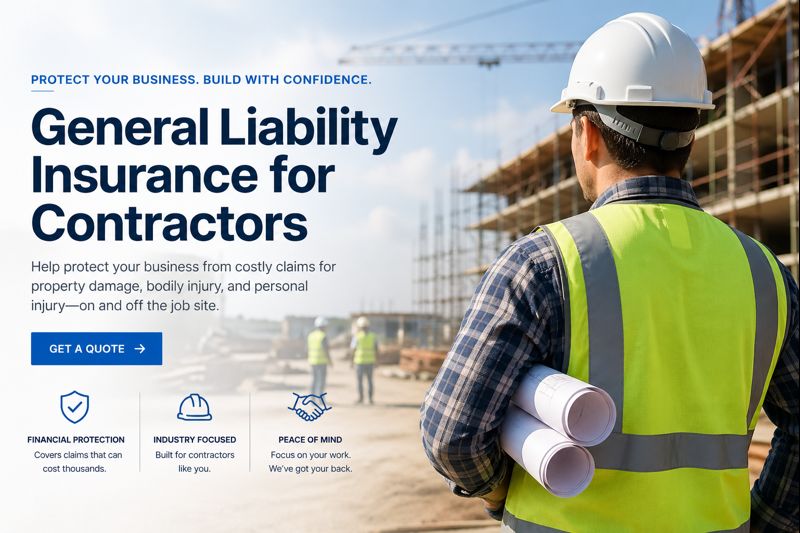
General liability insurance for contractors protects your business from common third-party claims involving bodily injury, property damage, personal and advertising injury, legal defense, and completed operations. In 2026, contractors also need more than a policy number. They need fast quote-and-buy options, accurate certificates of insurance, correct additional insured wording, and coverage that matches the contract before work begins.
Contractors are asked for proof of insurance constantly. A general contractor may need a COI before a subcontractor steps onto a job site. A property manager may require additional insured status before a repair contract starts. A homeowner association may ask for liability limits before approving exterior work. A commercial client may ask for primary and non-contributory wording, waiver of subrogation, and completed operations coverage before releasing a purchase order.
If you are searching for general liability insurance for contractors near me, the best starting point is not just price. The right policy must fit your trade, your contract, your work location, your subcontractor use, your payroll or receipts, and the certificate wording your client expects. This page helps contractors compare quote-and-buy options from Thimble, NEXT, and Coterie while understanding the coverage details that affect job-site approval and claim protection.
Quick facts: contractor general liability insurance
Contractor general liability insurance is one of the most requested policies in construction and trades work. It can help protect against third-party bodily injury and property damage claims connected to your operations, plus certain personal and advertising injury claims. Many contractor GL policies also include products-completed operations coverage, which can respond when completed work later causes covered third-party injury or damage.
| Topic | What it means | Why contractors care | Best move |
|---|---|---|---|
| General liability | Coverage for certain third-party bodily injury, property damage, and personal/advertising injury claims | Clients, landlords, GCs, and job sites often require it before work starts | Match policy limits to the contract before buying |
| Completed operations | Protection for certain claims that arise after work is completed | Construction defects and completed work damage can surface after the job is done | Confirm completed operations is included and review limits |
| Additional insured | Extends certain policy protections to a client or project party when endorsed | Many contracts require additional insured status for owners or general contractors | Verify available wording before binding the policy |
| Waiver of subrogation | Limits the insurer’s ability to seek reimbursement from another party after a covered loss | Common in construction contracts and commercial service agreements | Confirm whether the contract requires a blanket or scheduled waiver |
| COI | Certificate of insurance showing proof of active coverage and limits | Often required before job-site access, vendor approval, or payment release | Copy certificate holder wording directly from the contract |
Quote and buy online: Thimble, NEXT, and Coterie for contractors
Contractors do not all fit the same quote lane. A handyman needing a quick certificate may need one path. A remodeler with employees, tools, and commercial auto needs may need another. A low-hazard service contractor may qualify quickly, while higher-risk trades may require closer review. Use the table below to choose a starting point.
| Quote path | Best fit | Common coverage focus | Use when | Start |
|---|---|---|---|---|
| Thimble | Small contractors, handymen, events, short jobs, and businesses needing quick proof of coverage | General liability and selected small business coverages depending on eligibility | You need a fast quote path and certificate-ready coverage for eligible work | Start Thimble Quote |
| NEXT | Contractors, construction trades, service businesses, consultants, and many small business classes | General liability, workers’ comp, commercial auto, tools/equipment, professional liability, and more when eligible | You want a broader contractor insurance quote path with digital policy tools | Start NEXT Quote |
| Coterie | Standard small commercial businesses and eligible contractor/service classes needing quick quote review | General liability, business owners policy, professional liability, and selected small commercial options | Your operation fits a standard commercial profile and you need a fast bindable quote lane | Start Coterie Quote |
What general liability insurance for contractors typically covers
Contractor general liability insurance is designed for third-party claims. That means it is focused on injuries or damage involving people or property outside your business. Common examples include a customer tripping over your equipment, a ladder damaging a client’s property, overspray damaging a nearby surface, or completed work leading to covered third-party property damage after the job is finished.
General liability can also help pay for legal defense when a covered claim is made. This matters because a contractor can face legal costs even when the claim is disputed. The policy is not a workmanship guarantee, and it does not automatically cover every mistake, employee injury, vehicle accident, tool theft, or professional design error. It is one part of a complete contractor insurance program.
Coverage snapshot: contractor general liability and related policies
General liability is often the first contractor policy requested, but it is not the only coverage a contractor may need. Use this table to compare what each coverage is designed to protect and why contracts often request more than one policy.
| Coverage | What it protects | Common contractor trigger | Important note |
|---|---|---|---|
| General liability | Third-party bodily injury, property damage, and personal/advertising injury claims | Client contract, landlord lease, job site, vendor approval, bid requirement | Does not replace workers’ comp, commercial auto, or tool coverage |
| Products-completed operations | Certain injury or damage claims arising after completed work | Construction defect allegations, repair damage after job completion, warranty-adjacent disputes | Review completed operations limit and contract requirements |
| Workers’ compensation | Employee work-related injuries or illnesses | Employees, job-site rules, state requirements, subcontractor compliance | Required separately from general liability in many situations |
| Commercial auto | Business vehicle liability and physical damage when selected | Work trucks, vans, trailers, deliveries, job-site travel | Personal auto usually does not cover full business vehicle exposure |
| Tools and equipment | Contractor tools, equipment, and mobile gear | Theft, damage, job-site storage, equipment in transit | General liability usually does not cover your own stolen tools |
| Professional liability | Errors, omissions, design, consulting, or professional service claims | Design-build work, consulting, plans, specifications, advice, project management | Needed when your work includes professional judgment or design exposure |
Contract requirements: what clients often ask contractors to show
Many contractor insurance problems begin after the policy is already purchased. The contractor buys coverage, sends a COI, and then the client rejects it because the limits are wrong, the certificate holder is incomplete, additional insured wording is missing, or the waiver of subrogation is not available. Before you buy, review the insurance section of the contract.
Additional insured status can extend certain protections under your liability policy to another party, such as a general contractor, property owner, landlord, or project owner. A waiver of subrogation is different. It limits the insurer’s ability to seek recovery from another party after paying a covered claim. Contracts may require one, both, or neither. Some contracts also require primary and non-contributory wording, per-project aggregate wording, completed operations additional insured wording, or specific certificate language.
| Requirement | What it usually means | Why it matters | Before you buy |
|---|---|---|---|
| Additional insured | Adds a client or project party as an insured for certain covered liability claims | Often required by GCs, owners, landlords, and property managers | Confirm whether wording applies to ongoing operations, completed operations, or both |
| Waiver of subrogation | Restricts the insurer from seeking reimbursement from another party after a claim | Common in construction and commercial service contracts | Ask whether the policy supports scheduled or blanket waiver wording |
| Primary and non-contributory | Your policy responds before the additional insured’s policy, when required and applicable | Many larger contracts require this wording | Check whether the endorsement is available |
| Per-project aggregate | Applies aggregate limits separately to each qualifying project | Useful for contractors working multiple jobs | Verify availability if contract requires it |
| Completed operations wording | Extends certain protections after job completion when endorsed | Important for construction defect and post-completion claims | Do not assume ongoing operations wording is enough |
| Specific limits | Contract may require $1M/$2M, umbrella, auto, or workers’ comp limits | Wrong limits can delay project approval | Compare the contract requirements before binding |
COIs for contractors: get approved the first time
A certificate of insurance is proof of active coverage. For contractors, it is often required before starting work, accessing a job site, receiving payment, joining a vendor list, or signing a lease. The COI should match the contract, but it cannot change the policy by itself. If a contract requires an endorsement, the policy must actually support that endorsement.
Contractors should keep a COI folder with client requirements, certificate holder names, addresses, job numbers, project names, and required wording. This makes renewals easier and reduces the chance of sending a certificate that gets rejected.
| Item | Why it matters | Best practice |
|---|---|---|
| Legal business name | COI must match the entity signing the contract | Use the exact legal name or DBA required by the contract |
| Certificate holder | Wrong holder details cause rejections | Copy the name and address exactly from the contract |
| Required limits | Client may require specific liability, auto, umbrella, or workers’ comp limits | Confirm the quote limits before purchase |
| Additional insured wording | Often required for owners, GCs, landlords, and project parties | Verify endorsement availability before buying |
| Waiver of subrogation | Common construction contract requirement | Confirm whether scheduled or blanket waiver wording is needed |
| Project description | Some COIs need job name, location, or project number | Keep project details in one request to avoid back-and-forth |
Before buying, compare your contract’s insurance page against the quote’s limits, exclusions, available endorsements, and certificate capabilities.
What affects the cost of general liability insurance for contractors?
Contractor general liability pricing is based on the risk of the trade and the size of the business. A low-risk handyman operation does not price the same as a roofing contractor, excavation contractor, or structural trade. Premium can also change based on receipts, payroll, subcontractor costs, location, years in business, claims history, selected limits, requested endorsements, and whether completed operations exposure is significant.
| Factor | Why it matters | How to manage it |
|---|---|---|
| Trade type | Risk varies widely by contractor class | Describe the work accurately and avoid vague categories |
| Annual receipts | Higher sales often mean more exposure | Estimate annual revenue realistically |
| Payroll | Employee exposure can influence underwriting | Track payroll by role and pair with workers’ comp review |
| Subcontractor cost | Uninsured subcontractors can increase exposure | Collect subcontractor COIs and written agreements |
| Limits and endorsements | Higher limits and special endorsements can affect price | Match coverage to contract requirements, not guesswork |
| Claims history | Prior liability claims can affect eligibility and premium | Use safety procedures, written job scopes, and claim prevention practices |
What general liability usually does not cover
General liability is essential, but it is not a catch-all policy. Contractors often need additional coverage depending on the work performed, vehicles used, employees, equipment, and contract requirements. Knowing what GL does not cover helps prevent a false sense of security.
| Exposure | Why GL may not be enough | Coverage to review |
|---|---|---|
| Employee injuries | General liability is for third-party claims, not employee work injuries | Workers’ compensation |
| Business vehicles | Auto accidents involving work vehicles need separate auto coverage | Commercial auto |
| Stolen tools | Your own equipment is usually not covered by GL | Tools and equipment / inland marine |
| Faulty workmanship itself | GL may respond to resulting damage, but not to redo your defective work | Contractor risk review, warranty practices, quality control |
| Professional design errors | Design, consulting, plans, or specifications may require separate protection | Professional liability / errors and omissions |
| Pollution or hazardous materials | Pollution exclusions can be broad | Contractors pollution liability |
Contractor general liability service areas
Blake Insurance Group helps contractors compare online quote paths and coverage options across multiple licensed states. For contractors, the key details are where the work is performed, what trade is involved, whether subcontractors are used, what contracts require, and whether the job site needs special certificate wording.
| Region | States commonly supported | What we verify |
|---|---|---|
| West and Southwest | AZ, CA, NM, TX | Trade class, license needs, COI wording, additional insured, and job-site requirements |
| South and Southeast | AL, FL, GA, NC, SC, VA, OK | Contract limits, subcontractor proof, completed operations, and GL eligibility |
| Midwest and Plains | IA, KS, MI, NE, OH, SD | Contractor operations, payroll, receipts, tools, and certificate requirements |
| Northeast and Appalachia | NY, WV | State-specific requirements, project proof, trade restrictions, and policy fit |
Get general liability insurance for contractors online
Use the quote-and-buy buttons below to start the application that best fits your contractor business. Before you apply, gather your legal business name, business address, trade description, annual receipts, payroll, subcontractor costs, prior claims, required limits, and the contract’s insurance wording. This keeps the quote more accurate and helps you avoid buying coverage that does not satisfy the job.
Not every quote path fits every trade, state, or endorsement request. If one lane does not fit, compare the other options before assuming coverage is unavailable.
Related topics
General liability insurance for contractors FAQs (2026)
What does general liability insurance cover for contractors?
General liability insurance for contractors commonly covers certain third-party bodily injury, property damage, personal and advertising injury, legal defense, and completed operations claims, subject to policy terms, exclusions, and limits.
Do contractors need general liability insurance?
Most contractors need general liability because clients, landlords, property managers, general contractors, and job sites often require proof before work starts. It also protects against common third-party claims that can happen during normal operations.
Is general liability the same as workers’ compensation?
No. General liability is designed for third-party injury and property damage claims. Workers’ compensation is designed for employee work-related injuries and illnesses. Many contractors need both.
What is completed operations coverage?
Completed operations coverage can help protect against certain third-party injury or property damage claims that arise after a contractor’s work is finished. Contractors should verify completed operations limits and whether the contract requires completed operations additional insured wording.
Can I get a certificate of insurance online?
Many online business insurance platforms provide certificate tools after purchase, but the exact process depends on the policy and carrier. Have the certificate holder, required limits, additional insured wording, and project details ready before buying.
What is additional insured wording?
Additional insured wording can extend certain liability protection to a client, property owner, general contractor, landlord, or project party when the policy is properly endorsed. The exact wording should match the contract requirement.
What is a waiver of subrogation?
A waiver of subrogation limits the insurer’s ability to pursue reimbursement from another party after paying a covered loss. It is common in construction contracts, but it must be supported by the policy endorsement when required.
Does general liability cover my tools?
General liability usually does not cover your own stolen or damaged tools. Contractors should review tools and equipment coverage, sometimes called inland marine coverage, for business equipment and mobile gear.
Independent agency: Blake Insurance Group LLC is an independent insurance agency and is not affiliated with any single insurance company, platform, or carrier.
Licensing: Licensed insurance producer (NPN 16944666).
Important: Contractor general liability coverage, pricing, underwriting eligibility, exclusions, endorsements, additional insured wording, waiver of subrogation availability, completed operations terms, COI rules, and quote availability vary by state, trade, insurer, platform, and business operations.
Online quote note: Thimble, NEXT, and Coterie quote paths may not offer every coverage type, endorsement, or contractor class in every state. Review all terms, limits, exclusions, endorsements, and certificate requirements before buying coverage.
Contract note: A certificate of insurance is proof of coverage; it does not change policy terms. If a contract requires additional insured, waiver of subrogation, primary and non-contributory wording, or completed operations wording, confirm the policy can support the required endorsement.
Trademarks: All product, platform, and company names are trademarks™ or registered® trademarks of their respective holders. Use of them does not imply affiliation, sponsorship, endorsement, or approval.





Reviews are loaded from Google when you click “View reviews.”