Is Flood Insurance Required Outside a High-Risk Zone in 2026?
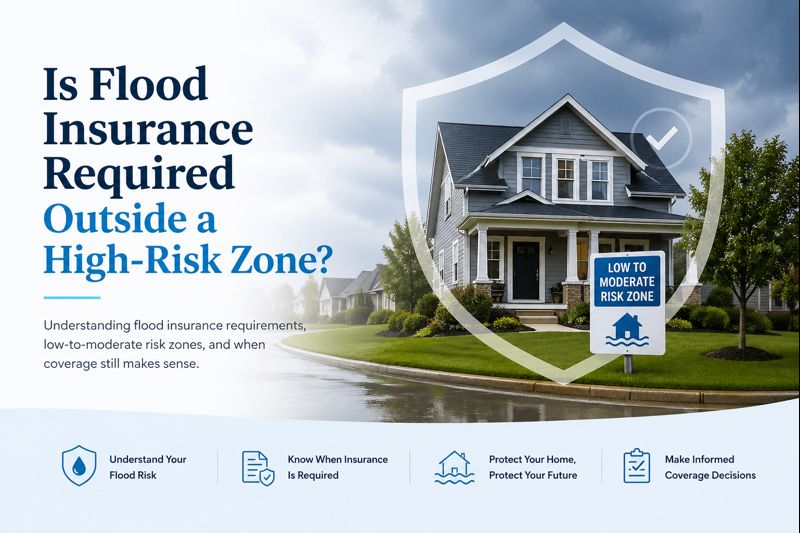
Flood insurance is usually not federally required when a property is outside a high-risk flood zone, but that does not mean it is unnecessary. In 2026, many homeowners in FEMA low-to-moderate risk zones—commonly shown as Zone X, Zone B, or Zone C—still choose flood insurance because flooding can happen outside mapped Special Flood Hazard Areas. Heavy rain, drainage backup, monsoon runoff, storm surge, snowmelt, blocked culverts, wildfire burn scars, and new development can all create flood losses in places that do not look “high risk” on a map.
The standard rule is this: if your property is in a FEMA Special Flood Hazard Area, typically a zone beginning with A or V, and you have a federally backed or federally regulated mortgage, flood insurance is generally mandatory. If your property is outside that high-risk area, the federal mandatory-purchase rule usually does not apply. However, a lender can still require flood insurance as a condition of the loan, especially if its internal risk review, appraisal, prior claim data, or local flood information raises concern.
If you are searching for flood insurance near me because your home is “not in a flood zone,” the better question is: what would happen financially if water entered your home? Standard homeowners insurance generally does not cover flood damage from rising water. That makes flood insurance a separate decision from your home policy, even when your lender does not require it.
Quick facts: flood insurance outside a high-risk zone
Use this snapshot to separate what is legally required from what may be financially smart. Flood risk is property-specific, and a “low-risk” label does not mean “no-risk.”
| Question | Typical answer | What to verify |
|---|---|---|
| Is flood insurance federally required outside Zone A or V? | Usually no, if the property is outside the Special Flood Hazard Area | Confirm the current FEMA map, lender determination, and loan requirements |
| Can a lender still require it? | Yes. Lenders may apply their own risk standards | Ask for the lender’s flood determination and coverage requirement in writing |
| Does homeowners insurance cover flood? | Generally no for rising water flood damage | Review your homeowners policy exclusions and buy separate flood coverage if needed |
| Can private flood be used? | Often yes, depending on eligibility and lender acceptance | Compare Neptune Flood or another private option by limits, deductibles, waiting period, and exclusions |
| Is it worth buying voluntarily? | Often yes for homeowners with meaningful water exposure | Compare annual premium to potential uninsured repair, contents, and displacement costs |
When is flood insurance required?
Flood insurance is generally required when three conditions line up: the property is in a Special Flood Hazard Area, the community participates in the National Flood Insurance Program, and the mortgage is federally backed, federally regulated, or otherwise subject to a lender’s flood insurance rules. These high-risk zones are usually shown on FEMA maps as Zone A or Zone V.
Outside those zones, federal mandatory-purchase rules usually do not force you to buy flood insurance. However, the lender still has a say. A mortgage company can require flood coverage outside a high-risk zone if its own guidelines, investor rules, property review, or risk model call for it. That is why two homeowners in similar areas can receive different requirements based on lender, loan type, elevation, property history, or local conditions.
| Situation | Usually required? | What it means for homeowners |
|---|---|---|
| Property in Zone A or V with federally backed mortgage | Yes | Flood insurance is generally mandatory as a loan condition |
| Property in Zone X, B, or C with no lender requirement | Usually no | You can often choose whether to buy flood coverage voluntarily |
| Property outside high-risk zone but lender requires it | Yes, as a loan condition | The lender can require coverage even when federal rules do not |
| Paid-off home outside high-risk zone | Usually no | No lender requirement, but flood insurance may still protect your equity |
| Map revision moves property into high-risk zone | Often yes if mortgage rules apply | You may receive a new requirement after updated maps become effective |
Why buy flood insurance if it is not required?
The strongest reason is simple: flood damage can be financially devastating, and standard homeowners insurance typically excludes it. A homeowner outside a high-risk zone may still face flooding from overloaded drainage systems, sudden downpours, levee or canal issues, street runoff, nearby construction, wildfire-related debris flows, or water collecting around the foundation. The cost to remove water, tear out flooring and drywall, replace contents, dry the structure, treat mold risk, and live elsewhere during repairs can add up quickly.
If you would struggle to pay for flood repairs, replacement contents, cleanup, and temporary housing out of pocket, compare flood insurance even when it is not required.
Flood zones explained: A, V, X, B, and C
FEMA flood maps are used by lenders, insurers, communities, and property owners to understand mapped flood risk. The most important split is between Special Flood Hazard Areas and areas outside the Special Flood Hazard Area. Zones beginning with A or V are generally high-risk zones. Zones X, B, and C are generally low-to-moderate risk zones.
| Flood zone | General risk category | Common insurance rule | Important caution |
|---|---|---|---|
| Zone A | High-risk flood area | Usually required with a federally backed or federally regulated mortgage | Review elevation, building details, and coverage limits carefully |
| Zone V | High-risk coastal flood area | Usually required with a federally backed or federally regulated mortgage | Coastal exposure can involve stricter underwriting and higher loss severity |
| Zone X | Low-to-moderate mapped risk | Usually not federally required | Flooding can still happen from drainage, rainfall, runoff, or map changes |
| Zone B | Moderate mapped risk on older maps | Usually not federally required | Still compare coverage if the property has water exposure |
| Zone C | Lower mapped risk on older maps | Usually not federally required | Low mapped risk does not equal no flood risk |
Can a lender require flood insurance outside a high-risk zone?
Yes. Even when federal rules do not require flood insurance, a lender may still require it as a condition of the mortgage. This can happen after a flood determination review, a map update, a portfolio risk review, a refinance, a home purchase, or a servicing change. The lender’s job is to protect the collateral. If the lender believes the property has meaningful flood exposure, it may require coverage even outside Zone A or V.
If you disagree with a lender’s flood determination, ask for the flood zone documentation and the specific reason coverage is being required. In some cases, a property owner may pursue a map amendment or correction if the structure is incorrectly shown in a high-risk area. In other cases, the lender may still maintain an internal requirement even when the federal mandatory-purchase rule does not apply.
| Step | What to ask for | Why it matters |
|---|---|---|
| 1. Flood determination | Ask which FEMA zone the structure is in | Land and structure can be treated differently; verify what the lender reviewed |
| 2. Requirement source | Ask whether the requirement is federal, investor, or lender-specific | This tells you whether it is mandatory by law or by loan policy |
| 3. Required amount | Ask how much coverage the lender requires | The required amount may differ from the amount you want for full protection |
| 4. Private policy acceptance | Ask whether a private flood policy is acceptable | Private flood can be a strong option only if the lender accepts it |
| 5. Evidence timing | Ask when proof of coverage must be submitted | Missing deadlines can delay closing or trigger force-placed coverage |
Private flood insurance outside a high-risk zone
Private flood insurance can be worth comparing when coverage is voluntary or lender-required. Neptune Flood is one private flood option homeowners often review because the quote process can be fast and may provide different limits, deductibles, and coverage selections than a traditional NFIP policy. The strongest comparison includes more than price. Review the building limit, contents limit, waiting period, deductible, additional living expense, other structures, basement or enclosure restrictions, and claim terms.
| Comparison point | What to review | Common mistake |
|---|---|---|
| Building limit | How much the policy can pay for covered building damage | Using mortgage balance instead of rebuild cost |
| Contents limit | Personal belongings, appliances, furniture, and covered property rules | Assuming contents are included automatically at the needed amount |
| Waiting period | When coverage starts after purchase | Waiting until a storm, heavy rain, or flood warning is already approaching |
| Lender acceptance | Whether the mortgage company accepts the private flood policy | Buying a policy without confirming it satisfies loan requirements |
| Exclusions and lower levels | Basements, crawlspaces, enclosures, detached structures, pools, fences, and exterior property | Assuming every water-related loss or outdoor item is covered |
Coverage is not bound until the application is accepted, required information is complete, payment is made when required, and the insurer confirms the effective date.
Flood insurance support in our licensed states
Blake Insurance Group helps property owners review flood insurance needs across our licensed footprint. Flood risk outside a high-risk zone can look different by region: flash flooding in desert communities, river flooding in the Midwest and Plains, storm surge and hurricane rainfall in coastal states, snowmelt, drainage overflow, and urban development runoff. The best flood insurance decision starts with the property address and the lender’s requirement.
| Region | States | Common outside-zone question |
|---|---|---|
| Southwest and West | AZ, CA, NM, TX | Should I buy flood coverage for desert washes, monsoon runoff, coastal areas, or drainage risk even in Zone X? |
| Southeast and Mid-Atlantic | AL, FL, GA, NC, SC, VA, WV | Can heavy rain, hurricane surge, inland flooding, or lender rules make flood coverage important outside high-risk zones? |
| Midwest and Plains | IA, KS, MI, NE, OH, OK, SD | How do river corridors, snowmelt, basements, and severe storms affect voluntary flood decisions? |
| Northeast | NY | Should homeowners compare private flood for coastal exposure, urban drainage, basements, or high-value property limits? |
Get a flood insurance quote outside a high-risk zone
If your lender does not require flood coverage, you can still compare your options voluntarily. Start with the property address, current homeowners policy, mortgage information if any, foundation type, year built, occupancy, prior flood history, and estimated rebuild cost. Then compare the flood quote by coverage limit, deductible, waiting period, exclusions, and what happens if you are displaced after a covered flood.
If your lender requires coverage, confirm the required amount and whether it accepts the private flood policy before relying on it for loan compliance.
Flood insurance outside a high-risk zone FAQs (2026)
Is flood insurance required outside a high-risk flood zone?
Usually no under the federal mandatory-purchase rule, unless your lender requires it as a loan condition. Properties outside Special Flood Hazard Areas, often shown as Zone X, B, or C, are typically not federally required to carry flood insurance.
Can my lender require flood insurance even if I am not in Zone A or V?
Yes. A lender may require flood insurance outside a high-risk zone based on its own risk standards, investor rules, flood determination, appraisal, or property-specific concerns.
Does homeowners insurance cover flooding outside a high-risk zone?
Standard homeowners insurance generally does not cover flood damage from rising water, even if the home is outside a high-risk flood zone. Flood insurance is usually separate coverage.
Should I buy flood insurance if it is not required?
Consider it if a flood loss would create serious financial strain. Low-to-moderate risk does not mean no risk, and flooding can occur from storms, drainage problems, runoff, snowmelt, and local development changes.
Can I use private flood insurance outside a high-risk zone?
Often yes, depending on eligibility, underwriting, and lender acceptance if a mortgage is involved. Compare private flood options by limits, deductibles, waiting period, exclusions, and claim terms before choosing.
Independent agency: Blake Insurance Group LLC is an independent insurance agency and is not affiliated with Neptune Flood, NFIP, FEMA, or any single insurance company.
Licensing: Licensed insurance producer (NPN 16944666).
Important: Flood zone status, lender requirements, coverage eligibility, limits, deductibles, exclusions, underwriting rules, waiting periods, moratoriums, claim handling, and availability vary by property, state, policy, carrier, and lender. Your issued policy governs coverage. This page is general insurance information and not legal, tax, lending, engineering, floodplain, or claims advice.
Trademarks: Neptune Flood, NFIP, FEMA, and any carrier or program names are trademarks™ or registered® trademarks of their respective owners. Use of these names is for identification and does not imply affiliation or endorsement.





Reviews are loaded from Google when you click “View reviews.”