
General Liability Insurance Cost Calculator (2026): Estimate Your Small Business Premium and Compare Coverage Paths
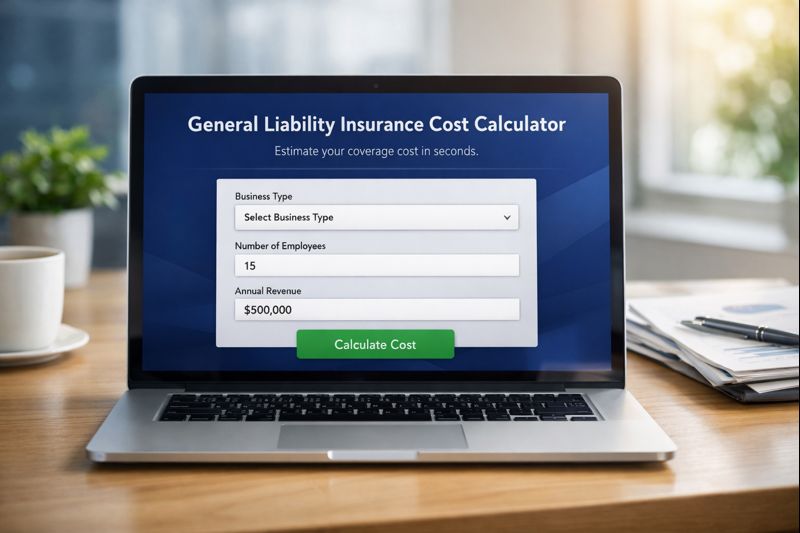
If you want a better answer than a generic “starting at” price, use a calculator that mirrors how underwriters actually think. General liability cost usually changes with your industry, where you work, how many people you have, the amount of public or jobsite exposure you face, and whether a landlord, client, or vendor is asking for higher limits, additional insured wording, or certificate-ready proof of coverage. A useful calculator does not promise your final premium. It gives you a realistic lane so you can compare quotes with the right expectations.
This 2026 page is built for that purpose. Instead of forcing every business into one price bucket, it helps you estimate a likely monthly and annual range, then points you toward the coverage path that usually fits your operations. If you are searching for general liability insurance near me, start by estimating your own risk profile first. A home-based consultant, a retail shop, a janitorial company, an event vendor, and a contractor should not be shopping from the same baseline.
Working calculator: estimate your general liability insurance cost
Use the estimator below to build a practical range. It is designed for fast comparison, not for binding coverage. Your final premium can still move during underwriting, but this tool helps you see the main cost drivers before you submit an application. Change the limit, industry risk, revenue size, and operating style, and the estimate will update instantly.
Quick facts: what this calculator is actually measuring
General liability is often the first commercial policy a small business reviews because it helps address common third-party claims such as bodily injury, property damage, and certain personal or advertising injury allegations. But cost is not built from one flat number. It is shaped by what your business does, how it interacts with the public, where work happens, and whether you are buying only general liability or stepping into a broader business package.
| Topic | What it usually means | Why it matters for cost |
|---|---|---|
| General liability | Core third-party liability protection for common accidents and allegations | Often the first policy quoted because contracts, landlords, and vendors ask for it |
| Industry class | The closest description of the work your business really performs | Usually the strongest premium driver because different classes carry different exposure |
| Limit selection | The coverage amount available for covered claims | Higher limits can increase cost, but may be required for contracts |
| Operating style | Remote, office-based, retail, mobile service, or jobsite-heavy work | Customer interaction and field exposure often change risk quickly |
| BOP choice | Whether you need only GL or a broader package with property value | A package estimate is larger because it prices more than liability alone |
How to use the calculator so the estimate is useful
Start with the closest industry fit, not the most flattering label. A cleaner application and a cleaner calculator input both come from accuracy. Then set the location style. If you work from home and never meet customers, your liability picture is different from a business that visits worksites, hosts customers in a storefront, or sends teams to events. After that, choose the limit path that matches your real world. Many small businesses begin around a $1 million general-liability lane, but some need lower or higher limits depending on the contracts they sign.
- Pick the real class: describe the work you actually do today.
- Choose where work happens: office, customer-facing premises, client locations, or jobsites.
- Set the right size inputs: revenue and headcount can affect how risk is viewed.
- Decide whether GL alone is enough: if you have equipment, furniture, inventory, or leased-space concerns, compare a BOP-style path too.
- Use the result as a lane, not a promise: final underwriting can still change pricing.
What moves the cost of general liability insurance most
Premium usually moves when the business class changes, when more work is done away from your primary premises, when the public interacts with the business more often, when limits increase, or when a claims history needs to be priced in. The calculator above mirrors that logic so you can change one input at a time and watch the estimate shift. That makes it easier to understand why two quotes for different businesses should not look the same.
| Factor | How it affects cost | Smart move before quoting |
|---|---|---|
| Industry risk | Usually the strongest rating driver because claim severity changes by class | Use the closest description of real operations |
| Location of work | Remote, premises-based, retail, mobile, and jobsite work are not priced the same | Separate office-only work from field activity clearly |
| Revenue and size | Larger businesses often create broader exposure and underwriting review | Use current numbers instead of rough guesses |
| Policy limits | Higher limits usually increase premium but may be necessary for contracts | Match your quote to landlord, vendor, or client requirements |
| Claims history | Prior loss activity can increase price or narrow carrier options | Be accurate and disclose known claims early |
| BOP packaging | Adding property value creates a broader premium than GL-only pricing | Compare both paths when equipment or leased space matters |
Limits, BOP value, and when standalone GL may not be enough
A lot of small businesses ask only one question: “What does a $1 million liability policy cost?” That is a good starting point, but it is still only part of the answer. If your business owns computers, tools, inventory, furniture, or relies on leased space, standalone general liability may leave out part of the real risk. In that case, a Business Owner’s Policy can become the better comparison because it layers property value into the insurance conversation instead of treating liability as the whole solution.
| Option | Often fits | Main trade-off | Best question to ask |
|---|---|---|---|
| GL-only lower-limit path | Very lean operations with modest contract needs | May not satisfy stronger vendor or landlord requirements | Is a lower limit enough for the way I do business? |
| $1M starting path | Many common small-business contract situations | Still may not cover property or business interruption needs | Is this enough for my contract and my actual exposure? |
| $2M stronger contract path | Businesses with larger or stricter contractual requirements | Premium usually increases as limits rise | Am I buying for compliance, risk protection, or both? |
| BOP-style package | Businesses with physical assets, leased space, or property exposure | Broader total premium because more than liability is being priced | Would packaging liability and property create better value? |
Industry fit: why one calculator must show different answers for different businesses
A low-risk consultant, a retail studio, a mobile cleaner, an event vendor, and a contractor can all shop for general liability, but they should not expect the same premium lane. That is exactly why the estimator above changes when you switch industry risk. The point is not to make the quote look bigger or smaller. The point is to stop false comparisons and help you shop from the right baseline.
| Business type | Typical pressure on cost | What often gets reviewed next |
|---|---|---|
| Consultant / office service | Often lighter when public interaction and field work are limited | Professional liability if advice or deliverables create financial-loss exposure |
| Retail / studio | Premises exposure and customer traffic usually matter more | BOP packaging for property, fixtures, and income-related concerns |
| Cleaning / light field service | Client-property exposure can move premium upward | Tools, hired/non-owned auto, and workers’ compensation review |
| Event vendor | Public-facing activity and venue requirements can push pricing and limits higher | Certificates, additional insured wording, and event requirements |
| Contractor / trade | Jobsite risk often creates the strongest pressure in this group | Commercial auto, inland marine, workers’ comp, and umbrella review |
Licensed service areas for general liability quote support
We help businesses compare general liability and small-business package options across our licensed footprint. If your operation is multi-state, split between office and field work, or growing into new contracts, include those details in your application so the quote reflects how the business actually operates.
| Region / states | Common request | Why it matters |
|---|---|---|
| Southwest AZ, NM, TX |
GL-only vs BOP comparisons for growing small businesses | Useful for mobile operations, leased offices, and contractor-style exposure |
| Southeast AL, FL, GA, NC, SC, VA, WV |
Certificate-ready quoting and contract-driven limit review | Helps match estimate assumptions to real vendor or landlord requirements |
| Midwest / Plains IA, KS, MI, NE, OH, SD |
BOP packaging and broader business-insurance comparisons | Important when property value and liability need to be evaluated together |
| Large-market states CA, NY, OK |
Higher-limit and broader package discussions | Good fit for businesses with stricter contract expectations or larger operations |
Get quote options after you run the calculator
Once the estimate looks close to your business profile, move to a real application. The fastest way to improve quote quality is to keep the business description specific. State whether you work remotely, on customer premises, in retail space, or on jobsites. Then match the limit path to the contracts you actually sign. Cleaner inputs usually lead to cleaner options.
Use the same assumptions from the calculator when you quote: class, work location, revenue, headcount, and limit need.
Related topics
General liability insurance cost calculator FAQs (2026)
Is this calculator my final premium?
No. It is a working estimate built to give you a realistic pricing lane before you apply. Final premium still depends on underwriting, class details, claims history, location factors, and the carrier you choose.
What usually changes the estimate the most?
Industry class is usually the strongest driver, followed by where the work happens, how much business you do, the liability limit you select, and whether you are pricing only general liability or a broader BOP-style package.
Should I quote GL only or a BOP too?
Quote both when your business has property value, leased space, equipment, inventory, or income-related exposure. GL alone is narrower. A BOP-style path can be the better comparison when the business is more than a desk and a laptop.
Why does customer traffic or field work affect cost?
Because more public interaction, client-premises work, or jobsite exposure can change the likelihood and severity of third-party claims. That is why the calculator asks where your work actually happens.
What if my contracts require specific wording or higher limits?
Use the estimate as a starting point, then quote with the actual contract requirement in mind. Limits, certificates, additional insured wording, and similar requirements can change which coverage path makes the most sense.
Independent agency: Blake Insurance Group LLC is an independent insurance agency and is not affiliated with any single insurance company.
Licensing: Licensed insurance producer (NPN 16944666).
Important: Calculator results are illustrative only. Actual premium, eligibility, forms, limits, exclusions, and underwriting decisions vary by carrier, state, business class, and application details.
No coverage is bound: Coverage is not in force until an application is completed, underwriting is approved, and the insurer confirms issued terms and effective date.
Trademarks: All product and company names are trademarks™ or registered® trademarks of their respective holders. Use of them does not imply affiliation or endorsement.




