Permanent coverage • Contract guarantees • Cash value
Whole Life Insurance: Lifetime Protection, Cash Value, and Policy Tradeoffs
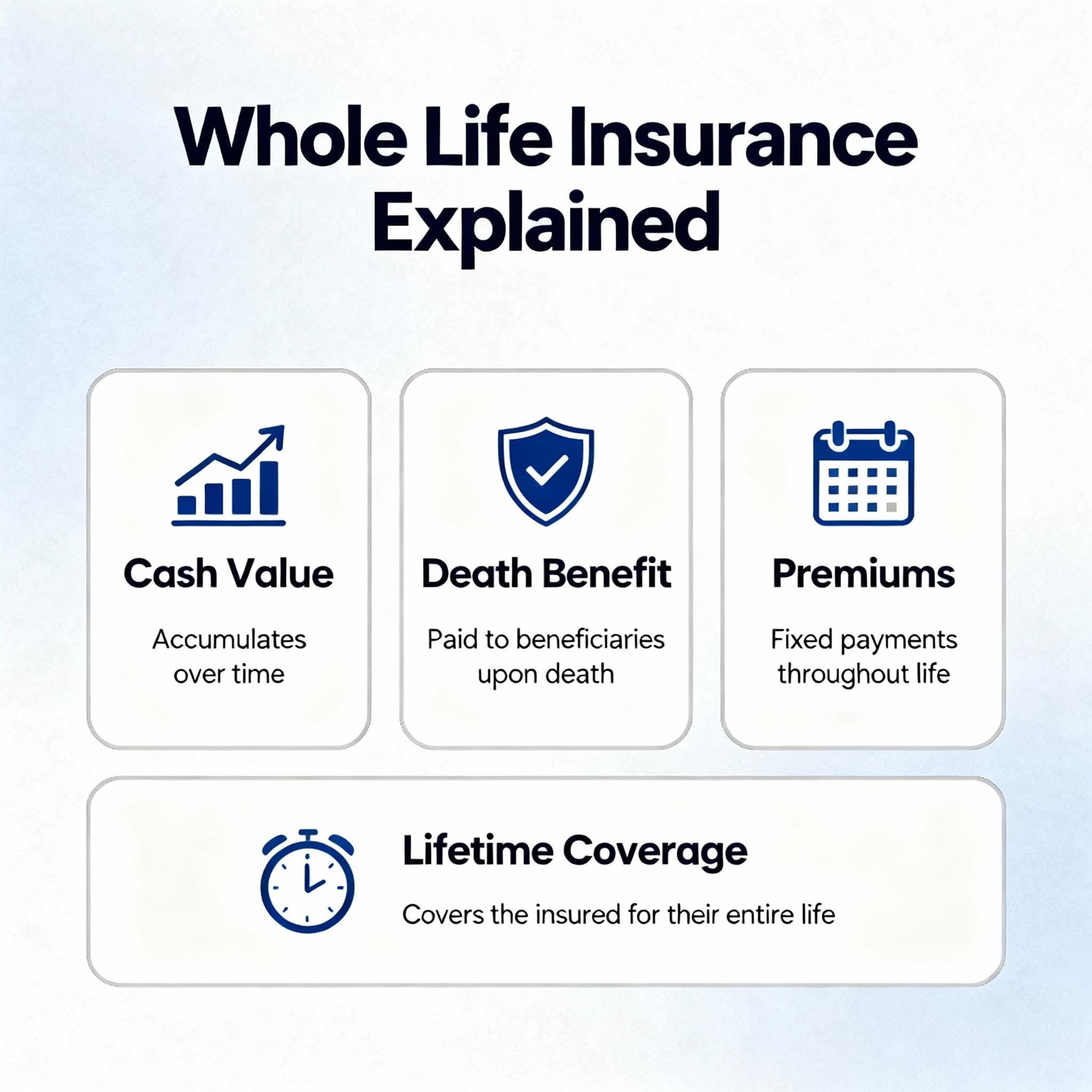
Whole life insurance is permanent life insurance that generally combines a death benefit, scheduled premiums, and cash values stated in the contract. It is designed to remain in force for life when required premiums are paid and other policy conditions are satisfied. The useful comparison begins with guaranteed values—not dividends, projections, or borrowing strategies.
If you searched for whole life insurance near me, focus first on the financial need that does not end: final expenses, support for a lifelong dependent, estate liquidity, a legacy, business planning, or another permanent obligation. Then compare the premium commitment with term and other permanent alternatives. Whole life can be durable and predictable, but it is not automatically the right policy for every household.
The quote button opens LifeLink, a separate third-party website. Submitting information is not an approval, binder, illustration, or guarantee of coverage.
How whole life insurance works
A whole life policy is a contract among the owner, the insured person, and the insurer. The owner controls policy rights, pays or arranges the premiums, chooses beneficiaries, and may use available cash-value features. The insured is the person whose death triggers a claim. The beneficiary receives the payable death benefit after the insured dies, subject to the policy, claim approval, assignments, and any outstanding policy debt.
Traditional whole life is built around a premium schedule and guaranteed policy values. If premiums are paid as required and no loan, withdrawal, rider change, or other action disrupts the contract, coverage is intended to continue for the insured’s life. Limited-payment versions may require larger premiums for a shorter stated period. Modified-premium or other designs can use a different schedule, so “level premium” should never be assumed without checking the contract.
Protection component
Death benefit
The death benefit is the amount used to evaluate the protection goal. It may help beneficiaries with final expenses, household support, debts, estate needs, a legacy, or business obligations. Loans, withdrawals, accelerated benefits, assignments, and unpaid amounts can reduce the proceeds ultimately payable.
Contract value
Guaranteed cash value
The policy lists guaranteed values by policy year, assuming stated premiums and no transactions that alter the schedule. Early guaranteed values may be substantially below cumulative premiums. Cash value is not an additional death benefit automatically paid on top of the face amount.
Optional experience
Participating dividends
A participating policy may receive a dividend when declared by the insurer. Dividends are not guaranteed in amount or timing. Depending on the contract, options may include cash, premium reduction, accumulation, loan-interest treatment, or purchasing paid-up additional insurance.
Long-term obligation
Premium commitment
Permanent coverage can require premiums for decades or under a limited-pay schedule. The best-designed policy is still unsuitable if its required outlay cannot be maintained. Compare the guaranteed premium schedule, optional additions, rider costs, and what happens after a missed payment.
Start with the guarantees. The contract’s guaranteed death benefit, guaranteed cash values, and required premium schedule form the policy’s foundation. Dividends and other illustrated nonguaranteed values may improve results, but they should not be needed to make an unaffordable design appear sustainable.
Participating and nonparticipating whole life
A participating whole life policy is eligible for dividends if the insurer declares them. A nonparticipating policy does not provide policyholder dividends and is evaluated primarily through its contractual guarantees. “Participating” is not a promise of superior performance, and a current dividend scale is not a guaranteed future rate. Compare the policy structures and guarantees before comparing projected dividends.
Lifetime-pay and limited-pay designs
A lifetime-pay design generally spreads scheduled premiums over a longer period. A limited-pay design aims to become contractually paid-up after a stated number of payments or at a stated age, usually requiring a higher scheduled premium during the pay period. Verify whether every planned payment is guaranteed, which riders continue after the base policy is paid-up, and whether optional paid-up additions are included in the quoted outlay.
Whole life versus term, universal life, and final-expense coverage
The first decision is whether the protection need is temporary, permanent, or a combination. Whole life is one permanent design, not a universal solution. A household needing a large benefit during working and child-raising years may reach a different answer from someone planning for a lifelong dependent or final expenses.
How whole life compares with other coverage approaches
Approach
Coverage design
Cash-value structure
Primary issue to verify
Whole life
Permanent protection with scheduled premiums and contract guarantees
Guaranteed cash-value schedule; participating dividends may add nonguaranteed value
Can the guaranteed premium commitment be maintained for the required pay period?
Level term life
Protection for a stated period, often with an initial level-premium interval
Generally no cash value
When does the level period end, what are renewal rates, and is conversion available?
Universal life
Permanent design with flexible elements that vary by product
Values can depend on charges, credited interest, funding, guarantees, loans, and withdrawals
Which elements are guaranteed, and what funding keeps the policy in force under less favorable assumptions?
Final-expense whole life
Usually a smaller permanent policy marketed for end-of-life obligations
May include guaranteed cash values; underwriting can be simplified, graded, or guaranteed issue
Is the death benefit immediate or graded, and is a healthier applicant eligible for another option?
Layered term and whole life
A permanent base plus temporary coverage during higher-responsibility years
Cash value is limited to the permanent layer
Do the benefit amounts and end dates match the household’s separate permanent and temporary needs?
When whole life may deserve consideration
Whole life may be a starting point when the need is expected to last throughout life and the owner values contractual predictability. Examples can include a defined final-expense amount, a legacy target, support for a lifelong dependent, liquidity connected to an estate plan, charitable planning, or a properly structured business obligation. Legal, tax, estate, and business planning should be coordinated with qualified professionals.
When term insurance may be the stronger starting point
Term life may be more suitable when the need has a clear end date or when the priority is obtaining a larger initial death benefit within a limited budget. Common temporary needs include income replacement during working years, a mortgage, dependent children, education funding, and time-limited business debt. Term can expire or become more expensive to renew, so duration and conversion rights matter.
Why a layered plan can be practical
A household can use term for a large temporary need and whole life for a smaller permanent need. This can prevent the premium for permanent coverage from crowding out the amount of death benefit the family needs today. The tradeoff is administration: multiple premiums, beneficiary records, policy dates, and coverage purposes must remain organized.
Use the dedicated term versus whole life insurance comparison to evaluate those timelines side by side before selecting a permanent policy based only on cash-value features.
Cash value, dividends, loans, and withdrawals
Cash value is an internal policy value controlled by the contract. It is not a bank deposit, brokerage account, or freely available balance with no consequences. The amount shown in a year-end statement may differ from the net amount available after surrender because policy debt, interest, charges, and timing can affect the calculation.
Guaranteed value versus illustrated value
The guaranteed column shows the minimum contract values under the illustration’s stated assumptions, including required premiums and no unshown transactions. A nonguaranteed column may assume dividends or other current elements. Those projections can change. If a proposal uses nonguaranteed dividends to reduce future out-of-pocket premiums, ask what happens when dividends are lower or not declared.
Paid-up additions
When available, a paid-up-additions option uses a dividend or additional premium to purchase small amounts of fully paid-up life insurance. Paid-up additions can increase cash value and death benefit, but the option’s limits, fees, underwriting rules, flexibility, and effect on the policy vary. Separate the guaranteed base premium from optional additional funding when testing affordability.
Policy loans
A policy loan is made under the contract using policy value as security. It accrues interest, and the policy remains affected even when repayment is not scheduled like a bank loan. Unpaid principal and interest can reduce available cash value and death proceeds. If debt grows too large, the policy can lapse or require additional payments, potentially producing a tax consequence. Request an in-force illustration before and after a material loan.
Withdrawals and partial surrenders
Some policies permit a partial surrender or withdrawal. It may permanently reduce cash value, the death benefit, or both. Contract charges and tax rules can apply. Whole life access rules differ by contract and may be less flexible than those in some universal-life policies, so confirm the exact provision instead of assuming access works the same across permanent policies.
Full surrender and nonforfeiture choices
Surrender terminates coverage and pays the net cash surrender value, if any, after applicable policy debt and adjustments. The net amount can be less than premiums paid, especially in early years. Depending on the contract, nonforfeiture options may include reduced paid-up insurance or extended-term coverage. Each option changes the benefit, duration, or future value and may be difficult to reverse.
Before accessing value: request a current statement or in-force illustration showing the transaction, loan interest, future premiums, guaranteed and nonguaranteed values, death benefit, and lapse risk. Consult a qualified tax professional when distributions, loans, surrender, ownership changes, or a modified endowment contract may be involved.
How to read a whole life illustration
An illustration is a structured explanation of how a proposed policy may operate under specified assumptions. It is not the contract, a forecast, or a promise that nonguaranteed values will occur. Read the narrative pages, numeric summary, ledger, definitions, and required signatures together.
Whole life illustration review checklist
Item
What to identify
Question to ask
Guaranteed premium
Required amount, frequency, and number of payments
Can the base policy remain in force using only the guaranteed payment schedule?
Guaranteed death benefit
Benefit by policy year, including maturity provisions
Do loans, withdrawals, or rider changes alter the guaranteed amount?
Guaranteed cash value
Value by year before policy debt
When does the guaranteed cash value become meaningful relative to cumulative outlay?
Nonguaranteed values
Dividend assumptions, dividend option, and projected additions
What happens if future dividends are lower than illustrated?
Premium outlay
Base premium, rider cost, and optional paid-up-additions amount
Which payments are required, optional, or assumed to be offset by dividends?
Liquidity
Cash surrender value, loan provisions, and early-year values
What net amount would be available after a surrender or loan at the years that matter?
Compare policies on the same baseline
Use the same insured, final underwriting class, face amount, premium frequency, pay period, rider package, and optional funding assumptions. A design with a lower base death benefit and a large paid-up-additions contribution should not be compared casually with a different policy using the same total outlay. Identify what each dollar is purchasing.
Stress-test nonguaranteed assumptions
Ask for lower-dividend or reduced-nonguaranteed scenarios when permitted. If the design assumes dividends will pay premiums, repay loans, or maintain a target benefit, review what the owner must do when results are lower. A whole life policy should be selected for its protection and contract structure, not marketed as a guaranteed investment return.
Read riders separately
A waiver-of-premium rider, accelerated death-benefit rider, guaranteed-insurability rider, term rider, child rider, or long-term-care rider has its own definitions, cost, limitations, waiting periods, and effect on benefits. An accelerated benefit typically reduces the amount left for beneficiaries. A waiver rider generally waives eligible premiums after a qualifying disability; it does not provide monthly disability income.
Choose an amount, compare cost, and prepare to apply
The appropriate amount begins with the permanent need rather than the largest amount an illustration can support. Estimate final expenses, legacy goals, lifelong caregiving, estate liquidity, business obligations, or other needs expected to remain. Subtract assets and existing insurance specifically dedicated to those purposes. If the family also needs substantial temporary income replacement, calculate that layer separately.
Premiums may reflect age, health, nicotine use, prescription history, build, family history, occupation, driving history, activities, coverage amount, payment period, riders, state, and underwriting method. Shorter limited-payment periods generally concentrate the premium into fewer years, but product designs vary. A quote is only a preliminary estimate until underwriting and policy issue are complete.
Define the permanent need. Write down the lifelong obligation, beneficiary, target amount, and why term insurance alone would not address it.
Protect the current household first. Confirm that the premium allocated to whole life does not force the family to buy too little total death benefit for income, debt, dependent, or mortgage needs.
Set a sustainable premium ceiling. Test the required outlay against income changes, retirement, emergencies, and other long-term commitments. Separate required premium from optional additional funding.
Request matched illustrations. Compare the same face amount, underwriting assumption, pay period, riders, dividend option, and paid-up-additions funding. Label guaranteed and nonguaranteed results.
Prepare accurate application details. Gather identification, beneficiary information, health history, physicians, medications, nicotine use, occupation, finances, existing coverage, and replacement information requested by the insurer.
Complete underwriting. The process may use traditional, accelerated, or simplified underwriting. An exam-free application still involves eligibility review and is not guaranteed acceptance.
Review the issued offer and contract. Confirm the owner, insured, beneficiaries, premium schedule, death benefit, cash values, riders, exclusions, loan provisions, surrender terms, and effective-date requirements.
Store and review the policy. Keep carrier contact information with trusted records, monitor annual statements and loans, and update beneficiaries after major family, financial, or business changes.
Replacement warning: do not cancel an existing policy until the new coverage has been issued, delivered, reviewed, accepted, and confirmed in force. A replacement can restart surrender charges, contestability provisions, suicide exclusions, and acquisition costs, and health changes can affect the new offer.
Common whole life mistakes to avoid
Buying primarily for a projected return instead of a defined death-benefit need.
Treating dividends, paid-up additions, or a future premium offset as guaranteed.
Confusing gross cash value with the net cash surrender value available after debt and adjustments.
Borrowing without monitoring interest, future premiums, death-benefit reductions, and lapse risk.
Selecting a permanent premium that leaves the household underinsured during its highest-responsibility years.
Adding riders without comparing their definitions, cost, benefit reductions, and overlap with other coverage.
Ignoring ownership and beneficiary consequences involving minors, trusts, estates, businesses, or special-needs planning.
Replacing existing coverage before the new policy is effective and fully reviewed.
Continue your life insurance research
Use these related guides to separate permanent needs from temporary protection and understand the underwriting and funding choices around whole life.
Begin with the permanent need, a sustainable premium range, and the beneficiary the policy should protect. The quote experience opens on LifeLink, where available products and application steps can be reviewed.
LifeLink is a separate third-party website. Its pathway may not include every insurer, product, or underwriting option. A quote is not a binder, policy, illustration, or guarantee. Coverage is not effective unless and until the insurer approves and issues the policy and all applicable delivery and premium requirements are satisfied.
Whole life insurance FAQ
Is whole life insurance guaranteed for life?
Whole life is designed as permanent coverage. Guarantees depend on paying required premiums and following the contract. Loans, withdrawals, assignments, missed payments, rider changes, or other transactions can reduce values, change benefits, or contribute to lapse.
Does the beneficiary receive the death benefit and cash value?
Usually, the insurer pays the policy’s applicable death benefit, reduced by outstanding loans, interest, withdrawals, accelerated benefits, or other amounts. Cash value generally supports the policy rather than being added separately to the death benefit. Some specialized designs operate differently, so check the contract.
Are whole life insurance dividends guaranteed?
No. Participating policies may receive dividends if the insurer declares them, but future dividends and dividend scales are not guaranteed. Evaluate the policy’s guaranteed values first and verify the selected dividend option.
Can I borrow from a whole life policy?
Many whole life policies permit loans when sufficient value is available. Loans accrue interest and can reduce cash value and death proceeds. Growing debt can require additional funding, cause lapse, or create a tax consequence. Review an in-force illustration before borrowing.
What happens if I surrender the policy?
Coverage ends, and the owner receives any net cash surrender value after policy debt and applicable adjustments. The amount may be less than total premiums, particularly in early years. Surrender can have tax consequences, so request current figures and qualified advice first.
Is whole life better than term life?
Neither is universally better. Whole life addresses permanent needs with contract guarantees and cash value. Term addresses needs with an end date and generally provides more initial death benefit per premium dollar. Some households use both for different timelines.
Can I buy whole life insurance without an exam?
Some products use accelerated or simplified underwriting without a routine exam, while guaranteed-issue products may avoid health questions. Amounts, issue ages, premiums, graded benefits, data checks, and eligibility vary. No exam does not mean no underwriting unless the product specifically uses guaranteed issue.
When does a new whole life policy become effective?
Do not assume coverage begins with a quote or application. Effectiveness depends on insurer approval, issue and delivery rules, signatures, premium payment, and any conditions in the application, receipt, or policy. Request written confirmation before relying on coverage.