Licensed Insurance Agents Compare Trusted Insurance Companies Secure & Private Online Quotes No Spam We Never Sell Your Personal Information
Talk to a licensed agent
888-387-3687
Fast Quotes • Coverage Reviews • Independent Advice
Blake Insurance Group
Modern Independent Insurance Agency
Compare coverage from trusted insurance companies with licensed agents who work for you—not a single carrier.
Skip to the modern collector car insurance guide
Newer vehicles can be collectible • Use and condition affect eligibility • Final coverage is determined by the issued policy
Request a Collector Car Quote

Specialty coverage guidance for newer enthusiast, limited-production, and special-interest vehicles

Modern Collector Car Insurance

Modern performance car maintained for collector use

Modern collector car insurance is specialty auto coverage for a qualifying newer vehicle kept primarily for collecting, pleasure driving, exhibitions, or enthusiast use rather than routine transportation. A vehicle from the 1980s, 1990s, 2000s, or a more recent model year may be considered when its rarity, specification, condition, value, cultural significance, or special interest separates it from an ordinary daily-use car.

There is no universal age, production number, price, or appreciation test that makes a newer car collectible for every insurer. Eligibility depends on the specific vehicle and program, plus how it is stored and driven, who operates it, its condition, modifications, value evidence, and whether the household has other regular transportation.

Submitting the form requests a quote review and does not bind insurance. Availability, eligibility, valuation, premium, coverage, terms, and effective dates vary by insurer and state.

Modern Collector Car Insurance: Quick Facts

A modern collector vehicle may look familiar to people who remember seeing it new, yet its insurance needs can already differ from those of an ordinary used car. Low production, a desirable drivetrain, special factory package, documented provenance, exceptional condition, or enthusiast demand can make generic replacement data incomplete. At the same time, a newer car is often comfortable enough to use every day, which makes accurate use disclosure especially important.

Issues to resolve before selecting coverage
IssueWhy it mattersWhat to verify
CollectibilityA newer age, high purchase price, or enthusiast label alone does not establish specialty eligibility.Whether the exact year, make, model, trim, edition, specification, condition, and use fit the insurer’s program.
Primary useModern performance and luxury cars can be practical daily drivers even when owners also collect them.Rules for commuting, errands, mileage, trips, events, backup transportation, business use, and household vehicles.
Accepted valueOrdinary used-car data may miss rarity, condition, options, provenance, and collector demand.The valuation method, accepted amount, evidence, deductible, total-loss provision, and update process.
Complex repairsSpecial materials, electronics, calibration, limited components, and trained facilities can affect repair decisions.Repair-shop choice, labor, parts, diagnostic work, calibration, transport, and limits or exclusions.
ModificationsTuning, wheels, suspension, forced induction, wraps, exhaust, aero, or track equipment can change eligibility and value.Which changes must be disclosed and how accepted custom equipment is described and valued.
Market changeEnthusiast demand can move differently from general depreciation and can also fall.How often to review value and when a revised amount becomes effective.

“Future classic” is an opinion, not a coverage form. Insurance should be based on the vehicle that exists, its supported current value, and its actual use—not a prediction that it will appreciate.

What Can Make a Newer Vehicle Collectible?

Insurers do not use one market-wide definition. A modern vehicle may receive specialty consideration because the exact configuration has recognized collector interest and the owner follows a collector pattern of use and care. Provide specific facts rather than relying on words such as rare, iconic, investment-grade, or special.

Limited-production models

A production cap, short model run, numbered series, or limited regional allocation can support collectibility. Document the exact edition, production or serial number when applicable, factory certificate, original window sticker, build sheet, and matching identifying features. A marketing label containing “limited” does not by itself prove scarcity.

High-performance variants

A special engine, transmission, drivetrain, chassis, braking system, aerodynamic package, or factory motorsport connection may distinguish a trim from the volume model. Provide the VIN, option codes, factory specifications, current condition, and any modifications. Performance can also affect driver and program eligibility.

Historically or culturally significant cars

Some vehicles develop interest because they represent a technological shift, design era, motorsport story, influential subculture, or important end or beginning of a model line. Support significance with documentation relevant to the exact car rather than general enthusiasm for the model.

Special-interest imports

A vehicle not commonly distributed in the United States may have unusual title, VIN, parts, repair, emissions, and compliance considerations. Provide import documents, title and registration, federal or state paperwork where applicable, specifications, photographs, and parts or service information.

Exceptional original examples

Low mileage can matter, but condition, originality, maintenance, storage, documentation, and market demand also count. Explain any replaced paint, tires, batteries, fluids, wear items, accident repair, paint protection, or preservation work rather than presenting odometer mileage as the only evidence.

Documented modified builds

A respected restomod, tuner build, custom, or performance project may be collectible to a specialized market. Full disclosure is essential. Provide the builder, parts, specifications, invoices, photographs, output information, safety systems, intended use, and a defensible value.

What does not automatically prove eligibility?

A high purchase price, low mileage, sports-car body, premium badge, dealer markup, discontinued model, online popularity, or owner attachment does not make every vehicle suitable for collector insurance. Nor does a prior specialty policy guarantee continued acceptance. Insurers can revise programs, and a vehicle’s use or condition can change.

Condition and preservation still matter

Underwriters may request current images of every side, the cabin, dashboard, engine compartment, wheels, tires, VIN, storage, and any damage or modification. A vehicle driven hard, neglected, heavily damaged, used as a regular backup, or undergoing extensive construction may require different treatment from an excellent collector example.

Age-based labels vary

Terms such as modern classic, emerging collectible, future classic, neo-classic, youngtimer, and special-interest vehicle are used differently. State historic-registration rules can use definitions unrelated to insurance. Describe the exact vehicle and let the insurer determine classification under its current guidelines.

Modern Collector Insurance Versus Standard Auto Insurance

The right choice begins with actual use. Standard personal auto insurance is generally built for routine transportation. Collector coverage is generally designed around a special-interest vehicle with limited or nonprimary use, supported value, careful storage, and a qualified driver profile. Neither category is automatically broader in every respect; the contract must fit the risk.

Practical differences to discuss with a licensed agent
QuestionCollector-policy considerationStandard-policy consideration
How is the car used?Often intended for pleasure, shows, club activities, exhibitions, tours, or other limited collector use.Generally designed to accommodate commuting, errands, and routine personal transportation, subject to policy terms.
Is another car available?Some programs expect or require regular transportation for licensed household drivers.The insured car may be the household’s primary or only vehicle, depending on underwriting.
How is physical damage valued?May offer an agreed or scheduled approach suited to an individually evaluated collector vehicle.Commonly uses actual cash value or another form-specific settlement approach after a total loss.
What storage is expected?Secure or protected storage may be required or considered, with rules varying by location and program.Broader everyday parking patterns may be expected, though location and garaging still affect underwriting.
How are repairs handled?May address specialty shops, limited components, restoration knowledge, and collector-focused towing.Repair provisions are designed for mainstream claims but still depend on state law and the policy.
What uses may be restricted?Commuting, business use, rideshare, delivery, racing, timed events, track use, or high annual mileage may be restricted or excluded.Some routine uses may be permitted, but business, delivery, rideshare, racing, or track restrictions can still apply.

Modern usability creates a disclosure trap

Air conditioning, reliability, safety features, navigation, and comfortable highway performance can make a modern collectible easy to use frequently. Do not describe it as show-only when it also handles work trips, school runs, shopping, airport parking, or routine backup duty. Mileage and purpose both matter.

Event and tour use should be specific

Tell the agent about local shows, club meetings, road rallies, multi-day tours, concours events, exhibitions, photography, storage away from home, and long-distance trips. A road tour is different from a timed competition. An event parking area is different from operation on a racecourse. Ask for clear answers before participating.

Track capability does not create track coverage

Many modern performance vehicles are marketed with track capability, special driving modes, data recorders, roll structures, or competition packages. Road or collector insurance can restrict or exclude racing, speed contests, driver education, timed events, practice, or use on a racing surface. Disclose every planned activity and obtain appropriate coverage guidance before entering the facility.

Review the broader classic car insurance versus regular auto insurance guide for additional policy-selection questions.

Valuing a Modern Collector Car

Modern vehicles can be deceptively difficult to value. Automated sources may group a rare manual-transmission, special-color, factory-package car with ordinary examples. Auction results may reflect exceptional provenance or buyer fees. Dealer asking prices may remain unsold. A strong submission uses several forms of evidence and explains the exact specification.

Prove the configuration

Gather the VIN, original window sticker, build sheet, option codes, factory certificate, production number, manuals, service records, ownership history, and documentation for special equipment or provenance.

Show present condition

Provide current high-resolution photographs of all sides, interior, engine bay, trunk, wheels, tires, VIN, mileage display, underbody when practical, storage, and every imperfection or modification.

Explain the market

Use relevant completed sales, an appraisal when appropriate, purchase records, maintenance history, and other evidence. Adjust for trim, transmission, options, color, mileage, condition, originality, history, and venue.

Purchase price is useful but not conclusive

A recent arm’s-length sale can be important evidence, yet taxes, dealer fees, financing, trade allowances, scarcity premiums, and rapidly changing demand can complicate the number. A past purchase price may become stale. The insurer must accept the requested value under its rules.

Agreed value requires an accurate vehicle description

An agreed amount can make the total-loss basis more predictable when the insurer and insured accept a value, but it does not convert an excluded event into a covered loss. Deductibles, misrepresentation, fraud, salvage, lienholder, policy conditions, and duties after loss can still affect payment. Read the full comparison of agreed value versus stated value insurance.

Do not insure expected appreciation as if it already exists

Collector markets rise and fall. Social-media attention, an anniversary, a movie appearance, a famous sale, or the end of production can influence interest without establishing the value of every example. Ask for a supported current amount and review it periodically. If the market or vehicle changes materially, request an update and confirm when it takes effect.

Modifications can add cost without equal market value

Wheels, exhaust, tuning, suspension, forced induction, aero components, wraps, audio systems, paint protection, and custom interiors can be expensive. Cost does not automatically translate dollar for dollar into collector value. Some changes may reduce originality or narrow the buyer market. Provide receipts and photographs, but let the appraisal and underwriting process evaluate the whole car.

Keep factory parts in the conversation. Removed wheels, exhaust components, seats, body panels, electronics, or other original parts may have value, but uninstalled property is not necessarily covered as part of the automobile. Ask whether spare-parts coverage applies and at which locations.

Coverage and Claim Questions for Newer Collectibles

Modern collector car insurance still uses familiar auto coverage concepts. Liability addresses covered claims for bodily injury or property damage caused by an insured, subject to limits and terms. Collision generally addresses covered impact or rollover damage to the insured vehicle. Comprehensive generally addresses covered non-collision causes such as theft, fire, vandalism, weather, glass breakage, or animal contact. Available coverages and state requirements vary.

Policy details that can matter after a loss
IssueQuestion to askWhy it matters
Repair facilityCan an appropriate marque specialist, certified facility, composite technician, or specialty body shop complete covered repairs?Training, tools, structural methods, and calibration capability can differ significantly among shops.
PartsHow are original-equipment, aftermarket, recycled, remanufactured, limited-production, and unavailable parts handled?Correct trim or electronic modules may be scarce, discontinued, coded, or tied to the vehicle.
MaterialsHow are aluminum, carbon fiber, composites, adhesives, ceramic brakes, and specialized finishes addressed?Material-specific procedures can affect repairability, labor, and total-loss decisions.
Electronics and calibrationDoes the repair process address diagnostics, sensor calibration, cameras, radar, coding, keys, and control modules?A vehicle can look repaired while safety, driver-assistance, security, or performance systems still need work.
Diminished valueDoes the policy provide any first-party diminished-value coverage, and what does state law allow?A documented accident may affect collector-market perception even after proper repair, but coverage is not automatic.
Towing and transportDoes assistance accommodate clearance, wheel drive, battery state, immobilization, value, and enclosed or flatbed needs?Incorrect loading or transport can create additional damage.
Total loss and salvageHow is a total loss determined, who retains salvage, and can the owner buy back the vehicle?Rare parts and provenance may make salvage important, but rights depend on policy and law.

Mechanical and electronic failure are not automatically insured

Auto physical damage insurance is not a warranty or service contract. Wear, defect, deterioration, software malfunction, battery degradation, overheating, tuning problems, faulty workmanship, and mechanical or electrical breakdown may be excluded. If a failure causes additional damage, report the facts promptly and allow the insurer to evaluate the cause and resulting loss under the policy.

Electric and hybrid collector vehicles

A modern collector may use a high-voltage battery, electric drive unit, hybrid system, specialized cooling, software, or charging equipment. Identify the exact configuration and modifications. Ask about repair facilities, diagnostics, towing, battery-related loss, charging equipment, spare parts, and whether a home or business policy should address installed charging property. Do not assume battery degradation or capacity loss is covered physical damage.

Cyber, data, and subscription features

Connected services, stored personal data, downloadable functions, subscriptions, and mobile-app access create concerns beyond ordinary vehicle parts. Ask what the auto policy treats as insured property and what remains a service, license, account, or data issue. Before sale, repair, or salvage transfer, follow manufacturer guidance for removing personal data and account access.

Liability limits deserve equal attention

A precise vehicle value does not replace adequate liability planning. Review bodily injury and property damage limits, uninsured and underinsured motorist options, state-specific medical coverages, deductibles, permitted drivers, territorial limits, and any umbrella-policy requirements with a licensed agent.

How to Prepare for a Modern Collector Car Quote

A complete application gives the agent a better basis for determining whether specialty coverage fits. Use consistent, accurate information when comparing options; a quote based on a different use, value, driver, or configuration is not an equivalent comparison.

Identify the exact vehicleGather the VIN, title, registration, year, make, model, trim, edition, production number, body, engine, transmission, drivetrain, mileage, purchase date, and lienholder.
Document collectibilityOrganize the window sticker, build sheet, option codes, factory certificate, production information, provenance, awards, ownership history, and evidence explaining why the exact specification has collector interest.
Photograph present conditionCapture every side, cabin, dashboard, engine bay, trunk, wheels, tires, VIN, odometer, special equipment, storage, modifications, and existing flaws in clear current images.
Disclose modificationsList tuning, engine, intake, exhaust, forced induction, drivetrain, suspension, brakes, wheels, tires, aero, wrap, paint, interior, electronics, security, safety, and track-oriented equipment.
Support the requested valueCombine purchase records, relevant completed sales, appraisal information, receipts, condition, mileage, specification, and provenance. Explain differences from ordinary examples.
Describe actual useEstimate annual mileage and disclose pleasure drives, shows, tours, commuting, errands, backup use, business activity, long trips, driver education, autocross, racing, and any track operation.
List drivers and storageProvide household drivers, regular vehicles, driving history, overnight address, garage or parking arrangement, security, secondary locations, and anyone who services or road-tests the car.
Compare contract termsReview valuation, deductibles, limits, repair provisions, parts, calibration, towing, spare parts, use, mileage, drivers, storage, exclusions, salvage, and duties to report changes.

A quote or application is not proof of coverage. Do not cancel existing insurance or assume the vehicle, value, use, modification, or event is covered until you receive and review the issued terms and effective date.
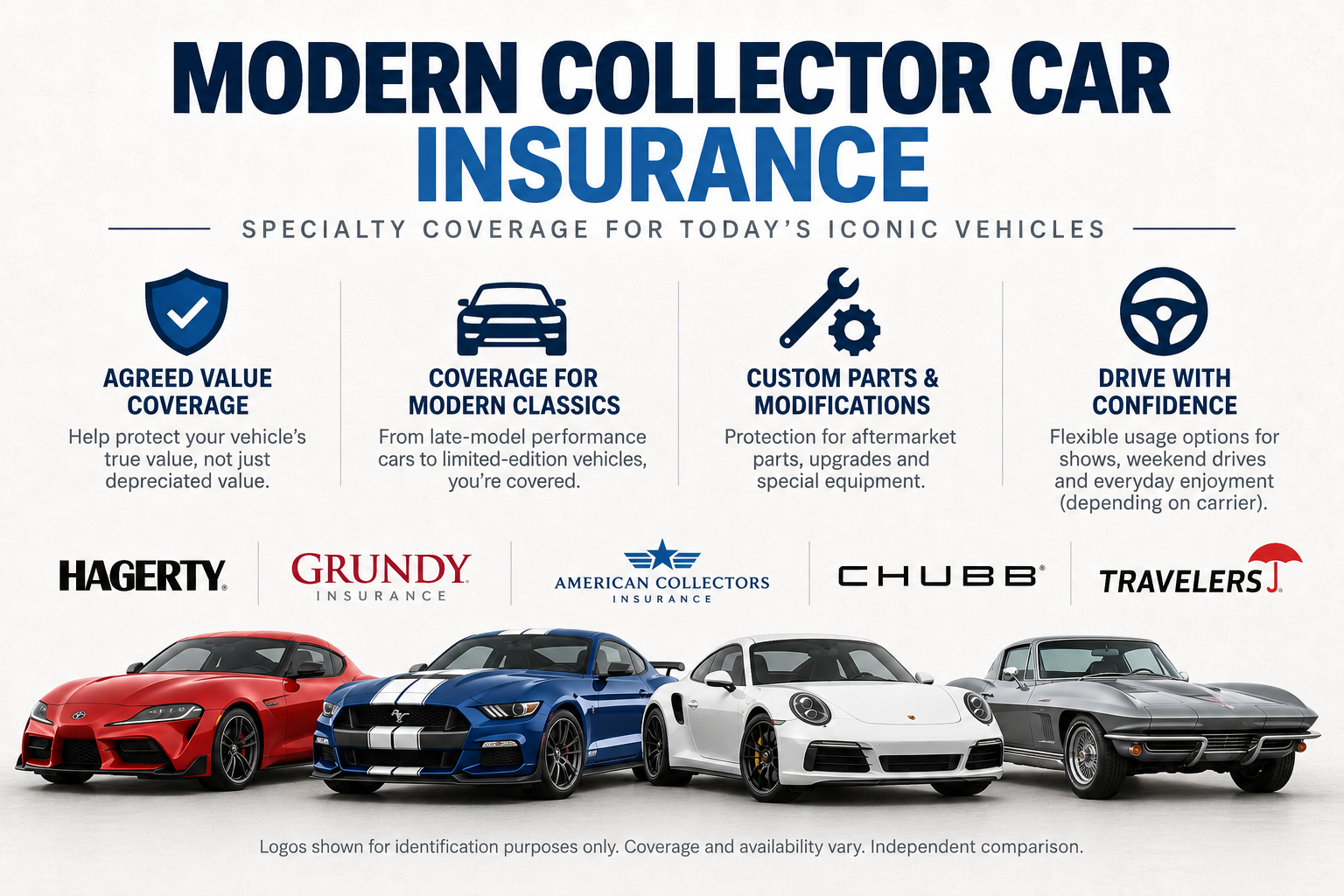

Modern Collector Car Insurance FAQs

How old does a modern collector car need to be?

There is no universal minimum age. Some specialty programs consider vehicles from the 1980s and newer, including more recent models, when the exact car and collector-use pattern meet current guidelines. Age is only one factor among specification, interest, condition, value, use, storage, and drivers.

What is the difference between a modern classic and a future classic?

Both are informal market labels rather than standardized coverage forms. “Modern classic” often describes a newer vehicle with established special interest, while “future classic” can express an expectation about later demand. Insurance eligibility and value must be based on present facts, not a prediction.

Can I commute in a modern collector car?

Collector programs often restrict regular commuting or primary transportation. Do not assume occasional commuting is allowed. Describe frequency, destinations, mileage, and access to other vehicles, then obtain a policy-specific answer.

Does low mileage automatically make my car collectible?

No. Low mileage can support condition or rarity, but the insurer may also consider the model, trim, value, collectibility, use, storage, documentation, driver profile, and overall condition. A low-mileage ordinary vehicle may still fit standard insurance.

Can a modified modern car qualify?

Possibly. Eligibility depends on the modifications, workmanship, performance, value, driver experience, use, and program. Fully disclose tuning and all mechanical, suspension, brake, wheel, body, interior, electronic, and track-related changes.

Will an appraisal guarantee the total-loss payment?

No. An appraisal supports an opinion of value but does not amend or override the policy unless the contract says so. The insurer must accept the vehicle and amount, and the loss must be covered subject to deductibles, limits, exclusions, and conditions.

Does modern collector insurance cover track days?

Do not assume it does. Road and collector policies can restrict or exclude racing, timed events, instruction, practice, autocross, or use on a racing surface. Disclose the activity and arrange appropriate coverage before entering the event.

Are original parts stored in my garage covered?

Not necessarily. Removed wheels, exhaust, seats, body panels, electronics, and other parts may not be part of the insured automobile. Ask about spare-parts coverage, covered locations, causes of loss, deductibles, and limits.

What if the car becomes my daily driver?

Contact the agent before or as soon as the use changes. Daily commuting, routine errands, or primary transportation can fall outside collector-program rules. The vehicle may need standard personal auto coverage or another arrangement.

Related collector vehicle guides

Request a Quote for Your Modern Collector Car

Share the exact specification, condition, collector history, value evidence, modifications, storage, drivers, and actual use so a licensed agent can review available options.

Reviewed by Blake Nwosu
Owner and Principal Agent, Blake Insurance Group
National Producer Number (NPN): 16944666 • Read Blake Nwosu’s bio

Insurance disclosure: This page provides general educational information and is not legal advice, a binder, a policy, or a guarantee of eligibility, coverage, price, appreciation, claim payment, or availability. Product definitions, underwriting rules, valuation provisions, exclusions, limits, deductibles, forms, and state availability vary by insurer. Coverage is subject to the application, underwriting approval, payment, effective date, declarations, endorsements, exclusions, and complete issued policy. If this page conflicts with a policy, the policy controls.

Blake Insurance Group is an independent insurance agency. References to vehicle categories or market practices do not imply that any particular insurer will accept a risk or that the agency represents every insurer offering specialty coverage. Request licensed, state-specific advice for your vehicle and circumstances.

Blake Insurance Group
Call: (888) 387-3687 Email: info@blakeinsurancegroup.com Mon–Fri 9:00–5:00
Blake Nwosu, Owner and Principal Agent
Blake Nwosu Owner & Principal Agent

Expert in personal and commercial insurance, including auto, home, business, health, and life insurance.

License: 16117464

Bio: blakeinsurancegroup.com/blake-nwosu/

★★★★★ Google reviews Loading…
Share: Facebook icon X (Twitter) icon LinkedIn icon Email icon



