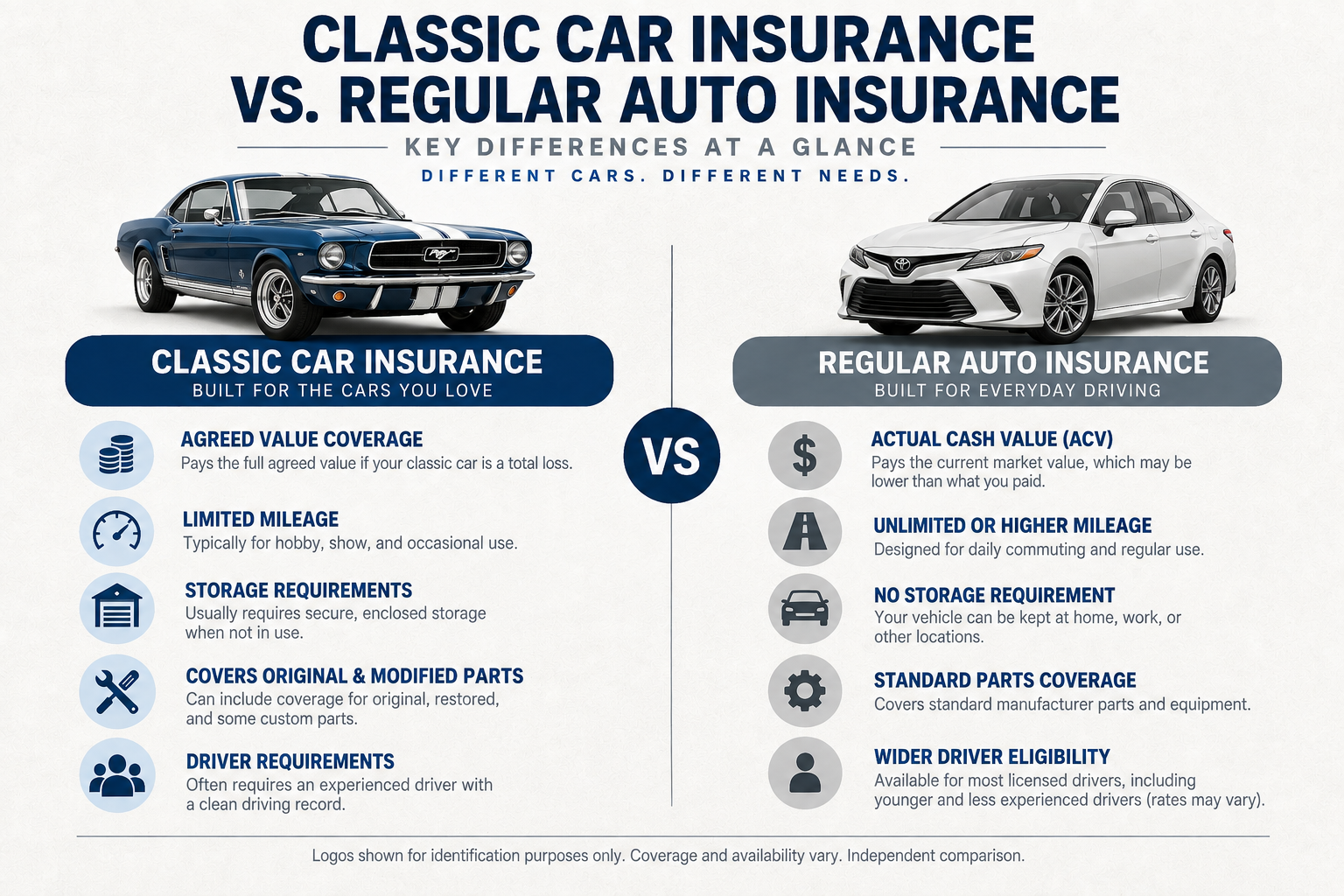
Agreed Value vs. Actual Cash Value
Valuation is often the strongest reason to explore collector coverage. A common vehicle has many comparable sales and typically depreciates through ordinary use. A rare or restored car may have limited comparable data, appreciate, or derive value from provenance, originality, workmanship, and hard-to-find components.
How collector policies often approach value
Many specialty policies use an agreed value approach. The applicant requests an amount, supplies evidence when required, and the insurer approves or revises that figure. For a covered total loss, settlement is generally based on the accepted amount without applying depreciation to that agreed figure, subject to deductible, salvage, exclusions, taxes, fees, fraud, title, lienholder, and other policy provisions.
“Agreed value,” “stated value,” and branded valuation terms should not be treated as interchangeable. A stated amount may be only a maximum while another calculation can produce a lower payment. Read the loss-settlement clause and endorsement, not merely the number shown on the declarations.
How regular policies commonly approach value
A standard policy commonly settles a totaled vehicle at actual cash value, calculated at the time of loss under the policy and applicable law. The insurer may consider year, make, model, mileage, equipment, condition, prior damage, local comparable vehicles, and market information. A valuation guide or online estimate can be evidence without being conclusive.
Actual cash value may work predictably for an ordinary vehicle with many close comparables. It may produce disagreement when a restored or modified vehicle is compared with superficially similar cars that do not share its condition, documentation, equipment, or history.
Questions to ask about total-loss valuation| Question | Why it matters | Evidence to review |
|---|
| When is value determined? | Collector value may be accepted before loss; regular-policy value is often calculated after loss. | Declarations, loss-settlement condition, valuation endorsement, and application. |
|---|
| Can payment be lower than the displayed amount? | A stated amount or limit may not guarantee the figure. | Exact language explaining agreed value, stated amount, ACV, repair cost, and maximum liability. |
|---|
| Does a deductible apply? | Valuation terminology does not reveal the deductible. | Separate collision and comprehensive deductibles and any glass or theft terms. |
|---|
| Who keeps salvage? | Owner retention can change payment and title status. | Salvage condition, endorsement, claim procedure, and state title rules. |
|---|
| How often is value reviewed? | Collector values and restoration progress can change. | Renewal process, inflation protection if any, appraisal age, photos, and reporting duties. |
|---|
Documentation strengthens either claim
Keep current photographs, bill of sale, title, factory records, build sheet, appraisal, restoration invoices, parts receipts, provenance, modifications, awards, and relevant comparable sales. Store copies away from the vehicle. Documentation helps underwriting establish an accepted amount and helps explain a vehicle’s condition after a loss, but it does not rewrite the policy.
For a deeper explanation, see agreed value versus stated value insurance.