Licensed Insurance Agents Compare Trusted Insurance Companies Secure & Private Online Quotes No Spam We Never Sell Your Personal Information
Talk to a licensed agent
888-387-3687
Fast Quotes • Coverage Reviews • Independent Advice
Blake Insurance Group
Modern Independent Insurance Agency
Compare coverage from trusted insurance companies with licensed agents who work for you—not a single carrier.
Skip to the classic car insurance requirements guide
Collector-vehicle eligibility guidance • Requirements vary by insurer and state • Final acceptance determined by underwriting
Request a Classic Auto Quote

What collectors should know before requesting coverage

Classic Car Insurance Requirements

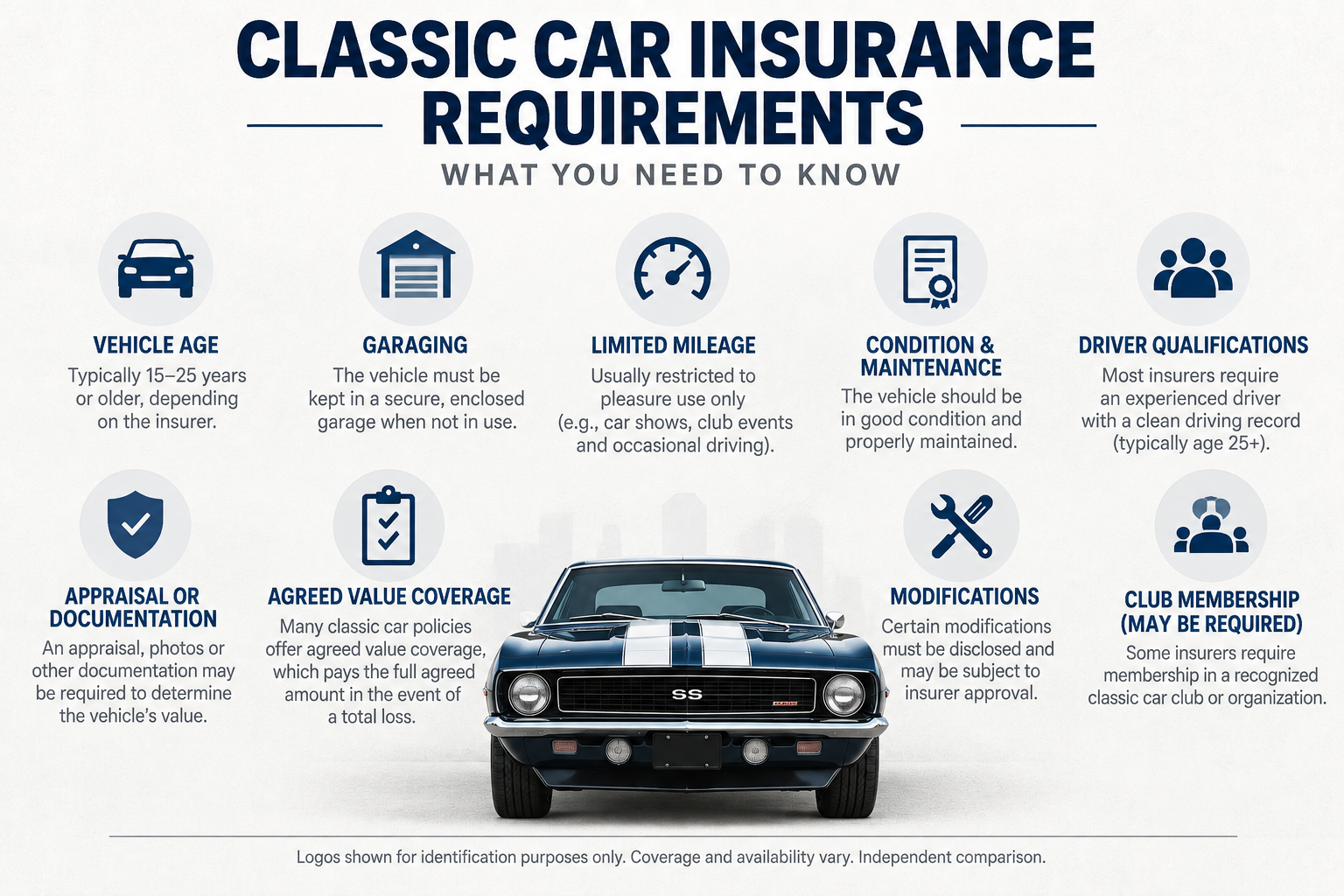
Checklist illustrating common classic car insurance requirements

Classic car insurance requirements commonly address the vehicle’s collectibility and condition, how it is used, annual mileage, storage, driver history, access to regular transportation, and the requested value. There is no universal vehicle-age or mileage rule. Each insurer applies its own underwriting guidelines, state restrictions, documentation standards, and policy terms.

A car can be old without qualifying for a collector program, and a newer limited-production or special-interest vehicle may qualify with some insurers. Eligibility is based on the complete risk—not the model year alone. State financial-responsibility and registration laws are separate from an insurer’s voluntary collector-program requirements.

Submitting the form requests review and does not bind coverage. Insurer access, eligibility, accepted value, terms, premium, and effective dates vary by state, vehicle, applicant, and underwriting.

Classic Car Insurance Requirements: Quick Facts

Specialty collector insurance is designed around a different use pattern from ordinary daily transportation. Insurers generally expect a collectible vehicle to be cared for, driven less frequently, stored appropriately, and supported by a reasonable value. The details can be flexible or strict depending on the company, form, vehicle, household, and state.

Common underwriting topics and what they really mean
Requirement areaCommon underwriting concernWhat varies
VehicleCollectibility, condition, rarity, originality, modifications, restoration status, and insurable interest.Accepted years, vehicle types, values, and condition levels differ by insurer.
UseCollector cars are generally not intended to replace an everyday vehicle.Pleasure driving, shows, tours, errands, commuting, business use, and track activity are treated differently.
MileageLower or limited use helps distinguish a collector exposure from regular driving.Some programs use annual tiers or caps; others focus more on actual use than a fixed number.
StorageUnderwriters want to know how the vehicle is protected when not driven.Enclosed garages are commonly preferred, but acceptable alternatives and security requirements vary.
DriversLicensing, experience, violations, accidents, claims, and intended operators help determine acceptability.Age, experience, and driving-record guidelines vary by insurer and state.
Regular transportationThe household may need suitable vehicles for work, school, errands, and routine travel.Rules for household members, company cars, public transportation, motorcycles, and policy ownership differ.
ValueThe requested amount should reflect the specific vehicle and be supported when necessary.Photos, appraisals, receipts, comparable sales, and valuation methods are not standardized.

Important distinction: qualifying for a collector program does not replace state-required auto insurance, registration, title, inspection, or financial-responsibility obligations. Likewise, obtaining an antique or historic plate does not guarantee that an insurer will accept the vehicle.

Three Different Sets of Rules Can Apply

“What are the requirements?” sounds like one question, but it usually contains three. Separating them prevents a collector from relying on a license plate, an online quote, or a declarations page for something it does not establish.

1. State requirements

State law determines matters such as minimum financial responsibility, vehicle registration, title status, inspections, proof of insurance, and rules for historic or antique plates. These obligations vary by jurisdiction and can change. A specialty policy must still satisfy applicable law for the way the vehicle is registered and operated.

2. Underwriting requirements

The insurance company decides whether it will accept the applicant, drivers, vehicle, value, use, mileage, storage, and location. Guidelines may differ by program and state. A preliminary indication is not final approval, and an agent cannot override underwriting.

3. Policy requirements

After issuance, the contract defines covered autos, drivers, uses, causes of loss, duties, exclusions, limits, deductibles, settlement, and notice obligations. Continuing eligibility and claim coverage depend on the issued policy and accurate information, not merely on what qualified at application.

Antique registration and collector insurance are not the same

A motor vehicle department may use a specific model-year threshold for special plates. An insurance company can use a different definition because its question is whether the risk fits its collector program. A vehicle might qualify for historic registration but not a particular insurance program because it is a daily driver, stored outside, undergoing an ineligible type of use, in poor condition, or operated by drivers outside the guidelines. The reverse can also occur: a newer limited-production, exotic, or special-interest vehicle may be considered collectible even when it is too new for a state’s antique plate.

Legal minimum coverage is not a complete collector strategy

Required liability coverage addresses covered injury or property damage you cause to other people. It generally does not repair or replace your own vehicle. Collision and comprehensive coverage, appropriate valuation, uninsured or underinsured motorist options, medical-related coverages, towing, spare parts, and other features must be considered separately. Required coverage names and limits vary by state, and lenders can impose additional physical-damage requirements.

The application must remain accurate

Applications commonly ask where the vehicle is kept, who drives it, how it is used, how many miles it travels, what regular-use vehicles are available, whether it is modified, and whether it has existing damage. Answer based on current facts. If the vehicle later begins commuting, moves to different storage, adds a household driver, enters commercial use, or receives major modifications, notify the agency and obtain confirmation of any approved change.

Collector-Vehicle Eligibility Checklist

Insurers evaluate the entire submission. Meeting one item does not guarantee acceptance, and failing a familiar rule does not mean every specialty option is unavailable. Use this checklist to prepare accurate information for underwriting.

Collector interest

The car should have a reason to be treated differently from ordinary transportation. Age can help, but rarity, historical importance, limited production, originality, performance, design, enthusiast demand, or a high-quality custom build may also establish collector interest.

Condition

Many programs prefer completed vehicles in good, restored, preserved, or show-quality condition. Existing rust, unrepaired collision damage, missing parts, exposure, or major mechanical problems can affect eligibility. Projects may require a dedicated vehicle-under-construction option.

Vehicle category

Potential categories include antiques, classics, muscle cars, sports cars, exotic or limited-production cars, hot rods, restomods, replicas, kit cars, vintage trucks, military vehicles, retired commercial vehicles, motorcycles, and other specialty vehicles. Each category can have separate guidelines.

Modifications

Disclose engine swaps, forced induction, suspension changes, chassis work, body conversions, roll cages, altered brakes, custom paint, electronics, and safety equipment. Modifications can increase value, change performance, require documentation, or move the risk into another program.

Title and ownership

Underwriting may review the titled owner, insurable interest, vehicle identification number, lienholder, branded or salvage title, imported-vehicle documentation, registration, ownership entity, and purchase status. Unresolved paperwork can delay or prevent issuance.

Requested value

The amount should be supportable for the specific condition and configuration. The insurer may request photos, a bill of sale, appraisal, restoration invoices, build records, provenance, or comparable sales and can approve a different amount or decline the request.

Age is evidence, not a universal definition

Industry education commonly describes classic or antique vehicles as older cars, but there is no uniform insurance definition. Some programs publish age ranges for specific categories and make separate provision for newer collector vehicles. A mass-produced older car used every day may fit standard auto coverage better than a specialty program. A newer limited-edition vehicle used for occasional enthusiast driving may receive specialty consideration.

Projects and restoration work need a separate conversation

An unfinished vehicle presents different exposures: its value changes as labor and parts are added; it may not be roadworthy; loose components may be stored elsewhere; and a shop may have custody of it. Ask whether the proposal covers a vehicle under construction, how the value increases, what documentation is required, whether owner-performed work is included, and how off-premises parts, tools, towing, and test drives are handled.

Race cars and track use are not ordinary collector use

Do not assume a collector policy covers racing, timed events, driver education, autocross, track testing, exhibition runs, or use on a surface designed for competition. A vehicle can have collector value and still need different coverage for on-track exposure. Describe the activity precisely, including whether the vehicle is driven on public roads, transported by trailer, displayed only, or operated at speed.

Use, Mileage, and Storage Requirements

These requirements help underwriters distinguish a collector vehicle from a daily-use auto. The safest approach is to describe what actually happens, not to choose the answer that appears most likely to qualify.

How to describe collector-car use accurately
TopicDetails to provideQuestions to ask
Pleasure drivingFrequency, destinations, trip length, season, and whether drives include routine shopping or errands.Is occasional pleasure use allowed, and how does the policy define it?
Shows and eventsClub meetings, exhibitions, parades, tours, multi-day trips, and transport method.Are organized tours and overnight event travel covered without special notice?
CommutingAny use to travel to work or school, including occasional days.Is all commuting prohibited, limited, or eligible only under another program?
MileageCurrent odometer, expected annual mileage, recent history, and unusually long planned trips.Is there a hard annual cap, a selected tier, or a flexible-use guideline? What happens if mileage changes?
StorageGaraging address, building type, locks, access, alarms, cameras, weather exposure, and time stored elsewhere.Must storage be fully enclosed? Are carports, gated lots, trailers, or parking garages considered?
Business or commercial useAdvertising, client visits, delivery, rideshare, rental, promotional use, or use tied to income.Is the use excluded, declined, or eligible under a different commercial or specialty policy?

Mileage is not the only measure of risk

A vehicle driven a modest distance every day can present a different exposure from one driven the same annual distance on a few organized tours. Underwriting may consider frequency, traffic conditions, parking away from home, travel radius, overnight trips, and whether the vehicle must be available when a regular car breaks down. Ask how the program treats both the annual total and the purpose of each trip.

Do not promise a mileage figure you cannot maintain

Estimates should be honest and reasonable. Keep maintenance and odometer records when required. If your plans change—for example, you join a touring club, move farther from events, retire and drive more often, or begin using the car for errands—ask the agency to review the policy before the new pattern becomes routine.

Storage details matter beyond the word “garage”

Underwriters may want to know whether a structure is locked, enclosed, private, shared, climate controlled, attached, detached, or located at the insured residence. They can also consider flood, wildfire, wind, theft, and weather exposure. If the car spends part of the year at a restoration shop, seasonal home, event venue, or storage facility, disclose those locations and custody arrangements.

Driver and Regular-Use Vehicle Requirements

Collector programs commonly assess every intended operator and the household’s everyday transportation. The goal is to confirm that the classic is driven by acceptable operators and is not needed as a substitute for ordinary daily use.

Driver licensing and experience

Provide each driver’s legal name, date of birth, license information, relationship to the applicant, years licensed, and intended use. Minimum age or experience rules can differ by company, vehicle type, performance, value, and state.

Violations, accidents, and claims

Disclose requested history completely, including serious violations and losses involving other policies or vehicles. Underwriters determine which events are material and how far back they review.

Household members

Insurers may ask about all licensed household residents even when they are not expected to drive the collector car. Do not omit a resident because the owner intends to hide keys or verbally prohibit use.

Young or occasional drivers

Ask whether a family member, friend, mechanic, appraiser, transporter, or potential buyer may operate the vehicle. Permission and coverage depend on the contract, listed operators, exclusions, and applicable law.

Regular-use vehicles

List the suitable everyday vehicle available to each licensed household member and identify its insurance. Rules can differ for company cars, motorcycles, public transit, shared vehicles, and household members away at school.

Policy ownership

Confirm whether regular auto coverage must be maintained in the applicant’s name and whether liability limits must align across policies. An insurer may request declarations as proof.

Why the regular-use car matters: collector pricing and eligibility often assume the specialty vehicle is not the household’s primary transportation. If the regular vehicle is sold, becomes inoperable, or is no longer available, contact the agency before relying on the classic for routine travel.

Named-driver and permissive-use questions deserve written answers

Do not assume every licensed person can drive the car simply because they have permission, and do not assume a person is excluded merely because they are absent from an ID card. Review definitions of insured, family member, permissive user, excluded driver, and covered auto in the actual policy. State law can affect how exclusions and mandatory coverages operate.

What to Prepare for a Classic Car Insurance Quote

A complete submission reduces follow-up and helps the agent compare proposals using consistent information. The insurer may ask for additional documents after reviewing the vehicle and applicant.

Identify the carGather year, make, model, trim, vehicle identification number, mileage, purchase date, title status, registered owner, lienholder, original equipment, modifications, restoration status, and existing damage.
Photograph the conditionPrepare current exterior, interior, dashboard, odometer, engine-bay, trunk, wheels, undercarriage, vehicle identification number, and existing-damage images. Use clear, well-lit photos without filters.
Support the valueOrganize the bill of sale, appraisal, restoration invoices, build sheet, factory records, parts receipts, provenance, awards, and useful comparable sales. Explain differences between your vehicle and each comparable.
Describe use and storageEstimate annual mileage and list pleasure driving, events, tours, commuting, business use, track activity, transport, garaging address, storage type, security, and seasonal locations.
List drivers and daily vehiclesProvide requested license and driving-history information for intended operators and household members. Gather current regular-auto declarations when proof of everyday transportation is requested.
Compare issued termsCheck accepted value, valuation method, liability limits, uninsured-motorist options, deductibles, use, mileage, storage, drivers, exclusions, repair provisions, spare parts, towing, and effective date.

Compare the same facts, not just the premium

The National Association of Insurance Commissioners advises consumers to provide the same information when requesting auto quotes. For a collector car, align the requested value, liability limits, deductibles, annual mileage, listed drivers, storage, and optional coverages as closely as possible. One proposal may appear less expensive because it uses a lower value, narrower use, higher deductible, different liability limit, or fewer endorsements.

Understand agreed value before accepting the proposal

Collector policies often use agreed value, but labels can be misunderstood. Confirm the amount approved by the insurer and the provision that applies after a covered total loss. A stated amount may work differently. Review the detailed guide to agreed value versus stated value insurance before relying on the declarations alone.

Review the final policy, not only the application

The declarations identify the insured, vehicle, limits, deductibles, and policy term, while the policy and endorsements define coverage, duties, and exclusions. Verify that every requested change appears in the issued documents. Keep a copy of the signed application, photos, value evidence, proposal, declarations, forms, and correspondence away from the vehicle.

For broader coverage guidance, visit the classic auto insurance overview. To understand the agency’s role in organizing a collector submission, read about working with a classic auto insurance agency.

Classic Car Insurance Requirements FAQs

How old must a car be to qualify for classic car insurance?

There is no universal age. Insurers can use different age guidelines for antiques, classics, modern collectibles, trucks, military vehicles, motorcycles, replicas, customs, and other categories. Collectibility, condition, value, use, storage, and drivers can matter as much as model year.

Is there always an annual mileage limit?

No. Some programs use a fixed maximum or selected mileage tier, while others allow flexible occasional use and evaluate the purpose and frequency of driving. Ask whether the figure is a hard policy condition, an underwriting estimate, or a rating choice, and report changes.

Can I commute in a classic car?

Many collector programs prohibit or restrict regular travel to work or school because the vehicle is intended for hobby use rather than daily transportation. Occasional commuting may also be outside some guidelines. Disclose the expected use and seek a form designed for it.

Must the vehicle be kept in a locked garage?

Secure enclosed storage is commonly preferred, but acceptable structures vary. Some insurers may consider carports, gated or monitored parking, trailers, driveways, or other arrangements after review. Provide the actual address, structure, access, security, and weather exposure.

Do I need another vehicle for daily driving?

Many collector programs require suitable regular transportation for the applicant or each licensed household member. Insurers differ on company cars, motorcycles, public transit, shared vehicles, and whose name must appear on the regular policy. Confirm the exact rule.

Can a modified car qualify?

Often, yes, but the type and extent of modification matter. Fully disclose engine, power, suspension, brake, frame, body, interior, and safety changes. Underwriting may request photographs, receipts, build records, an appraisal, or driver experience and can require a different program.

Does an antique license plate prove insurance eligibility?

No. Registration and insurance serve different purposes. A state may issue an antique or historic plate under its laws, while an insurer separately evaluates the vehicle, applicant, use, storage, value, and policy requirements.

Can a car under restoration be insured?

Possibly. Some specialty programs consider vehicles under construction, but the policy should address the current value, planned increases, roadworthiness, parts, tools, off-site work, transit, and test drives. A standard completed-vehicle policy may not fit an active project.

Does qualifying mean every type of loss is covered?

No. Eligibility only means the insurer has accepted the risk under stated facts. Coverage still depends on the cause of loss, policy, endorsements, exclusions, limits, deductibles, duties after loss, and applicable law.

Related Collector-Car Resources

Use these pages to continue from eligibility into coverage selection and quoting.

Find Out Whether Your Vehicle May Qualify

Share the vehicle, drivers, regular transportation, use, mileage, storage, value, and documentation. Blake Insurance Group can review available collector-auto paths and help explain the requirements. The insurer makes the final underwriting, pricing, value, and coverage decisions.

The request does not create, change, renew, or bind insurance. Keep existing coverage in force until replacement coverage is confirmed in writing.

Important disclosure: This page provides general educational information and is not legal, registration, title, appraisal, repair, tax, or claims advice. State laws and insurer guidelines vary. Coverage is subject to the application, underwriting approval, declarations, policy, endorsements, exclusions, limits, deductibles, and applicable law. Only the issuing insurer can bind coverage and decide a claim.

Independent-agency disclosure: Blake Insurance Group is an independent insurance agency, not an insurance company. Discussion of a vehicle category, underwriting practice, insurer, administrator, program, brand, or trademark does not imply endorsement, appointment, affiliation, or availability. Product access and eligibility vary by state and applicant.

Reviewed by Blake Nwosu
Owner and Principal Agent • National Producer Number 16944666

Read Blake Nwosu’s professional bio

Blake Insurance Group
Call: (888) 387-3687 Email: info@blakeinsurancegroup.com Mon–Fri 9:00–5:00
Blake Nwosu, Owner and Principal Agent
Blake Nwosu Owner & Principal Agent

Expert in personal and commercial insurance, including auto, home, business, health, and life insurance.

License: 16117464

Bio: blakeinsurancegroup.com/blake-nwosu/

★★★★★ Google reviews Loading…
Share: Facebook icon X (Twitter) icon LinkedIn icon Email icon



