Licensed Insurance Agents Compare Trusted Insurance Companies Secure & Private Online Quotes No Spam We Never Sell Your Personal Information
Talk to a licensed agent
888-387-3687
Fast Quotes • Coverage Reviews • Independent Advice
Blake Insurance Group
Modern Independent Insurance Agency
Compare coverage from trusted insurance companies with licensed agents who work for you—not a single carrier.
Skip to the modified classic car insurance guide
Modification disclosure matters • Value and use affect eligibility • Final coverage is determined by the issued policy
Request a Classic Auto Quote

Coverage guidance for restomods, hot rods, customs, and upgraded classics

Modified Classic Car Insurance

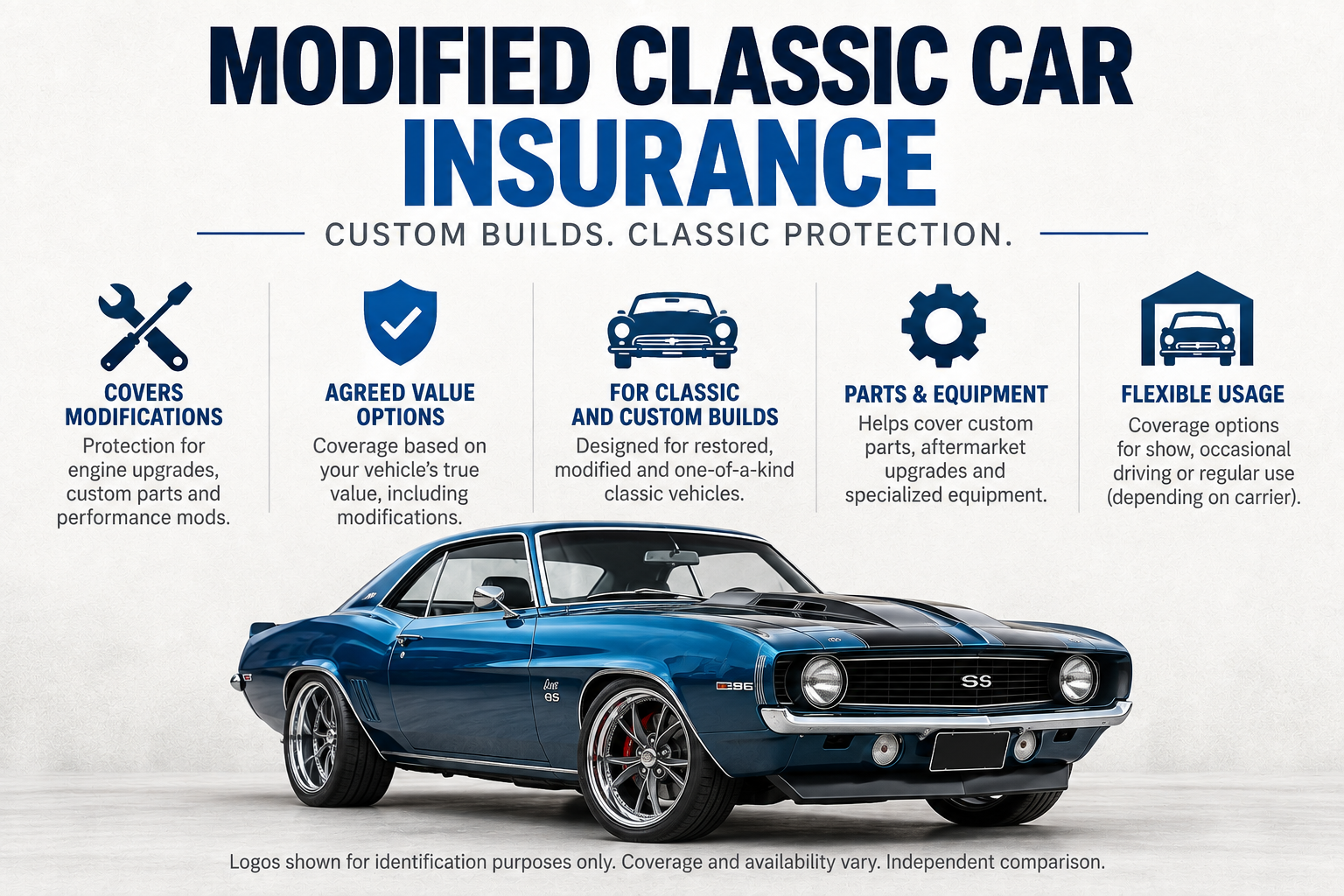
Modified classic car with custom performance and appearance upgrades

Modified classic car insurance is specialty coverage for a qualifying collector vehicle whose engine, drivetrain, suspension, brakes, body, interior, electronics, or other features differ from its factory configuration. A well-prepared application describes the finished car as it exists now—not merely its original year, make, and model—and supports the requested value with photographs, specifications, receipts, and other relevant evidence.

Modification does not automatically make a classic uninsurable, but it can change eligibility, repair complexity, value, performance, permitted use, and the information an underwriter needs. Full disclosure is essential. The insurer’s accepted application, declarations, endorsements, exclusions, and policy form determine the actual coverage.

Submitting the form requests a quote review and does not bind insurance. Availability, eligibility, valuation, premium, terms, and effective dates vary by insurer and state.

Modified Classic Car Insurance: Quick Facts

A modified collector vehicle may be a period-correct hot rod, a modernized restomod, a custom-bodied show car, an engine-swapped classic truck, or something that fits no simple label. The insurance question is not only whether the car is old. It is whether the insurer understands and accepts the vehicle’s present configuration, value, condition, drivers, storage, and intended use.

Issues to resolve before relying on a policy
IssueWhy it mattersWhat to verify
Complete disclosureA stock vehicle description may omit equipment that materially changes value, performance, or repair cost.Which modifications must appear on the application, build sheet, photographs, appraisal, or endorsement.
Collector eligibilityAge alone does not establish eligibility. Use, storage, condition, driver history, and the build itself can matter.Permitted use, mileage expectations, storage rules, driver qualifications, and any primary-vehicle requirement.
Accepted valueParts and labor receipts do not automatically equal the car’s market or insured value.The valuation method, accepted amount, deductible, total-loss basis, and process for updating value.
Custom componentsFabricated or rare parts can require specialized labor, sourcing, and repair decisions.How custom equipment, paint, upholstery, electronics, wheels, and fabricated parts are treated after a covered loss.
Road and event usePleasure driving, commuting, autocross, timed competition, track use, and displays create different exposures.Exactly which uses are allowed, restricted, or excluded; do not infer permission from a general label.
Changes after issueA new engine, forced induction, suspension redesign, or custom paint can make the original description and value stale.When changes must be reported and when revised coverage becomes effective.

Use the VIN, but do not stop at the VIN. A vehicle identification number typically points to the original vehicle, not every component installed decades later. Provide a current, plain-language description of what has changed.

Which Modifications Should Be Reported?

Report any material change from factory specification, even if the work seems common within the hobby or was completed by a prior owner. Let the licensed agent and insurer decide what affects underwriting. Concealing a change because it might affect price or eligibility can create serious problems when the application is reviewed or a claim is investigated.

Engine and power

Document engine swaps, displacement changes, cylinder-head work, carburetion or fuel injection, turbochargers, superchargers, nitrous systems, engine-control changes, cooling upgrades, and material increases in output. Include builder information, dyno results if available, component details, and current photographs without presenting an estimate as a guaranteed rating factor.

Transmission and driveline

List manual or automatic conversions, overdrive transmissions, transfer cases, differentials, axle upgrades, driveshafts, clutches, and altered gear ratios. These details help explain how the finished vehicle differs from a stock comparison and which parts may be needed after a covered loss.

Chassis, suspension, and steering

Describe frame changes, subframes, chassis swaps, air suspension, coilovers, altered ride height, steering conversions, four-link systems, tubs, roll structures, and other fabrication. Clear photos of the underside and attachment points may be as important as exterior beauty shots.

Brakes, wheels, and tires

Disclose disc-brake conversions, power-assist changes, upgraded master cylinders, anti-lock retrofits, wheel size and material, specialty tires, and nonstandard fitment. Keep invoices and specifications for components that would be difficult to identify from a single photograph.

Body, paint, and glass

Include chopped roofs, widened bodies, shaved trim, custom panels, fiberglass or carbon-fiber pieces, custom bumpers, altered lighting, wraps, murals, multi-stage paint, and nonstandard glass. Note whether a component is commercially replaceable or must be fabricated.

Interior, electrical, and safety systems

List custom upholstery, seats, restraints, dashboards, gauges, audio systems, navigation, alarm systems, battery relocation, rewiring, modern driver aids, fuel-system changes, fire suppression, and roll bars or cages. Competition-oriented equipment does not by itself create insurance for racing or track use.

Restomod, hot rod, custom, replica, and modified classic

Enthusiasts use these terms differently. A restomod usually retains classic identity and appearance while incorporating modern components. A hot rod may emphasize performance and traditional customization. A custom may involve extensive body, chassis, paint, or interior work. Replicas and kit cars can have distinct title and identification issues. For insurance, a detailed build description is more useful than debating the label.

Modern conversions require extra clarity

Electric drivetrains, battery systems, advanced electronics, aftermarket fuel systems, and major chassis conversions can introduce specialized repair, parts, fire, towing, and technical considerations. Provide the installer, component manufacturer, system specifications, inspection or certification documents when available, and photographs. Compliance with registration, inspection, emissions, or equipment law is separate from insurance eligibility and varies by jurisdiction.

How Insurers Evaluate a Modified Classic

Underwriting is the insurer’s process for deciding whether to accept a risk and on what terms. Modified classics are not evaluated by one industry-wide checklist. A build accepted by one program can fall outside another program’s guidelines. Accurate details allow an agent to seek an appropriate fit rather than forcing the car into a stock description.

Common underwriting questions for a modified collector vehicle
FactorInformation to provideWhy the insurer may ask
Identity and titleVIN, title status, registration, year represented, body and chassis origin, kit or replica documents, and lienholder.Establishes ownership, insurable interest, legal identity, and how the vehicle should be classified.
Build qualityWho completed the work, invoices, build records, component brands, inspections, and clear photos.Helps the insurer understand workmanship, condition, replacement complexity, and uncertainty.
PerformanceEngine specifications, estimated or measured output, vehicle weight, drivetrain, brakes, suspension, tires, and safety equipment.Major performance changes can affect loss potential and eligibility.
ConditionCurrent exterior, interior, engine bay, trunk, underside, glass, wheels, and any unrepaired damage.Separates pre-existing damage from future loss and supports the requested value.
UseAnnual mileage, pleasure driving, shows, tours, club events, errands, commuting, business use, and any track activity.Frequency, purpose, and environment of operation affect exposure and program fit.
Storage and securityOvernight address, building type, access controls, alarms, immobilizers, and off-site or seasonal locations.Theft, weather, fire, vandalism, and access conditions differ by storage arrangement.
DriversLicensed operators, ages, experience, household vehicles, driving records, and who performs testing or service.Collector programs may apply driver and household requirements.

Limited use must match real life

Many collector programs are designed for pleasure use rather than routine transportation. Do not describe a car as show-only if it is driven to work, used for errands, rented, used for deliveries, or regularly driven long distances. Ask how occasional pleasure drives, club events, tours, overnight trips, service visits, and test drives are treated. Mileage is only one part of use; purpose also matters.

Track equipment is not track coverage

A roll cage, racing harness, high-output engine, or competition history can trigger additional questions. Standard road or collector insurance commonly contains restrictions or exclusions related to organized racing, speed contests, timed events, driver education, or use on a racing surface. The exact language controls. If the vehicle will enter any track, autocross, drag, drift, or timed event, disclose it and request a specific answer before participating.

For a broader eligibility checklist, review classic car insurance requirements.

Establishing the Value of a Modified Classic Car

Stock price guides can be weak comparisons for a one-off build. Two cars sharing a model year and body style may differ dramatically in chassis design, powertrain, fabrication, paint, interior, workmanship, provenance, and market appeal. A credible value file connects the requested amount to the vehicle that actually exists.

Photograph the whole build

Provide dated views of every side, interior, dashboard, engine bay, trunk or cargo area, wheels, underside, VIN, and important custom details. Use well-lit images that show condition rather than only artistic angles.

Create a build sheet

Identify major components, manufacturers, specifications, builders, completion dates, and fabrication. Note original parts retained with the car and equipment stored separately.

Organize value evidence

Keep the bill of sale, parts receipts, labor invoices, appraisal, awards or provenance records, and relevant comparable sales. Explain unusual features that a general appraiser or adjuster might miss.

Cost, value, and coverage are different numbers

The amount spent on a build is evidence, not an automatic settlement. Some labor preserves value, some adds market appeal, and some represents troubleshooting or personal preference that a buyer would not repay dollar for dollar. Conversely, a skilled or historically important build may have market value not obvious from receipts. The requested value must be reviewed and accepted under the insurer’s rules.

Read beyond the valuation label

Policies may use agreed value, stated amount, actual cash value, or other terms. Similar-sounding labels can operate differently, and a displayed amount may be a limit rather than a promise to pay that amount in every loss. Confirm the settlement provision, deductible, maximum payment, salvage treatment, appraisal process, duties after loss, and conditions that could reduce or bar payment. See the detailed comparison of agreed value versus stated value insurance.

Update value when the build changes

A new paint job, completed interior, upgraded drivetrain, major award, market shift, or additional fabrication can make an earlier value outdated. Report material changes instead of waiting for renewal or a claim. Ask what documentation is required and when a revised amount becomes part of the policy. If the car is still being built, the issues may overlap with classic car restoration insurance.

An appraisal does not rewrite the policy. It can support an opinion of value, but the insurer must accept the vehicle and amount. Covered causes of loss, exclusions, deductibles, limits, and policy conditions still apply.

Coverage and Claim Questions for Custom Builds

Modified classic car insurance still combines familiar auto concepts with collector-specific concerns. Liability coverage addresses covered bodily injury or property damage claims against an insured, subject to policy terms and limits. Collision and comprehensive coverages address covered physical damage to the insured vehicle, subject to the contract. State requirements and available medical, personal injury protection, or uninsured and underinsured motorist coverages vary.

Questions to ask before choosing coverage
Coverage issueAsk thisWhy it matters
Custom partsAre all disclosed installed components included within the vehicle’s physical damage coverage and accepted value?A standard custom-equipment sublimit may be inadequate for extensive modifications.
Repair facilityCan a specialty shop perform repairs, and how are labor rates, transport, storage, and estimates handled?Custom fabrication and marque expertise may not be available at a conventional collision shop.
Repair methodHow are original, aftermarket, used, remanufactured, fabricated, or obsolete parts addressed?A custom component may have no direct catalog replacement.
Paint and finishHow will a custom color, graphic, patina treatment, or multi-stage finish be matched after a partial loss?Blending and recreating specialized work can affect scope and cost.
Spare partsAre uninstalled parts covered, at which locations, for which causes of loss, and to what limit?Extra engines, wheels, trim, and body panels are not necessarily part of the insured auto.
TowingDoes roadside or towing coverage accommodate the vehicle’s clearance, dimensions, driveline, and transport needs?Improper equipment can damage low or unusually configured vehicles.
Salvage and total lossWho retains salvage, how is its value calculated, and can the owner buy back the vehicle?Owners may want unique components or the identity of a one-off build, but rights are contractual.

Damage is different from failure

Auto physical damage insurance is not automatically a warranty for an engine, transmission, electrical system, battery, fabrication, or workmanship. A component that fails because of wear, overheating, defect, faulty installation, tuning, or mechanical breakdown may be excluded even if the repair is expensive. A separate covered event that follows a failure can raise a more complex claim question. Report the facts promptly and let the insurer determine coverage under the policy.

Owner labor and sentimental value

Thousands of personal hours can make a car priceless to its owner, but sentimental value is generally not a separately measurable auto coverage. Owner labor may also be treated differently from invoiced professional work when establishing value or settling repairs. Ask how labor is evaluated and retain a detailed project log, without assuming the insurer will reimburse every hour.

Do not overlook other property and liability

A collector-auto policy may not insure tools, a detached shop, business inventory, customers’ vehicles, trailers, transport operations, or liability arising from paid fabrication work. Home, business, garage, inland marine, trailer, or umbrella coverage may need separate review. Describe the complete activity, not just the car.

How to Prepare for a Modified Classic Car Quote

Collecting accurate information before submitting a request can reduce follow-up and make comparisons more meaningful. Use the same material facts when reviewing different options; a lower number based on incomplete information is not a reliable comparison.

Identify the vehicleGather the VIN, title, registration, purchase date, lienholder, original year/make/model, current mileage, and any body, frame, kit, replica, or reconstructed-title information.
Describe every major changeCreate a component-by-component build sheet covering engine, fuel, cooling, exhaust, transmission, axle, chassis, suspension, steering, brakes, wheels, tires, body, paint, glass, interior, wiring, electronics, and safety equipment.
Document who did the workList professional shops, fabricators, tuners, and owner-completed work. Organize receipts, invoices, serial numbers, inspection records, specifications, and completion dates.
Photograph current conditionTake clear, recent images of all sides, cabin, dash, engine compartment, trunk, underside, wheels, VIN, storage, and special components. Include existing flaws rather than hiding them.
Support the requested valueCombine cost records with an appraisal or relevant market evidence when appropriate. Explain why the proposed amount fits this particular build, condition, and market.
State actual use and storageEstimate annual mileage and describe every expected use, driver, overnight location, garage arrangement, event, tour, service trip, road test, and any competition or track activity.
Compare policy languageReview valuation, covered causes of loss, deductibles, limits, exclusions, custom equipment, parts, repairs, towing, mileage, use, drivers, territory, and duties to report changes.
Report later modificationsKeep the file current. Contact the agent before or promptly after material changes and confirm when any revised description or value is effective.

A quote or application is not proof of coverage. Do not cancel existing insurance or assume a modification is covered until you receive and review confirmation of the issued terms and effective date.

Modified Classic Car Insurance FAQs

Can an engine-swapped classic qualify for collector insurance?

It may qualify, depending on the insurer’s guidelines, the engine and installation, overall performance, condition, drivers, storage, value, and use. Disclose the engine identity, specifications, builder, supporting systems, estimated or measured output, and photographs. Acceptance is not automatic.

Is a restomod insured differently from a stock classic?

It can be. Modern brakes, suspension, powertrain, climate control, electronics, and custom finishes can change value, repair needs, parts availability, and underwriting. A stock vehicle description may not capture those changes, so the application and accepted value should reflect the actual restomod.

Will modifications increase the premium?

They can affect premium, but there is no universal formula. Value, performance, repair complexity, component cost, use, location, storage, driver characteristics, limits, deductibles, and insurer rating rules can all matter. An accurate quote requires the complete risk.

Are receipts enough to prove the car’s value?

Receipts are useful evidence of parts and paid labor, but build cost does not necessarily equal current market or insured value. Photographs, specifications, condition, workmanship, comparable sales, provenance, and an appraisal may also be relevant. The insurer must accept the amount.

Are custom paint and upholstery covered?

They may be included when properly disclosed and accepted as part of the insured vehicle and value. Verify custom-equipment limits, repair methods, matching or blending, deductibles, exclusions, and how a partial loss will be evaluated. Coverage depends on the policy.

Does the policy cover racing or track driving?

Do not assume it does. Policies can restrict or exclude racing, speed contests, timed events, practice, instruction, or operation on a racing surface. Tell the agent about every planned event and obtain specific coverage guidance before participating.

Can an owner-built custom qualify?

Possibly. An underwriter may request detailed build records, component specifications, inspections, photographs, condition information, and evidence supporting roadworthiness and value. Professional work is not the only possible path, but requirements and acceptance vary.

What if I modify the car during the policy term?

Report material changes. A modification can alter the vehicle description, value, performance, use, or eligibility. Ask what documents are needed and when any change to coverage becomes effective; spending money on the car does not automatically increase the policy amount.

Does insurance pay when a modified part simply breaks?

Not necessarily. Wear, defect, faulty workmanship, tuning problems, overheating, and mechanical or electrical breakdown may be excluded. Collision or comprehensive coverage applies only to covered causes of loss under the contract. A claim involving both failure and resulting damage requires policy-specific review.

Related classic auto guides

Request a Quote for Your Modified Classic

Share the real build, current value evidence, storage, drivers, and intended use so a licensed agent can review available options for your collector vehicle.

Reviewed by Blake Nwosu
Owner and Principal Agent, Blake Insurance Group
National Producer Number (NPN): 16944666 • Read Blake Nwosu’s bio

Insurance disclosure: This page provides general educational information and is not legal advice, a binder, a policy, or a guarantee of eligibility, coverage, price, claim payment, or availability. Product names, definitions, underwriting rules, valuation provisions, exclusions, limits, deductibles, forms, and state availability vary by insurer. Coverage is subject to the application, underwriting approval, payment, effective date, declarations, endorsements, exclusions, and complete issued policy. If this page conflicts with a policy, the policy controls.

Blake Insurance Group is an independent insurance agency. References to vehicle types or market practices do not imply that any particular insurer will accept a risk or that the agency represents every insurer offering specialty coverage. Request licensed, state-specific advice for your vehicle and circumstances.

Blake Insurance Group
Call: (888) 387-3687 Email: info@blakeinsurancegroup.com Mon–Fri 9:00–5:00
Blake Nwosu, Owner and Principal Agent
Blake Nwosu Owner & Principal Agent

Expert in personal and commercial insurance, including auto, home, business, health, and life insurance.

License: 16117464

Bio: blakeinsurancegroup.com/blake-nwosu/

★★★★★ Google reviews Loading…
Share: Facebook icon X (Twitter) icon LinkedIn icon Email icon



