Licensed Insurance Agents Compare Trusted Insurance Companies Secure & Private Online Quotes No Spam We Never Sell Your Personal Information
Talk to a licensed agent
888-387-3687
Fast Quotes • Coverage Reviews • Independent Advice
Blake Insurance Group
Modern Independent Insurance Agency
Compare coverage from trusted insurance companies with licensed agents who work for you—not a single carrier.
Skip to the classic car restoration insurance guide
Vehicle-under-construction guidance • Changing value and custody matter • Final coverage determined by the issued policy
Request a Classic Auto Quote

Protecting a collector vehicle while its condition and value change

Classic Car Restoration Insurance

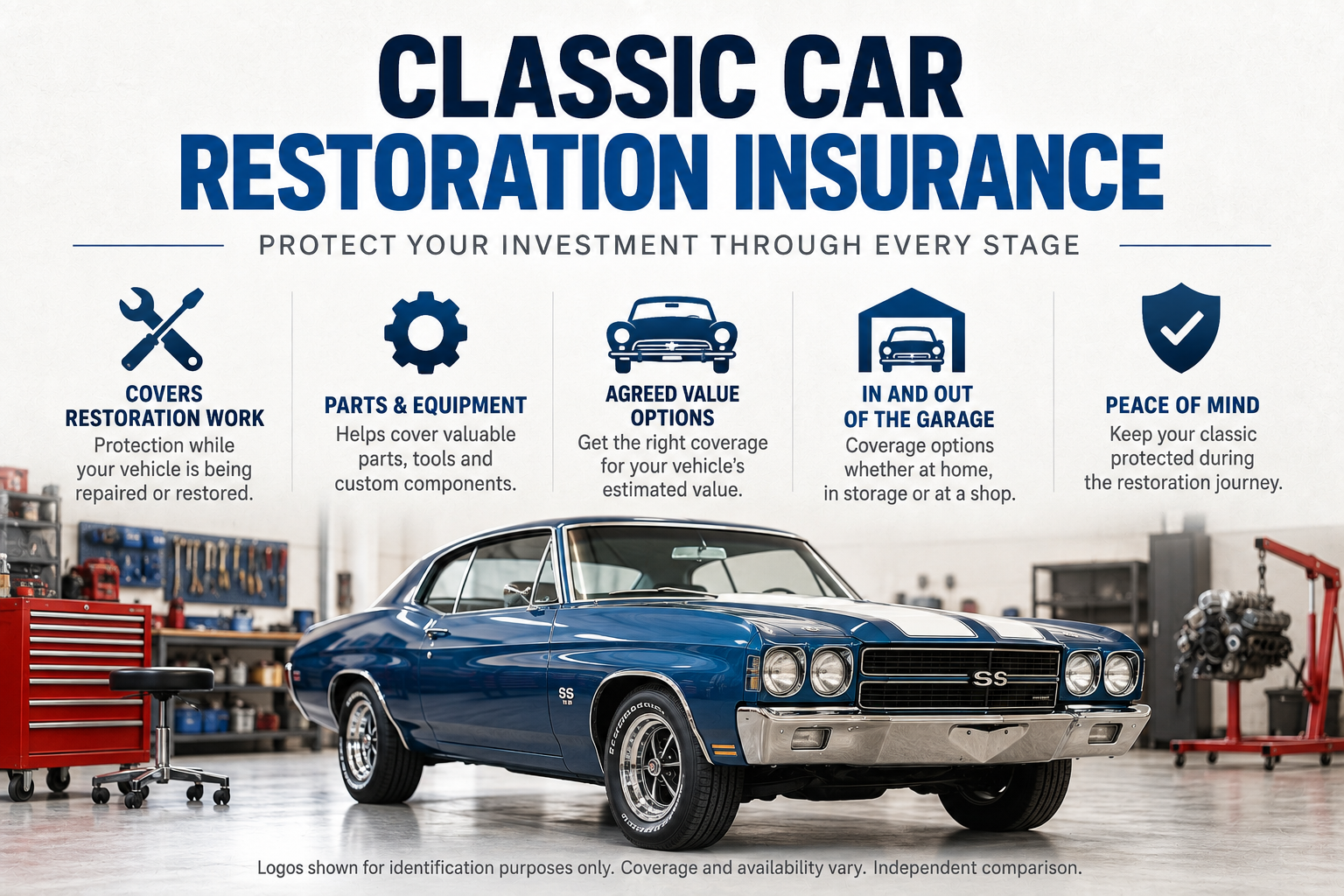
Classic car undergoing restoration in a workshop

Classic car restoration insurance is not one standardized policy; it generally means coverage designed or endorsed for a collector vehicle while it is under construction. The right arrangement should account for the project’s current value, increases as work progresses, loose or newly purchased parts, storage, transport, shop custody, limited road testing, and the transition to a completed vehicle.

A standard auto policy or completed-collector policy may not automatically reflect a disassembled vehicle, substantial modifications, stored components, owner labor, or a rapidly changing value. Coverage, eligibility, documentation, and valuation methods vary by insurer and state, so the restoration must be described accurately before coverage is bound.

Submitting the form requests licensed review and does not bind coverage. Insurer access, project eligibility, accepted value, covered property, terms, premium, and effective dates vary.

Classic Car Restoration Insurance: Quick Facts

Restoration creates exposures that change from week to week. A purchased shell may become a rolling chassis, then a running vehicle, then a completed collector car. Parts move between the owner, vendors, storage locations, and a restoration shop. The amount spent can rise faster than the project’s insurable market value, and the car may not be roadworthy for much of the policy term.

Questions a restoration policy or endorsement should answer
Project issueWhy it mattersWhat to verify
Current vehicle valueA disassembled project may be worth more or less than its purchase price or completed target.The accepted starting value and the evidence required to support it.
Value increasesParts and completed work can add value during the term.Whether increases are automatic, reported, scheduled, capped, or subject to approval and proof.
Loose partsEngines, trim, wheels, glass, interiors, and rare components may be off the vehicle.Covered property, causes of loss, per-item or aggregate limits, locations, and deductibles.
Tools and equipmentOwner tools, lifts, welders, paint equipment, and consumables are not the insured auto itself.Whether any tool coverage exists and which home, business, or inland-marine policy should respond.
Shop custodyThe vehicle can spend months in another business’s care, custody, or control.Off-premises coverage, notice, storage, test drives, shop insurance, and who is responsible for damage.
TransportA nonrunning project may be trailered among home, body, paint, upholstery, and mechanical shops.Coverage during loading, unloading, towing, transit, and temporary storage.
Road testingA project can move from inoperable to drivable before it is finished.Registration, roadworthiness, permitted drivers, mileage, use, and when liability and physical damage apply.

Restoration cost is not automatically insured value. Labor, parts, delays, rework, and personal attachment do not always translate dollar for dollar into market value. The insurer must accept the amount under the policy’s valuation method.

Match Coverage to Each Restoration Stage

A project’s condition and use can change materially before renewal. Treat restoration as a sequence of underwriting checkpoints rather than a single description.

Acquisition and transport

The first exposure may begin before the vehicle reaches its long-term storage. Confirm the titled owner, insurable interest, purchase documentation, vehicle identification number, condition, loading method, carrier, trailer, route, and when insurance becomes effective.

Disassembly

Doors, trim, drivetrain, glass, interior, wheels, and body panels may be spread across several rooms or buildings. Create an inventory with photos, identifiers, condition, value, and location before items become difficult to distinguish.

Body, paint, and fabrication

Welding, grinding, cutting, solvents, paint, temporary wiring, heat, and fabrication introduce fire, property, and workmanship exposures. The auto policy may not cover the owner’s building, business activity, or liability arising from work.

Mechanical and electrical assembly

A newly installed engine, transmission, brake system, fuel system, battery, wiring harness, or electronic control can change value and performance. Disclose major modifications and retain receipts, serial numbers, build sheets, and photos.

Initial start and road testing

A vehicle that runs is not necessarily registered, inspected, roadworthy, or insured for public-road testing. Explain who will drive, where, how far, for what purpose, and whether the trip is on private property, public roads, or a track.

Completion and collector use

When the car is substantially complete, the policy may need a new accepted value, updated photographs, appraisal, mileage, storage, drivers, use, and endorsements. Do not assume construction coverage converts automatically.

Define what “under restoration” means

One owner may perform a cosmetic refresh over several weekends. Another may begin with a bare frame and outsource paint, engine, upholstery, and assembly over years. Underwriters may distinguish active restoration from stalled projects, parts cars, vehicles in poor condition, major customs, kit builds, replicas, or vehicles intended for competition. Provide the actual scope, timeline, current condition, target configuration, and who is doing the work.

Do not insure the finished dream as if it exists today

A projected completed value can guide planning, but it does not prove the current project value. The policy may begin with a supported amount and provide a method to increase it as work is completed. Ask how progress is documented, when approval is effective, and whether the insurer can revise or decline the requested amount.

How to Insure a Value That Changes During Restoration

A restoration file should show both the current state and the intended result. Insurers may use agreed value, stated amount, actual cash value, scheduled increases, an inflation feature, or another contract method. The label alone does not explain the settlement.

Evidence for establishing and updating a restoration value
EvidenceWhat it supportsLimitation
Bill of saleOwnership, acquisition date, initial condition, and transaction amount.One purchase price may not equal current value after disassembly or work.
Current photographsCompleteness, condition, installed components, existing damage, storage, and progress.Photos do not establish the quality or market value of unseen work by themselves.
Parts receiptsAcquisition and cost of engines, trim, body panels, interior, glass, wheels, electronics, and other components.Retail cost does not always increase vehicle market value by the same amount.
Shop invoicesWork performed, labor, materials, dates, vendors, and custody.Cost can include diagnosis, rework, storage, or maintenance that does not add equivalent market value.
Build sheet and specificationsOriginal configuration, modifications, components, craftsmanship, and intended finished vehicle.Future plans are not completed work and can change underwriting eligibility.
AppraisalAn expert opinion about present condition, configuration, market evidence, and value as of a date.An appraisal does not bind the insurer or amend the policy unless the contract says so.
Comparable salesMarket context for similar completed or project vehicles.Condition, originality, provenance, workmanship, options, venue, and buyer fees can make comparisons imperfect.

Ask exactly how increases work

Some vehicle-under-construction options may provide a scheduled or automatic increase, while others require the owner to report each change and receive approval. Ask how often value can change, what percentage or dollar cap applies, whether increases are temporary or permanent, and what records must exist before a loss. Do not publish or rely on one insurer’s formula as a market-wide rule.

Agreed value helps only after the risk is accurately described

An agreed amount can make total-loss valuation more predictable, but the cause of loss must be covered and the application must reflect the vehicle’s condition, modifications, use, storage, and locations. Deductible, salvage, fraud, misrepresentation, lienholder, title, and other policy provisions can still affect payment.

Read the full guide to agreed value versus stated value insurance before relying on the number displayed on the declarations.

Separate insurable value from the emotional investment

Owners may spend years sourcing parts, learning skills, or recreating a family vehicle. Insurance cannot restore lost time, memories, or sentimental value. The insured amount must be supported and accepted within the contract. Preserve photographs, history, serial numbers, and documents off-site because those records may be irreplaceable.

Parts, Tools, Labor, and Workmanship

A restoration includes more property and activity than the titled vehicle. Each category needs a clear coverage answer.

Installed parts

Once a component is permanently installed, it may become part of the vehicle’s value. Report material changes and update photographs. Do not assume the policy limit increases merely because the part is attached.

Loose and spare parts

Uninstalled engines, transmissions, wheels, body panels, trim, glass, interiors, and new old stock may have separate coverage, limits, deductibles, locations, and covered causes of loss. Create an itemized inventory.

Tools and shop equipment

Hand tools, lifts, welders, compressors, diagnostic equipment, paint booths, and consumables are not automatically part of the insured vehicle. Home, business, inland-marine, or dedicated tool coverage may need review.

Owner-performed labor

The owner’s time can improve the project, but a policy does not automatically reimburse every hour at a professional shop rate. Ask how a covered loss values completed work and whether owner repair is permitted after a claim.

Faulty workmanship

Insurance generally is not a warranty for poor restoration or mechanical failure. A resulting fire or other damage may be treated differently from the defective part or work itself. The exact exclusion and facts control.

Business activity

Restoring cars for other people, selling repeated builds, charging labor, or operating a shop can create commercial property, liability, garagekeepers, workers’ compensation, and business-auto exposures beyond a personal collector policy.

Keep the inventory away from the project. Store receipts, photos, serial numbers, appraisals, and backups in a secure separate location. A fire or theft can destroy both the parts and the only proof that they existed.

Parts at multiple locations need specific attention

A body can be at a paint shop while the engine is at a machine shop and the interior is stored at home. Ask whether the policy follows covered parts, limits the distance from the primary storage location, requires notice, or excludes property in another business’s custody. Shipping and freight damage may also depend on the seller, carrier, shipping contract, and separate transit coverage.

Restoration Shops, Storage, and Transport

Moving a project outside the owner’s control creates some of the most important coverage questions. A shop’s willingness to accept the car does not prove that its insurance covers every kind of damage or the full vehicle value.

Questions for each place that holds or moves the project
SituationQuestions for your policyQuestions for the vendor
Restoration or body shopIs off-premises storage allowed? Must the shop be reported? Are theft, fire, weather, and collision covered while in custody?What insurance applies to customer vehicles? Who may move or test the car? Is subcontracting allowed?
Machine, upholstery, or specialty vendorAre detached parts covered away from the vehicle, during shipping, and while being worked on?How are parts identified, stored, secured, and insured? What happens after damage or loss?
Owner’s trailerDoes coverage apply during loading, transit, unloading, and temporary trailer storage? Is the trailer separately insured?If another person tows, who supplies the vehicle, driver, tie-downs, and liability coverage?
Professional transporterDoes the collector policy cover transit, or is the transporter’s cargo coverage primary, secondary, or separate?What limits, deductibles, exclusions, inspection records, subcontractors, and claim procedures apply?
Car show or unveilingIs display, judging, temporary storage, overnight parking, loading, and limited driving allowed before completion?Who controls the venue, moves vehicles, provides security, and assumes responsibility?
Road testingAre public-road tests permitted, and are the driver, registration, use, mileage, and condition acceptable?Who drives, on what route, for how long, and under whose insurance?

Garagekeepers coverage is not a substitute for your own review

A repair or restoration business may carry coverage for customer autos in its care, custody, or control, but terms, triggers, limits, deductibles, exclusions, and valuation can differ. Ask for evidence when appropriate and read the restoration agreement. Do not cancel your collector coverage merely because the shop says it is insured.

Storage conditions can change mid-project

A rolling chassis might begin in a home garage, move to a shared warehouse, spend months at a paint shop, then return to a trailer during assembly. Report material location and security changes. If the project lacks a private garage, review the separate guide to classic car insurance without a garage.

Road testing is not the same as track use

A short public-road test after mechanical work can require registration, legally required insurance, a licensed acceptable driver, and a roadworthy vehicle. A test on a track, timed course, autocross, or competition surface can fall under exclusions or need motorsports coverage. Describe the location and activity precisely before the car moves.

How to Prepare a Restoration Insurance Submission

A clear project file helps the agent and underwriter understand what exists today, what is planned, where property is located, and how value will change.

Identify the projectProvide year, make, model, trim, vehicle identification number, title status, purchase date, ownership, lienholder, current condition, existing damage, missing components, modifications, and target configuration.
Document the starting pointPhotograph every side, interior, engine bay, trunk, frame, undercarriage, identification numbers, stored components, existing damage, workshop, and security. Date and organize the images.
Build a parts inventoryList installed, loose, spare, ordered, shipped, and vendor-held parts with description, serial number, receipt, condition, value, and exact location.
Map vendors and movementIdentify each shop, subcontractor, storage facility, transporter, trailer, planned route, custody date, test driver, and anticipated road or event use.
Support current and target valueOrganize the bill of sale, appraisal, comparable sales, build sheet, invoices, receipts, provenance, original documents, and realistic timeline. Separate completed work from planned work.
Confirm the update processAsk when values, locations, modifications, roadworthiness, photos, and completion must be reported. Retain written approvals and updated declarations.

Questions to answer before binding

  • What is the accepted value today, and how is a covered total loss settled?
  • How does the insured value increase as work and parts are added?
  • Are loose parts covered at home, at shops, in storage, and in transit?
  • Are tools, owner labor, shop labor, and faulty workmanship treated separately?
  • Must each vendor, location, modification, or transport be reported?
  • What collision and comprehensive deductibles apply?
  • Are loading, unloading, towing, road testing, and event display permitted?
  • When and how does the project convert to completed collector coverage?

Review the broader classic car insurance requirements for driver, storage, use, and vehicle eligibility. For a general view of policy features, visit the classic auto insurance guide.

Classic Car Restoration Insurance FAQs

Can I insure a classic car that is completely disassembled?

Possibly, depending on the insurer, condition, collectibility, storage, documentation, value, and restoration plan. The underwriter may require photographs and a parts inventory and can distinguish an active project from a parts car or abandoned restoration.

Does the insured value automatically rise as I restore the car?

Not always. Some endorsements may provide scheduled or automatic increases, while others require reporting, evidence, and approval. Ask about timing, limits, documentation, and whether the updated amount appears on the declarations.

Are loose spare parts covered?

They may be covered under a collector endorsement, subject to causes of loss, limits, deductibles, locations, ownership, and documentation. Parts can also require separate property or inland-marine coverage. Do not assume every item near the vehicle is included.

Does restoration insurance cover my tools?

Not automatically. Any tool benefit can be limited, and heavy equipment or tools used for business may need home, business, inland-marine, or other coverage. Inventory tools and confirm the applicable policy.

Is my own labor included in the vehicle value?

Completed work can influence current vehicle value, but the hours spent do not automatically equal an insured dollar amount or professional labor rate. Support the result with photographs, records, appraisal, and market evidence, then obtain insurer acceptance.

Is the car covered while a restoration shop has it?

It may be, but off-premises and custody terms must be reviewed. The shop may also carry insurance for customer autos. Ask both parties about theft, fire, collision, test drives, subcontractors, limits, deductibles, and claim procedures.

Can I drive the project during restoration?

Only when the vehicle is legally registered, roadworthy, operated by an acceptable driver, and the policy permits the test or use. Public-road tests, occasional pleasure use, and track activity are separate questions. Obtain written confirmation first.

Does the policy cover poor workmanship or mechanical failure?

Insurance is generally not a workmanship warranty. Exclusions can apply to faulty work, wear, deterioration, or mechanical breakdown, while resulting covered damage may be treated differently. The cause, sequence, and policy wording control.

What happens when the restoration is complete?

Notify the agency and provide final photographs, appraisal or value support, modifications, mileage, storage, drivers, and intended use. The insurer may update the accepted value, forms, rating, and eligibility. Do not assume conversion happens automatically.

Related Collector-Car Resources

Continue with the valuation, storage, or eligibility topic that matches your project.

Build the Coverage File Alongside the Car

Share the project’s current condition, value, parts, modifications, storage, shops, transport, drivers, testing, timeline, and completed goal. Blake Insurance Group can review available collector-auto paths and help explain material requirements. The insurer makes the final eligibility, value, pricing, coverage, and claim decisions.

The form does not create, change, renew, or bind insurance. Keep existing coverage in force until replacement coverage is confirmed in writing.

Important disclosure: This page provides general educational information and is not legal, appraisal, mechanical, restoration, storage, shipping, tax, business, or claims advice. Insurer forms and state laws vary. Coverage is subject to the application, underwriting approval, declarations, policy, endorsements, exclusions, limits, deductibles, and applicable law. Only the issuing insurer can bind coverage and decide a claim.

Independent-agency disclosure: Blake Insurance Group is an independent insurance agency, not an insurance company, appraiser, repair shop, or transport company. Discussion of an endorsement, coverage approach, insurer, administrator, program, brand, or trademark does not imply approval, endorsement, appointment, affiliation, discount, or availability.

Reviewed by Blake Nwosu
Owner and Principal Agent • National Producer Number 16944666

Read Blake Nwosu’s professional bio

Blake Insurance Group
Call: (888) 387-3687 Email: info@blakeinsurancegroup.com Mon–Fri 9:00–5:00
Blake Nwosu, Owner and Principal Agent
Blake Nwosu Owner & Principal Agent

Expert in personal and commercial insurance, including auto, home, business, health, and life insurance.

License: 16117464

Bio: blakeinsurancegroup.com/blake-nwosu/

★★★★★ Google reviews Loading…
Share: Facebook icon X (Twitter) icon LinkedIn icon Email icon



