Neutral comparison • Specialty and multiline options • Policy-first guidance
Compare Classic Car Insurance Companies
Compare classic car insurance companies by more than the premium. The best fit depends on whether the vehicle qualifies, how it is driven and stored, how a total loss is valued, which repair and parts provisions apply, and which legal insurer actually issues the policy. A famous collector-car brand does not automatically mean the same contract, underwriting company, or coverage in every state.
If you searched for classic car insurance companies near me, begin with the vehicle and its real use—not a list ranked from first to last. A preserved antique, a modified muscle car, a modern collectible, an active restoration, and a race car stored between events can require different underwriting paths. The right comparison keeps those differences visible instead of forcing every enthusiast into one template.
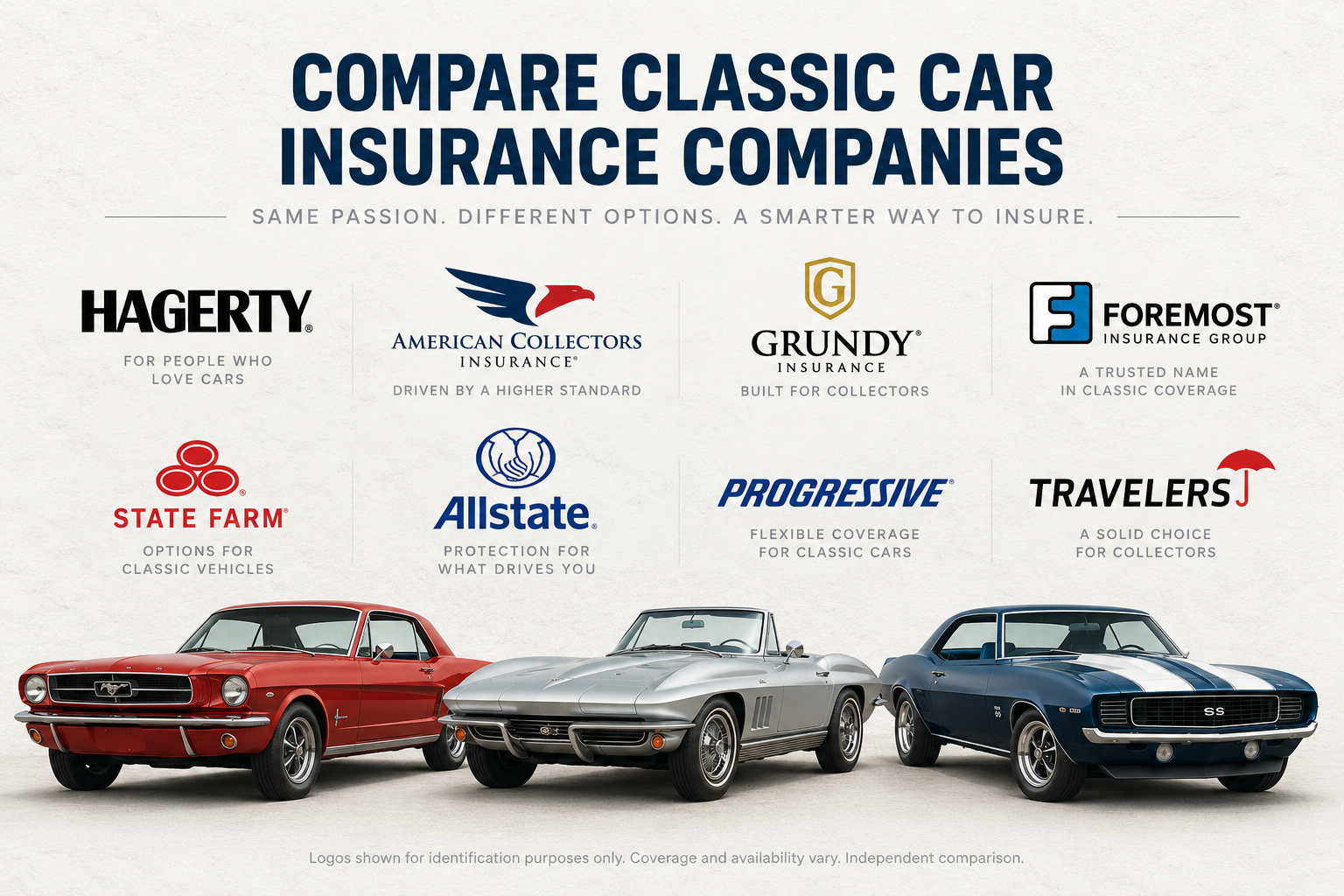
This guide reviews eight recognizable companies or program brands as research starting points. Inclusion is not an endorsement, award, appointment claim, or statement that a policy is available through Blake Insurance Group. Some names below are agencies or specialty program administrators rather than the legal insurer. Always identify the underwriting company, policy form, endorsements, and state-specific terms shown on the actual proposal.
The quote link opens Blake Insurance Group’s classic-auto quote request form. Submitting information requests a review; it does not bind insurance, guarantee eligibility, confirm a premium, or create an effective policy.
How to compare classic car insurance companies fairly
A useful comparison begins with identical facts and coverage requests. If one quote assumes occasional pleasure use and another assumes commuting, or one insures the car on an agreed-value basis while another uses stated amount, the premium difference does not reveal which policy is stronger. It reveals that the proposals are not equivalent.
Define the vehicle accurately
Record the vehicle identification number, year, make, model, trim, engine, transmission, condition, title status, modifications, restoration status, purchase date, requested value, and current photographs. A replica, kit car, restomod, tribute vehicle, imported model, or race-prepared car should be described plainly.
Describe how the car is really used
State annual mileage and every intended use, including pleasure drives, shows, club events, parades, tours, errands, commuting, business, exhibitions, driver education, road rallies, or track activity. Do not reshape the answer to fit a program; an undisclosed use can become a serious claim problem.
Request the same coverage design
Hold liability limits, uninsured and underinsured motorist limits, deductibles, medical or personal-injury protection where applicable, vehicle value, roadside protection, spare-parts coverage, and optional endorsements as consistent as possible. Mark every difference that cannot be aligned.
Identify the contract parties
Write down the agency or administrator, the legal underwriting insurer, the named insured, the vehicle’s titled owner, any loss payee, the policy form, and the state. A brand may administer more than one insurer’s policies, and a multiline group may issue through different subsidiaries.
The table below is a policy-comparison scorecard, not a ranking formula. A feature matters only if it fits the owner’s actual exposure. For example, generous event usage does not solve a daily-commuting need, and a restoration endorsement is not useful if the policy’s vehicle definition excludes the project.
Use the same questions for every classic-car proposal
Comparison item
What to obtain in writing
Common comparison mistake
Legal insurer
Full issuing-company name, policy form, administrator, and state
Assuming the consumer-facing brand is the underwriting company
Vehicle value
Accepted value, settlement clause, deductible, and conditions
Treating agreed value, stated amount, and actual cash value as synonyms
Permitted use
Pleasure, event, tour, errand, commute, business, and track wording
Relying on a salesperson’s broad description of “flexible use”
Mileage
Any plan, estimate, cap, reporting duty, or review trigger
Comparing mileage labels without reading how use is restricted
Storage
Accepted structure, address, security, off-site treatment, and exceptions
Assuming a carport, shared garage, trailer, or shop automatically qualifies
Drivers
Eligible operators, household rules, experience, records, and regular autos
Leaving out a household member or occasional operator
Repairs
Shop choice, labor method, parts basis, appraisal process, and transport
Assuming “full coverage” guarantees original or rare replacement parts
Special situations
Restoration, modifications, spare parts, new acquisitions, salvage, and events
Believing a feature name provides broader protection than its endorsement
Eight classic car insurance companies and program brands to research
The following profiles are deliberately unranked. They summarize the type of comparison each name can introduce; they do not promise eligibility, availability, appointment, or a particular feature. Public descriptions can change, and state variations matter. The quote and issued policy—not this overview—determine coverage.
Unranked research overview for eight recognizable classic-car insurance paths
Company or program name
Useful reason to research it
Verify before comparing price
Hagerty
Dedicated collector-vehicle ecosystem and multiple specialty vehicle categories
Legal insurer, Guaranteed Value® terms, permitted use, and optional features
American Collectors Insurance
Collector program for classics, customs, imports, trucks, motorcycles, and other eligible vehicles
Underwriter, mileage or usage plan, storage, driver qualifications, and agreed value
Grundy
Collector Vehicle Program plus a broader motor-vehicle program described for mixed vehicle needs
Which program applies, legal insurer, value basis, use, drivers, and vehicle mix
American Modern
Specialty insurer group with collector-vehicle categories and multiple coverage choices
Exact group insurer, agreed versus stated value option, endorsements, and eligibility
Heacock Classic
Specialty focus spanning antique, classic, modern collector, exotic, replica, and race-related risks
Underwriter, on-road versus off-track protection, agreed value, and use restrictions
J.C. Taylor
Longstanding collector program for antique, classic, vintage luxury, muscle, and hot-rod categories
Issuing insurer, accepted value, eligibility, storage, use, and driver terms
State Farm
Multiline insurer group with collector and classic-auto options in eligible situations
State-specific program, legal entity, vehicle definition, enclosed storage, and limited use
Liberty Mutual
Multiline option describing specialty protection for eligible antique and classic vehicles
Issuing insurer, state availability, valuation, usage, storage, parts, and endorsements
Specialty program
Hagerty
Collector vehicles
Agreed value
Specialty options
Agency administered
Hagerty is one of the most visible names in collector-vehicle insurance. Its public materials describe coverage for classic and collector cars as well as modern collectibles, modified vehicles, trucks, motorcycles, military vehicles, tractors, trailers, boats, and selected motorsport-related needs. That breadth makes it a logical research path when the garage includes more than a stock antique.
Hagerty Insurance Agency, LLC administers insurance, while policies are underwritten by carriers identified in its disclosures. That distinction matters. Record the actual insurer on the proposal and confirm that its Guaranteed Value® wording, optional salvage treatment, vehicle-under-construction provisions, permitted pleasure use, and state-specific endorsements match the intended use.
Best comparison question: Which benefits are part of the policy, which require an added endorsement or membership, and what does the total-loss clause say after deductibles, salvage choices, taxes, fees, exclusions, and policy conditions are applied?
Specialty program
American Collectors Insurance
Classics
Customs
Modern collectibles
Agreed value
American Collectors Insurance publicly describes programs for classic and collector cars, custom cars and hot rods, import and exotic collectibles, trucks and utility vehicles, motorcycles, and other eligible collectibles. Its eligibility material emphasizes the larger collector profile: vehicle condition, experienced drivers, secure storage, another personal-auto policy, and non-routine use.
Do not turn those general descriptions into assumptions about a particular applicant. Vehicle age thresholds, mileage approaches, driver requirements, modifications, off-road use, business use, and event restrictions can differ by plan, state, underwriter, and policy form. Ask the proposal to identify each one rather than relying on a general webpage.
Best comparison question: Does the proposed usage plan fit the mileage and activities honestly expected during the policy term, and does the accepted agreed value reflect current condition, modifications, provenance, and restoration work?
Specialty and broader vehicle programs
Grundy
Collector program
Agreed value
Collections
Mixed vehicle needs
Grundy publicly distinguishes a Collector Vehicle Program from a broader Motor Vehicle Program. The collector path is presented for classic, vintage, and collectible vehicles, while the broader path is described for households that may want to coordinate daily drivers and specialty vehicles. That structure can be relevant when the owner has several autos with different uses.
Marketing phrases such as flexible usage or no mileage tracking should never be read as permission for every activity. Commuting, regular transportation, business use, rentals, speed events, and operation on a racing surface require specific answers. Confirm which Grundy program is quoted, the insurer that issues it, and whether every vehicle and driver qualifies under that program.
Best comparison question: Is the proposal a collector-only contract or a broader household vehicle program, and how do the value, mileage, use, driver, storage, repair, roadside, and claims provisions differ between those paths?
Specialty insurer group
American Modern
Collector vehicles
Restorations
Agreed or stated value
Multiple group insurers
American Modern’s consumer materials describe collector-vehicle options for classics, antiques, muscle cars, exotics, street rods, customs, kit cars, replicas, trucks, military vehicles, collectible farm equipment, vehicles under restoration, late-model collectibles, and race cars when not racing. Its public materials also distinguish agreed-value and stated-value choices.
American Modern is an insurance group, and the policy may be written by one of its licensed insurers. Use the full legal company name on the proposal when checking licensing, complaint information, financial strength, claims contacts, and form language. Do not assume a feature described for one state, vehicle class, or form appears on another.
Best comparison question: Which valuation option is actually selected, which optional coverages have been added, and how does the contract treat restoration work, new acquisitions, trailers, automobilia, spare parts, emergency expenses, and off-premises locations?
Specialty program
Heacock Classic
Classic and antique
Modern collector
Exotic and replica
Race-related risks
Heacock Classic presents a specialty focus that includes antique and classic cars, modern collector cars, muscle cars and hot rods, exotic and sports cars, tribute and replica vehicles, restoration risks, and storage, transit, and paddock protection for qualifying race cars. That range makes it worth researching when a vehicle falls outside a conventional stock-classic definition.
Race-car language requires special care. Off-track physical-damage protection is not the same as coverage while racing, practicing, participating in a timed event, or operating on a racing surface. Likewise, tribute, replica, exotic, and heavily modified vehicles may need different documentation and underwriting review.
Best comparison question: Where does coverage begin and end for storage, loading, transit, paddock, testing, road use, driver education, and track activity, and which legal insurer and endorsement contains that answer?
Specialty program
J.C. Taylor
Antique and classic
Vintage luxury
Muscle cars
Hot rods
J.C. Taylor publicly describes collector insurance for antique and classic cars, vintage luxury vehicles, muscle cars, hot rods, tribute vehicles, and replicas. Its historical connection to car clubs and events may make the name familiar to longtime enthusiasts, but history is not a substitute for comparing the current policy offered to a specific owner.
Review the accepted value, any deductible, the exact underwriter, eligibility, driver qualifications, storage, usage, mileage, modifications, and claims process. If the vehicle is rarely driven but frequently trailered to shows, ask how loading, unloading, transport, overnight event storage, and operation by others are handled.
Best comparison question: Does the current contract support the owner’s actual mix of pleasure driving, club activities, shows, tours, parades, transportation, and storage without relying on an undocumented interpretation?
Multiline insurer group
State Farm
Classic and antique
Agreed value
Limited use
State-specific programs
State Farm’s public materials describe collector and classic-auto insurance and explain that certain program options vary by state. Its general eligibility discussion includes limited use, a vehicle maintained, preserved, restored, or under restoration, and storage in an enclosed building. Those are program descriptions—not universal definitions for the entire industry.
A multiline path can appeal to a household that values coordination with other personal insurance, but packaging convenience should be evaluated separately from collector-policy terms. State Farm operates through multiple legal companies. Verify the state-specific program, issuing entity, form, accepted value, parts treatment, driver rules, and every limitation that applies to the particular quote.
Best comparison question: Does the state-specific collector form provide the valuation and specialized repair treatment the vehicle needs, and what changes if the car’s use, condition, storage, or restoration status changes?
Multiline insurer group
Liberty Mutual
Classic and antique
Liability
Physical damage
Optional coverages
Liberty Mutual’s public classic-car materials describe liability, comprehensive and collision, and optional protection for eligible antique and classic vehicles. They also note that vehicle age, collectibility, use, storage, driving history, and other factors can influence eligibility or price. A general description should be matched to the actual state contract before comparison.
Ask whether the proposed contract uses an agreed-value, stated-amount, or another loss-settlement approach and how hard-to-find parts, modifications, glass, towing, rental, and repair-shop selection are treated. Confirm the legal underwriting insurer because a national brand can conduct business through more than one company.
Best comparison question: Is the quote a true collector-vehicle form suited to the car’s value and limited use, or a standard-auto approach with selected endorsements—and what practical difference would that make after a partial or total loss?
Trademark and inclusion note: Company, program, and product names belong to their respective owners. Their use is for identification and educational comparison only and does not imply affiliation, endorsement, sponsorship, appointment, or availability through Blake Insurance Group.
Compare the coverage contract, not just the company logo
Classic-car owners often begin with the total-loss value because standard auto settlement can be poorly suited to a collectible. That is important, but it is only one part of the contract. Partial losses are more common than total losses, and repair decisions may depend on labor methods, parts availability, fabrication, paint matching, transport, and the vehicle’s post-repair value.
Agreed value, stated amount, and actual cash value
Labels can be used differently across contracts, so the complete loss-settlement wording controls. The comparison below describes the central question commonly associated with each approach; it is not a substitute for the policy.
Compare how the policy determines a covered total-loss payment
Value approach
Central idea
What to verify in the contract
Agreed value
The insurer and insured accept a scheduled amount for the vehicle.
Whether a covered total loss pays that amount, how any deductible applies, and how salvage, taxes, fees, fraud, misrepresentation, prior damage, and other conditions affect payment.
Stated amount
The owner states an amount, but that number may function as a limit rather than a guaranteed settlement.
Whether the insurer may pay the lesser of stated amount, actual cash value, repair cost, or another measure; read the exact limit-of-liability provision.
Actual cash value
Settlement generally depends on the vehicle’s value immediately before loss, subject to policy terms.
Ask whether the owner may select the repair facility and how the insurer determines reasonable labor, parts, material, transport, and storage charges. Original equipment, new old stock, reproduction, used, fabricated, and aftermarket parts can differ in price and suitability. A policy may not promise a particular part merely because the vehicle is collectible. Also review appraisal procedures, supplements, diminished value where applicable, and what happens when the vehicle cannot be restored economically.
Salvage and cherished-vehicle options
Some programs advertise options that may let an owner retain a covered total-loss vehicle. That does not mean the owner automatically receives the full scheduled value and keeps the salvage without adjustment. Review whether the feature is included or optional, state availability, eligibility, deductible, salvage deduction, title consequences, lienholder rights, and the insurer’s settlement procedure.
New acquisitions, spare parts, tools, and automobilia
A policy may provide limited temporary protection for a newly acquired collector vehicle, but time limits, notice, maximum amounts, vehicle definitions, and existing-policy conditions vary. Parts, tools, memorabilia, signs, artwork, documents, trailers, and transport equipment are not automatically covered as part of the automobile. Schedule or insure each property class under the appropriate contract.
Restoration and vehicles under construction
A project can change value quickly as work and components are added. Confirm whether the vehicle is eligible before completion, how its current and increasing value is documented, where it may be stored, whether parts away from the car are covered, and how shop custody, transport, testing, and unfinished modifications are handled. The restorer’s insurance and the owner’s policy address different interests.
Track activity, racing, and driver education
Do not assume collector insurance covers a vehicle on a racing surface. Racing, practice, speed contests, timed events, high-performance driver education, autocross, parade laps, test sessions, storage, transit, and paddock exposure can be treated differently. Obtain a written answer before the event and secure specialized protection if needed.
Eligibility can eliminate a company before price matters
A classic-car quote is an underwriting request. The insurer decides whether the vehicle, owner, drivers, use, storage, value, and location meet its rules. A vehicle may be old enough for antique registration yet fail an insurer’s collector definition; a newer model may qualify because of rarity or collector interest. Registration rules and insurance eligibility are separate.
Eligibility questions that can change the company shortlist
Underwriting area
Information to disclose
Why companies may differ
Vehicle category
Age, rarity, collectibility, body style, originality, condition, and market
Each program defines acceptable classics, modern collectibles, customs, replicas, and projects differently.
Use
Pleasure, shows, tours, parades, errands, commuting, business, rentals, and events
Some programs permit broader pleasure use, while regular transportation may require a different policy.
Mileage
Current odometer, expected annual miles, trip patterns, and seasonal use
A company may use mileage plans, estimates, caps, or use-based underwriting rather than one standard rule.
Storage
Structure, address, locks, access, security, weather protection, and off-site locations
Enclosed private garages, shared buildings, secure facilities, carports, shops, and trailers may be evaluated differently.
Drivers
Household members, licenses, experience, violations, accidents, and other autos
Age, experience, records, regular transportation, and undisclosed operators affect acceptance.
Stock, period-correct, modestly modified, restomod, pro-street, and race-prepared vehicles are not treated alike.
Ownership
Title, registration, individual, trust, estate, business, lienholder, and insurable interest
Programs vary in accepted ownership forms and required documentation.
Location and regulation
Garaging ZIP code, state, seasonal location, and registration
Forms, limits, mandatory coverage, underwriting, and program availability vary by jurisdiction.
Secure storage is common but not identical across companies. If the owner lacks a private enclosed garage, disclose the actual arrangement rather than checking the closest box. A locked commercial storage unit, shared collector facility, pole building, parking structure, carport, trailer, or private-property location may receive different answers. Review the detailed guidance on classic-car insurance without a garage before requesting a quote.
Regular transportation is another dividing line. Many collector programs expect a reliable daily-use vehicle for household drivers and limit commuting or routine errands in the classic. Other programs may offer broader usage or coordinate regular-use vehicles. “No fixed mileage cap” does not automatically mean “use the vehicle for anything.” The purpose of each trip and the contract wording still matter.
How to compare classic car insurance costs without being misled
There is no responsible universal price for classic-car insurance. Premium can depend on the accepted vehicle value, vehicle type, condition, modifications, usage, mileage, storage, garaging location, drivers, records, claim history, coverage limits, deductibles, optional endorsements, household profile, payment plan, state rules, and insurer. Insurance-based credit information may also be considered where permitted.
Collector coverage can cost less than standard auto coverage in some situations because eligible vehicles are often driven less and subject to storage and use requirements. That does not make a percentage-savings claim portable to another driver or state. Compare individualized proposals using the same facts, and treat promotional examples as marketing—not as your expected premium.
Separate premium from financial protection
A lower premium can result from a higher deductible, lower liability limits, restricted mileage, narrower usage, fewer endorsements, a different value, or omitted coverage. Conversely, a higher quote may reflect a broader use allowance, different settlement terms, stronger ancillary coverage, or simply different underwriting. Label the cause before deciding whether the difference is worthwhile.
Compare liability and vehicle coverage together
A valuable collector car can still cause bodily injury or property damage. Keep liability limits consistent, examine uninsured and underinsured motorist coverage, and review medical payments or personal-injury protection as applicable. If an umbrella policy is involved, confirm required underlying limits and whether the collector auto is scheduled correctly. Physical-damage value alone does not complete the comparison.
Use the approved value, not just the requested value
An application may request one amount and the insurer may require photographs, an appraisal, receipts, or a different accepted value. Compare the final approved schedule. If two quotes use different values, adjust them or clearly note the difference. Revisit the amount after a restoration, major modification, significant market movement, purchase, or sale.
A quote is not coverage. The insurer may change the value, deductible, premium, form, endorsement, driver terms, or eligibility after underwriting. Coverage begins only when the insurer approves and issues the policy and all required signatures, payments, delivery, inspection, and effective-date conditions are satisfied. Obtain confirmation before relying on the policy or canceling existing insurance.
Prepare one complete quote packet for every company
Accurate information makes proposals easier to compare and reduces last-minute underwriting changes. Use the same vehicle description and supporting records for each request. If a company asks different questions, add those answers to the master file so the next comparison remains complete.
Identify the vehicle. Provide the VIN or serial number, year, make, model, trim, body style, engine, transmission, title status, registration state, and titled owner.
Describe its category and condition. State whether it is original, preserved, restored, modified, under construction, a replica, kit car, restomod, import, exotic, modern collectible, or race-prepared vehicle.
Document value. Gather the bill of sale, current photographs, appraisal if available, comparable sales, restoration invoices, build records, provenance, awards, and the requested value.
List every modification. Include engine, induction, fuel, transmission, axle, chassis, suspension, steering, brakes, wheels, tires, bodywork, paint, interior, electronics, and safety equipment.
Explain actual use. Estimate annual mileage and disclose pleasure drives, errands, shows, tours, parades, club activities, commuting, business, rentals, testing, and any track or timed events.
Describe storage. Identify the normal garaging address, building type, locks, access, security, fire protection, weather exposure, seasonal locations, restoration shops, and overnight event storage.
Identify drivers and regular autos. List household members and possible operators, driver experience, licenses, accidents, violations, claims, and each driver’s regular transportation.
Set consistent limits. Choose liability, uninsured and underinsured motorist, medical or personal-injury protection, deductibles, value, roadside, spare-parts, and other requested options.
Compare the written proposals. Record the legal insurer, administrator, form, endorsements, accepted value, permitted use, exclusions, premium, payment terms, and every difference.
Review the issued policy immediately. Confirm vehicle, value, named insured, drivers, coverages, limits, deductibles, endorsements, lienholder, effective date, and any right-to-review or return notice.
After purchase, keep the comparison current
Report a move, storage change, new driver, title change, lien, substantial modification, completed restoration, new acquisition, sale, material increase in value, change in use, business activity, or new event exposure. Review the declarations and endorsements at renewal. A policy selected for last year’s stock weekend cruiser may not fit this year’s modified tour car.
There is no universal winner. The better fit depends on the vehicle category, value, condition, use, storage, drivers, state, modifications, desired coverage, legal insurer, and underwriting result. Compare multiple eligible proposals using identical assumptions.
Are the companies on this page ranked?
No. They are presented as recognizable research paths, not from best to worst. Inclusion does not mean endorsement, appointment, availability through Blake Insurance Group, or superiority over a company not listed.
Is a classic-car insurance brand always the insurer?
No. A familiar name may be an agency, administrator, program brand, insurer group, or marketing name. The legal company on the declarations and policy assumes the contractual insurance obligations. Record that exact entity.
Does an older car automatically qualify?
No. Insurers consider more than age, including collectibility, condition, value, use, mileage, storage, drivers, modifications, ownership, and regular transportation. Newer special-interest vehicles may qualify in some programs, while some old vehicles may not.
What is agreed-value classic car insurance?
Generally, the insurer and insured accept a scheduled vehicle value. The policy must explain what is paid after a covered total loss and how deductibles, salvage, taxes, fees, exclusions, fraud, misrepresentation, prior damage, and other conditions apply.
Is stated amount the same as agreed value?
Not necessarily. A stated amount may act as a maximum while allowing settlement based on a lower measure such as actual cash value or repair cost. Read the exact limit-of-liability and loss-settlement language instead of relying on the label.
Can I commute in a car insured under a collector policy?
Only if the specific policy and underwriting approval allow it. Many collector programs are designed for limited pleasure and hobby use rather than routine transportation. Disclose commuting, school, errands, and business use before binding coverage.
Do all classic-car policies have mileage limits?
No single rule applies. A company may use a mileage plan, estimate, cap, use-based restriction, or another method. Even without a fixed cap, regular commuting or commercial use may remain restricted. Compare both mileage and permitted-purpose wording.
Can a modified classic or restomod qualify?
Possibly. Acceptance depends on the company, vehicle, modification type, workmanship, power, value, driver, intended use, and documentation. Disclose every modification and provide current photographs, specifications, invoices, and build records when requested.
Is track use covered by classic car insurance?
Do not assume it is. Racing, practice, speed contests, timed events, driver education, autocross, and operation on a racing surface may be excluded or require specialized coverage. Storage, transit, and paddock protection can be separate from on-track coverage.
Should I choose the lowest classic-car insurance quote?
Not until the proposals are aligned. A lower quote may use a different value, deductible, liability limit, usage restriction, mileage plan, valuation clause, or optional coverage. Compare policy terms and legal insurers before comparing the final premium.
When does a new classic-car policy become effective?
Submitting a form or receiving an estimate does not create coverage. The insurer must approve and issue the policy, and all required payment, signature, inspection, delivery, and effective-date conditions must be satisfied. Confirm coverage before driving or canceling another policy.