Small Business Insurance Companies Michigan: Compare Liability, BOP, Workers’ Compensation, Commercial Auto, Professional Liability, Cyber, Certificates, Costs, and Quote Options
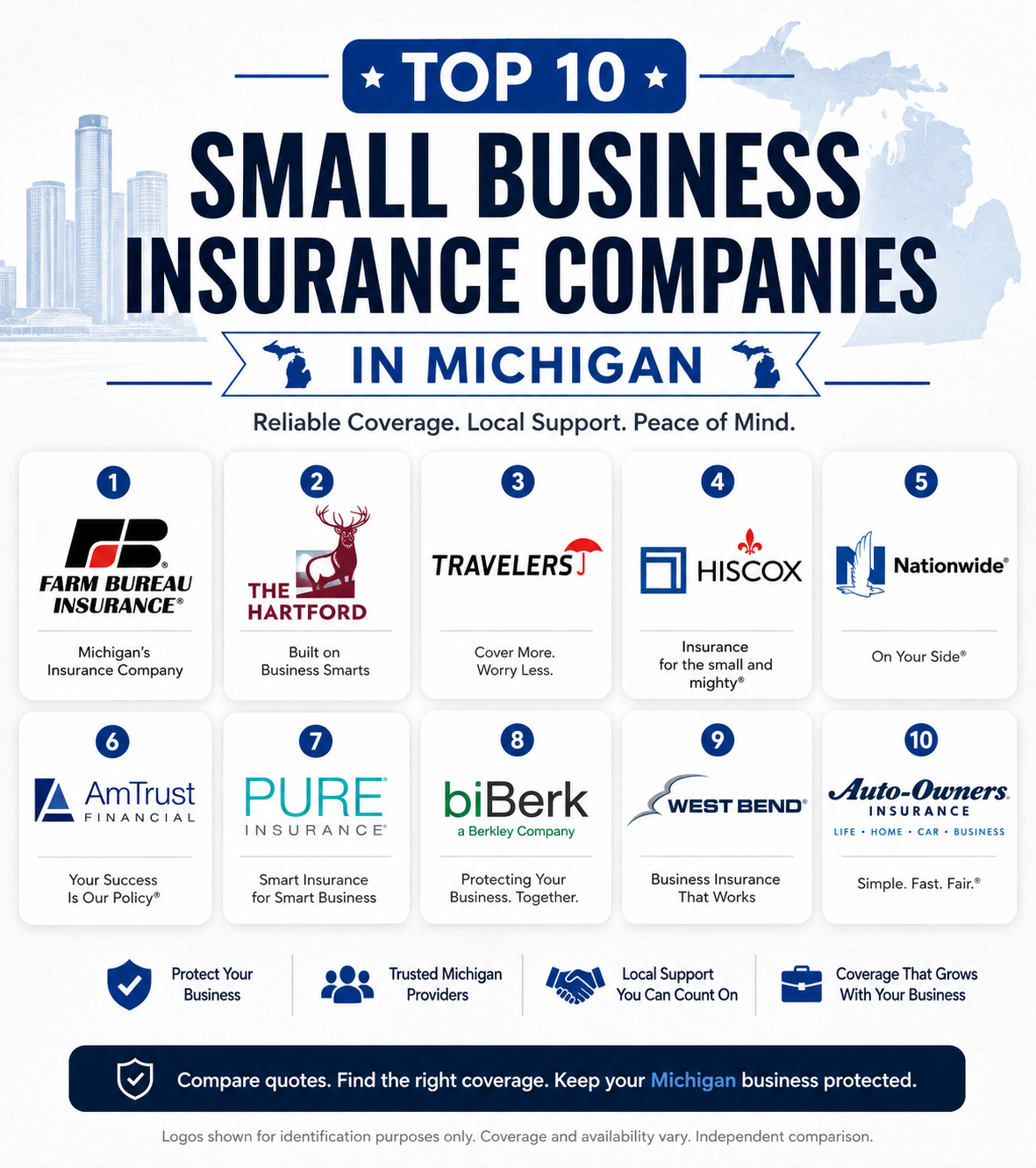
Small business insurance companies Michigan owners compare in 2026 should be reviewed by coverage fit, industry eligibility, certificate speed, claim support, workers’ compensation rules, vehicle exposure, payroll, revenue, contracts, and long-term scalability. A contractor in Detroit, a restaurant in Grand Rapids, a consultant in Ann Arbor, a retailer in Lansing, a trucking operation near Flint, or a manufacturing support business in Warren will not all need the same policy package.
Michigan small businesses commonly compare general liability insurance, business owners policies, commercial property insurance, workers’ compensation, professional liability, cyber liability, commercial auto, inland marine, tools and equipment coverage, employment practices liability, and umbrella liability. For many owners, the first policy starts with general liability or a BOP. As soon as the business adds employees, jobsite work, client contracts, leased space, vehicles, subcontractors, or higher-value equipment, the insurance conversation becomes broader.
Workers’ compensation is a major Michigan planning point. Michigan’s Workers’ Disability Compensation Act generally requires coverage for private employers regularly employing one or more employees working 35 hours or more per week for 13 weeks or longer during the preceding 52 weeks, and for private employers regularly employing three or more employees at one time, including part-time employees. Agricultural employers, domestic servants, public employers, partners, corporate officers, and LLC managers can also require careful review under Michigan rules.
Commercial auto also deserves special attention in Michigan because vehicles are subject to Michigan no-fault coverage requirements. Business-owned cars, trucks, vans, delivery vehicles, contractor vehicles, and employee-driven vehicles need to be reviewed separately from personal auto coverage. Michigan no-fault policies include required coverage components such as Personal Injury Protection, Property Protection, and residual bodily injury/property damage liability, and business contracts often call for limits above basic personal coverage.
If you are searching for business insurance near me in Michigan, start with your industry, contracts, payroll, vehicle use, property values, and certificate requirements. The best company is not always the cheapest company; it is the one that can write your actual exposure, issue the certificates you need, and respond when a claim or client request happens.
Coverage availability, premiums, eligibility, certificates, endorsements, deductibles, exclusions, and underwriting decisions vary by carrier, business class, payroll, location, vehicles, claims history, contracts, and Michigan-specific rules.
Quick facts: Michigan small business insurance in 2026
Michigan small businesses should compare insurance companies by industry appetite, workers’ compensation eligibility, no-fault vehicle exposure, certificate requirements, policy exclusions, and quote speed.
| Review point | What Michigan businesses should check | Why it matters |
|---|---|---|
| General liability | Third-party bodily injury, property damage, personal injury, advertising injury, and completed operations. | Often required by landlords, clients, vendors, lenders, and project contracts. |
| Workers’ compensation | Employee count, hours worked, payroll classification, ownership structure, exclusion forms, and proof of coverage. | Michigan rules can require coverage based on employee count, hours, and business structure. |
| Business owners policy | Liability plus business property coverage in one package for eligible operations. | Useful for offices, retail shops, service businesses, salons, and lower-to-moderate-risk operations. |
| Commercial auto | Business-owned vehicles, employee drivers, delivery, contractor trucks, trailers, and hired/non-owned auto exposure. | Michigan vehicle insurance rules and business contracts make auto review essential. |
| Certificates | COIs, additional insured wording, waiver of subrogation, primary/noncontributory wording, and project-specific forms. | Certificate problems can delay jobs, leases, vendor approvals, and project payments. |
Small business insurance companies Michigan owners commonly compare
Michigan business owners often compare online-first quote platforms, traditional commercial insurers, independent agency markets, and specialty carriers. The right option depends on the business class. A home-based consultant may qualify for a fast professional liability quote, while a roofing contractor, trucking company, restaurant, manufacturer, or multi-vehicle service business may need broader underwriting review.
Online quote platforms can work well for businesses that need general liability, BOP, professional liability, or quick certificate access. More complex operations may need a deeper look at jobsite work, subcontractor agreements, payroll, commercial vehicles, property values, equipment, prior losses, and client contracts. Michigan businesses with employees should also review workers’ compensation early so payroll classification and coverage timing do not become a problem.
| Option | Often reviewed for | Best-fit Michigan business type |
|---|---|---|
| NEXT Insurance | Online general liability, professional liability, tools and equipment, business policies, and select workers’ comp options where available. | Contractors, consultants, cleaning businesses, fitness professionals, salons, service providers, and small commercial operations. |
| Authentic Insurance | Digital quote-and-apply access for eligible small business insurance products. | Business owners who want a streamlined application path and quick eligibility review. |
| Coterie Insurance | Fast small business liability and BOP quoting for many eligible classes. | Professional services, offices, retail operations, local service companies, and straightforward small businesses. |
| Commercial auto quote path | Business vehicles, contractor trucks, vans, delivery vehicles, trailers, and employee driver exposure. | Contractors, mobile service providers, transportation operators, delivery businesses, and companies with business-use vehicles. |
| Specialty commercial markets | Harder-to-place liability, property, workers’ comp, commercial auto, and umbrella risks. | Restaurants, manufacturers, contractors, trucking, hospitality, repair shops, and businesses with unusual exposures. |
Coverage types Michigan businesses should compare
Most Michigan small businesses need more than one policy. General liability is a strong starting point, but it does not cover employee injuries, business vehicles, professional mistakes, cyber incidents, or all property losses. A complete insurance plan should match the business model and the contracts the company accepts.
| Coverage | What it helps protect | Common Michigan use case |
|---|---|---|
| General liability | Third-party injury, property damage, personal injury, advertising injury, and completed operations claims. | A contractor damages a client’s property or a customer is injured at a retail location. |
| BOP | Liability plus business personal property, tenant improvements, and covered property losses. | A shop, office, salon, studio, or service business wants bundled protection. |
| Workers’ compensation | Employee injuries arising out of work. | An employee slips, strains a back, cuts a hand, or is injured while performing job duties. |
| Commercial auto | Business vehicle liability, physical damage, hired auto, and non-owned auto exposure. | A company van, truck, delivery vehicle, or contractor vehicle is involved in an accident. |
| Professional liability | Professional errors, omissions, negligence, and service-related financial loss allegations. | A consultant, designer, bookkeeper, technology provider, or advisor is accused of a mistake. |
| Inland marine | Tools, equipment, materials, and movable property away from the main business premises. | A contractor’s tools or equipment are stolen from a trailer, truck, or jobsite. |
Michigan requirements that affect small business insurance
Michigan workers’ compensation rules are one of the most important compliance items for small businesses with employees. Private employers may need coverage when they regularly employ one or more employees working 35 hours or more per week for 13 weeks or longer during the preceding 52 weeks. Private employers may also need coverage when they regularly employ three or more employees at one time, including part-time employees. Agricultural employers, domestic servants, public employers, partners, corporate officers, and LLC managers can have additional treatment under Michigan law.
Contractors should also review licensing, project, and contract requirements. Certain construction and housing-related projects require evidence of comprehensive general liability, workers’ compensation, and employer’s liability coverage in the amounts required by the construction contract. Even when a specific insurance limit is not imposed by one statewide rule for every business, clients, landlords, municipalities, lenders, and project owners often require proof of liability insurance before work begins.
Michigan commercial auto planning should begin whenever a business owns, leases, borrows, or regularly uses vehicles for work. Michigan vehicles must carry required no-fault coverage components, and business use can create exposures that personal auto policies do not handle well. Contractors, delivery companies, mobile service providers, repair businesses, and sales teams should review business vehicle classification, drivers, garaging ZIP codes, radius, hired/non-owned auto exposure, and contract limit requirements.
| Requirement area | What to review | Business planning tip |
|---|---|---|
| Workers’ compensation | Employee count, hours worked, payroll, ownership structure, exemption/exclusion treatment, and proof of insurance. | Review coverage before hiring employees or signing contracts that require proof of workers’ comp. |
| Contractor work | General liability, workers’ compensation, employer’s liability, licensing, and project-specific insurance wording. | Send contract requirements before buying a policy so endorsements can be reviewed. |
| Commercial auto | Michigan no-fault requirements, business vehicle use, drivers, hired/non-owned auto, and contract limits. | Do not rely on personal auto coverage for regular business use. |
| Leases and client contracts | Additional insured, waiver of subrogation, primary/noncontributory language, and certificate holder details. | Certificate wording should be reviewed before a policy is bound. |
| Professional services | Errors and omissions requirements in client contracts or vendor agreements. | General liability does not replace professional liability coverage. |
What affects small business insurance cost in Michigan?
Michigan small business insurance cost depends on the business class, payroll, revenue, employee count, vehicle use, property values, prior claims, location, coverage limits, deductibles, endorsements, and contract requirements. A home-based bookkeeper will usually rate differently than a roofing contractor, restaurant, machine shop, delivery business, cleaning company, or manufacturer.
Workers’ compensation pricing is closely tied to payroll and class codes. General liability pricing can be influenced by revenue, subcontractor exposure, premises risk, completed operations, and business activities. Commercial auto pricing depends on vehicle type, garaging location, radius, drivers, business use, physical damage coverage, and limit selection. Property insurance can be affected by building construction, occupancy, protection class, equipment values, inventory, business interruption exposure, and deductible.
The lowest premium is not always the best value. A policy with weak exclusions, missing endorsements, poor certificate handling, low limits, or the wrong classification can create problems when a client asks for proof of coverage or when a claim occurs. The best quote comparison uses the same limits, deductibles, business description, payroll, vehicle details, and certificate requirements across options.
| Cost factor | Why it changes premium | What to prepare for a quote |
|---|---|---|
| Industry class | Higher-risk operations usually cost more because claim frequency or severity is greater. | Describe exactly what your business does and does not do. |
| Payroll | Workers’ compensation premiums are heavily tied to payroll and class codes. | Prepare estimated annual payroll by job duty and ownership status. |
| Revenue | Liability exposure often rises as sales and operations grow. | Provide current and projected annual gross receipts. |
| Vehicles | Business vehicles add no-fault, liability, physical damage, driver, and radius exposure. | Gather VINs, drivers, garaging ZIP codes, business use, and driving radius. |
| Claims history | Prior losses may affect eligibility, pricing, deductibles, and carrier interest. | Prepare loss runs if requested by the insurer. |
| Certificate wording | Contracts may require endorsements that change eligibility or cost. | Upload lease, client, vendor, or contractor requirements before binding. |
Small business insurance across Michigan cities and metros
Blake Insurance Group helps Michigan business owners compare coverage across major metros, manufacturing communities, college towns, logistics corridors, contractor-heavy markets, and local service areas. Your city matters because business property values, vehicle garaging, jobsite radius, employee exposure, client contracts, and certificate requirements can influence how coverage is structured.
| Michigan area | Common small business risks | Coverage to review |
|---|---|---|
| Detroit | Contractors, restaurants, retail, professional services, logistics, and mobile service businesses. | GL, BOP, workers’ comp, commercial auto, cyber, and umbrella. |
| Grand Rapids | Retail, hospitality, construction trades, offices, manufacturing support, and service companies. | Property, liability, workers’ comp, tools, equipment, and auto. |
| Ann Arbor | Technology, consulting, medical offices, education support, professional services, and restaurants. | Professional liability, BOP, cyber, GL, employment-related coverage, and workers’ comp. |
| Lansing | Government-adjacent services, offices, contractors, retail, restaurants, and local service providers. | BOP, general liability, workers’ comp, professional liability, and commercial auto. |
| Flint and Saginaw | Manufacturing support, contractors, repair shops, transportation, and service businesses. | Commercial auto, inland marine, workers’ comp, liability, and umbrella. |
| Warren, Sterling Heights, Livonia, Troy, Kalamazoo | Offices, trades, manufacturing support, retail, restaurants, mobile services, and professional firms. | BOP, GL, workers’ comp, cyber, commercial auto, and property coverage. |
Quote Michigan small business insurance online
Use the quote paths below to compare Michigan business insurance options. If your business needs general liability, BOP, professional liability, tools and equipment, or a contractor policy, start with the online business quote options. If your business uses trucks, vans, delivery vehicles, contractor vehicles, company cars, trailers, or employee drivers, use the commercial auto quote form.
Before starting a quote, gather your legal business name, DBA, address, FEIN, owner information, industry description, annual revenue, payroll, employee count, subcontractor costs, prior claims, desired limits, lease requirements, client contract requirements, vehicle details, and certificate holder information. Clear information helps improve quote accuracy and reduces delays when certificates or endorsements are needed.
Quote availability, binding eligibility, premiums, policy forms, certificates, endorsements, payment options, and effective dates vary by insurer, business class, Michigan rules, underwriting review, and completed application details.
Michigan small business insurance FAQs
What insurance does a small business in Michigan need?
Most Michigan businesses should review general liability, workers’ compensation, commercial property, business owners policy coverage, professional liability, cyber liability, inland marine, and commercial auto. The exact mix depends on employees, vehicles, contracts, property, industry, and customer requirements.
Is workers’ compensation required in Michigan?
Michigan generally requires workers’ compensation for private employers that regularly employ one or more employees working 35 hours or more per week for 13 weeks or longer during the preceding 52 weeks, and for private employers that regularly employ three or more employees at one time, including part-time employees. Ownership structure and exclusion rules should be reviewed carefully.
Do Michigan contractors need business insurance?
Many Michigan contractors need general liability, workers’ compensation if they have employees, commercial auto for business vehicles, inland marine for tools and equipment, and certificates that satisfy project owners or general contractors. Some projects may require specific liability, workers’ compensation, employer’s liability, bond, or certificate wording.
Does general liability cover business vehicles in Michigan?
No. General liability does not replace commercial auto insurance. If your business owns vehicles, uses trucks or vans, makes deliveries, sends employees on business errands, or relies on personal vehicles for work tasks, review commercial auto and hired/non-owned auto coverage.
Which Michigan small business insurance company is best?
The best company depends on your industry, payroll, revenue, vehicles, claims history, certificate needs, and required coverage. Compare online options and carrier eligibility using the same limits, deductibles, and endorsements before choosing.
Can I get a Michigan certificate of insurance online?
Many online business insurance platforms provide certificate access after a policy is issued. Always confirm additional insured wording, waiver of subrogation, primary/noncontributory language, employer’s liability requirements, and certificate holder details before assuming a certificate will satisfy a contract.
Independent agency: Blake Insurance Group LLC is an independent insurance agency and is not affiliated with NEXT Insurance, Authentic Insurance, Coterie Insurance, Michigan state agencies, any carrier, administrator, quote platform, or government entity.
Licensing: Licensed insurance producer (NPN 16944666).
Important: Business insurance availability, premiums, coverage limits, deductibles, endorsements, certificates, exclusions, underwriting decisions, claim outcomes, and effective dates vary by insurer, business class, payroll, revenue, location, vehicles, property values, prior claims, contract requirements, state rules, and policy form. Your issued policy, declarations page, endorsements, exclusions, certificates, and claim documents govern your coverage and obligations. This page is general information only and is not legal, tax, financial, compliance, payroll, employment, or claims advice.
Trademarks: NEXT®, Authentic Insurance®, Coterie®, and any carrier, platform, program, product, or agency names are trademarks™ or registered® trademarks of their respective owners. Use of these names does not imply affiliation or endorsement.




