Small Business Insurance in Alabama: General Liability, BOP, Workers’ Comp, Commercial Auto, Cyber, Tools, Certificates, and Contract Requirements
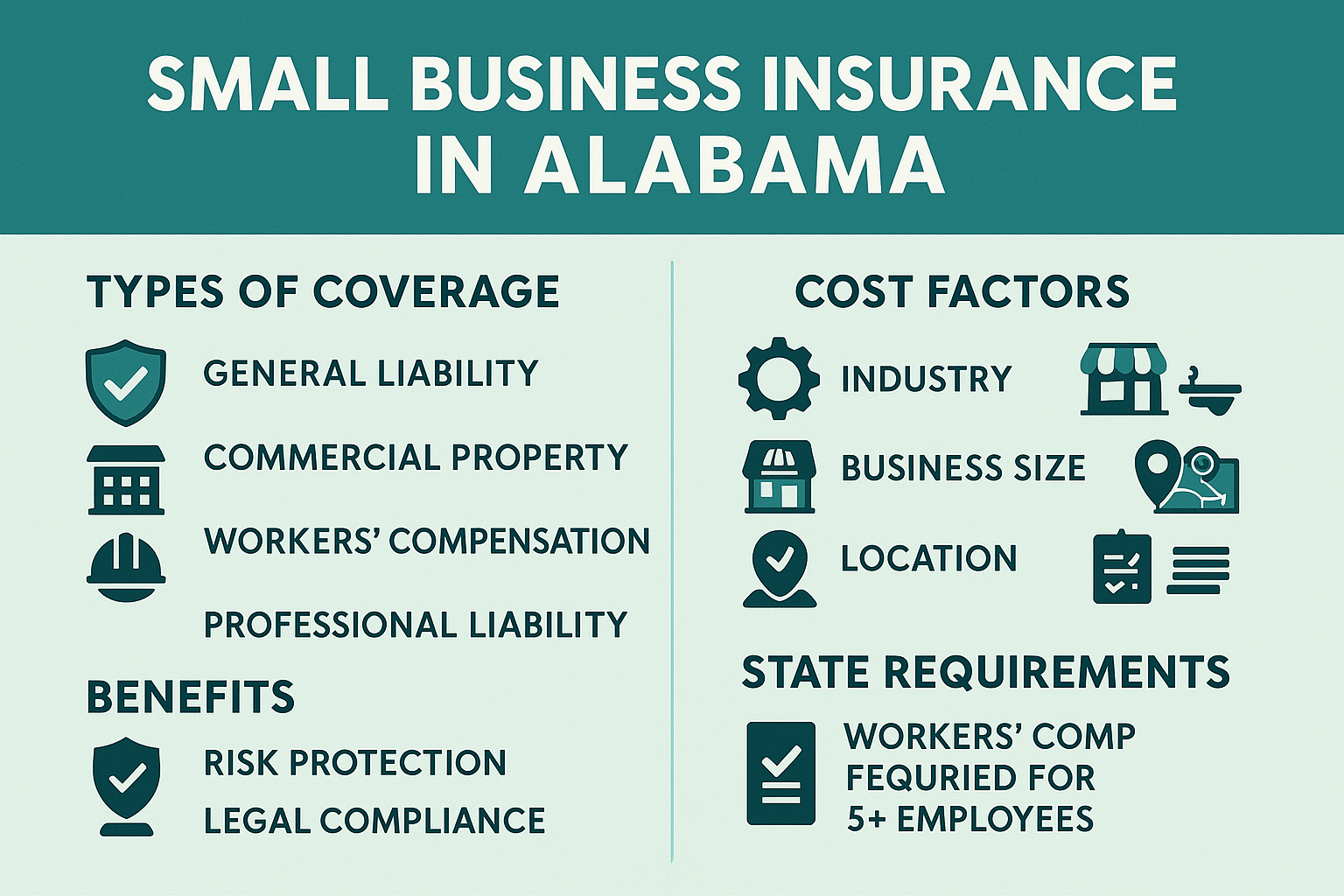
Small business insurance in Alabama should be built around the work you perform, where you serve customers, the property you depend on, the employees you hire, the vehicles you use, and the insurance documents your contracts require. A Birmingham contractor, Huntsville technology company, Montgomery professional office, Mobile restaurant, Tuscaloosa retailer, Auburn consultant, Dothan service business, Hoover repair shop, or rural Alabama field-service company will not always need the same insurance package. The right plan should match your actual operation, your industry, your customers, your locations, and your proof-of-insurance deadlines.
Alabama businesses operate across construction, aerospace and defense support, automotive manufacturing, logistics, healthcare support, restaurants, retail, hospitality, agriculture-related services, professional services, repair trades, local vendors, and home-based operations. That variety matters because insurance underwriting looks at industry, revenue, payroll, business property, vehicles, prior claims, contract wording, subcontractor use, customer traffic, products exposure, and certificate requirements. A business that only needs basic general liability has a very different risk profile than a company with employees, leased space, inventory, fleet vehicles, customer data, subcontractors, delivery routes, commercial equipment, or multiple locations.
Alabama also requires careful review because workers’ compensation, Secretary of State filings, state and county business privilege licenses, local city licensing, professional licenses, commercial auto, and contract insurance requirements are separate issues. Alabama Secretary of State Business Services administers business entity responsibilities such as registering new businesses, while Alabama Department of Revenue business-license resources coordinate state and county business privilege licenses. Alabama workers’ compensation requirements should also be reviewed closely because many employers that regularly employ five or more employees need coverage. Insurance does not replace licensing, registration, tax, or permit obligations, but the right coverage package can help your business qualify for leases, jobsites, vendor approvals, lender requests, municipal requirements, and commercial contracts.
An Alabama business insurance plan should be reviewed around operations, employees, property, vehicles, cyber exposure, contracts, certificates, workers’ compensation, business privilege licenses, and local requirements—not just the lowest premium.
Quick snapshot: how small business insurance works in Alabama
Small business insurance is usually a coverage package, not a single policy. Most Alabama businesses review general liability, property, BOP coverage, workers’ compensation, business auto, cyber, professional liability, tools, umbrella, endorsements, and certificates.
| Coverage question | What to review | Why it matters |
|---|---|---|
| Do customers visit you or do you visit them? | General liability, premises exposure, products liability, completed operations, and customer property damage. | Customer injury, property damage, and contract disputes can affect contractors, retailers, offices, restaurants, vendors, and service businesses. |
| Do you own or lease business property? | Building, contents, inventory, equipment, tenant improvements, signs, computers, and business income. | A BOP or commercial property policy can help protect physical assets and revenue after covered losses. |
| Do you have employees? | Workers’ compensation, employer liability, payroll, class codes, owner status, subcontractors, and contract proof requirements. | Alabama employers that regularly employ five or more employees should review workers’ compensation requirements carefully. |
| Do you use vehicles for business? | Commercial auto, hired and non-owned auto, driver lists, delivery routes, trailers, and vehicle ownership. | Personal auto may not cover business use, employee driving, commercial deliveries, hauling, or company-owned vehicles. |
| Do contracts require proof? | Additional insured, waiver of subrogation, primary noncontributory wording, umbrella limits, and certificate holders. | Missing wording can delay a jobsite, lease, vendor account, event, municipal approval, payment, or customer onboarding. |
Coverage types Alabama businesses should review
Most Alabama businesses begin with general liability insurance. General liability helps respond to covered third-party bodily injury, third-party property damage, personal and advertising injury, products liability, completed operations, and defense costs. It is commonly requested by landlords, property managers, general contractors, municipalities, lenders, vendor platforms, commercial customers, and event venues. General liability is important, but it does not cover every business risk. It does not replace your own tools, insure employee injuries, protect business-owned vehicles, respond to every professional error allegation, or restore lost income after every type of interruption.
A Business Owner’s Policy, often called a BOP, can be a strong fit for eligible Alabama businesses because it combines general liability with commercial property and business income coverage. Retailers, offices, small professional firms, restaurants, salons, repair shops, clinics, eligible service businesses, and local storefronts often compare BOP options when they lease space, own equipment, keep inventory, or need income protection after a covered loss. In Alabama, property coverage should be reviewed around wind, hail, severe storms, tornado, coastal exposure, fire, roof age, equipment breakdown, outdoor signs, water backup, business income waiting periods, and tenant improvements.
Businesses with employees should review workers’ compensation carefully. Alabama employers that regularly employ five or more employees typically need workers’ compensation coverage, and payroll, class codes, ownership details, job duties, subcontractors, and certificate requirements should be reviewed before hiring or bidding. Businesses with vehicles should compare commercial auto, hired and non-owned auto, driver screening, vehicle schedules, deliveries, trailers, and route exposure. Businesses that store customer information, use email invoicing, accept electronic payments, or rely on cloud software should review cyber liability. Consultants, designers, technology firms, accountants, real estate-related businesses, marketing agencies, and other professional service providers should review professional liability or errors and omissions coverage.
| Coverage | What it helps protect | Alabama business review point |
|---|---|---|
| General liability | Third-party injury, property damage, products, completed operations, and legal defense for covered claims. | Review operations, premises exposure, contracts, additional insured wording, products exposure, and exclusions. |
| Business Owner’s Policy | General liability plus business property and business income for eligible businesses. | Review wind, hail, tornado, coastal, roof age, equipment breakdown, business income, and tenant improvements. |
| Workers’ compensation | Employee job-related injuries and employer liability exposure when coverage applies. | Review employee count, payroll, class codes, owner status, subcontractors, and contract proof requirements. |
| Commercial auto | Business-owned cars, trucks, vans, trailers, and vehicles used for company operations. | Review delivery, hauling, employee driving, vehicle ownership, garaging, routes, driver lists, and limits. |
| Cyber liability | Data breach, ransomware, privacy incidents, fraud response, recovery costs, and notification expenses. | Important for businesses using email, online payments, client records, scheduling tools, or cloud software. |
| Professional liability / E&O | Financial loss allegations tied to advice, services, errors, omissions, or professional judgment. | Review contracts, retroactive dates, claims-made terms, defense provisions, and excluded services. |
| Tools and inland marine | Tools, mobile equipment, rented equipment, installation materials, and property in transit. | Schedule high-value items and document replacement values, serial numbers, storage, and jobsite exposure. |
| Umbrella / excess liability | Additional liability limits over eligible underlying policies. | Useful for larger contracts, fleets, events, property owners, manufacturers, contractors, and higher-risk operations. |
A certificate of insurance is proof of current coverage, not a coverage upgrade. The policy, endorsements, exclusions, limits, deductibles, and effective dates control what the insurer can actually do.
Alabama business registration, privilege licenses, workers’ comp, local permits, and contract requirements
Alabama businesses should separate insurance from entity registration, tax accounts, business privilege licenses, local licensing, professional licensing, and signed contracts. Insurance can help manage liability, property, employee injury, cyber, vehicle, and professional risk, but it does not replace a business entity filing, name reservation, business privilege license, city license, regulated professional license, food permit, contractor requirement, zoning approval, or event authorization. Alabama Secretary of State Business Services administers business-related responsibilities including new business registration and business entity records, while Alabama Department of Revenue business-license resources oversee and coordinate state and county business privilege licenses.
Alabama Department of Revenue guidance describes a business privilege license as a license requirement for every person, firm, company, or corporation engaged in covered businesses, vocations, occupations, or professions under Alabama law. Rates and local steps can vary by business activity, county, municipality, capital invested, gross orders, or other statutory conditions. That license review is separate from insurance. A retailer, restaurant, repair shop, contractor, consultant, event vendor, or service business can have the correct liability policy and still need the correct state, county, municipal, professional, or tax registration to operate legally.
Workers’ compensation is another major Alabama review point. Alabama Department of Labor workers’ compensation resources provide insurance requirement information and employer guidance, and most Alabama employers that regularly employ five or more employees should review workers’ compensation coverage. Some businesses may also review self-insurance requirements, but Alabama self-insurance eligibility requires substantial financial qualifications. Because employee count, payroll, ownership, subcontractors, industry, and contract wording can change the analysis, Alabama businesses should verify workers’ comp obligations before hiring, entering a jobsite, renewing insurance, or bidding on work that requires proof of coverage.
| Requirement area | What to review | Action step |
|---|---|---|
| Business registration | LLC, corporation, partnership, registered agent, name reservation, Secretary of State records, and ownership details. | Confirm the legal business name, entity status, registered address, and filing details before quoting or issuing certificates. |
| Business privilege license | State, county, and local license requirements, business type, location, gross receipts, capital, and municipal rules. | Verify Alabama business privilege license needs separately from insurance and keep license details aligned with operations. |
| Workers’ compensation | Employee count, payroll, class codes, owner status, subcontractors, self-insurance eligibility, and contracts. | Review Alabama coverage requirements before hiring, bidding, entering jobsites, or renewing coverage. |
| Local licenses and permits | City, county, trade, food, health, professional, construction, event, zoning, and occupancy requirements. | Check location and industry rules before operating, selling, building, hosting, delivering, or serving customers. |
| Contract insurance wording | Additional insured, waiver of subrogation, primary noncontributory, umbrella limits, COIs, and policy endorsements. | Send written insurance clauses before binding coverage or issuing certificates. |
| Subcontractors and vendors | Certificates, written agreements, workers’ comp proof, additional insured status, and audit records. | Collect documentation before work begins and keep records for renewals, audits, contract disputes, and claims. |
Alabama businesses that should compare insurance
Business insurance is not only for large companies. Small shops, solo professionals, contractors, restaurants, home-based businesses, seasonal vendors, consultants, repair shops, delivery businesses, technology firms, manufacturers, healthcare-related offices, hospitality vendors, logistics operations, agriculture-adjacent service providers, and local service companies all face risk when customers rely on their work. A small lawsuit, stolen equipment, employee injury, vehicle accident, cyber incident, product allegation, storm loss, water damage claim, or rejected certificate can interrupt revenue and strain a business quickly.
Alabama’s economy includes Birmingham-area professional services and healthcare, Huntsville aerospace and technology support, Mobile port and coastal commerce, Montgomery government and service operations, Tuscaloosa hospitality and university activity, automotive manufacturing, agriculture-related services, construction, logistics, restaurants, retail, and local field-service operations. That means insurance planning should account for geography as well as industry. A Huntsville technology consultant may need professional liability and cyber. A Mobile restaurant or coastal hospitality business may need BOP, spoilage, equipment breakdown, workers’ comp, wind review, and business income planning. A Birmingham contractor may need general liability, tools, workers’ comp, and commercial auto. A manufacturing or auto-supply business may need products liability and equipment breakdown. A rural service business may need trailers, inland marine, and property coverage built around distance, weather, and mobile equipment.
| Business type | Common exposure | Coverage focus |
|---|---|---|
| Contractors and trades | Jobsite injury, property damage, completed operations, tools, vehicles, subcontractors, and certificate requirements. | General liability, workers’ comp, tools, commercial auto, umbrella, and endorsements. |
| Retail and storefronts | Customer slips, inventory, business property, signs, theft, storm damage, and business income loss. | BOP, general liability, property, cyber, equipment breakdown, and business income. |
| Restaurants, food, and hospitality | Customer injury, food-related claims, equipment breakdown, spoilage, delivery, and employment issues. | GL, property, spoilage, equipment breakdown, workers’ comp, cyber, commercial auto, and liquor liability if applicable. |
| Professional services and tech | Advice, deliverables, client records, missed deadlines, contract disputes, and data privacy exposure. | Professional liability, cyber, general liability, BOP, and employment practices review. |
| Manufacturing and logistics | Products liability, equipment breakdown, supply chain dependency, vehicles, workplace injury, and customer contracts. | GL, property, workers’ comp, products liability, equipment breakdown, commercial auto, cyber, and umbrella. |
| Mobile, coastal, and field services | Venue requirements, mobile equipment, business driving, tools, customer property, and storm exposure. | General liability, inland marine, commercial auto, HNOA, workers’ comp, property, and umbrella. |
Certificates of insurance, endorsements, and Alabama contract wording
Certificates of insurance are often the key to getting approved for a lease, jobsite, vendor packet, event, municipal requirement, lender request, property management agreement, or commercial customer. The challenge is that a COI does not automatically satisfy the written contract. The certificate holder may require additional insured status, waiver of subrogation, primary and noncontributory wording, per-project aggregate, completed operations additional insured, umbrella limits, commercial auto limits, workers’ compensation proof, professional liability, cyber coverage, or specific cancellation wording. Some requirements can be added quickly. Others require underwriting approval, a different policy form, or a different carrier.
The fastest way to avoid delays is to send the full insurance clause before buying or renewing coverage. That allows the policy to be built around the required wording instead of trying to fix a rejected certificate after a deadline. Alabama contractors, vendors, consultants, manufacturers, repair services, janitorial companies, restaurants, event businesses, delivery operations, port-related vendors, coastal hospitality businesses, and professional firms should keep a simple certificate checklist ready: certificate holder legal name, certificate holder address, project description, job location, contract insurance clause, required endorsements, required limits, workers’ compensation requirements, and deadline.
| Requirement | What it does | Where it appears |
|---|---|---|
| Additional insured | Extends certain liability protection to a client, landlord, general contractor, or project owner as allowed by the endorsement. | Leases, construction contracts, vendor onboarding, event agreements, property management agreements, and commercial customer contracts. |
| Primary and noncontributory | Requires your policy to respond first for covered claims before the certificate holder’s insurance. | General contractor agreements, landlord contracts, municipal work, and larger commercial contracts. |
| Waiver of subrogation | Limits the insurer’s ability to recover against a protected party after a covered claim. | Construction, landlord, project owner, event, venue, property management, and vendor agreements. |
| Per-project aggregate | Applies the aggregate limit separately to covered projects when available. | Construction, installation, repair, municipal, and larger project contracts. |
| Hired and non-owned auto | Provides liability coverage for certain rented vehicles and employee-owned vehicles used for business. | Delivery, sales, errands, consulting visits, nonprofit operations, events, and mixed driving exposure. |
| Umbrella / excess limits | Adds higher liability limits above eligible underlying policies. | Higher-value contracts, fleets, manufacturers, property owners, municipalities, and event requirements. |
What affects small business insurance cost in Alabama?
Alabama business insurance pricing depends on what the business does, how much revenue it generates, how many people it employs, where it operates, what property it owns, how many vehicles it uses, what contracts require, and what losses have occurred in the past. A low-risk consultant will not price like a roofer, trucking operation, restaurant, manufacturer, logistics company, delivery company, construction subcontractor, food vendor, auto repair shop, machine shop, or retailer with inventory. Pricing also changes when a business adds employees, expands locations, buys vehicles, increases payroll, stores more inventory, signs larger contracts, or needs umbrella limits.
The best quote is not always the cheapest quote. A cheaper policy can become expensive if it excludes the actual work performed, lacks completed operations coverage, cannot issue a required additional insured endorsement, omits hired and non-owned auto, leaves tools uninsured, uses inaccurate payroll, fails to include business income, or does not meet a lease or vendor requirement. Alabama businesses should compare quote quality: limits, deductibles, exclusions, endorsements, claims handling, certificate speed, carrier appetite, billing structure, audit terms, and whether the policy can grow with the business.
| Cost factor | Why it changes pricing | What to prepare |
|---|---|---|
| Industry and operations | Higher-hazard work has greater injury, property damage, products, completed operations, and professional exposure. | Clear description of all services, products, locations, jobsite work, delivery operations, and excluded operations. |
| Revenue and payroll | Sales and payroll often determine rating basis for liability, property, and workers’ compensation planning. | Annual revenue, payroll by role, owner payroll, employee count, subcontractor cost, and officer/member details. |
| Property and equipment | Buildings, inventory, tools, signs, computers, equipment, and tenant improvements affect property pricing. | Replacement values, addresses, roof age, security details, equipment list, and business income needs. |
| Vehicles and drivers | Business auto pricing depends on vehicles, use, garaging, driving radius, drivers, and loss history. | Vehicle schedule, driver list, VINs, routes, trailer details, MVRs, and business use description. |
| Contracts and endorsements | Special wording and higher limits can affect eligibility, price, and underwriting review. | Insurance clauses, certificate holder details, required limits, and requested endorsements. |
| Claims history and safety | Prior losses and weak controls can reduce carrier options or increase premiums. | Loss runs, safety procedures, employee training, maintenance logs, cyber controls, and corrective actions. |
Quote and buy Alabama small business insurance online
Blake Insurance Group helps Alabama small businesses compare online quote options for general liability, Business Owner’s Policies, professional liability, workers’ compensation, commercial auto, cyber, tools and equipment, and related business coverage. The right starting point depends on your business type, certificate deadline, contract wording, employee structure, vehicle use, property exposure, license status, and whether you need coverage today or a broader review. NEXT, First Connect, and Coterie can each be useful depending on the class of business, available carrier appetite, desired limits, certificate needs, and underwriting requirements.
Before starting a quote, gather your legal business name, DBA or trade name, Alabama business address, entity type, Secretary of State filing details if applicable, business privilege license details if applicable, industry description, annual revenue, payroll, employee count, subcontractor cost, years in business, prior insurance, prior claims, vehicles, equipment values, lease or contract requirements, certificate holder information, and requested coverage limits. If a landlord, lender, venue, general contractor, municipality, vendor platform, manufacturer, property manager, port authority, or commercial customer gave you written insurance requirements, review those requirements before selecting a policy. That prevents buying coverage that looks affordable but cannot satisfy the paperwork needed to operate.
Coverage is not bound until the application is completed, underwriting requirements are satisfied, payment is accepted where required, and the insurer confirms the policy effective date.
Alabama small business insurance FAQs
Is small business insurance required in Alabama?
Requirements depend on the business type, employees, vehicles, property, contracts, leases, local permits, professional licensing, business privilege license rules, and customer requirements. Many landlords, lenders, municipalities, venues, general contractors, and commercial customers require proof of liability insurance before work begins, even when a specific coverage is not required for every business by state law.
Do Alabama businesses need workers’ compensation insurance?
Many Alabama employers that regularly employ five or more employees need workers’ compensation coverage. Employee count, payroll, ownership, subcontractors, industry, and contract requirements should be reviewed carefully before hiring, bidding, or entering a jobsite.
What is the difference between general liability and a BOP?
General liability helps with covered third-party injury and property damage claims. A Business Owner’s Policy usually combines general liability with commercial property and business income coverage for eligible businesses. A BOP can be a stronger fit when you own equipment, inventory, tenant improvements, furniture, computers, or other business property.
Can I get a certificate of insurance online?
Many online business insurance platforms can issue certificates after coverage is bound. Before buying, compare whether the policy can provide the exact limits and endorsements required by the certificate holder, including additional insured, waiver of subrogation, primary noncontributory wording, workers’ comp proof, or umbrella limits.
Do I need commercial auto if I already have personal auto insurance?
You may need commercial auto if a vehicle is owned by the business, used for deliveries, used for jobsite travel, used by employees, used to haul tools or materials, or required by contract. Hired and non-owned auto should also be reviewed when employees use personal vehicles for business tasks.
Which quote option should I start with?
Start with the platform that best matches your business type, coverage need, and certificate deadline. NEXT, First Connect, and Coterie can each be useful for different Alabama small business situations, so compare eligibility, pricing, limits, endorsements, policy forms, and certificate options.
Independent agency: Blake Insurance Group LLC is an independent insurance agency and is not affiliated with any single insurance company, quote platform, government agency, licensing office, taxing authority, Alabama Secretary of State, Alabama Department of Revenue, Alabama Department of Labor, carrier, landlord, municipality, lender, vendor platform, general contractor, property manager, or certificate holder.
Licensing: Licensed insurance producer (NPN 16944666).
Important: Business insurance availability, eligibility, premiums, limits, deductibles, exclusions, endorsements, certificate wording, workers’ compensation requirements, business registration, business privilege license requirements, local licenses, professional licensing, commercial auto requirements, underwriting approval, online quote availability, and claim outcomes vary by business, location, industry, insurer, policy, contract, and Alabama law. Your issued policy, endorsements, declarations, applicable law, contracts, permits, licenses, and tax guidance govern your obligations and coverage. This page is general information only and is not legal, tax, licensing, accounting, risk-management, or claims advice.
Trademarks: NEXT Insurance®, First Connect®, Authentic Insurance®, Coterie Insurance®, and any carrier, quote platform, trade, city, state, government, licensing, or program names are trademarks™ or registered® trademarks of their respective owners. Use of these names does not imply affiliation or endorsement.




