Texas • Collector vehicles
Classic Auto Insurance in Texas: What Collectors Need to Know
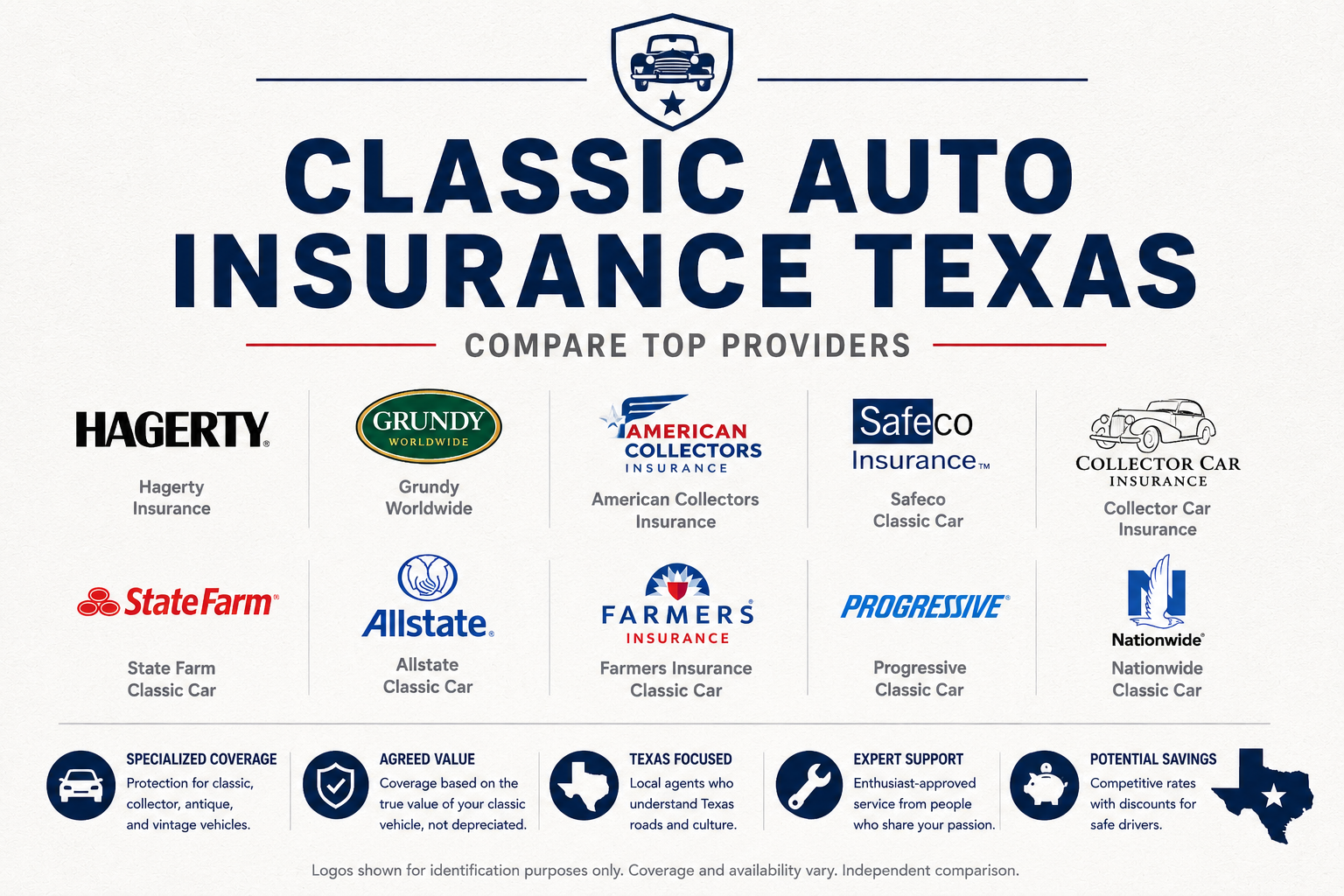
Classic auto insurance in Texas protects collector vehicles with agreed value coverage while meeting Texas's 30/60/25 liability requirement. Texas offers antique license plates for vehicles at least 25 years old, and the application requires proof of insurance. Hail, flooding, and long event drives make the right coverage especially important in Texas.
This guide covers Texas plates and requirements, Texas-specific risks, valuation, and how to compare quotes. Blake Insurance Group is an independent agency licensed in Texas. For a general overview, see our classic auto insurance guide.
Get a Texas classic car quote
Tell us about your collector vehicle, and a licensed agent will follow up with options available to us. Submitting the form does not bind coverage.
If the form does not load, call 888-387-3687, Monday through Friday, 9:00 to 5:00, or email info@blakeinsurancegroup.com.
Texas antique plates and registration
Texas offers antique license plates for vehicles at least 25 years old. To apply, owners complete the Application for Antique License Plates (form VTR-54), available from the Texas Department of Motor Vehicles, and provide proof of insurance or a Department of Public Safety SR-2 waiver, ownership documents, and fees, according to the Dallas County Tax Office. Antique-plated vehicles are subject to use restrictions, generally limited to exhibitions, club activities, parades, and similar purposes, so check current TxDMV rules before relying on antique registration. Vehicles that do not meet those limits can be registered with standard plates and still insured under a classic policy if the insurer's usage rules are met.
Texas insurance requirements
| Coverage | Minimum |
|---|---|
| Bodily injury liability | $30,000 per person / $60,000 per accident |
| Property damage liability | $25,000 per accident |
| PIP and UM/UIM | Must be offered; can be rejected in writing |
Source: Insurance Information Institute table. Texas is an at-fault state.
Texas-specific risks for collector cars
- Hail. Texas has frequent, severe hail. Comprehensive with agreed value is essential for collector cars, and secure garaging reduces risk.
- Flooding. Hurricanes and flash floods can total a car. Comprehensive covers flood damage.
- Heat. Extreme heat stresses older cooling systems; collector roadside and flatbed towing help.
- Long event drives. Texas shows and cruises often involve long distances; check mileage limits and trip coverage.
- Theft. Secure storage and anti-theft devices reduce risk and may be required.
Classic vs. regular coverage
| Feature | Classic car insurance | Regular auto insurance |
|---|---|---|
| Valuation | Agreed or guaranteed value set in advance | Actual cash value, which reflects depreciation |
| Usage | Limited pleasure use, shows, club events; mileage limits common | Unrestricted daily driving |
| Storage | Often requires a locked garage or secure storage | No storage requirement |
| Driver rules | Clean records, minimum ages, and a regular-use vehicle often required | Broad driver eligibility |
| Cost | Often lower for qualifying vehicles because of limited use | Priced for daily exposure |
| Extras | Spare parts, restoration, and show-trip coverage options | Rental, roadside, and new car replacement options |
General comparison. Eligibility rules and coverage options vary by insurer.
Agreed value and documentation
The most important difference is how a total loss is paid. A regular auto policy pays actual cash value: the market value at the time of loss, minus depreciation, which can be far below what a collector car is worth. Classic policies typically use agreed or guaranteed value, where you and the insurer agree on the car's value when the policy is written, and that amount is paid if the car is totaled, minus any deductible where one applies. Stated value policies are different: they may pay the lesser of the stated amount or actual cash value. Read the valuation wording carefully, and update the agreed value after restoration work or as market values rise. Keep appraisals, receipts, and photos.
Who qualifies
Specialty insurers set their own eligibility rules, but common requirements include:
- Vehicle age or status. Many insurers look for vehicles at least 20 to 25 years old, though some cover modern collectibles, exotics, and limited-production vehicles.
- Condition. The vehicle is maintained, restored, or being restored, and is not a daily driver.
- Storage. A locked, enclosed garage or storage unit.
- Regular-use vehicle. Each household driver has another car for daily transportation.
- Driving record. Clean records and minimum driver ages, often 25 or older.
- Usage limits. Pleasure use, club activities, and shows, sometimes with annual mileage caps.
Coverage options to consider
- Spare parts coverage for parts you store for the vehicle.
- Restoration or under-construction coverage that increases value as work is completed.
- Flatbed towing to protect the vehicle during transport.
- Show and trip coverage, including transport to events.
- Inflation guard that increases agreed value over time.
- Roadside assistance designed for collector vehicles.
When an agent may help
Online tools work well for simple situations. A conversation with a licensed agent may be more useful when:
- You have a teen driver, several vehicles, or drivers with recent accidents or violations.
- You need an SR-22 or other state filing. See our SR-22 insurance page.
- You use a vehicle for rideshare, delivery, or other business purposes.
- You own a home, rental property, or significant savings and want liability limits that work with an umbrella policy.
- You have had a claim denied or a policy nonrenewed and need help understanding your options.
An agent can also explain differences in policy wording that are hard to see on a results page.
Insuring a car under restoration
A car being restored has a value that changes as work progresses. Some classic insurers offer restoration or under-construction coverage that increases the insured value on a schedule or as you document completed work. Keep receipts and dated photos of each stage. If the car is at a body shop or restoration shop for an extended period, ask whether your policy covers it while in the shop's care and whether the shop carries garagekeepers coverage.
Classic car claims
Collector car claims differ from everyday claims. Ask whether you can choose a restoration specialist, how original or reproduction parts are handled, and whether the policy pays for diminished value after repairs. With agreed value coverage, a total loss pays the agreed amount; some insurers let you buy back the salvage. Report claims promptly and document damage thoroughly.
Shows, clubs, and transport
Car shows, club rallies, parades, and track-style events are central to collector ownership, but coverage varies. Most classic policies cover driving to and from shows and club events. Racing, timed events, and track days are usually excluded and need separate coverage. When trailering a car to an event, confirm whether the policy covers it during loading, transport, and unloading, and whether the trailer itself is covered.
Liability and umbrella for collectors
Collectors often have significant assets, and a serious accident in any vehicle can lead to a large claim. Classic policies include liability, but limits may be modest by default. Ask about higher liability limits, and consider an umbrella policy, checking whether the umbrella insurer requires the classic policy's liability limits to meet a minimum.
Storage and security
Most classic insurers require a locked, enclosed garage, and some accept secure storage facilities. Security measures such as alarms, cameras, battery disconnects, and steering locks reduce theft risk. Check whether the policy covers the car while stored at another location, such as a seasonal storage facility, and tell your insurer if storage changes.
Appraisals and inspections
Many classic insurers set agreed value using your estimate supported by photos, with a professional appraisal required for higher-value vehicles. An appraisal from a recognized appraiser documents condition, originality, and comparable sales. Update it every few years or after significant work. Some insurers inspect vehicles or request additional photos before binding coverage on high-value cars.
A hail plan for Texas collectors
Keep the car garaged during hail season, avoid parking outdoors at shows when storms are forecast, and carry a fitted hail cover for trips. Document the car's condition with dated photos before each season so pre-existing damage is not confused with new hail damage on a claim.
What to have ready for a Texas classic quote
These details help produce accurate quotes.
- Vehicle details. Year, make, model, VIN, and modifications.
- Value documentation. Appraisal, receipts, and photos.
- Storage. Garage type and location in Texas.
- Registration. Antique or standard plates.
- Drivers and daily vehicles. Records and regular-use vehicles for each driver.
Texas classic auto insurance FAQs
Is classic car insurance cheaper than regular insurance?
Often, for qualifying vehicles, because of limited use and careful owners. Eligibility rules apply.
Can I drive my classic car every day?
Most classic policies prohibit daily driving and commuting. Regular insurance is needed for daily use.
What is agreed value?
A value you and the insurer agree on when the policy is written, paid if the car is totaled.
Do I need a garage?
Most classic insurers require a locked, enclosed garage or secure storage.
Does classic insurance cover modified cars?
Many insurers cover modified vehicles and restomods. Disclose modifications and include them in the agreed value.
Can I insure a car under restoration?
Some insurers offer restoration coverage that increases value as work progresses.
How old must a car be for Texas antique plates?
At least 25 years old.
Do I need insurance for antique plates in Texas?
Yes. The application requires proof of insurance or an SR-2 waiver.
Does classic insurance cover hail in Texas?
Comprehensive coverage covers hail, typically at the agreed value for a total loss.
Can I drive an antique-plated car to work in Texas?
Antique plates carry use restrictions. Check current TxDMV rules, and remember classic policies usually prohibit commuting.
Does my classic policy cover me in Mexico?
Generally not to Mexico's requirements. Buy a separate Mexican policy before crossing.
How often should I update my agreed value?
Review it every year and after restoration work or market changes.
Do I need an appraisal?
It depends on the insurer and the car's value. High-value vehicles often require one.
Is Texas an at-fault state?
Yes. Texas follows an at-fault system for auto accidents.
Related guides
Important information
Independent agency. Blake Insurance Group LLC is an independent insurance agency. Licensed insurance producer NPN 16117464. Licensed states: AZ, AL, TX, CA, NY, OH, FL, NC, VA, GA, OK, NM, IA, KS, MI, NE, SC, SD, WV, IL, NJ, PA, TN, and WA. Which insurance companies we can quote depends on our current appointments, the product, and your state. Mentioning a company on this page does not mean we represent it.
Legal requirements. State requirements summarized here are general information as of October 2026 and can change. This page is not legal advice; confirm current rules with your state's insurance regulator or motor vehicle agency.
Availability. Coverage, prices, discounts, and eligibility vary by insurer, state, and applicant, and are subject to underwriting. The issued policy controls.
Your next step
Request a quote, and a licensed agent will compare Texas classic auto options available to us.