Tesla comparison • Insurance cost factors • Independent analysis
Tesla Model 3 vs. Model Y: Car Insurance Cost Comparison
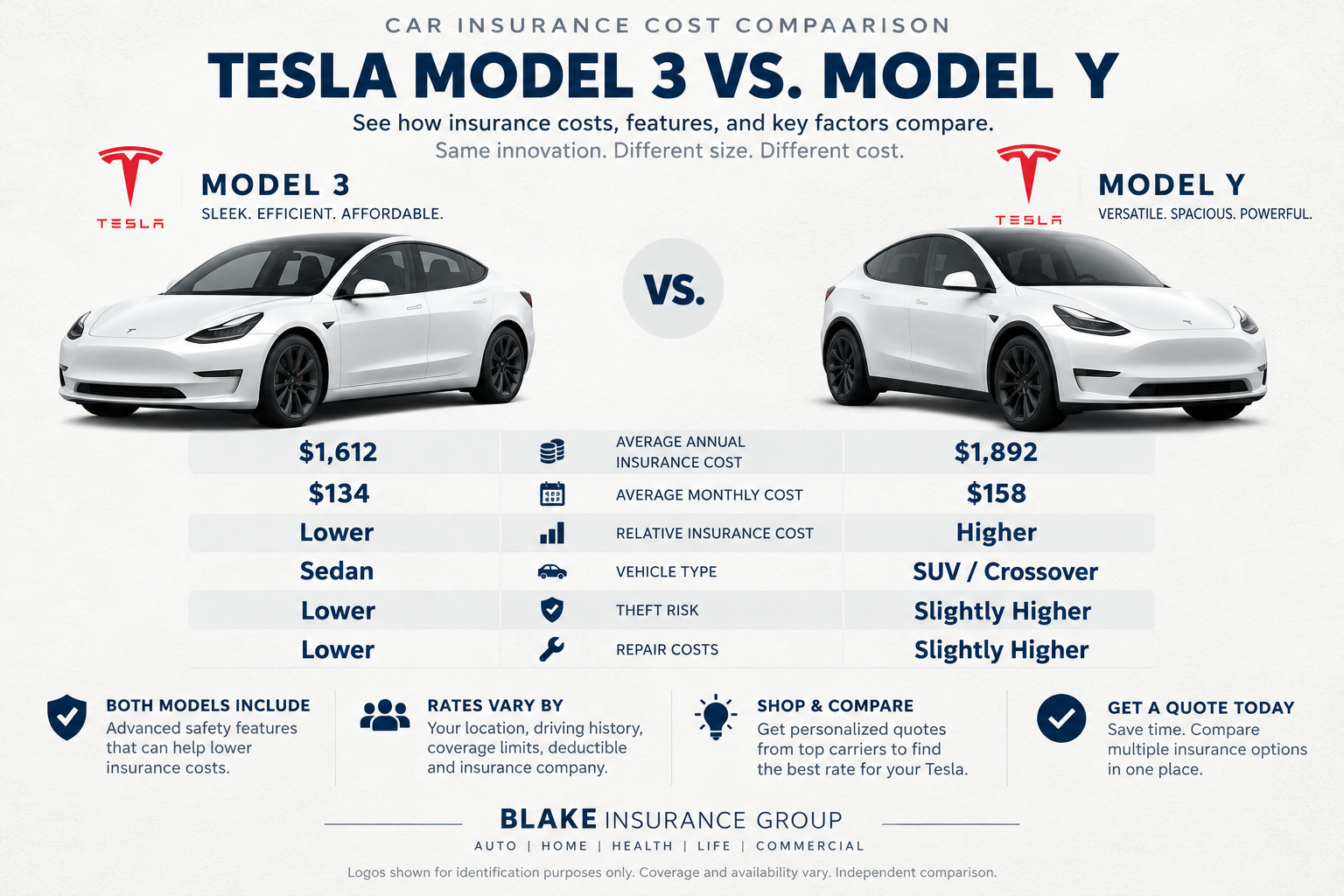
In the Tesla Model 3 vs. Model Y insurance comparison, the two cars share most of what drives Tesla premiums: high repair costs, a specialized repair network, and very low theft rates. The main differences come from price, since the Model Y typically costs more, and from trim choice, where the Performance versions of both are the most expensive to insure.
This page compares the factors insurers weigh for each Tesla, where they differ, and how to decide based on your situation. It is an independent comparison by Blake Insurance Group, an independent agency, not a ranking or a quote. Dollar figures shown in illustrations are not quotes; your premium depends on your driver profile, location, and coverage.
Compare Tesla Model 3 and Model Y quotes
Tell us which Tesla or Teslas you are considering and who will drive. A licensed agent can quote both with matching coverage. Submitting the form does not bind coverage.
If the form does not load, call 888-387-3687, Monday through Friday, 9:00 to 5:00, or email info@blakeinsurancegroup.com.
Side-by-side insurance factors
The table below compares the factors most likely to affect insurance for each Tesla, based on public data and our independent interpretation.
| Factor | Model 3 | Model Y |
|---|---|---|
| Trims | Standard (RWD), Premium (RWD or AWD), Performance (AWD) | Standard (RWD or AWD), Premium (RWD or AWD), Performance (AWD) |
| Starting price with destination | $38,380 (Standard) | $41,630 (Standard RWD) |
| Performance trim price | $56,380 | $59,630 |
| Tesla's 0 to 60 mph estimate, Performance | 2.9 seconds | 3.3 seconds |
| HLDI relative theft claim frequency, 2022 to 2024 (100 = average) | 1 (AWD), 2 (RWD) | 2 (AWD) |
| IIHS 2026 award | No 2026 award listed | TOP SAFETY PICK+ (2027 model year) |
Sources: Edmunds 2026 pricing guides (prices include destination; Model Y also includes Tesla's order fee); Highway Loss Data Institute 2022 to 2024 theft claim study; IIHS 2026 award list.
Because prices overlap across trims, a Model 3 Premium AWD can cost more to buy, and possibly to insure, than a Model Y Standard. Compare the specific trims, not just the model names.
What the two Teslas have in common
The Model 3 and Model Y share much of their engineering, so they share most insurance considerations:
- Repair costs. Large aluminum castings, cameras, and sensors make collision repairs more involved than on many conventional cars.
- Repair network. Tesla certifies collision centers. Depending on your area, approved shops may be limited, which can lengthen repairs and rental periods.
- Battery damage. Damage near the high-voltage battery can require specialized inspection and may lead to a total loss.
- Theft. Both have extremely low theft claim rates thanks to connectivity, GPS tracking, and phone-key technology.
- Telematics. Tesla's own insurance, available in a limited number of states, may use driving data from the car. Other insurers also offer app-based programs.
Where they differ for insurance
Price and replacement cost
At comparable trims, the Model Y usually costs more than the Model 3, so collision and comprehensive premiums may be somewhat higher for the Model Y. The size of that difference depends on the insurer.
Performance
The Model 3 Performance is the quicker of the two, at 2.9 seconds to 60 mph by Tesla's estimate. Some insurers weigh acceleration and performance trims in their pricing, especially for young drivers. Choosing a Standard or Premium trim of either car usually lowers the premium compared with a Performance trim.
Body style and use
The Model Y's SUV shape and hatch suit families and cargo-heavy use, and it is offered with a tow package. If you tow, ask how your policy treats an attached trailer. Glass is another consideration: both cars have large glass roofs, so glass coverage is worth reviewing for either.
Crash-test results
The 2027 Model Y's TOP SAFETY PICK+ indicates strong crash protection in the latest IIHS tests. Insurers rarely discount for the award itself, but occupant protection can influence injury claim costs over time.
Which Tesla may fit which driver
Based on our independent analysis:
- Drivers focused on the lowest premium may find a Model 3 Standard the least expensive Tesla to insure, since it has the lowest price.
- Families and cargo haulers may prefer the Model Y. The insurance difference at similar trims is often modest compared with the practical benefit.
- Performance buyers should expect higher premiums for either Performance trim, particularly the Model 3 Performance for young drivers.
- Drivers who finance or lease should consider gap coverage on either car, since EVs can lose value quickly early on, and should check the lender's or lessor's required limits and maximum deductible before choosing coverage.
- Drivers who want Tesla Insurance should first confirm it is offered in their state, then compare it with other insurers for the same trim.
How to compare Model 3 and Model Y quotes
- Quote the exact trims you are considering, not just the model names.
- Keep liability limits, uninsured motorist coverage, deductibles, and add-ons identical.
- Ask each insurer how it handles repairs at Tesla-approved collision centers and how long rental coverage lasts.
- Compare Tesla Insurance, where available, with other insurers using the same coverage.
- Consider how driving-data programs could affect your renewal. See our guide to usage-based insurance.
Our car insurance comparison guide explains how to compare quotes side by side.
Coverage to consider for either Tesla
- Collision and comprehensive with deductibles you can afford.
- Rental reimbursement with daily and total limits that cover a long repair.
- Gap coverage if you financed or leased with little down.
- New car replacement, where offered, for newer vehicles.
- Glass coverage for the large glass roof and camera-equipped windshield.
- Strong liability limits and uninsured and underinsured motorist coverage.
A home charger installed on your property is generally covered under homeowners insurance as part of the home. Ask your auto insurer about portable charging cables.
Ownership costs insurance does not cover
When you compare the two Teslas, it helps to separate insurance from other ownership costs that are sometimes confused with it:
- Tires. Electric vehicles are heavy and deliver instant torque, which can wear tires faster than on comparable gas cars. Tire wear is a maintenance cost, not an insurance claim. Performance trims with larger wheels typically use more expensive tires.
- Mechanical and battery defects. Failures from defects or wear fall under Tesla's warranty, not auto insurance. Insurance pays for sudden accidental damage such as a collision, fire, or flood.
- Charging equipment. A wall connector installed at home is usually part of your home for insurance purposes. Electrical work and the electricity itself are household costs.
- Software features. Optional software, such as Full Self-Driving capability, may be bought outright or by subscription. If the car is totaled, ask how your insurer values purchased features, because practices vary.
Thinking about these costs alongside insurance gives a more complete picture of what each Tesla will cost to own.
What you need to compare Tesla quotes
Have these details ready so both quotes are accurate.
- Exact trims or VINs. Model, trim, drivetrain, and model year for each Tesla you are considering.
- Driver details. Dates of birth, license numbers, and recent accidents or violations.
- Financing or lease plans. Lender or lessor requirements, and whether you want gap coverage.
- Current declarations page. So quotes match your current or desired coverage.
- Garaging and charging. Where the car will be parked and whether you will charge at home.
Model 3 vs. Model Y insurance FAQs
Is a Model 3 or Model Y cheaper to insure?
At comparable trims, the Model 3 is often slightly cheaper because it costs less to buy, but the difference varies by insurer and driver. Quote both with identical coverage.
Why are Teslas expensive to insure?
Mainly repair costs: aluminum castings, multiple cameras, high-voltage batteries, and a specialized repair network. Very low theft rates help offset some of that.
Are the Performance trims more expensive to insure?
Usually, because they are the most expensive and quickest versions of each car.
Are the dollar figures in Tesla comparison graphics accurate?
No illustration can predict your premium. Prices depend on your driver profile, location, coverage, and insurer.
Is Tesla Insurance cheaper than other companies?
Sometimes. It is available only in some states and may use driving data. Compare it with other insurers using the same coverage.
Are Teslas often stolen?
No. HLDI data shows the 2022 to 2024 Model 3 and Model Y among the least-stolen vehicles.
Does the Model Y's IIHS award lower my insurance?
Insurers rarely discount for the award itself, but strong crash protection can lower injury claim costs over time.
Does tire wear on a Tesla count as an insurance claim?
No. Tire wear is routine maintenance. Insurance covers tire damage only when it is part of a covered loss, such as a collision.
Should I choose rear-wheel or all-wheel drive for insurance reasons?
All-wheel-drive versions usually cost more, which can raise physical damage premiums slightly. Choose the drivetrain you need, then compare quotes on that exact trim.
Related vehicle insurance guides
These guides cover closely related vehicles and situations:
Important information
Independent agency. Blake Insurance Group LLC is an independent insurance agency. Licensed insurance producer NPN 16117464. Licensed states: AZ, AL, TX, CA, NY, OH, FL, NC, VA, GA, OK, NM, IA, KS, MI, NE, SC, SD, WV, IL, NJ, PA, TN, and WA. Which insurance companies we can quote depends on our current appointments and your state.
Trademarks. Tesla, Model 3, and Model Y and the insurance company names and logos shown in the image on this page are trademarks of their respective owners and are used for identification only. Blake Insurance Group is not affiliated with or endorsed by any vehicle manufacturer, and the logos do not mean we represent, partner with, or are endorsed by those insurance companies.
Independent comparison. Vehicle details on this page come from manufacturer and public safety sources and can change by model year and trim. Our explanations of how those details may affect insurance are general and are not a quote. Premiums, discounts, and eligibility vary by insurer, state, driver, vehicle, and coverage, and are subject to underwriting. The issued policy controls.
Your next step
Choose the exact Model 3 and Model Y trims you are considering, then request quotes on both with matching coverage. We will compare insurers on price, repair handling, and rental limits.