Ten RV Insurance Companies in Texas: Compare Motorhome, Travel Trailer, Fifth-Wheel, and Full-Time Coverage
Comparing ten RV insurance companies in Texas requires more than placing ten premiums beside one another. A motorhome combines characteristics of a vehicle and a temporary living space. A travel trailer or fifth wheel may carry personal belongings, appliances, awnings, solar equipment, and other accessories that standard automobile coverage was not designed to address. The best insurer for a weekend camper may not be the strongest fit for a full-time traveler, financed Class A motorhome, vintage travel trailer, or high-value toy hauler.
Texas RV owners can encounter long highway trips, hail, wind, severe thunderstorms, intense heat, theft, falling objects, animal contact, and campground liability exposures. Owners also need to consider storage location, distance traveled, towing arrangements, vehicle value, personal property, emergency expenses, and whether the RV is used as a residence. These details affect which companies may quote the risk and which coverage options deserve priority.
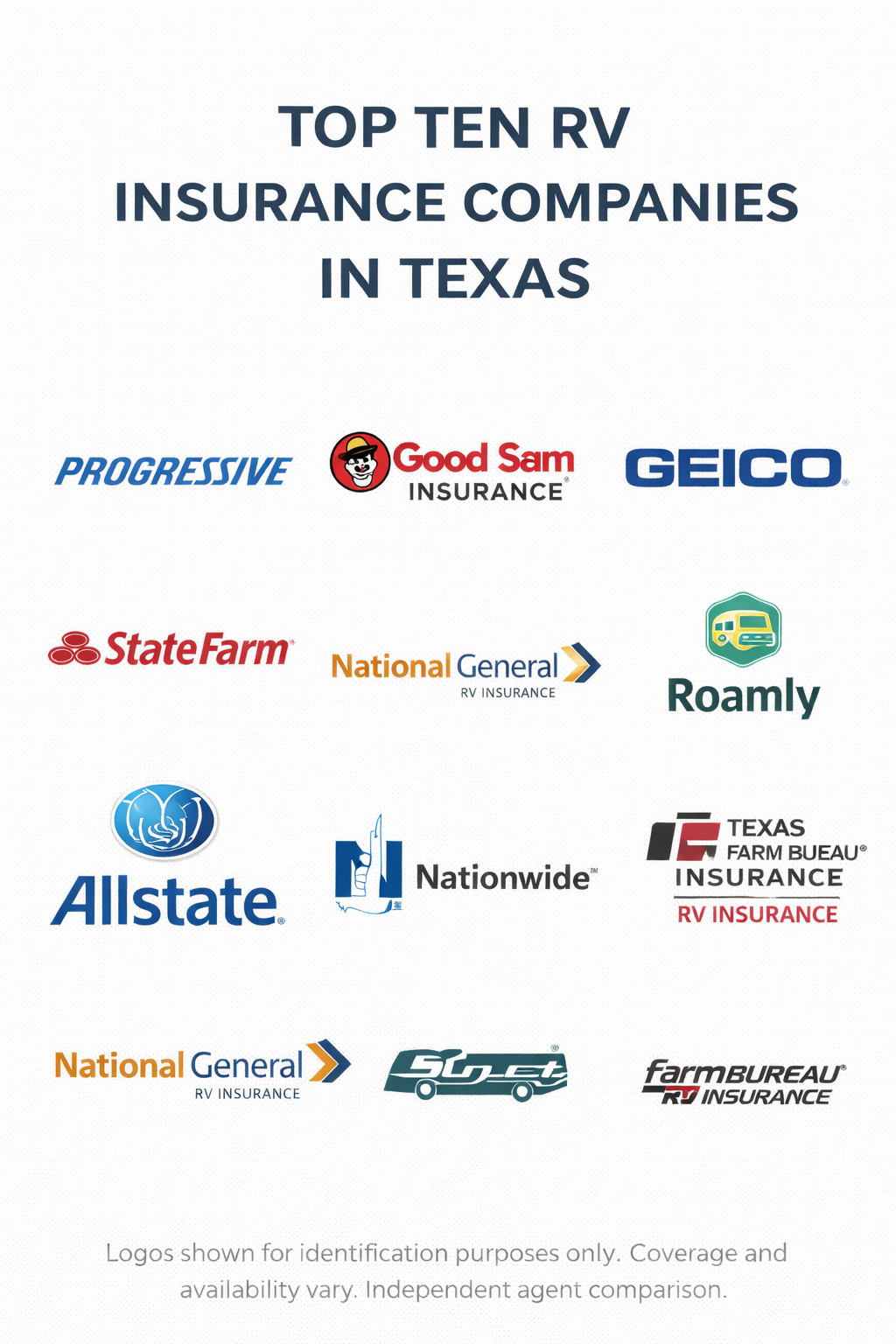
This independent 2026 comparison reviews Progressive, National General through Good Sam, Foremost, Nationwide, State Farm, Allstate, Farmers, GEICO, USAA, and Safeco as commonly researched RV insurance paths for Texas consumers. It does not declare one universal winner. Company eligibility, product availability, underwriting appetite, policy language, discounts, and distribution channels can change. The practical goal is to understand what to ask before choosing a policy.
Blake Insurance Group does not claim to represent every company discussed on this page. Company names are included for independent identification and consumer education. An online quote may return a different group of participating insurers based on current carrier access and applicant eligibility.
Compare Texas RV insurance using your actual RV type, value, drivers, storage location, and travel habits.
Quick facts about RV insurance in Texas
The correct insurance approach depends first on whether the RV is motorized or towable. Motorhomes need their own liability protection because they are driven. A travel trailer or fifth wheel is pulled by another vehicle, but the towing vehicle’s policy should not be assumed to provide complete protection for damage to the trailer, its contents, or every campground exposure.
| Insurance question | What to determine | Why it matters |
|---|---|---|
| Is the RV motorized? | Class A, Class B, Class C, camper van, or another self-propelled motorhome. | Motorized RVs generally need liability insurance and must satisfy applicable Texas financial-responsibility rules. |
| Is the RV towable? | Travel trailer, fifth wheel, toy hauler, pop-up camper, or truck camper. | Towable units need separate consideration for physical damage, personal property, roadside events, and liability while parked. |
| How is it used? | Occasional vacations, seasonal travel, extended trips, or full-time residence. | Residential-style or full-time use can require different coverage and underwriting. |
| What is the RV worth? | Purchase price, current market value, custom equipment, upgrades, and outstanding loan. | Settlement options and coverage limits determine how a covered total loss may be valued. |
| Where is it kept? | Home, covered storage, gated facility, campground, or another location. | Garaging and storage affect exposure to theft, hail, wind, fire, flood, and vandalism. |
| What travels inside? | Clothing, electronics, sporting equipment, tools, furniture, and household property. | Personal effects may have limits, sublimits, deductibles, and exclusions that differ from RV physical-damage coverage. |
Identify the RV before comparing insurance companies
Class A motorhomes are generally the largest self-propelled units and may have substantial values, complex systems, multiple slide-outs, and expensive attached equipment. Class B motorhomes and camper vans are smaller but may contain costly conversions, cabinetry, electronics, solar equipment, and custom interiors. Class C motorhomes typically have a truck-style cab with a living area extending over it and may be used for family travel or rental activity.
Travel trailers are bumper- or frame-towed units available in a wide range of sizes and values. Fifth wheels connect through a hitch mounted in the bed of a pickup and often contain larger living areas. Toy haulers are designed to transport recreational equipment, but motorcycles, ATVs, golf carts, or other cargo may need their own insurance. Pop-up campers, truck campers, teardrop trailers, and specialty conversions can also require product-specific underwriting.
The title, registration, VIN, body type, manufacturer, model, length, weight, purchase price, and current value should agree with the application. A company may accept one category but restrict another based on age, value, condition, usage, prior damage, custom construction, or conversion work.
| RV type | Primary insurance concern | Details to disclose |
|---|---|---|
| Class A motorhome | High vehicle value, liability, specialized towing, attached equipment, and total-loss settlement. | Length, value, drivers, usage, custom equipment, and storage. |
| Class B or camper van | Conversion value, compact living systems, daily driving, and custom components. | Factory versus aftermarket conversion, business use, mileage, and modifications. |
| Class C motorhome | Driving liability, family use, roadside assistance, personal effects, and vacation liability. | Drivers, annual mileage, sleeping capacity, rental activity, and value. |
| Travel trailer | Physical damage, theft, parked liability, personal belongings, and towing emergencies. | Tow vehicle, hitch setup, storage, length, value, and frequency of use. |
| Fifth wheel | Higher values, larger contents exposure, full-time use, and specialized recovery. | Truck and hitch, occupancy, custom equipment, storage, and residential use. |
| Toy hauler | Trailer coverage versus separate coverage needed for recreational vehicles or cargo. | Type and value of transported equipment and whether it has separate insurance. |
RV insurance coverage to compare before choosing a company
Liability coverage for a motorhome can help address covered bodily injury and property damage when an insured driver is legally responsible for an accident. Texas minimum financial-responsibility limits are a legal starting point, not an individualized recommendation. A large motorhome can cause substantial damage, so owners should consider whether higher liability limits and a personal umbrella policy better reflect their financial exposure.
Collision coverage generally addresses covered damage from impact with another vehicle or object or from overturning, subject to the deductible. Comprehensive coverage generally addresses eligible non-collision losses such as theft, fire, hail, wind, vandalism, falling objects, glass damage, or animal contact. Exact covered causes of loss, exclusions, deductibles, and settlement provisions are controlled by the policy.
RV-specific options can be equally important. Vacation liability may address certain liability claims arising while the RV is parked and used as a temporary residence. Personal effects coverage may protect eligible belongings kept inside the RV. Emergency expense or trip interruption protection may help with qualifying lodging, transportation, or related expenses after a covered event. Roadside coverage should be examined closely because moving or towing a large motorhome or fifth wheel can require specialized equipment.
| Coverage | What it may address | What to compare |
|---|---|---|
| Liability | Covered bodily injury or property damage caused while operating an insured motorhome. | Limits, exclusions, permissive drivers, defense terms, and umbrella compatibility. |
| Collision | Covered impact or overturn damage to the insured RV. | Deductible, settlement basis, custom equipment, and lender requirements. |
| Comprehensive | Eligible theft, hail, wind, fire, vandalism, glass, animal contact, and falling-object losses. | Deductible, glass treatment, excluded causes, and storage requirements. |
| Uninsured/underinsured motorist | Eligible losses involving an at-fault driver with no insurance or inadequate limits. | Available forms, limits, rejection requirements, and covered damages. |
| Vacation liability | Certain covered liability claims while the RV is parked and used for temporary living. | Limit, qualifying use, location restrictions, and full-time exclusions. |
| Personal effects | Eligible belongings such as clothing, electronics, kitchen items, and camping equipment. | Total limit, per-item sublimits, deductible, replacement cost, and excluded property. |
| Roadside assistance | Specified towing, winching, jump-start, tire, lockout, or fuel-delivery events. | RV-capable towing, distance, service limits, trailer handling, and out-of-pocket reimbursement. |
| Emergency expense | Eligible lodging, transportation, or travel expenses after a covered loss. | Trigger, daily limit, total limit, distance requirement, and covered expenses. |
| Total-loss replacement | A defined replacement or settlement option after a qualifying total loss. | Eligibility period, age restrictions, valuation language, and what happens after the initial period. |
| Full-timer coverage | Broader personal-liability or residential-style protection for eligible full-time users. | Occupancy definition, personal liability, medical payments, loss assessment, and storage of belongings. |
Actual cash value, agreed value, stated amount, purchase-price protection, and total-loss replacement are not interchangeable. Ask how depreciation is handled, what documentation establishes value, and how the policy responds as the RV ages.
Ten RV insurance companies Texas owners commonly compare
The companies below are commonly researched for recreational vehicle coverage, but their strengths are not identical. Some emphasize dedicated RV programs and optional specialty benefits. Others may be attractive to households that want to keep auto, home, and RV insurance with one insurer. Eligibility and product details must be confirmed through a current Texas quote.
| Company or program | Why Texas RV owners may compare it | Important verification point |
|---|---|---|
| 1. Progressive | Frequently considered for motorhomes and towable RVs, with an established specialty-vehicle insurance presence and multiple optional protections. | Confirm the unit’s eligibility, settlement option, personal effects limit, roadside benefits, full-time use, and current Texas discounts. |
| 2. National General through Good Sam | Often researched by RV owners seeking an RV-focused program, storage-related features, roadside options, and protection tailored to recreational travel. | Identify the actual underwriting insurer, policy form, storage terms, usage classification, claims process, and membership-related details. |
| 3. Foremost | Known for specialty insurance and commonly evaluated for motorhomes, travel trailers, fifth wheels, and other recreational units. | Review eligible RV classes, full-time occupancy, personal property, emergency expense, replacement options, and agent availability. |
| 4. Nationwide | May appeal to households comparing RV protection alongside existing auto, home, or other personal insurance. | Verify current Texas product availability, RV type eligibility, multi-policy savings, roadside terms, and specialty endorsements. |
| 5. State Farm | Often considered by consumers who prefer a local-agent relationship and want to coordinate several personal insurance policies. | Ask whether the exact motorhome or trailer qualifies and compare RV-specific features rather than assuming they match a specialty policy. |
| 6. Allstate | May be researched by households interested in coordinating an RV with auto, home, renters, or umbrella insurance. | Confirm the current Texas RV form, optional coverage, settlement basis, full-time use rules, discounts, and roadside scope. |
| 7. Farmers | May provide an agent-supported route for insuring eligible motorhomes, travel trailers, fifth wheels, or related recreational units. | Verify which underwriting company issues the policy, the eligible RV categories, available endorsements, and residential-use restrictions. |
| 8. GEICO | Commonly researched by price-focused shoppers and customers interested in adding RV coverage to an existing insurance relationship. | Confirm whether coverage is written directly or through an affiliated or partner program and review every RV-specific term. |
| 9. USAA | Eligible military families may begin with USAA when coordinating household insurance and looking for an RV insurance solution. | Confirm membership eligibility, the company actually underwriting the RV policy, bundling treatment, servicing, and claims responsibilities. |
| 10. Safeco | May be considered through independent agents by households seeking to coordinate RV, auto, home, and umbrella coverage. | Verify Texas availability, eligible RV categories, usage restrictions, optional endorsements, discounts, and current underwriting appetite. |
A familiar brand name should not end the comparison. Ask which legal insurance company will appear on the declarations page, who handles billing and claims, and whether another company administers the specialty product. This is especially important when a consumer-facing brand, membership program, affiliated insurer, or partner arrangement is involved.
Compare the issued coverage, not a general marketing summary. An advertised feature may be optional, limited to certain RV classes, restricted by unit age, unavailable for full-time use, or subject to underwriting. The quote and policy documents should confirm each requested protection.
How to narrow ten RV companies to the right shortlist
Start by removing companies that do not accept the RV type, age, value, condition, or usage. A factory-built Class C used for occasional vacations presents a different risk from a converted school bus, custom camper van, restored vintage trailer, or fifth wheel occupied most of the year. Disclose unusual construction, aftermarket conversions, salvage history, prior damage, permanent campground placement, and rental use before relying on a quote.
Next, compare valuation. Owners of newer, financed, or high-value units may prioritize replacement-oriented coverage or a clearly defined agreed-value approach. Owners of older units may focus on actual cash value, stated amount provisions, eligibility for physical damage, and whether documentation or an appraisal is required.
Then compare service features. A standard automobile tow may be inadequate for a large RV. Ask whether roadside coverage can arrange the correct heavy-duty equipment, move both a tow vehicle and trailer, handle a breakdown far from home, or provide reimbursement when network service is unavailable. Review trip interruption and emergency expense benefits separately because they may require a covered loss rather than a mechanical breakdown.
Full-time RV insurance requires a different review
Full-time RV use can change the nature of the risk because the unit functions more like a residence. A vacation-liability limit designed for temporary campground stays may not provide the residential-style protection a full-time household expects. Full-timer coverage may include or make available broader personal liability, medical payments to others, loss-assessment protection, or coverage related to personal property kept in the RV, depending on the insurer and form.
Insurers define full-time use differently. The threshold may involve primary-residence status, the number of days occupied during a year, whether the owner maintains another permanent residence, or how the RV is registered and garaged. Do not describe full-time occupancy as occasional use to obtain a lower premium. A material difference between actual use and the application can create underwriting and claim problems.
Full-time owners should inventory their belongings and identify high-value property. Jewelry, firearms, collectibles, electronics, tools, bicycles, recreational equipment, and business property may be subject to sublimits or exclusions. Remote workers should also disclose business equipment and business activity because a personal RV policy may not fully insure professional property or liability.
- Explain how many days each year the RV is occupied.
- Confirm whether it is your primary legal residence.
- Review personal liability beyond vacation liability.
- Inventory personal effects and property kept in storage.
- Disclose remote work and business equipment.
- Confirm mail, garaging, registration, and domicile information.
- Review emergency living expenses after a covered loss.
What affects the cost of RV insurance in Texas?
RV insurance pricing depends on the unit, drivers, location, usage, coverage, and insurer. A high-value Class A motorhome generally creates a different premium exposure from a small pop-up camper. Repair complexity, parts availability, custom construction, slide-outs, electronics, engine type, body materials, and specialized labor can affect physical-damage pricing.
Driver age, experience, driving record, claim history, prior insurance, annual mileage, and intended travel also matter for a motorhome. For towable units, the insurer may consider the trailer’s value, tow vehicle, storage, usage, and prior losses. Texas territory differences can reflect weather, theft, traffic, repair costs, catastrophe exposure, and local claim experience.
Coverage choices influence the final premium. Higher liability and personal-effects limits generally cost more. Lower comprehensive and collision deductibles usually increase premium. Replacement-oriented settlement features, full-time protection, roadside service, emergency expenses, and other endorsements can also add cost. The correct comparison uses matching coverage selections across companies.
| Pricing factor | What the insurer may evaluate | Smart comparison step |
|---|---|---|
| RV specifications | Class, age, manufacturer, model, length, value, engine, condition, and construction. | Use the VIN, title, purchase documents, and accurate equipment details. |
| Drivers | Licensing, experience, accidents, violations, claims, and household operators. | List all requested drivers consistently on every quote. |
| Usage | Annual mileage, trip frequency, full-time occupancy, business use, and rental activity. | Describe actual use rather than choosing the lowest-cost category. |
| Storage | ZIP code, home storage, gated facility, covered space, campground, and seasonal location. | Enter the location where the RV is normally kept. |
| Coverage | Liability limits, settlement option, deductibles, personal effects, roadside, and full-time protection. | Match every major selection before comparing premiums. |
| Discounts | Multi-policy, safe-driver, paid-in-full, original-owner, association, storage, or safety-course eligibility. | Confirm that each quoted discount is verified and sustainable at renewal. |
Responsible savings can come from comparing insurers, coordinating policies, choosing an affordable deductible, maintaining continuous coverage, improving storage security, and removing unnecessary duplication. Reducing liability or misclassifying full-time use may lower the displayed premium but can create a much larger financial gap.
Texas weather, storage, and travel risks to consider
Hail is a major concern for RV roofs, vents, skylights, air-conditioning units, solar panels, windows, and exterior surfaces. Wind can damage awnings, slide toppers, attachments, and improperly secured units. Comprehensive coverage may address eligible storm damage, but the deductible, exclusions, maintenance requirements, and settlement language should be reviewed before a loss.
Texas heat can accelerate deterioration of tires, seals, roof materials, batteries, hoses, and mechanical systems. Insurance is not a maintenance contract. Damage caused by wear, deterioration, mechanical failure, neglect, or failure to protect the property may be excluded even when the resulting problem is discovered during a trip. Regular inspections and documented maintenance remain essential.
Flooding can occur beyond coastal areas. Standard comprehensive coverage and specialty RV forms should be reviewed carefully to determine how flood or rising-water damage is treated. Owners storing units near rivers, low-water crossings, drainage channels, or coastal zones should evaluate elevation, evacuation access, and the ability to move the RV before a storm.
Theft prevention also matters. Secure keys, hitch locks, wheel locks, GPS devices, alarms, storage gates, lighting, and documentation of the VIN and equipment can reduce risk. Photograph the RV inside and outside and keep receipts for major upgrades. Good records can support underwriting and simplify claim documentation.
Use an apples-to-apples RV insurance comparison
Set a coverage baseline before requesting quotes. Use the same liability limits, uninsured motorist selections, comprehensive and collision deductibles, valuation method, personal-effects limit, vacation or full-time liability, emergency expense benefits, and roadside selection. Otherwise, the least expensive quote may simply provide less protection.
| Comparison item | Keep consistent | Verify before purchasing |
|---|---|---|
| RV and drivers | VIN, value, equipment, usage, storage, mileage, and household drivers. | Check classifications, listed operators, garaging, and ownership. |
| Liability | Use the same bodily injury and property damage limits. | Review permissive use, exclusions, defense, and umbrella requirements. |
| Physical damage | Match comprehensive and collision deductibles. | Confirm valuation, custom equipment, glass, awnings, and lender information. |
| Living and travel protection | Match personal effects, vacation liability, emergency expense, and full-time coverage. | Review limits, sublimits, occupancy definitions, and covered triggers. |
| Roadside service | Request comparable towing and assistance options. | Confirm heavy-duty capability, distance, trailer handling, and service caps. |
| Premium | Use the same policy term, effective date, and payment method. | Review total premium, deposit, installments, fees, and verified discounts. |
What to prepare for a Texas RV insurance quote
Gather the RV’s VIN, title, registration, year, make, model, body type, length, purchase date, purchase price, current value, financing details, and storage address. List all drivers requested by the application and prepare their license and driving-history information. Estimate annual mileage and explain whether the RV is used occasionally, seasonally, for long trips, or as a full-time residence.
Create a list of permanently installed and portable property. Permanently attached equipment may include awnings, satellite systems, solar panels, generators, custom wheels, upgraded suspension, appliances, and electronics. Portable property may include clothing, cookware, computers, camping equipment, bicycles, and tools. The insurer may classify these categories differently.
If the RV is financed, obtain the lender’s exact name and address. If it is a custom conversion, rebuilt unit, vintage RV, or exceptionally high-value motorhome, collect photographs, receipts, appraisals, conversion records, and maintenance documentation. Disclose any rental or peer-to-peer sharing because ordinary personal RV insurance may exclude that exposure.
- Use the VIN and exact RV classification.
- Enter the true storage and garaging location.
- List all requested drivers and accurate travel mileage.
- Disclose full-time occupancy, business use, or rental activity.
- Choose matching limits and deductibles for each quote.
- Review the final insurer, policy form, valuation, exclusions, and effective date.
A quote does not bind insurance. Coverage becomes effective only after the application is complete, underwriting requirements are satisfied, required payment is accepted, and the insurer confirms issuance and the effective date.
Texas RV insurance FAQs
Is RV insurance required in Texas?
A self-propelled motorhome operated on public roads generally must satisfy Texas financial-responsibility requirements. A towable travel trailer or fifth wheel is not driven independently, but a lender may require physical-damage coverage. Owners should also consider separate protection for the trailer, belongings, parked liability, and roadside events.
Does my Texas auto policy cover a travel trailer?
A towing vehicle’s liability coverage may extend in limited ways while an eligible trailer is attached, subject to the policy. Do not assume it covers physical damage to the trailer, theft, personal effects, vacation liability, roadside service, or every detached-trailer loss. Review separate RV or trailer coverage.
Which RV insurance company is best in Texas?
No single company is best for every Texas RV owner. The right fit depends on RV type, age, value, usage, drivers, location, storage, claims, desired valuation, full-time occupancy, and coverage priorities. Compare matching quotes and read the policy terms.
What are ten RV insurance companies to compare in Texas?
Commonly researched paths include Progressive, National General through Good Sam, Foremost, Nationwide, State Farm, Allstate, Farmers, GEICO, USAA, and Safeco. Product availability and eligibility can change, and an online comparison may include a different set of participating insurers.
What is full-time RV insurance?
Full-time RV insurance is designed for eligible owners whose RV functions as a primary residence or is occupied extensively. It may include broader residential-style liability and other protections beyond vacation use. Definitions and benefits vary by insurer.
Does RV insurance cover hail damage in Texas?
Comprehensive coverage may address eligible hail damage, subject to the deductible, exclusions, maintenance conditions, and policy terms. Damage caused by deterioration, wear, leaks, or neglected maintenance may be treated differently from direct storm damage.
Does RV insurance cover water damage?
Coverage depends on the cause. Sudden covered events may be treated differently from long-term leakage, defective seals, wear, rot, mold, maintenance problems, or flooding. The policy’s covered causes of loss and exclusions control the claim outcome.
Are personal belongings inside my RV automatically covered?
Some RV policies include limited personal-effects protection or offer it as an option. Limits, deductibles, sublimits, and exclusions apply. Homeowners or renters insurance may offer some off-premises coverage, but it should not be assumed to replace dedicated RV personal-effects protection.
Will RV insurance cover my solar panels and awning?
Permanently installed equipment may qualify as part of the insured RV or require custom-equipment coverage, depending on the policy. Disclose solar panels, awnings, satellite systems, generators, and modifications and retain photographs and receipts.
Can I suspend RV insurance while the unit is stored?
Some programs may offer storage-related options or permit certain coverage changes, but removing protection can leave the RV exposed to theft, fire, hail, wind, vandalism, or lender violations. Confirm the consequences before changing coverage.
Does RV insurance cover mechanical breakdowns?
Standard RV insurance generally is not a maintenance plan or mechanical warranty. Roadside assistance may help with specified services after a breakdown, but it normally does not pay to repair worn or failed mechanical components unless separate coverage applies.
Can I rent my RV to other people?
Personal RV insurance may exclude or restrict commercial rental and peer-to-peer sharing. Disclose any planned rental activity before allowing another person to rent the unit and obtain insurance specifically designed for that exposure.
Related RV and vehicle insurance topics
Independent comparison: Blake Insurance Group LLC is an independent insurance agency. This page is an educational comparison and does not state or imply that the agency represents, offers, or can quote every company discussed.
Company relationships: Progressive®, National General®, Good Sam®, Foremost®, Nationwide®, State Farm®, Allstate®, Farmers®, GEICO®, USAA®, Safeco®, and all other company and product names are trademarks™ or registered® trademarks of their respective owners. Inclusion does not imply affiliation, appointment, sponsorship, recommendation, or endorsement.
Availability: Carrier participation, underwriting companies, RV classes, full-time coverage, discounts, valuation options, roadside services, limits, deductibles, premiums, online purchasing, and policy forms vary by applicant, RV, driver, usage, storage location, state, insurer, and program. Current quote results and issued policy documents control.
No ranking guarantee: Numbering is used to organize the ten-company discussion and is not a financial-strength, price, claims-service, or quality ranking. No company is universally best or cheapest.
No coverage created: Starting an application, submitting information, or receiving a quote does not bind insurance. Coverage begins only after the insurer approves the risk, accepts required payment, issues the policy, and confirms the effective date and time.
General information: This page is educational and is not legal, financial, lending, registration, mechanical, engineering, valuation, claims, or risk-management advice. The issued policy, declarations, endorsements, exclusions, and applicable Texas law govern coverage.
Expert in personal and commercial insurance, including auto, home, business, health, and life insurance.
License: 16117464