General Liability vs Business Owners Policy (BOP): Which Coverage Fits Your Business?
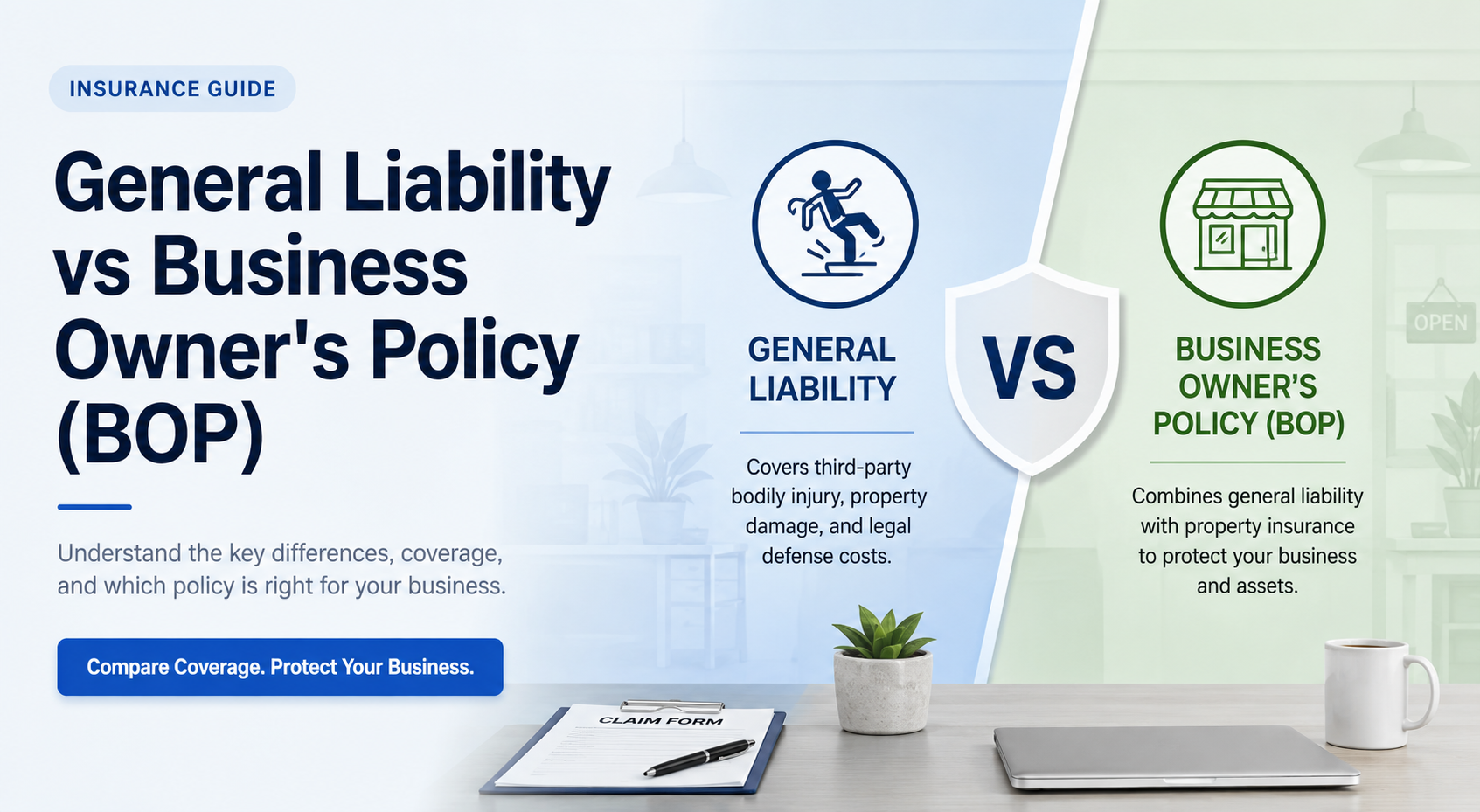
General liability insurance and a Business Owners Policy, often called a BOP, are two of the most common insurance options for small businesses. They overlap in one important way: both can include liability coverage for covered third-party bodily injury, property damage, and personal or advertising injury claims. The difference is that general liability is usually liability-focused, while a BOP is a package policy that combines general liability with business property coverage and often business income protection for eligible businesses.
That difference matters. A standalone general liability policy may help when a customer slips at your premises, your work damages someone else’s property, or a client requires a certificate of insurance before allowing you to start a job. But it typically does not protect your own equipment, office furniture, inventory, computers, tenant improvements, or lost income after a covered property loss. A BOP may be a better fit when your business has a physical location, valuable business property, inventory, equipment, or a lease that requires property coverage.
Blake Insurance Group LLC helps small business owners compare general liability, BOP coverage, professional liability, workers’ compensation, commercial auto, cyber liability, and other commercial insurance options. You can use the online quote and buy options on this page to compare eligible policies through Thimble, NEXT Insurance, and Coterie.
The right choice is not simply “general liability or BOP.” The right choice depends on what your business owns, what your contracts require, whether you have a location, how you serve customers, and what loss would hurt your cash flow.
Quick facts: general liability vs BOP
General liability is often the first business insurance policy small businesses buy. A BOP packages general liability with commercial property and business income coverage for eligible businesses.
| Question | General liability | Business Owners Policy (BOP) |
|---|---|---|
| What is the core purpose? | Helps protect against covered third-party liability claims. | Packages liability coverage with business property coverage and often business income coverage. |
| Does it cover your own property? | Usually no. It focuses on injury or damage claims made by others. | Often yes, subject to limits, deductibles, covered causes of loss, and policy terms. |
| Does it help with certificates? | Yes, many contracts ask for general liability proof of insurance. | Yes, and it may also help satisfy lease requirements for property coverage. |
| Who often considers it? | Contractors, consultants, vendors, service businesses, event businesses, and startups. | Offices, shops, salons, retail stores, restaurants, professional firms, and eligible property-based businesses. |
The main difference: liability-only protection vs package protection
General liability insurance focuses on covered claims made by other people or businesses. If a customer is injured in your office, your employee damages a client’s property, or your advertising creates a covered personal and advertising injury claim, general liability may help with defense costs, settlements, judgments, and covered medical expenses depending on the policy. It is commonly requested by landlords, clients, municipalities, event venues, vendors, and general contractors because it shows that your business has basic liability protection.
A BOP goes further for eligible businesses by combining general liability with commercial property coverage. That property portion can help protect business personal property such as furniture, computers, tools, fixtures, inventory, equipment, and tenant improvements from covered losses such as fire, theft, vandalism, wind, or other covered causes of loss. Many BOPs also include business income and extra expense coverage, which can help when a covered property loss forces the business to slow down or temporarily close.
Think of it this way: general liability is primarily about damage or injury claims made by others. A BOP is about liability claims plus your business property and income exposure. If you work from home with little equipment and only need a certificate for a client, general liability may be enough. If you lease a storefront, store inventory, own expensive equipment, or rely on a physical location to generate revenue, a BOP deserves a closer look.
Side-by-side comparison: general liability vs BOP
The comparison below shows where the two policies usually overlap and where they split. Exact coverage depends on the insurer, class of business, endorsements, exclusions, limits, deductibles, and underwriting approval.
| Coverage feature | General liability | BOP | Best review question |
|---|---|---|---|
| Customer bodily injury | Usually included for covered claims. | Usually included through the liability section. | Do customers, clients, vendors, or visitors interact with your business? |
| Third-party property damage | Usually included for covered claims. | Usually included through the liability section. | Could your work damage someone else’s property? |
| Personal and advertising injury | Often included, subject to exclusions. | Often included, subject to exclusions. | Do you advertise, publish content, use social media, or market services? |
| Your business property | Usually not covered. | Often included for covered property losses. | Could you afford to replace equipment, furniture, stock, or fixtures yourself? |
| Business income | Usually not covered. | Often available or included for covered property shutdowns. | Would a fire, theft, or covered property loss interrupt revenue? |
| Lease or landlord requirements | May satisfy liability-only requirements. | May satisfy liability and property requirements if properly structured. | Does your lease require both liability and business property coverage? |
Who may need general liability, a BOP, or both
Since a BOP normally includes general liability, many eligible businesses do not need to buy both a standalone general liability policy and a BOP for the same exposure. The key is determining whether the business qualifies for a BOP and whether the added property and income protection is needed. Some businesses are better served with general liability plus separate property, inland marine, professional liability, commercial auto, or workers’ compensation coverage. Others fit neatly into a BOP package.
A general liability policy is often a practical starting point for contractors, consultants, freelancers, event vendors, mobile service providers, and small businesses that need proof of liability insurance but do not have major business property at a leased or owned location. A BOP is often more appropriate for retail stores, offices, salons, small restaurants, medical offices, agencies, studios, and other eligible businesses with a physical location, furniture, fixtures, computers, inventory, or tenant improvements.
| Business situation | Coverage direction | Why |
|---|---|---|
| You need a COI for a client or jobsite | General liability may be enough. | The immediate requirement may be proof of third-party liability coverage. |
| You lease an office, shop, or studio | BOP should be reviewed. | The lease may require liability and property coverage, and your improvements may need protection. |
| You own inventory or expensive equipment | BOP or separate property coverage should be reviewed. | General liability does not usually replace your own damaged or stolen business property. |
| You provide professional advice or services | General liability or BOP plus professional liability. | General liability and BOP liability sections typically do not replace E&O coverage. |
| You use vehicles for business | Commercial auto should be reviewed separately. | Neither general liability nor a BOP is a substitute for commercial auto insurance. |
Coverage gaps business owners miss when comparing GL and BOP
The most common mistake is assuming general liability covers every business problem. It does not. General liability is important, but it usually does not cover your own property, employee injuries, professional mistakes, business vehicles, cyber incidents, flood damage, employment practices, or all contract requirements. A BOP fills some property and income gaps, but it still does not automatically solve every exposure.
The second mistake is assuming a BOP is available for every business. BOP eligibility depends on underwriting rules, class of business, size, revenue, location, property values, operations, claims history, and risk profile. Some higher-risk businesses may need separate general liability, commercial property, inland marine, or specialty policies rather than a prepackaged BOP.
| Gap | Why it matters | Coverage to review |
|---|---|---|
| Employee injuries | Workers’ compensation is not replaced by general liability or a BOP. | Workers’ compensation insurance. |
| Business vehicles | Business driving can be excluded or limited under personal auto policies. | Commercial auto or hired and non-owned auto. |
| Professional mistakes | Advice, design, consulting, and service errors may not be covered by GL. | Professional liability / errors and omissions. |
| Tools away from your location | Property coverage may be limited away from premises. | Inland marine / tools and equipment coverage. |
| Cyber and data events | Email compromise, ransomware, and customer data issues need separate review. | Cyber liability insurance. |
| Flood or storm surge | Commercial property coverage may exclude flood. | Commercial flood insurance. |
What affects the cost of general liability and BOP insurance?
Premiums depend on what your business does and how much risk the insurer sees. A low-risk office with limited foot traffic may price differently than a contractor working at customer properties. A retail store with inventory, foot traffic, and leased premises may need a BOP with property limits. A consultant may need professional liability in addition to general liability. A food business may need product liability, property, equipment, spoilage, and workers’ compensation. The right quote starts with accurate business information.
| Quote factor | Why it matters | What to prepare |
|---|---|---|
| Business operations | Insurers price and underwrite based on what the business actually does. | Clear description of services, products, jobsites, and customer types. |
| Revenue and payroll | Higher exposure can affect rating and eligibility. | Estimated annual revenue, payroll, owners, employees, and subcontractors. |
| Location and property values | BOP quotes need property details and values. | Address, lease details, business property value, inventory, fixtures, and equipment. |
| Claims history | Prior claims may affect pricing, eligibility, or available limits. | Loss history, dates, descriptions, and current safety controls. |
| Contract wording | Clients may require specific limits or endorsements. | COI instructions, additional insured wording, waiver wording, and required limits. |
Quote and buy general liability or BOP insurance online
Use the quote paths below to compare eligible general liability and BOP options online. Thimble can be useful for fast small business liability coverage and certificates. NEXT Insurance offers online quoting and policy management for many small business categories. Coterie provides another digital quote path for eligible commercial lines and small business risks.
Before starting, gather your legal business name, DBA if applicable, business address, business type, services performed, annual revenue, payroll, employee count, subcontractor use, desired effective date, certificate requirements, lease requirements, current policy, prior claims, and business property values if you want a BOP. Contractors should include trade details, job type, residential versus commercial work, subcontractor use, and whether tools or equipment need coverage.
Coverage is not bound until the application is completed, underwriting requirements are satisfied, payment is accepted where required, and the insurer confirms the effective date.
General liability vs BOP FAQs
Is a BOP the same as general liability insurance?
No. A BOP usually includes general liability coverage, but it also packages in commercial property coverage and often business income coverage for eligible businesses. General liability by itself is usually focused on covered third-party liability claims.
Do I need a BOP if I already have general liability?
You should review a BOP if your business owns equipment, inventory, computers, furniture, fixtures, tenant improvements, or other business property. General liability usually does not protect your own property from covered events such as fire, theft, or vandalism.
Can a contractor buy a BOP?
Some contractors may qualify, but many higher-risk trades need separate general liability, tools and equipment coverage, commercial auto, workers’ compensation, and other policies. Eligibility depends on the trade, operations, revenue, payroll, location, and underwriting rules.
Does general liability cover professional mistakes?
General liability usually does not replace professional liability or errors and omissions insurance. If your business gives advice, designs solutions, prepares reports, provides consulting, or performs professional services, professional liability should be reviewed separately.
Does a BOP cover business vehicles?
No. A BOP is not a substitute for commercial auto insurance. If your business owns vehicles, uses work trucks or vans, makes deliveries, or has employees driving for business, commercial auto or hired and non-owned auto coverage should be reviewed.
Which is better: general liability or a BOP?
General liability may be better when you only need third-party liability coverage or a basic certificate. A BOP may be better when your business also needs property coverage, business income protection, or lease-related coverage. The best choice depends on your business operations and risk profile.
Independent agency: Blake Insurance Group LLC is an independent insurance agency and is not affiliated with any single insurance company, online quoting platform, government agency, lender, landlord, contractor network, or certificate holder.
Licensing: Licensed insurance producer (NPN 16944666).
Important: General liability insurance, Business Owners Policy coverage, commercial property coverage, business income coverage, certificates, endorsements, availability, eligibility, premiums, limits, deductibles, exclusions, underwriting approval, online binding, and claim outcomes vary by insurer, state, business class, operations, location, payroll, revenue, property values, prior claims, and policy. Your issued policy controls coverage. This page is general information only and is not legal, tax, financial, risk-management, employment, claims, or regulatory advice.
Trademarks: Thimble®, NEXT Insurance®, Coterie Insurance®, and any carrier, marketplace, or program names are trademarks™ or registered® trademarks of their respective owners. Use of names does not imply endorsement or affiliation.




