Business insurance comparison • Vehicle liability
Commercial Auto vs. Hired and Non-Owned Auto Insurance
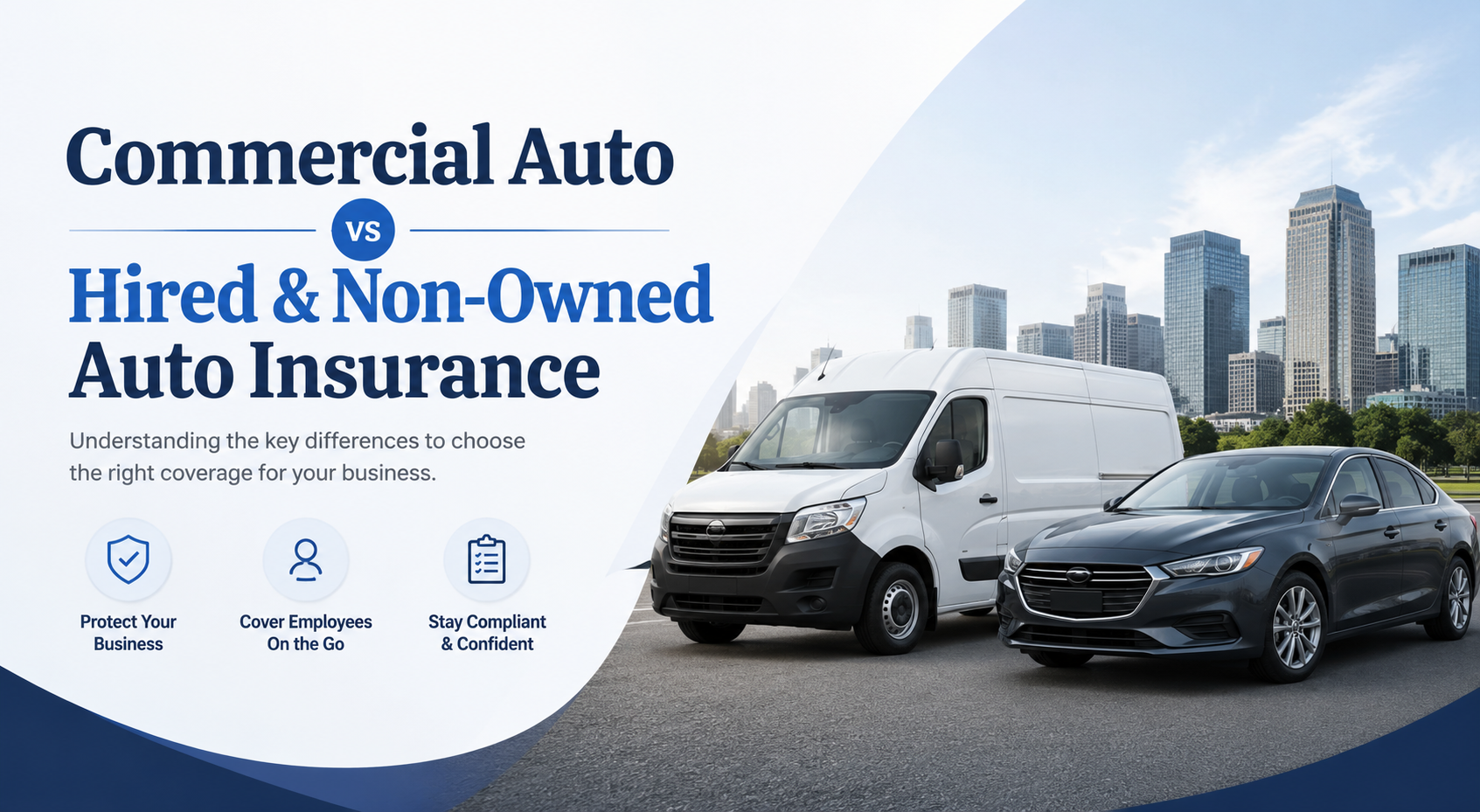
Commercial auto vs. hired and non-owned auto insurance is a question of who owns the vehicle. Commercial auto insurance covers vehicles your business owns or leases long term. Hired and non-owned auto (HNOA) coverage protects your business when employees drive vehicles the business does not own, such as rentals or their personal cars, for work.
This comparison explains what each covers, who needs which, and the gaps to watch. Blake Insurance Group is an independent agency; a licensed agent can compare options available to us.
Compare business auto options
Tell us about your business and how vehicles are used, and a licensed agent will follow up. Submitting the form does not bind coverage.
If the form does not load, call 888-387-3687, Monday through Friday, 9:00 to 5:00, or email info@blakeinsurancegroup.com.
Side-by-side comparison
| Feature | Commercial auto | HNOA |
|---|---|---|
| Vehicles | Owned or long-term leased by the business | Rented, hired, or owned by employees |
| Liability | Yes | Yes, for the business |
| Physical damage to the vehicle | Available | Generally not included |
| Driver injuries | Medical payments or PIP options | Generally not included; workers' compensation may apply |
| Typical buyer | Businesses with vehicles | Businesses without owned vehicles whose employees drive for work |
General comparison. Policy wording varies.
How HNOA works
If an employee runs an errand for your business in their own car and causes an accident, the injured party may sue your business as well as the employee. The employee's personal auto policy usually responds first, but its limits may be low. HNOA coverage protects your business above or alongside that coverage. Hired auto coverage works similarly for vehicles your business rents, though physical damage to a rental may need separate coverage or the rental company's damage waiver.
Who needs which
- Businesses with no owned vehicles whose employees occasionally drive for work: HNOA.
- Businesses that own or lease vehicles: commercial auto, usually with hired and non-owned coverage added.
- Businesses that rent vehicles frequently: hired auto liability plus physical damage coverage for rentals.
- Delivery or rideshare drivers working for themselves: typically a personal auto endorsement or commercial auto, not HNOA.
Covered-auto symbols
| Symbol | Covers |
|---|---|
| 1 | Any auto, including owned, hired, and non-owned |
| 2 | Owned autos only |
| 7 | Specifically described autos listed on the policy |
| 8 | Hired autos, such as rentals and leased vehicles without drivers |
| 9 | Non-owned autos, such as employees' personal vehicles used for business |
Symbols from the standard business auto policy. The symbols on your declarations page determine which vehicles are covered for each coverage.
Gaps to watch
- HNOA generally does not pay to repair the employee's car or the rental car.
- HNOA does not cover the employee's own injuries; workers' compensation may apply.
- Employees who regularly use their cars for business should carry adequate personal limits; some businesses set minimums.
- Vehicles titled to the business usually are not covered by HNOA.
When personal auto is not enough
Personal auto policies typically exclude or limit coverage for vehicles used primarily in a business, for carrying goods or people for a fee, or titled to a business. If a vehicle is owned by your business, used for deliveries or job sites, or driven by employees, a commercial auto policy is usually needed. Rideshare and delivery drivers using personal vehicles may instead need a rideshare or delivery endorsement. When in doubt, tell your insurer exactly how each vehicle is used.
Setting an employee driving policy
A written driving policy reduces risk. Common elements include verifying employees' licenses and personal insurance limits, reviewing motor vehicle records, prohibiting phone use while driving, defining approved business trips, and requiring prompt accident reporting. Insurers may ask about these practices when pricing HNOA or commercial auto.
When an agent may help
Online tools work well for simple situations. A conversation with a licensed agent may be more useful when:
- You have a teen driver, several vehicles, or drivers with recent accidents or violations.
- You need an SR-22 or other state filing. See our SR-22 insurance page.
- You use a vehicle for rideshare, delivery, or other business purposes.
- You own a home, rental property, or significant savings and want liability limits that work with an umbrella policy.
- You have had a claim denied or a policy nonrenewed and need help understanding your options.
An agent can also explain differences in policy wording that are hard to see on a results page.
Example scenarios
| Scenario | Typically responds |
|---|---|
| An employee drives their own car to a client meeting and causes a crash | Employee's personal auto first; HNOA protects the business |
| Your business rents a car for a trade show and the driver causes a crash | Hired auto liability; physical damage needs separate coverage or a waiver |
| A company-owned van causes a crash | Commercial auto |
| An employee is injured in their own car on a work trip | Workers' compensation and the employee's own auto coverage, not HNOA |
| A business owner uses a personal car for occasional errands | Personal auto, possibly with HNOA for the business |
Illustrative only. Actual coverage depends on policy wording and facts.
Rental car physical damage
Hired auto liability protects your business against claims from others, but damage to the rental car itself is a separate issue. Options include hired auto physical damage coverage added to a business auto policy, the rental company's collision damage waiver, or coverage provided by a business credit card, which often has limits and exclusions. Decide on a consistent approach so employees know whether to accept or decline the rental company's waiver.
Choosing limits
HNOA and commercial auto liability limits are often set to match your general liability limits, such as $1 million per occurrence. Contracts may require specific limits. A commercial umbrella can add limits above both. Consider the size of claims your business could face, including multiple injuries from a single accident.
What affects HNOA pricing
HNOA pricing generally depends on the number of employees, how often they drive for business, the types of trips, the business's industry, and claims history. Businesses where employees drive frequently, such as home health or sales, typically pay more than those with occasional errands. If driving becomes a regular part of operations, a commercial auto policy with owned vehicles may become more appropriate.
Adding umbrella limits
A commercial umbrella can sit above commercial auto and HNOA, adding limits for severe accidents. Confirm that the umbrella lists your auto coverage, including hired and non-owned autos, as underlying insurance so there is no gap.
Review coverage as your business grows
As your business adds employees, territories, or vehicles, revisit whether HNOA is still enough. Buying a first company vehicle, adding delivery services, or signing contracts with higher insurance requirements are common triggers for moving to a full commercial auto policy.
Industries where HNOA matters most
HNOA is especially relevant for businesses whose employees drive their own cars regularly: home health and caregiving agencies, real estate brokerages, sales organizations, consultants, catering and event companies, nonprofits with volunteer drivers, and professional services firms that visit clients. In these industries, an employee's accident on a business trip can quickly lead to a claim against the organization. Restaurants with delivery drivers using personal cars face similar exposure, though delivery often requires specialized coverage.
Employee vehicle checklist
- Collect a copy of each driving employee's license and personal auto declarations page.
- Set minimum personal liability limits, such as 100/300/100.
- Review motor vehicle records annually.
- Require prompt reporting of any accident during business use.
- Reimburse mileage consistently and document business trips.
HNOA and general liability
Standard general liability policies typically exclude auto-related claims, which is why HNOA exists as a separate coverage or endorsement. Without it, a business with no owned vehicles may have no protection for an employee's driving on company business. Ask your agent to confirm whether your general liability or business owner's policy includes HNOA or needs it added.
What to have ready
These details help an agent recommend the right coverage.
- Vehicle ownership. Owned, leased, rented, and employee vehicles used for work.
- Driver list. Employees who drive for business.
- Trip patterns. How often and how far employees drive.
- Current policies. General liability, business owner's, and auto declarations.
- Claims history. Auto-related claims in recent years.
Commercial auto vs. HNOA FAQs
What does HNOA stand for?
Hired and non-owned auto.
Does HNOA cover damage to an employee's car?
Generally no. It covers the business's liability.
Can I add HNOA to a business owner's policy?
Many insurers offer it as an endorsement to a business owner's or general liability policy.
Do I need commercial auto if I have HNOA?
If the business owns or leases vehicles, yes. HNOA does not cover owned vehicles.
Whose insurance pays first when an employee drives their own car?
The employee's personal auto policy usually responds first.
Does HNOA cover rental cars?
Hired auto coverage provides liability for rentals; physical damage may need separate coverage.
Do employees need minimum personal limits?
Many businesses require minimum limits for employees who drive for work.
Is HNOA expensive?
It is often relatively inexpensive compared with commercial auto, but price depends on exposure.
Is HNOA required by law?
Usually not, but contracts and customers may require it.
Does HNOA cover independent contractors' cars?
It depends on policy wording. Contractors should carry their own auto coverage.
Can sole proprietors buy HNOA?
Often yes, as an endorsement to a business owner's or general liability policy, but coverage for your own personal vehicle stays with your personal auto policy.
Does HNOA cover volunteers?
Many policies can be endorsed to include volunteers. Ask your agent.
Does HNOA cover employees driving to work?
Ordinary commuting is generally not business use. HNOA responds to business trips.
Can HNOA be added mid-term?
Usually yes, by endorsement.
Does HNOA cover my employee's ticket or fine?
No. Fines and penalties are the driver's responsibility.
Is HNOA part of general liability?
Not automatically. It is often added as an endorsement because general liability excludes auto claims.
Related guides
Partner quote options
Sponsored
Blake Insurance Group works with the partners below. Each link opens the partner's own website, where its terms, eligibility rules, and privacy policy apply. Blake Insurance Group may be compensated if you buy through these links.
- NEXT Insurance for small businesses: Online small business insurance quotes from NEXT Insurance.
- Thimble small business insurance: Short-term and on-demand business insurance quotes from Thimble.
Important information
Compensation. Links in the partner section of this page are sponsored, and Blake Insurance Group may be paid if you make a purchase. Sponsored placement does not affect the other information on this page.
Independent agency. Blake Insurance Group LLC is an independent insurance agency. Licensed insurance producer NPN 16117464. Licensed states: AZ, AL, TX, CA, NY, OH, FL, NC, VA, GA, OK, NM, IA, KS, MI, NE, SC, SD, WV, IL, NJ, PA, TN, and WA. Which insurance companies we can quote depends on our current appointments, the product, and your state. Mentioning a company on this page does not mean we represent it.
Availability. Coverage, prices, discounts, and eligibility vary by insurer, state, and applicant, and are subject to underwriting. The issued policy controls.
Your next step
Request a quote, and a licensed agent will help you decide between commercial auto, HNOA, or both.