
Workers Compensation Insurance South Dakota (2026): Coverage Choice, Payroll Rating, Certificates, Audits, and Online Quotes
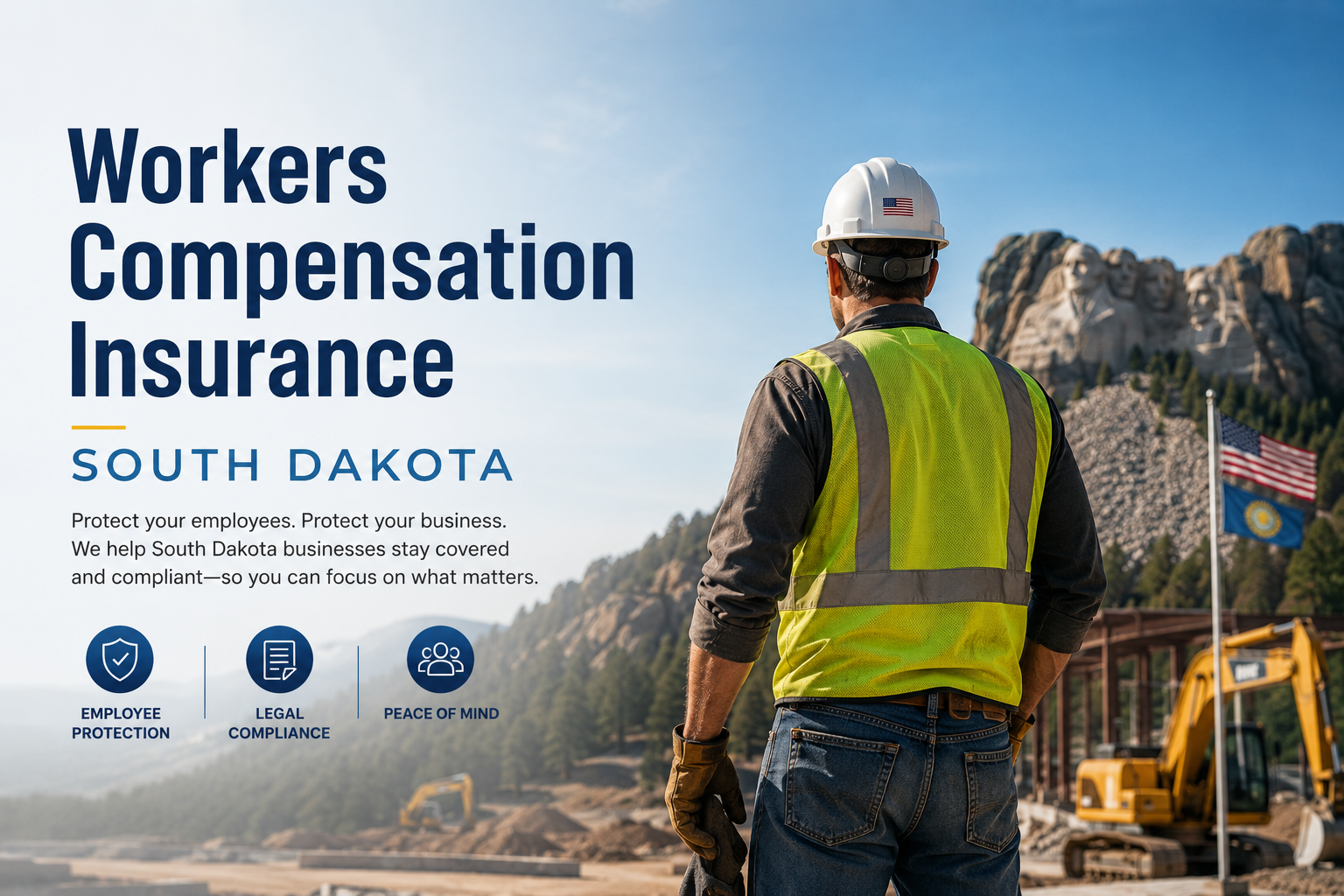
Workers compensation insurance in South Dakota helps businesses handle work-related employee injuries and occupational disease claims. If you are searching for workers compensation insurance near me in South Dakota, the first important difference is this: South Dakota does not require every employer to carry workers compensation insurance, but coverage is strongly recommended because an uninsured employer may be sued in civil court by an injured worker.
That makes South Dakota different from many states. The question is not only, “Am I required to buy workers comp?” The better question is, “What risk does my business carry if an employee is hurt and I do not have coverage?” For contractors, restaurants, healthcare teams, farms, retailers, transportation companies, property service businesses, and professional offices, the financial exposure can be serious. Coverage can also help satisfy client contracts, jobsite requirements, lease obligations, vendor agreements, and certificate requests.
A small business in Sioux Falls, Rapid City, Aberdeen, Brookings, Watertown, Mitchell, Pierre, Yankton, Huron, Spearfish, Vermillion, or a rural South Dakota community may need proof of workers compensation coverage before work begins even when state law does not impose a universal purchase mandate. General contractors, property managers, municipalities, landlords, healthcare clients, commercial customers, and vendors often make coverage a contract requirement.
Quick facts: South Dakota workers compensation insurance in 2026
South Dakota’s workers compensation system is voluntary in the sense that there is no universal state law requiring every employer to carry workers compensation insurance. However, choosing not to carry coverage can expose an employer to civil litigation if an employee is injured. For many businesses, the practical decision is driven by risk control, employee protection, contract compliance, and certificate requirements.
| Topic | What it means | Why it matters |
|---|---|---|
| No universal state mandate | South Dakota does not require every employer to carry workers compensation insurance. | Businesses still need to evaluate lawsuit risk, employee injury exposure, and contract requirements. |
| Coverage is strongly recommended | Employers without coverage may be sued in civil court by injured workers. | A single serious injury can create major financial exposure. |
| Contract requirements | Clients, general contractors, vendors, landlords, and municipalities may require proof of coverage. | Coverage can determine whether your business can start or keep certain jobs. |
| Employee injury benefits | Coverage may help pay medical and disability benefits for work-related injuries and diseases. | It creates a more organized path for handling eligible workplace claims. |
| Claim reporting duties | Employers with coverage must follow reporting, recordkeeping, and carrier claim procedures. | Prompt reporting helps protect the claim process and reduces compliance problems. |
| Independent contractor issues | Worker status, affidavits of exempt status, certificates, and owner-operator rules can affect the review. | Contractor labels and affidavits should not be treated as substitutes for careful documentation. |
South Dakota workers compensation rules: what employers should review
South Dakota does not have a universal legal requirement forcing every employer to buy workers compensation insurance. However, employers that choose not to carry coverage should understand the tradeoff. Without workers compensation insurance, an injured employee may be able to bring a civil lawsuit against the employer. That can mean higher uncertainty, defense costs, settlement exposure, and reputational harm.
For businesses that do carry coverage, South Dakota workers compensation functions as an insurance program for work-related injuries and diseases. It can help pay eligible medical and disability benefits, support return-to-work planning, and create a formal claim process. It can also satisfy business-to-business contract requirements that are often more demanding than the state’s baseline rule.
| Situation | What to verify | Why it matters | Business action step |
|---|---|---|---|
| Employer with employees | Whether the business has employees who could suffer work-related injuries or occupational disease. | Coverage can help avoid direct civil lawsuit exposure and provide a formal claim path. | Review coverage before hiring or sending employees to work locations. |
| Contractor or subcontractor | Whether contracts require workers compensation coverage or certificates. | General contractors and clients may require proof even when state law does not. | Review contract wording before bidding or starting work. |
| Independent contractor relationship | Whether the worker is truly independent and whether affidavits, certificates, or owner-operator rules apply. | Misclassification can create disputes after an injury. | Keep contracts, invoices, certificates, and work-control documentation organized. |
| Transportation and owner-operator work | Whether a truck owner-operator arrangement has special certification, participation, or carrier-policy options. | Trucking relationships require careful review of vehicle ownership, licensing, contracts, and coverage agreements. | Confirm classification and coverage before dispatching work. |
| Multi-state business | Whether employees travel into South Dakota or South Dakota workers perform work in other states. | Other states may have stricter mandatory workers compensation rules. | Confirm all operating states are properly shown on the policy. |
| Client certificate request | Whether the certificate holder requires workers compensation, waiver wording, alternate employer language, or special endorsements. | Certificate wording can determine whether a contract is accepted. | Review requirements before binding the policy. |
What South Dakota workers compensation insurance can cover
South Dakota workers compensation insurance is designed to provide medical and disability benefits for eligible work-related injuries and diseases. When a covered claim occurs, benefits may include necessary medical care, hospital services, rehabilitation, temporary total disability, temporary partial disability, permanent disability benefits, survivor benefits, and claim administration.
South Dakota employee guidance explains that an injured worker generally has the right to choose the first medical practitioner, with emergency-room treatment not counting as that first choice. Employer guidance also notes that employers with coverage must respond to injury notices and complete the First Report of Injury process within the required timeframe after learning of a reportable injury.
| Coverage area | What it can help with | Example South Dakota business scenario | Important note |
|---|---|---|---|
| Medical treatment | Necessary medical, surgical, hospital, rehabilitation, and related services for eligible work injuries. | A restaurant employee in Sioux Falls suffers a kitchen burn while working. | Prompt reporting and carrier coordination help the claim process move cleanly. |
| Temporary total disability | Benefits when a covered work injury prevents an employee from working for the required period. | A warehouse worker in Rapid City misses work after a lifting injury. | Eligibility depends on claim facts, medical restrictions, and South Dakota rules. |
| Temporary partial disability | Benefits may apply when an injured worker returns to modified or part-time work at lower earnings. | A trade worker returns on restrictions and earns less during recovery. | Light-duty and return-to-work procedures should be documented. |
| Permanent disability | Benefits may apply when a covered injury causes lasting limitations. | A manufacturing employee suffers a serious hand injury at work. | Medical evaluation and claim review determine the outcome. |
| Survivor benefits | Benefits may apply in certain fatal work-injury situations. | A severe jobsite accident results in a covered fatality. | Fatal claims require careful reporting, documentation, and claim handling. |
Workers compensation does not replace general liability, commercial auto, professional liability, cyber liability, employment practices liability, umbrella coverage, inland marine, tools and equipment, or a business owners policy.
Who should consider workers compensation insurance in South Dakota?
South Dakota employers should strongly consider workers compensation coverage before hiring, sending employees to a jobsite, signing contracts, onboarding subcontractors, opening a new location, adding seasonal labor, or sending employees across state lines. Even though South Dakota does not impose a universal purchase mandate, the business case for coverage is strong when employees perform physical work, drive for the business, handle tools or equipment, enter customer premises, lift patients or inventory, operate machinery, work around animals, or perform jobsite labor.
| Business type | Why coverage is commonly needed | What to prepare before quoting |
|---|---|---|
| Contractors and trades | Jobsites, ladders, tools, subcontractors, lifting, and certificate requirements. | Trade descriptions, payroll by duty, owner status, subcontractor COIs, and jobsite locations. |
| Restaurants and hospitality | Kitchen burns, slips, lifting, delivery exposure, part-time workers, and seasonal staffing. | Payroll by role, employee count, locations, tip reporting where applicable, and safety procedures. |
| Healthcare and home care | Patient handling, lifting, facility work, in-home visits, and caregiver injury exposure. | Care model, employee vs contractor structure, driving exposure, payroll, and location details. |
| Retail and office employers | Lower-hazard workplaces can still face employee injuries and contract requirements. | Clerical payroll, sales payroll, part-time workers, working owners, and location details. |
| Agriculture and rural operations | Seasonal labor, equipment, animals, outdoor work, transportation, and rural worksites. | Regular worker count, seasonal worker count, payroll, job duties, and operating locations. |
| Transportation and logistics | Drivers, owner-operators, warehouse workers, loading, unloading, routes, and multi-state exposure. | Payroll, route states, driver duties, owner-operator agreements, commercial auto details, and prior loss history. |
Worker classification, owner treatment, subcontractor status, affidavits of exempt status, trucking owner-operator rules, seasonal labor, and out-of-state exposure can be fact-specific. Review those details before assuming a person or business is automatically included, excluded, or exempt.
What affects workers compensation insurance cost in South Dakota?
South Dakota workers compensation cost is commonly driven by payroll, employee duties, class codes, claims history, ownership treatment, prior coverage, safety controls, experience modification where applicable, merit rating where applicable, schedule rating, and underwriting. A clerical office, roofing contractor, home healthcare agency, restaurant, delivery company, farm operation, auto repair shop, and warehouse can all price differently because employee injury exposure is different.
| Factor | Why it affects pricing | Smart move |
|---|---|---|
| Payroll | Premium is commonly calculated using estimated payroll by classification. | Use realistic annual payroll and update the policy if hiring changes quickly. |
| Class codes | Employee duties determine rating categories and expected claim risk. | Separate clerical, sales, field, driver, trade, healthcare, agricultural, and warehouse payroll correctly. |
| Claims history | Prior injuries, open claims, and loss trends can affect eligibility and pricing. | Be ready to explain safety improvements and prior loss details. |
| Experience or merit rating | Prior claim activity may affect rating for eligible accounts. | Keep loss runs, claim summaries, and safety documentation available when quoting. |
| Owner and contractor treatment | Owner inclusion, independent contractor status, and affidavits can affect payroll assumptions and protection. | Confirm worker status before binding coverage. |
| Certificates and contracts | Some contracts require proof of coverage, waivers, additional endorsements, or special wording. | Review contract requirements before choosing a policy. |
Audits, certificates, subcontractors, and South Dakota contract requirements
Workers compensation policies are commonly subject to premium audit. After the policy term, the carrier may compare estimated payroll to actual payroll, review employee duties, request payroll reports or tax filings, and check subcontractor certificates. South Dakota contractors, farms, service businesses, healthcare providers, retailers, restaurants, warehouses, and property service companies should keep payroll, certificates, and subcontractor documentation organized throughout the year.
| Item | What to keep organized | Why it helps |
|---|---|---|
| Payroll records | Payroll summaries, owner payroll, overtime details, employee duty breakdowns, seasonal payroll, and location information. | Cleaner records reduce audit delays and classification problems. |
| Class-code support | Job descriptions, duties, office vs field separation, routes, farm work, trade work, and daily work performed. | Underwriters and auditors need accurate work descriptions. |
| Subcontractor COIs | Certificates showing subcontractors carried workers compensation and liability coverage where required. | Missing certificates can create audit, contract, and jobsite problems. |
| Independent contractor documentation | Contracts, invoices, certificates, affidavits of exempt status where used, owner-operator records, and work-control details. | Worker status affects payroll, audit, and claim disputes. |
| Claim reporting process | Supervisor instructions, incident reports, carrier contact process, witness details, and employee reporting steps. | Accessible procedures help employees report injuries and support claim handling. |
Certificates of insurance are common across South Dakota construction, property management, healthcare, janitorial, agriculture, landscaping, trucking, logistics, municipal, vendor, and subcontractor relationships. Before you bind coverage, review contract language. Special wording, waiver of subrogation requests, alternate employer needs, out-of-state work, and project-specific requirements may require underwriting review.
South Dakota workers compensation insurance support by city and region
Blake Insurance Group helps South Dakota businesses compare workers compensation options for eligible operations across major metros, agricultural communities, healthcare hubs, tourism markets, transportation corridors, and regional service areas. Whether your business is in Sioux Falls, Rapid City, Aberdeen, Brookings, Watertown, Mitchell, Pierre, Yankton, Huron, Spearfish, Vermillion, Madison, Sturgis, Box Elder, Brandon, or a smaller South Dakota community, the policy should match your payroll, duties, contracts, and employee injury exposure.
| Region | Example cities | Common requests we help compare |
|---|---|---|
| Sioux Falls Metro | Sioux Falls, Brandon, Harrisburg, Tea, Dell Rapids, Hartford | Contractors, restaurants, offices, healthcare teams, vendors, and certificate requests. |
| Black Hills and Western South Dakota | Rapid City, Spearfish, Sturgis, Box Elder, Belle Fourche, Hot Springs | Tourism, hospitality, construction, repair services, trucking, and seasonal payroll. |
| Central South Dakota | Pierre, Fort Pierre, Chamberlain, Winner, Mobridge, Gettysburg | Government-adjacent services, agriculture, property services, restaurants, and local employers. |
| Northeast South Dakota | Aberdeen, Watertown, Brookings, Milbank, Sisseton, Webster | Healthcare, education-adjacent services, agriculture, retail, warehouses, and certificates. |
| Southeast South Dakota | Yankton, Vermillion, Mitchell, Huron, Madison, Canton | Small business payroll, trades, restaurants, healthcare, agriculture-adjacent work, and vendors. |
Quote and buy workers compensation insurance online
Use the online quote paths below to compare options for eligible South Dakota businesses. The best fit depends on your employee count, payroll, class codes, prior coverage, loss history, owner treatment, contract requirements, and whether you also need general liability, commercial auto, tools and equipment, professional liability, cyber liability, or a business owners policy.
Coverage is not bound until an application is completed, accepted, payment is processed where required, and policy documents confirm the effective date, insured information, endorsements, exclusions, and coverage terms.
Before you quote, gather this:
- Legal business name, DBA, entity type, FEIN, South Dakota location, mailing address, and contact information.
- Employee count, payroll estimates, job duties, class-code details, and whether workers are full-time, part-time, seasonal, temporary, agricultural, trucking, domestic, or casual.
- Owner, officer, member, partner, independent contractor, owner-operator, or sole proprietor details and whether each person actively works in the business.
- Subcontractor certificates, exempt-status affidavits where applicable, project requirements, waiver requests, certificate holder details, and contract deadlines.
- Prior policy information, loss runs, claim history, experience modification worksheet if available, and current policy declarations.
Related topics
South Dakota workers compensation insurance FAQs (2026)
Is workers compensation insurance required in South Dakota?
South Dakota does not have a universal law requiring every employer to carry workers compensation insurance. However, coverage is strongly recommended because an uninsured employer may be sued in civil court by an injured worker.
Why buy workers comp in South Dakota if it is not required?
Coverage can help pay eligible medical and disability benefits, create a formal claim process, reduce direct lawsuit exposure, support employee protection, and satisfy contract or certificate requirements from clients, general contractors, vendors, landlords, or municipalities.
Does South Dakota workers compensation cover independent contractors?
True independent contractor relationships can be treated differently from employee relationships. South Dakota also has specific rules for certain truck owner-operators and affidavits of exempt status. Worker classification should be reviewed carefully before relying on a label or form.
Can a client or contractor require workers comp coverage even when South Dakota does not?
Yes. Contracts often require workers compensation coverage, certificates of insurance, waiver wording, or special endorsements. Contract requirements can be stricter than the state’s baseline rule.
What information do I need for a South Dakota workers comp quote?
Be ready with your legal business name, FEIN, South Dakota business location, employee count, payroll estimates, job duties, owner details, contractor documentation, prior coverage, claims history, subcontractor certificates, and any contract or certificate requirements.
Is general liability the same as workers compensation?
No. General liability usually focuses on third-party bodily injury, property damage, and certain personal or advertising injury claims. Workers compensation focuses on employee work injuries and occupational disease.
Independent agency: Blake Insurance Group LLC is an independent insurance agency and is not affiliated with any single insurance company, carrier, marketplace, platform, or government agency.
Licensing: Licensed insurance producer (NPN 16944666).
Important: Coverage availability, pricing, payroll classifications, employee status, independent contractor classification, owner inclusion or exclusion, trucking owner-operator treatment, affidavits of exempt status, eligibility, limits, deductibles, endorsements, exclusions, certificates, audits, underwriting decisions, and binding rules vary by insurer, platform, business type, location, payroll, class code, and application details. Your issued policy controls all coverage terms.
South Dakota compliance note: Workers compensation insurance is not the same as business registration, payroll tax compliance, OSHA compliance, employment-law compliance, subcontractor management, workplace posting compliance, accident reporting, or commercial auto coverage. Review those obligations separately for your business and jurisdiction.
Trademarks: Carrier, platform, government, and partner names are trademarks™ or registered® trademarks of their respective owners. Use of them does not imply affiliation or endorsement.




