Auto insurance
Non-Owner SR-22 Insurance: Meeting the Requirement Without a Car
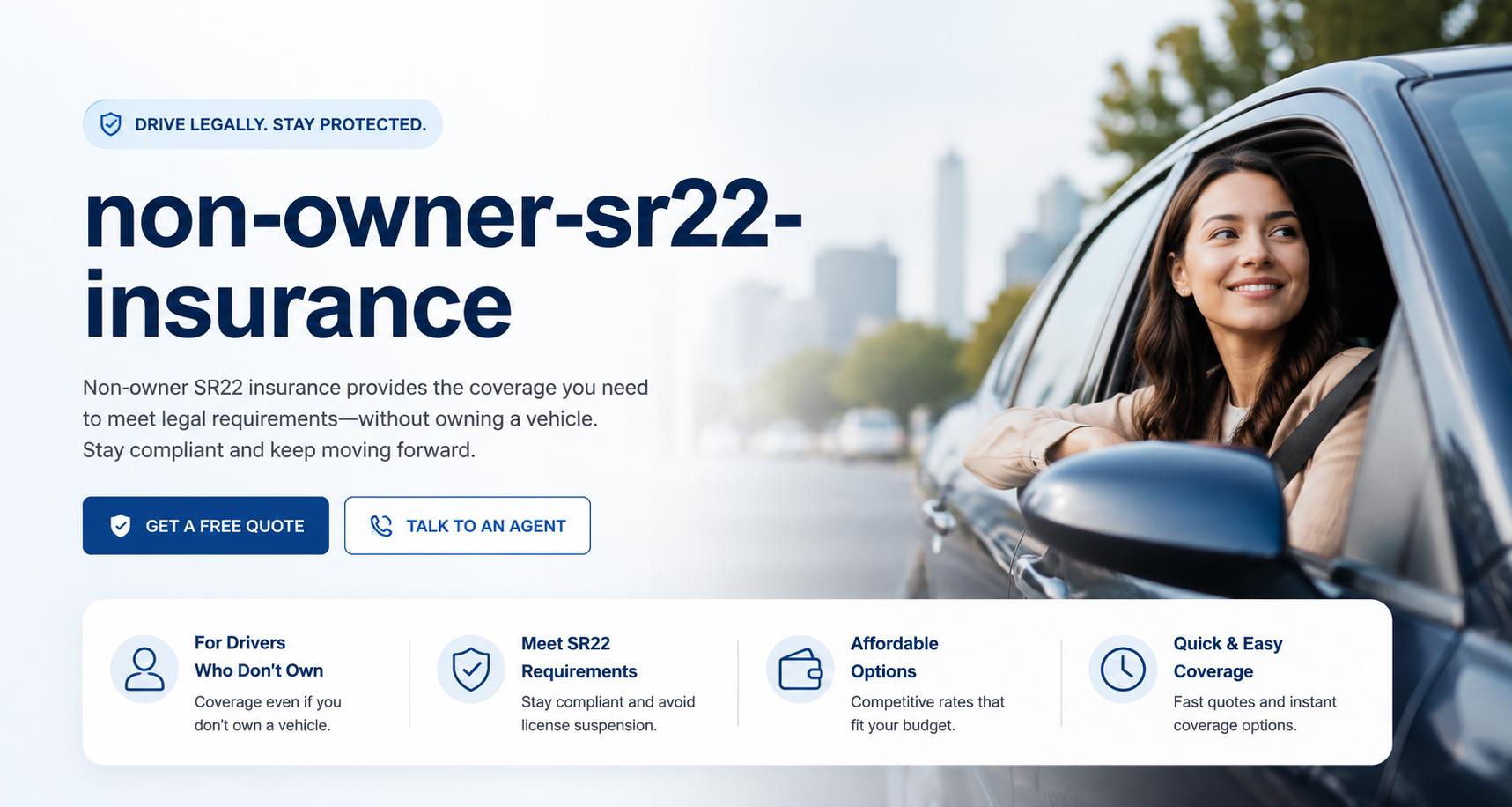
Non-owner SR-22 insurance combines a non-owner auto policy, which provides liability coverage when you drive cars you do not own, with an SR-22 filing that proves to the state you are insured. It is how many drivers without a vehicle reinstate a suspended license.
See also non-owner car insurance and SR-22 insurance. Blake Insurance Group is an independent agency; a licensed agent can compare options available to us. This page is general information, not legal advice.
Compare car insurance quotes
Tell us about your drivers and vehicles, and a licensed agent will follow up with options available to us. Submitting the form does not bind coverage.
If the form does not load, call 888-387-3687, Monday through Friday, 9:00 to 5:00, or email info@blakeinsurancegroup.com.
Who needs it
- Drivers required to file an SR-22 who do not own a car.
- Drivers who borrow or rent cars and want liability coverage while reinstating a license.
What it covers and excludes
| Covered | Not covered |
|---|---|
| Bodily injury and property damage liability | Damage to the car you are driving |
| Uninsured motorist where required | Cars owned by you or regularly available to your household |
| The SR-22 filing | Business use, in many policies |
General description. Policies vary.
How to get one
- Find an insurer that writes SR-22 filings in your state; not every insurer does.
- Buy a policy that meets at least the state's minimum liability requirements, or a non-owner policy if you do not own a car.
- The insurer files the SR-22 electronically or by mail; there is usually a small filing fee.
- Keep the policy active for the entire required period without any lapse.
- Confirm with the state when the requirement ends before dropping the filing.
If you buy a car
When you buy a car, replace the non-owner policy with an owner policy and have the new insurer file a new SR-22 before canceling the old one, so there is no gap in the filing.
What an SR-22 is
An SR-22 is not a type of insurance. It is a certificate your insurer files with your state's motor vehicle agency to prove you carry at least the required liability coverage. If the policy cancels or lapses, the insurer must notify the state, which can suspend your license again. Florida and Virginia use a similar form, the FR-44, after certain alcohol-related offenses; it requires higher limits than an SR-22, such as 100/300/50 in Florida.
Coverage terms to match on every quote
| Coverage | What it pays for | What to match |
|---|---|---|
| Bodily injury liability | Injuries you cause to others | Per-person and per-accident limits, such as 100/300 |
| Property damage liability | Damage you cause to others' property | Same limit on both quotes, such as $100,000 |
| Uninsured/underinsured motorist | Your injuries when the at-fault driver lacks enough coverage | Same limits; ideally equal to your liability limits |
| Collision | Damage to your car from a crash | Same deductible |
| Comprehensive | Theft, fire, hail, flood, animal strikes, glass | Same deductible; note any glass option |
| Medical payments or PIP | Medical costs for you and passengers | Same limit; PIP rules depend on your state |
| Rental and roadside | Transportation during repairs; towing | Same daily and total limits |
Limits shown are examples, not recommendations. State minimum requirements differ.
Ways to lower your premium
- Compare at least three quotes with identical coverage every year or two, and whenever your premium jumps at renewal.
- Raise collision and comprehensive deductibles to an amount you could pay tomorrow without strain.
- Drop collision and comprehensive on an older car only when the car's value is low enough that you could replace it yourself.
- Ask about every discount: multi-policy, multi-vehicle, good student, defensive driving, paperless, paid-in-full, and safety equipment.
- Try a driving-data program if you drive carefully and are comfortable sharing driving data. See usage-based insurance.
- Keep continuous coverage. Even a short lapse can raise future rates.
- Report accurate mileage. Lower annual mileage can mean a lower premium.
- Bundle auto with renters or homeowners insurance where the combined price is lower.
How insurers set your price
Most insurers price a policy using your driving record, years licensed, age where allowed, the vehicle, where it is garaged, annual mileage, coverage limits, deductibles, prior insurance history, and, where state law permits, a credit-based insurance score. Each insurer weighs these factors differently, which is why quotes for the same driver can differ by hundreds of dollars. Improving the factors you control, especially your record and continuous coverage, pays off over several renewals.
Payment plans and fees
How you pay can change your total cost. Many insurers charge installment fees for monthly payments, and some offer discounts for paying the full term upfront, enrolling in automatic payments, or going paperless. If paying in full is not possible, ask which payment plan has the lowest fees. Missing a payment can cancel your policy and create a lapse, which raises future rates, so set up reminders or autopay.
If you are considered high risk
If several insurers decline you because of violations, accidents, a lapse, or a DUI, you still have options. Many insurers specialize in higher-risk drivers, and every state has a residual market plan for drivers who cannot find coverage in the voluntary market. Prices are higher, but keeping coverage continuous and your record clean will usually bring rates down over three to five years. If a court or the motor vehicle agency requires an SR-22 or similar filing, see our SR-22 insurance and high-risk auto insurance pages.
When an agent may help
Online tools work well for simple situations. A conversation with a licensed agent may be more useful when:
- You have a teen driver, several vehicles, or drivers with recent accidents or violations.
- You need an SR-22 or other state filing. See our SR-22 insurance page.
- You use a vehicle for rideshare, delivery, or other business purposes.
- You own a home, rental property, or significant savings and want liability limits that work with an umbrella policy.
- You have had a claim denied or a policy nonrenewed and need help understanding your options.
An agent can also explain differences in policy wording that are hard to see on a results page.
Switching insurers without a gap
If a new quote is lower, switch carefully so you are never uninsured:
- Confirm the final price after the insurer verifies your information.
- Set the new policy to start on or before the date the old one ends.
- Give the new insurer your lender or lessor information if the vehicle is financed.
- Save your new ID cards and declarations page.
- Cancel the old policy effective the same day, and ask about any refund of unused premium.
- If you have an SR-22, confirm the new insurer files it before the old filing ends.
State rules that affect every policy
Car insurance is regulated state by state, which affects any company comparison:
- Minimum liability limits differ widely. State minimums are often far below what a serious accident costs, so many drivers choose higher limits.
- No-fault states require personal injury protection, which changes how injury claims are paid.
- Rating factors differ. Some states limit or ban the use of credit-based insurance scores, gender, or occupation in pricing.
- Uninsured motorist rules differ. Some states require it; others require insurers to offer it and let you reject it in writing.
- Company availability differs. A company's programs, discounts, and appetite in one state may not match another.
A comparison that is accurate in one state can be wrong in the next, which is another reason to compare actual quotes for your address rather than national averages.
Non-owner policies vs. being listed on someone's policy
If you regularly drive a household member's car, insurers usually expect you to be listed as a driver on that car's policy rather than buying a non-owner policy. Non-owner coverage is designed for occasional use of cars that are not regularly available to you, such as rentals or a friend's car.
Rental cars and car-sharing
A non-owner policy typically provides liability coverage when you rent a car, but not damage to the rental itself. Rental companies sell damage waivers, and some credit cards provide secondary rental damage coverage. Check car-sharing service terms, since they provide their own coverage tiers.
What affects the cost
Non-owner policies are often less expensive than owner policies because they cover only liability and no specific vehicle. The violation that triggered the SR-22, your location, and your limits drive the price. Compare insurers that write non-owner SR-22 policies in your state.
Keeping the filing active
Set up automatic payments so the policy never lapses, keep your contact information current with the insurer and the motor vehicle agency, and save confirmation when the SR-22 period ends. A single missed payment can restart the suspension process.
Common misunderstandings
- A non-owner policy does not cover a car you own or one registered to your household.
- It does not satisfy lender requirements for a financed car.
- It does not cover delivery or rideshare driving.
- Dropping it early can restart the SR-22 requirement.
What to have ready for a quote
These details help produce accurate quotes.
- Driver details. License numbers and dates of birth for every household driver.
- Vehicle VINs. And annual mileage for each vehicle.
- Driving history. Accidents and violations in the past three to five years.
- Current declarations page. To match limits and deductibles.
- Garaging address. Where each vehicle is kept.
Non-owner SR-22 insurance FAQs
What is non-owner SR-22 insurance?
A non-owner policy with an SR-22 filing.
Does it cover the car I borrow?
It covers liability, not damage to the car.
Can I use it for a household car?
Usually not.
Is it cheaper than a regular policy?
Often, because it covers only liability.
What if I buy a car?
Switch to an owner policy with a new SR-22.
Do all insurers sell it?
No.
How long do I need it?
For the state's required period, often about three years.
Does it cover rental cars?
Liability, typically.
Can I add collision to a non-owner policy?
No. Non-owner policies cover liability and, where required, uninsured motorist coverage, not physical damage.
Related guides
Important information
Independent agency. Blake Insurance Group LLC is an independent insurance agency. Licensed insurance producer NPN 16117464. Licensed states: AZ, AL, TX, CA, NY, OH, FL, NC, VA, GA, OK, NM, IA, KS, MI, NE, SC, SD, WV, IL, NJ, PA, TN, and WA. Which insurance companies we can quote depends on our current appointments, the product, and your state. Mentioning a company on this page does not mean we represent it.
Legal requirements. State requirements summarized here are general information as of October 2026 and can change. This page is not legal advice; confirm current rules with your state's insurance regulator or motor vehicle agency.
Availability. Coverage, prices, discounts, and eligibility vary by insurer, state, and applicant, and are subject to underwriting. The issued policy controls.
Your next step
Request a quote, and a licensed agent will compare options available to us using the coverage you choose.





Reviews are loaded from Google when you click “View reviews.”