
Cyber Insurance vs Technology E&O: Which Coverage Does Your Tech Business Need?
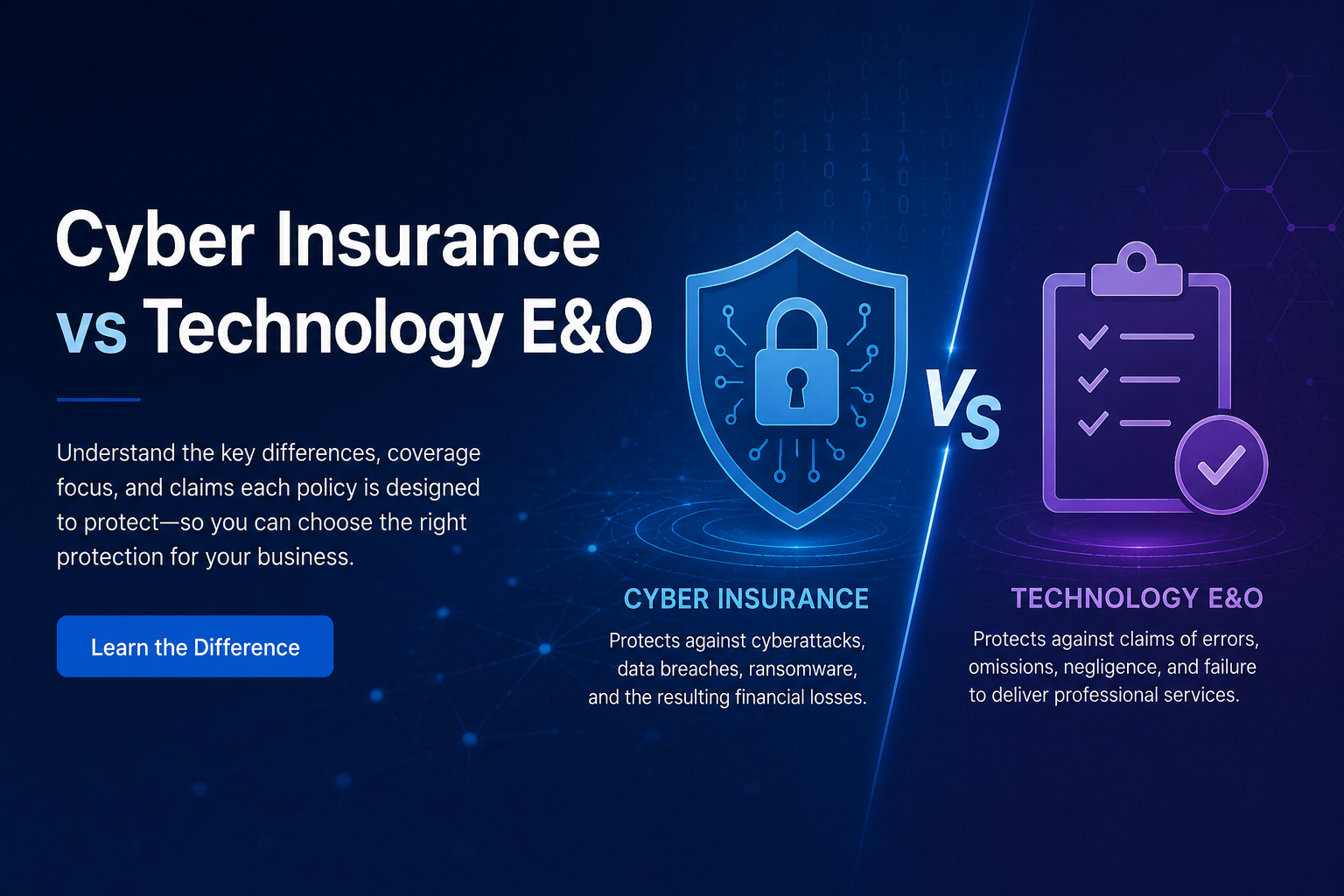
Cyber insurance and Technology Errors and Omissions insurance, often called Tech E&O, protect different parts of a technology-related risk. Cyber insurance focuses on cyber incidents such as data breaches, ransomware, phishing, business email compromise, network security failures, privacy events, and the costs of responding when digital systems or sensitive information are compromised. Technology E&O focuses on professional liability claims tied to technology products or services, such as software failures, bad implementations, missed deadlines, coding errors, system outages, failed integrations, or a technology service that causes a client financial loss.
For many modern businesses, cyber insurance is no longer only a “tech company” issue. Retailers, medical offices, contractors, accounting firms, real estate offices, insurance agencies, consultants, restaurants, logistics firms, and online sellers all rely on email, payment systems, cloud apps, customer records, employee records, websites, portals, and vendors. A cyber incident can create notification costs, forensic costs, legal expenses, extortion demands, recovery expenses, business interruption, privacy claims, and reputational damage.
Technology E&O is more specialized. It is designed for businesses that sell, build, maintain, host, install, advise on, or support technology. That includes MSPs, IT consultants, software developers, SaaS companies, web designers, cybersecurity firms, cloud service providers, data analytics firms, app developers, system integrators, and technology product companies. If a client claims your technology work failed, delayed their operations, corrupted data, caused downtime, created a security gap, or did not perform as promised, Tech E&O may be the coverage that addresses the professional liability side of the claim.
Blake Insurance Group LLC helps businesses compare cyber liability, Technology E&O, general liability, professional liability, business owners policies, commercial package policies, workers’ compensation, and commercial auto coverage. Use the quote and buy online links below to compare eligible options through Thimble, NEXT Insurance, and Coterie.
The key question is simple: did the loss come from a cyber event affecting data or systems, or from your technology product or service failing a client? Many technology businesses need both because one incident can involve both categories.
Quick facts: cyber insurance vs Technology E&O
Cyber insurance usually focuses on cyberattacks, data breaches, network security, privacy, and recovery costs. Technology E&O usually focuses on professional mistakes or technology failures that financially harm clients.
| Question | Cyber insurance | Technology E&O |
|---|---|---|
| Core purpose | Helps respond to cyber incidents, data breaches, ransomware, privacy events, and network security failures. | Helps respond when a technology service, product, advice, implementation, or platform allegedly fails a client. |
| Who usually needs it? | Any business that stores data, uses email, takes payments, relies on systems, or handles private information. | Technology providers, MSPs, SaaS firms, IT consultants, developers, cybersecurity providers, and system integrators. |
| First-party costs? | Often available for forensic investigation, recovery, extortion, notification, and business interruption. | Usually focused more on client claims, though combined Tech E&O/cyber forms may include cyber elements. |
| Client lawsuit protection? | May include third-party privacy and network security liability. | Designed for professional liability claims alleging your technology work caused financial harm. |
The main difference: cyber incident response vs technology professional liability
Cyber insurance is built around digital risk events. If hackers gain access to customer data, ransomware locks your systems, an employee clicks a phishing link, funds are misdirected through business email compromise, private records are exposed, or your network suffers a security failure, cyber coverage may help with response costs. Depending on the policy, that can include breach counsel, forensic investigation, customer notification, credit monitoring, public relations, data restoration, cyber extortion, business interruption, privacy liability, and regulatory defense.
Technology E&O is built around the professional liability risk of technology work. If your company designs software, manages a client’s network, installs a system, provides cybersecurity services, delivers a SaaS platform, integrates databases, supports cloud infrastructure, or advises on technology decisions, a client may claim your product or service failed. The claim may allege missed service levels, implementation mistakes, coding defects, poor project management, system downtime, data loss, compatibility problems, or failure to deliver as promised. Technology E&O is designed to address those types of client financial loss claims.
The two policies can overlap, but they are not interchangeable. A non-tech business may need cyber insurance but not Technology E&O. A technology provider often needs both because a single incident can create first-party cyber costs, third-party privacy claims, and professional liability allegations from clients. For example, if an MSP’s configuration mistake contributes to a client breach, the claim may involve cybersecurity liability, professional negligence, breach response, client damages, and contract disputes.
Side-by-side comparison: cyber insurance vs Technology E&O
The table below shows how the coverage conversation usually separates. Exact coverage depends on the policy form, endorsements, retroactive date, exclusions, underwriting requirements, security controls, client contracts, and claim facts.
| Coverage feature | Cyber insurance | Technology E&O | Best review question |
|---|---|---|---|
| Data breach response | Often included or available for covered cyber incidents. | May be included only if part of a combined Tech E&O/cyber policy. | Would you need help notifying customers, hiring forensics, or recovering systems? |
| Ransomware and cyber extortion | Often available subject to policy conditions and controls. | Not the main purpose unless bundled with cyber coverage. | Could a locked system stop your revenue or client service? |
| Client financial loss from tech failure | May not address professional service failure unless endorsed. | Core coverage focus for technology providers. | Could your software, implementation, advice, or support cause a client loss? |
| Network security liability | Often included as third-party cyber liability. | May be included or connected in tech-specific forms. | Could a security failure trigger a lawsuit or contract claim? |
| Contract requirements | Often required when handling data, credentials, payment information, or customer systems. | Often required in SaaS, MSP, IT consulting, cybersecurity, and software contracts. | Does your client contract require cyber, E&O, or both? |
| Professional mistakes | Usually not enough for technology professional liability by itself. | Designed for errors, omissions, negligent acts, failed services, and tech product issues. | Do clients rely on your technical expertise or platform performance? |
Who needs cyber insurance, Tech E&O, or both?
Most businesses should review cyber insurance because most businesses now depend on technology. Even a small company can face expensive recovery costs after a breach, ransomware event, phishing attack, payment fraud, or system outage. Cyber coverage is especially important for businesses that store names, addresses, dates of birth, Social Security numbers, medical records, financial records, employee files, passwords, payment data, contracts, or proprietary information.
Technology E&O is more targeted. It is meant for businesses paid to deliver technology products or services. An IT consultant who designs a network, a managed service provider supporting client systems, a SaaS company hosting customer workflows, a software developer writing code, a web agency managing e-commerce sites, or a cybersecurity firm monitoring threats can all face claims that their work failed. General liability usually does not solve that exposure because the loss is often financial, professional, contractual, or technology-service related.
| Business situation | Coverage direction | Why |
|---|---|---|
| You run a non-tech business using customer data | Cyber insurance should be reviewed. | Your main exposure is breach response, privacy liability, phishing, ransomware, and system recovery. |
| You provide IT support or managed services | Cyber plus Technology E&O should be reviewed. | You face your own cyber risk and client claims if your technology services fail. |
| You sell SaaS or software | Technology E&O plus cyber should be reviewed. | Clients may claim platform downtime, data loss, failed features, or security failure caused financial loss. |
| You build websites or apps | Technology E&O should be reviewed. | Missed deadlines, code defects, integrations, uptime, and project scope disputes can create client claims. |
| You handle healthcare, financial, or sensitive data | Cyber insurance should be prioritized. | Privacy events, notification duties, regulatory defense, and breach response costs can be significant. |
Coverage gaps businesses miss when comparing cyber and Tech E&O
The biggest mistake is assuming one policy covers every digital risk. Cyber insurance may help with breach response and privacy costs but may not cover a client’s claim that your software implementation failed. Technology E&O may help with professional liability allegations but may not include the full first-party cyber response your own company needs unless cyber coverage is built into the form. A combined Tech E&O/cyber policy can be valuable for technology providers, but the wording still needs careful review.
Another common gap is contract wording. Technology contracts may require cyber liability, professional liability, Technology E&O, media liability, intellectual property coverage, privacy liability, network security liability, additional insured wording, waiver language, minimum limits, or specific deductibles. A certificate that says “cyber” may not satisfy a contract that specifically requires Technology E&O. Likewise, an E&O certificate may not satisfy a client that requires cyber liability.
| Gap | Why it matters | Coverage to review |
|---|---|---|
| Professional service failure | A cyber policy alone may not cover software defects, failed implementation, or missed SLA claims. | Technology E&O. |
| First-party cyber costs | An E&O policy alone may not fully cover breach response, ransomware, forensics, or recovery costs. | Cyber insurance or combined Tech E&O/cyber. |
| Retroactive date issues | Claims-made policies may limit coverage for work performed before a certain date. | Policy retroactive date and prior acts wording. |
| Contract exclusions | Some policies limit breach of contract or warranty-related claims. | Technology E&O wording and client contract review. |
| Security control requirements | Cyber insurers may require MFA, backups, endpoint protection, training, and incident response controls. | Cyber underwriting requirements and security warranties. |
| Social engineering and funds transfer | Payment fraud and email compromise may require specific coverage and sublimits. | Cybercrime, social engineering, and funds transfer coverage. |
What affects the cost of cyber insurance and Technology E&O?
Cyber insurance pricing can depend on annual revenue, industry, number of records, security controls, claims history, use of cloud vendors, payment processing, remote access, email security, backup practices, MFA, endpoint protection, incident response planning, and the requested limits. Businesses with sensitive data, healthcare data, financial data, high transaction volume, or weak security controls may face more underwriting questions.
Technology E&O pricing can depend on revenue, technology services, client industries, contract size, platform dependency, uptime promises, data handled, prior claims, subcontractor use, intellectual property exposure, and whether the business provides cybersecurity, hosting, payment technology, healthcare technology, financial technology, or other higher-risk services. A technology provider should be prepared to explain exactly what it does and what it does not do.
| Quote factor | Why it matters | What to prepare |
|---|---|---|
| Business operations | Insurers need to know whether you are a general business, technology provider, SaaS firm, MSP, or consultant. | Clear description of services, products, client types, and technology responsibilities. |
| Data handled | Sensitive records, payment data, healthcare data, and financial data increase cyber exposure. | Record counts, data types, storage methods, vendors, and privacy controls. |
| Security controls | Cyber underwriting often depends on MFA, backups, patching, endpoint protection, and training. | Security questionnaire responses and control documentation. |
| Client contracts | Contracts can require specific limits, wording, cyber coverage, Tech E&O, and indemnity obligations. | COI instructions, contract insurance section, SLA wording, and required limits. |
| Revenue and project size | Larger contracts and revenue can increase potential client financial loss claims. | Annual revenue, largest contract, average project size, and client industries. |
Quote and buy cyber or Technology E&O coverage online
Use the quote paths below to compare eligible business coverage online. Thimble can be useful for fast small business coverage and certificates. NEXT Insurance offers online quoting and policy management for many business categories. Coterie provides another digital quote path for eligible commercial lines and small business risks.
Before starting, gather your business name, DBA if applicable, entity type, website, business address, services performed, industry, annual revenue, payroll, employee count, client contract requirements, technology services description, data types handled, number of records, security controls, prior claims, desired effective date, and current policy if available. Technology providers should also gather sample contracts, SLA details, hosting responsibilities, subcontractor use, platform dependency, and whether they provide cybersecurity, software, implementation, or managed services.
Coverage is not bound until the application is completed, underwriting requirements are satisfied, payment is accepted where required, and the insurer confirms the effective date.
Cyber insurance vs Technology E&O FAQs
Is cyber insurance the same as Technology E&O?
No. Cyber insurance usually focuses on cyber incidents, data breaches, privacy events, ransomware, and network security failures. Technology E&O focuses on professional liability claims when a technology product or service allegedly fails a client.
Does a SaaS company need both cyber and Tech E&O?
Most SaaS companies should review both. Cyber insurance can help with breach response and network security events, while Technology E&O can help with client claims involving platform failure, software errors, downtime, data loss, or missed performance expectations.
Does general liability cover technology mistakes?
General liability usually does not replace Technology E&O. Many technology claims involve financial loss, professional mistakes, failed services, contract disputes, or software performance issues rather than bodily injury or physical property damage.
Who needs cyber insurance?
Any business that uses email, stores customer or employee information, accepts payments, relies on cloud systems, uses remote access, or depends on technology should review cyber insurance. Cyber risk is not limited to technology companies.
Who needs Technology E&O?
Technology E&O should be reviewed by IT consultants, MSPs, SaaS companies, software developers, cybersecurity firms, cloud providers, web designers, app developers, system integrators, and other businesses paid to deliver technology products or services.
What information do I need for a cyber or Tech E&O quote?
Prepare your business operations, annual revenue, technology services, client contract requirements, data handled, security controls, prior claims, desired effective date, and current policy. Technology providers should also prepare service agreements, SLA details, and product or platform descriptions.
Independent agency: Blake Insurance Group LLC is an independent insurance agency and is not affiliated with any single insurance company, online quoting platform, government agency, technology vendor, software company, cybersecurity provider, or certificate holder.
Licensing: Licensed insurance producer (NPN 16944666).
Important: Cyber insurance, Technology E&O, professional liability, privacy liability, network security liability, cybercrime, breach response, ransomware coverage, business interruption, certificates, endorsements, availability, eligibility, premiums, limits, sublimits, deductibles, exclusions, underwriting approval, online binding, and claim outcomes vary by insurer, state, business class, technology services, security controls, contracts, revenue, prior claims, and policy. Your issued policy controls coverage. This page is general information only and is not legal, tax, financial, cybersecurity, risk-management, claims, or regulatory advice.
Trademarks: Thimble®, NEXT Insurance®, Coterie Insurance®, and any carrier, marketplace, software, or program names are trademarks™ or registered® trademarks of their respective owners. Use of names does not imply endorsement or affiliation.




