Dental coverage | Planned treatment
Dental insurance with no waiting period for major work
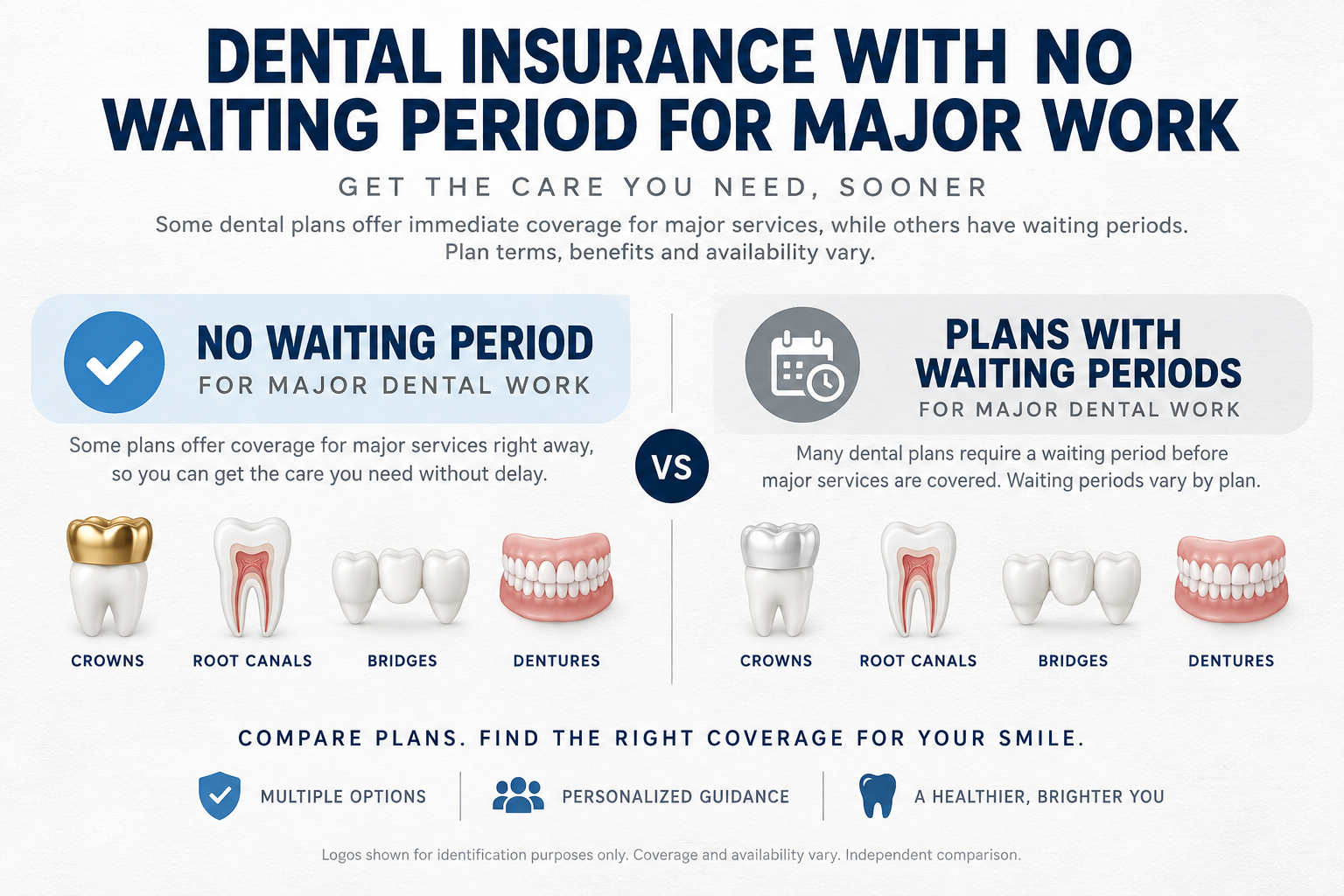
Dental insurance with no waiting period for major work exists in some products, but “day one” does not mean the insurer pays the entire bill. A crown, root canal, denture, or implant must still be an eligible service under the exact policy. Your first-year payment level, dentist network, deductible, annual insurer maximum, and any tooth-history or treatment-in-progress rule can leave a substantial amount for you to pay.
Three different situations are often described as “no waiting”: a policy includes a major-service benefit immediately, an insurer waives a waiting period because you meet its prior-coverage rules, or a dental savings membership offers a participating-provider discount without insurance benefits. These are not interchangeable. Use your dentist's itemized treatment plan and expected dates to identify which arrangement actually helps with your work.
These links open separate company websites. Check your ZIP code and the current policy documents before relying on any displayed benefit.
Quick fact: immediate benefits
A plan may begin paying a stated share of covered major care when coverage starts. That share may be lower during the first policy year than in later years. Confirm the exact service code, network tier, benefit schedule, and effective date.
Quick fact: no insurance claim
A savings membership can offer provider discounts without an insurance waiting period, but the member pays the participating dentist directly. The linked Careington option is savings, not dental insurance.
Four dates and rules you must separate
Application date: The date you submit information is not necessarily when coverage starts. An application may be subject to eligibility, payment, and a carrier-confirmed effective date. Do not schedule treatment based on the mere fact that a quote screen accepted your details.
Policy effective date: This is when an issued policy begins under its terms. A dentist visit before that date generally cannot become covered merely because an application was pending. Some products may offer a near-term start date, but the exact date displayed for your quote controls.
Service waiting period: A policy can be active while a benefit for particular services remains unavailable. Preventive care, basic treatment, and major procedures may have separate rules. A waiver may apply to one category and not another. Ask whether the policy measures the wait from its effective date, when a treatment phase begins, or another specified event.
Graduated benefit: A service can be eligible immediately while the insurer pays a smaller percentage or a smaller dollar allowance at first. After a defined period, the payment may increase if the policy remains in force. That is a meaningful immediate benefit, but it is not the same as full later-year coverage. Read the day-one and after-year-one columns separately. Also check whether a deductible and annual insurer maximum still apply.
| Arrangement | What can happen immediately | What to verify |
|---|---|---|
| Day-one insurance benefit | Eligible major care may receive an insurer payment from the policy start. | First-year percentage, allowed amount, exclusions, and limits. |
| Prior-coverage waiver | An otherwise applicable wait may be removed if requirements are met. | Accepted prior plan, continuous coverage, gap limit, proof, and written approval. |
| Savings membership | A participating provider may charge its member rate under membership terms. | Provider participation, membership fee, actual charge, and start date; no insurer payment. |
| Preventive-only no wait | Exams and cleanings may qualify right away while major work still waits. | Separate service schedules; do not infer a major benefit from a preventive claim. |
The last row is a common source of confusion. “No waiting for preventive services” answers a different question from “Will this policy pay toward a crown next month?” A marketing page may feature its fastest benefit, while the state-specific certificate has different rules for restorative work. Make the insurer identify the applicable service category and exact provision before you enroll.
What current carrier materials illustrate
UnitedHealthOne's public dental information says that some of its dental insurance plans have no waiting periods for preventive, basic, and most major services, including examples such as crowns and root canals. Its other published product information shows that some plans do have waits for major services. Neither statement tells you which option your ZIP code and application will produce. Check the named policy and plan-benefit schedule after opening the supplied UHOne quote path. A product that has no wait for a crown may still apply a different rule to an implant, orthodontia, or another procedure.
Ameritas presents day-one individual dental coverage, and its 2026 PrimeStar handbook illustrates a graduated major-service design. In one illustrated plan column, an in-network major benefit begins at 20% on day one and increases to 50% after year one; other illustrated plan columns have different day-one and later levels. Those figures describe the cited handbook's examples, not every Ameritas product or state, and are not a quote for your case. The handbook also notes that plan options may be unavailable in some areas. Review the actual product shown through your Ameritas shopping path and its current state-specific documents.
A different approach is a waiting-period waiver for prior insurance. Delta Dental of Arizona's public individual plan information, for example, shows specified waits on some major categories and says they may be waived for qualifying prior dental coverage with a limited gap, subject to its rules. This is an example of conditional waiver language, not a promise that Delta Dental or any other insurer will waive a wait for you. No Delta Dental quote link is supplied here. Ask the insurer for an eligibility decision based on your actual coverage history before depending on a waiver.
Check the entire treatment, not one headline procedure
Root canal and crown
A root canal and the final restoration are different billed services. An insurer might place them in different benefit categories or apply different limitations. A crown can involve buildup or other preparatory work. Ask the dentist for procedure codes and a proposed schedule, then verify the policy's payment rules for each code. “No wait for root canals” does not establish a day-one crown benefit, and “major services covered” does not establish that the insurer will pay the same share for both.
Dentures and bridges
A complete or partial denture may involve extractions, a temporary appliance, impressions, fitting, adjustments, relines, and later replacement. A bridge can involve several teeth and components. Some policies restrict replacement of teeth missing before the effective date or a restoration made recently. Even if a denture is eligible on day one, the waiting period is only one consideration; a missing-tooth clause, replacement interval, and insurer maximum can still determine the claim.
Implants
Confirm each component: evaluation, imaging, extraction, grafting, surgical placement, abutment, and crown. “Implant coverage” can refer to only part of the process. Some policies exclude implants entirely, pay an alternate benefit based on a different restoration, or impose a specific implant wait despite no waiting period for other major services. Ask how an implant-supported denture is treated if that is the proposed care. Do not assume that a day-one crown provision covers an implant crown under identical rules.
Gum treatment and oral surgery
Scaling and root planing, periodontal maintenance, gum surgery, and ordinary cleanings can have different classifications and frequencies. Oral surgery is also a broad description; the procedure code and clinical circumstances matter. A no-wait claim for “major care” may exclude a particular treatment or pay a first-year percentage that leaves most of the allowed amount to you. Discuss clinical timing with your dentist rather than delaying urgent care solely to fit a policy schedule.
For work already recommended or started, ask explicitly about preexisting missing teeth, treatment in progress, and the date a multi-stage procedure is considered incurred. A new policy cannot be assumed to pay retroactively. A predetermination or pretreatment estimate, if available, can provide useful detail; final payment can still depend on eligibility, coding, documentation, and benefits remaining when the claim is processed.
Estimate the first-year cost carefully
Add the premiums you expect to pay during the relevant period to your estimated member share of treatment. The member share can include deductibles, copays or coinsurance, noncovered components, out-of-network charges, and amounts after the insurer's annual payment maximum is reached. If the plan offers a smaller day-one percentage that rises later, use the day-one schedule for a procedure that occurs during the first year. Do not price that visit with the more generous later-year percentage.
Here is the arithmetic in an illustrative calculation, not a quoted price or benefit: if a plan allowed $1,000 for an eligible procedure and paid 20% after any deductible, its payment would be $200 before applying other limits and your estimated share of that allowed amount would be $800. At a hypothetical 50% later-year benefit on the same allowed amount, the corresponding amounts would be $500 and $500. The example deliberately omits premiums, deductible, provider billing differences, exclusions, and other services. Use the actual policy and dentist estimate to calculate your own total.
An annual dental maximum generally limits what the insurer pays in a benefit period; it is not a charge you add to your bill and it does not cap all your personal spending. A policy with immediate major benefits can still exhaust its insurer payment maximum before every stage of a large treatment plan is finished. Ask whether a particular service has an additional sublimit and whether preventive claims reduce the amount available. Identify whether the benefit period is a calendar year or runs from the policy anniversary.
If a waiting period can be waived, get confirmation before you substitute the no-wait scenario into your estimate. Ask what documentation of prior continuous coverage is needed, which service categories qualify, whether there is a maximum permitted gap, and whether a previous discount membership counts. A carrier's approval of a waiver is a contractual determination, not something a sales page can grant. If the waiver is denied, recalculate using the ordinary waiting period.
Compare a savings option differently: its membership fee plus the participating dentist's actual discounted charge. Careington says its savings programs are not insurance and members pay providers directly. Confirm your dentist and specialist participate in the correct network, and request the price for each proposed code. No insurance waiting period on a discount membership does not mean a claim will be paid. Our dental cost guide walks through the larger annual comparison.
What to do before applying
- Get the treatment plan. Ask your dentist for each procedure code, estimated charge, tooth or area involved, proposed dates, and whether work has begun. Save the details for every stage, not just the headline procedure.
- Find the exact product. Record the insurer, plan name, ZIP code, quote date, effective date, network, and state-specific policy or certificate version. Verify availability before comparing benefits.
- Read the first-year schedule. Check the major-service row for your codes, any waiting period, graduated percentage, deductible, maximum, exclusion, and out-of-network payment.
- Verify the dentist. Search the exact product's network and office location; call the practice to confirm a contract, not just its willingness to submit claims. Check a specialist independently.
- Confirm a waiver in writing. If relying on prior coverage, provide required proof and confirm the insurer's decision before scheduling a procedure as though the wait were removed.
- Compare full totals. Consider premiums plus member treatment payments for insurance, or membership fee plus discounted provider charges for savings. Include treatments the product will not cover.
A person who needs treatment soon may face a real choice among proceeding without new insurance, applying for a product with a modest immediate benefit, using a participating-provider savings arrangement, or planning a later phase of clinically appropriate care with the dentist. The correct course depends on medical judgment, policy terms, and personal finances. Do not buy a policy solely because a button promises speed. Confirm the treatment schedule and likely payment before relying on a new contract.
Individual dental shopping routes should also be distinguished from Marketplace dental enrollment. HealthCare.gov says separate Marketplace dental coverage has its own rules and may include waiting periods for adults. The supplied company links are separate shopping routes; do not assume Marketplace purchase timing applies to them. Our dental insurance hub covers the broader product choices and network basics.
Frequently asked questions
Does no waiting mean a major procedure is free on day one?
No. An eligible service may receive only a limited first-year insurer payment, and you can owe a deductible, your cost-sharing amount, excluded components, or charges above applicable limits. Ask for the named policy's day-one benefit schedule and a dentist estimate.
Can prior dental coverage remove a waiting period?
Some policies offer a conditional waiver. The acceptable prior coverage, permitted gap, proof, and services covered by the waiver vary. Submit the required documents and obtain the insurer's decision rather than assuming the waiver applies.
Are implants included in a no-wait major benefit?
Not necessarily. Implant placement, abutment, crown, imaging, and grafting can be treated separately. An implant-specific wait or exclusion may apply even if other major services have no wait. Verify all codes in the governing policy.
Does Careington provide no-wait dental insurance?
No. The supplied Careington route is a savings membership, not an insurance policy. Participating dentists may charge a discounted fee that members pay directly, subject to membership terms and provider participation.
What if treatment started before the policy became effective?
Ask the insurer how its treatment-in-progress and date-of-service provisions apply. Do not assume a later policy will pay for work already underway or for a stage performed before its effective date.
Compare the day-one benefit for your actual procedure
Bring the dentist's codes, proposed dates, your ZIP code, preferred providers, and any proof of prior coverage. Check the current policy before applying or scheduling care based on an advertised no-wait claim.