Towing
A tow to the nearest repair shop, or a set number of miles, when the vehicle can't be driven because of a breakdown.
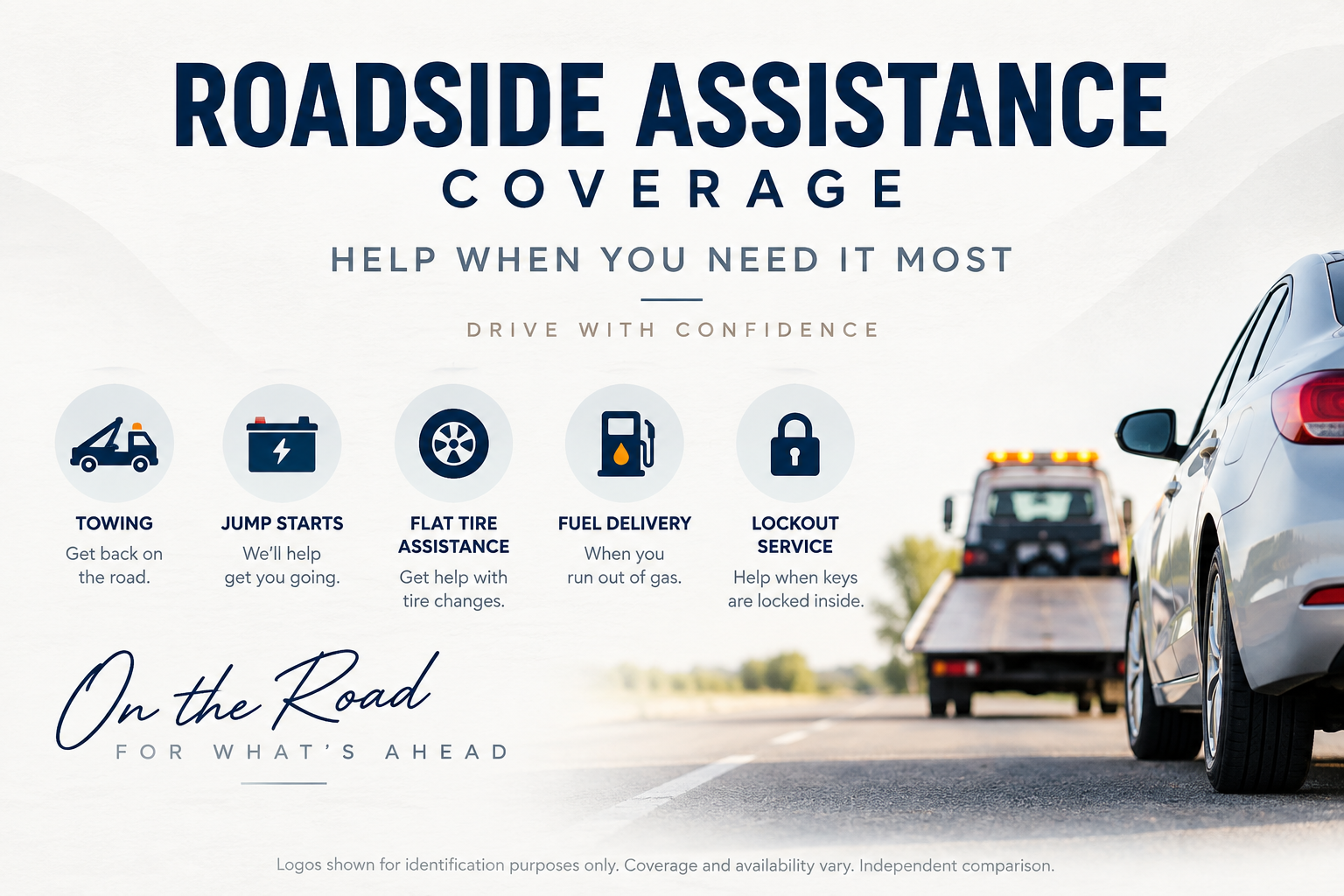
Roadside assistance pays for help when your car won't go — a tow, a jump start, a spare tire, a few gallons of gas or a locksmith. It's one of the cheapest things you can add to an auto policy, but it isn't the only way to get it, and it doesn't pay to fix what broke.
This guide explains what roadside coverage includes, where it comes from (your insurer, an auto club, your car's manufacturer or a vehicle service contract), what it usually costs and when a separate repair plan makes more sense. When you're ready, start an auto quote with roadside added, or compare a vehicle service contract that bundles roadside help with mechanical repair coverage.
Most roadside programs cover the same core services. What changes from plan to plan is the tow distance, the dollar cap per call, the number of calls per year, and whether you pay upfront and get reimbursed or the provider dispatches help directly.
A tow to the nearest repair shop, or a set number of miles, when the vehicle can't be driven because of a breakdown.
A battery boost at your location. Some programs also test or replace the battery, but you pay for a new one.
Installing your spare. If you don't have a usable spare, most plans treat it as a tow instead.
Enough gas to reach a station. Many plans cover the delivery but charge you for the fuel.
A locksmith to get you back in, usually up to a dollar limit. Replacement keys are often extra.
Pulling a vehicle out of a ditch, mud or sand when it's reachable from a normal road — common limits apply.
| Term | What it means | Why it matters |
|---|---|---|
| Tow distance | Miles covered per tow, or "to the nearest qualified shop" | Long rural stretches in Arizona and the West can exceed short tow limits quickly |
| Per-call limit | Maximum paid for a single service call | Extra miles, winching or after-hours service can go past the cap |
| Calls per year | How many uses you get in a policy or membership year | Older vehicles and multi-driver households use more calls |
| Dispatch vs. reimbursement | Whether the provider sends help or you pay and submit receipts | Reimbursement plans mean paying out of pocket first |
| Who is covered | The insured vehicle only, or listed drivers in any car | Auto club memberships often follow the person; insurance add-ons follow the vehicle |
| Vehicle types | Cars, trucks, motorcycles, RVs or trailers | RVs, motorcycles and heavy trucks often need a separate or upgraded plan |
Roadside assistance gets the car moving or to a shop. It generally does not pay for:
You might already have roadside coverage and not know it. Check your auto policy, your new-car warranty booklet, your credit card benefits and your phone carrier before you buy another plan.
| Source | How it works | Watch for |
|---|---|---|
| Auto insurance add-on | Endorsement on your policy; follows the insured vehicle | Tow limits, per-call caps and whether the carrier counts uses in underwriting |
| Auto club membership | Annual membership that follows the member in any vehicle; tiers offer longer tows | Tier differences, call limits and waiting periods on upgrades |
| Manufacturer program | Included with many new vehicles for a set time or mileage | Expiration date — often ends with the basic or powertrain warranty |
| Vehicle service contract | Repair coverage that may bundle roadside, towing and rental help | What's actually covered, exclusions, deductibles and who administers claims |
| Credit card or phone carrier | Pay-per-use dispatch or limited benefit tied to the account | Many charge a set fee per call rather than covering it |
For example, one AAA club's published chart shows its Classic tier towing 7 miles (or unlimited back to its own facility), Plus towing up to 100 miles, and Premier offering one tow per household up to 200 miles, with up to four service calls per year for primary members (AAA benefit chart). Benefits and dues vary by club and region.
Added to an auto policy, roadside assistance is usually inexpensive — commonly in the range of about $10 to $80 per year, depending on the carrier, state and limits (CarInsurance.com). Standalone auto club memberships generally cost more because they follow the person, cover any vehicle and often add longer tows and travel discounts.
A single tow without coverage can cost far more than a year of the add-on, especially on long rural highways or late at night. The better question is usually not "is roadside worth it?" but "do I already have it somewhere, and are the tow limits long enough for where I drive?"
Vehicle service contracts are priced differently because they cover mechanical repairs, not just roadside help. Prices depend on the vehicle's age, mileage, make and model, the coverage level and the deductible. The FTC notes that service contract prices can range from several hundred to several thousand dollars (FTC).
Usually a roadside call isn't treated like an at-fault accident or comprehensive claim. But carriers handle it differently: some record roadside use as claims or service activity, and frequent use may be considered at renewal or in eligibility decisions (State Farm).
If your vehicle is breaking down often, roadside coverage is treating the symptom. A repair plan, a maintenance catch-up or a vehicle change may save you money and repeated calls. Ask your agent how your specific carrier treats roadside use before you rely on it heavily.
What most people call an "extended auto warranty" is legally a vehicle service contract. The FTC explains that a manufacturer's warranty is included in the price of a new vehicle, while a service contract is bought separately and is not a warranty as defined by federal law (FTC). Neither one is auto insurance.
| Product | Pays for | Doesn't pay for |
|---|---|---|
| Roadside assistance | Towing, jump starts, tire changes, fuel delivery, lockouts | The repair, parts or accident damage |
| Collision & comprehensive | Damage from accidents, theft, weather, fire, glass and animals, minus your deductible | Mechanical breakdown and normal wear |
| Vehicle service contract | Covered mechanical and electrical repairs listed in the contract; may include roadside and rental help | Typically accident damage, normal wear and tear and excluded parts |
Arkay describes its product as a vehicle service contract, not a manufacturer's warranty. According to Arkay, its plans cover repairs after the factory warranty expires, are month-to-month, cover vehicles up to 12 years old with up to 200,000 miles at the time of sale (RVs up to 10 years and 90,000 miles), allow repairs at any dealership or shop you choose, and include complimentary roadside assistance, towing and rental car reimbursement while the plan is active. Arkay states its products are not available in California, and its RV products are not available in Washington (Arkay Auto Warranty).
Get an Arkay Auto Warranty Quote
Most plans cover towing, jump starts, flat tire changes, fuel delivery and lockout service, and many include winching. Limits on tow distance, dollars per call and calls per year vary by plan.
As an auto insurance add-on it is usually inexpensive, commonly about $10 to $80 per year depending on the carrier, state and limits. Auto club memberships usually cost more but follow the member in any vehicle.
No. Roadside assistance gets the vehicle started or towed; it does not pay for parts or labor to fix the problem. Mechanical repairs are covered by a factory warranty or a vehicle service contract, and accident damage by collision coverage.
A roadside call usually isn't treated like an at-fault accident, but some carriers record roadside use, and frequent use may be considered at renewal. Ask how your carrier handles it.
No. An "extended warranty" is usually a vehicle service contract. It is not auto insurance and, according to the FTC, not a warranty as defined by federal law. It helps pay for covered repairs, and some contracts include roadside, towing and rental benefits.
Maybe not. Many new vehicles include roadside assistance for a limited time, and auto club memberships cover you in any car. Compare tow limits and expiration dates before adding another plan.
According to Arkay, its vehicle service contracts include complimentary roadside assistance, towing and rental car reimbursement while the plan is active. Arkay products are not available in California. Review the contract for limits and exclusions.
It depends on the carrier. Some require comprehensive and collision on the vehicle before adding roadside or towing coverage. An agent can confirm when you quote.

Blake Nwosu — Owner & Principal Agent, Blake Insurance Group LLC
Arizona license 16117464 • NPN 16944666 • Bio & license
888-387-3687 • info@blakeinsurancegroup.com • Mon–Fri 9:00–5:00 AZ time
Disclosure: Blake Insurance Group LLC is an independent insurance agency. This page is general information, not a contract. Roadside assistance availability, limits, pricing and eligibility vary by carrier, state, vehicle and driver. Policy and contract terms control.
Vehicle service contracts: Vehicle service contracts ("auto warranties") are not insurance and are not a manufacturer's warranty. They are provided by third parties under their own terms, exclusions and state availability. Blake Insurance Group may receive compensation when you request a quote or buy through links on this page. Arkay products are not available in California.
Trademarks: AAA and other names are trademarks of their respective owners; mention does not imply affiliation or endorsement.
Licensing: Arizona insurance license 16117464; NPN 16944666. Author: Blake Nwosu. Updated September 22, 2026.



