Bundled path
Wellcare Medicare Advantage administers Part A and Part B through one plan. Many options also include Part D, but the exact plan must be checked.
Medicare coverage-path comparison • 2027 planning guide
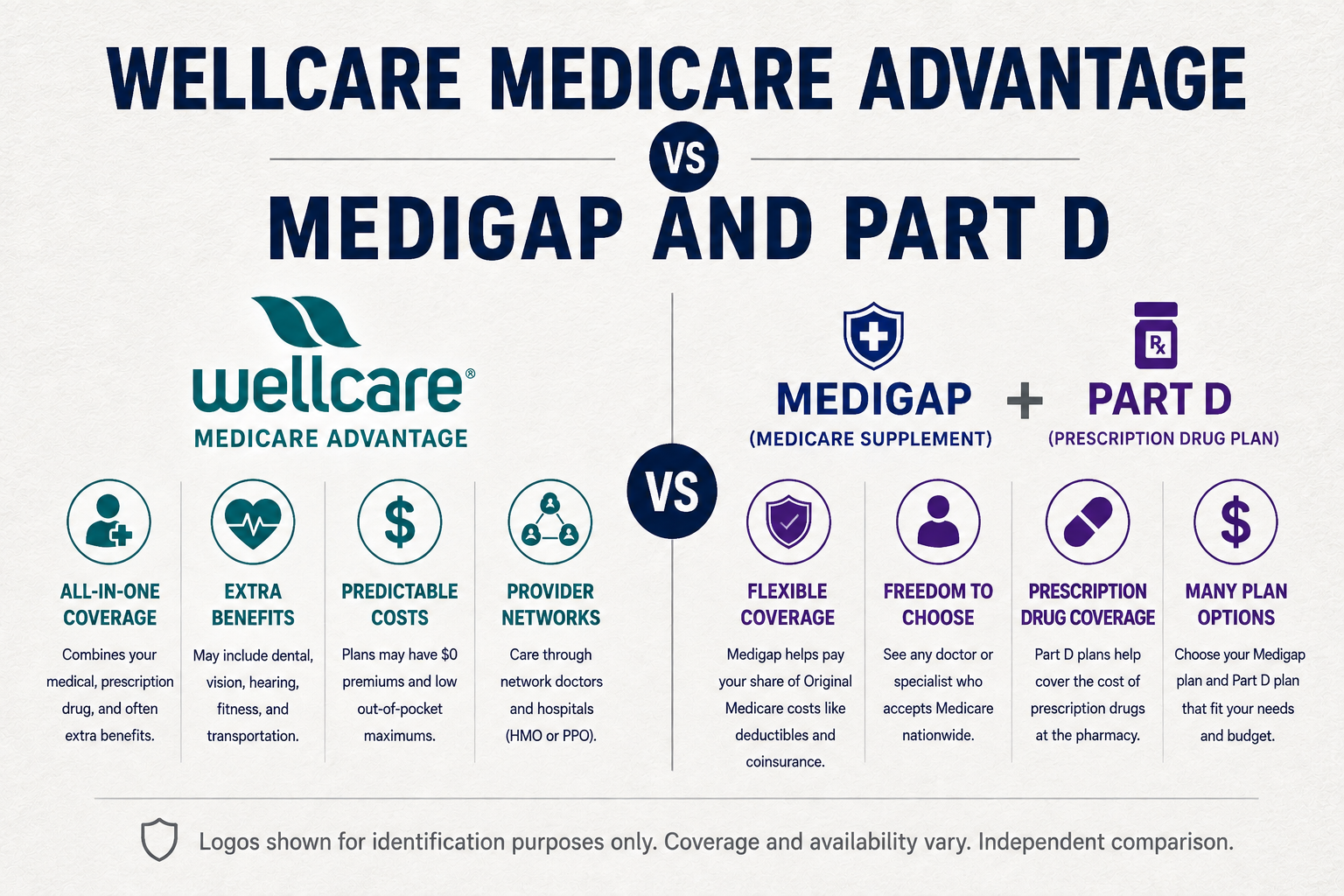
Wellcare Medicare Advantage vs Medigap and Part D is a comparison of a bundled coverage path and a three-part modular path. A Wellcare Medicare Advantage plan is a private Medicare-approved way to receive Part A and Part B benefits and may include Part D prescription coverage. The alternative keeps Original Medicare for Part A and Part B, adds Medigap for specified Original Medicare cost sharing, and adds a stand-alone Part D plan for outpatient prescriptions.
The pieces are not interchangeable. Medigap cannot pay a Wellcare Medicare Advantage plan’s costs, and a separate drug plan is incompatible with many Medicare Advantage structures. On the modular side, Medigap does not replace Original Medicare or provide modern outpatient drug coverage. The comparison must therefore evaluate two complete arrangements—not a medical plan on one side and a single supplement on the other.
This page is an educational framework for 2027 planning, not a list of plan-specific benefits or rates. As of August 2026, CMS has not released the finalized 2027 Medicare Advantage and Part D landscape. Current Wellcare premiums, networks, formularies, service areas, cost sharing and supplemental benefits must not be treated as final for 2027. Medigap availability, premiums, underwriting and state protections also must be verified for the applicant and intended effective date.
If you searched for Medicare coverage help “near me,” begin with the permanent address, Medicare effective dates, current coverage, doctors, hospitals, prescriptions, pharmacies, travel pattern and budget. Then identify both the Medicare election period and the Medigap purchase right. An opportunity to leave Medicare Advantage does not by itself guarantee that an insurer will issue a Medigap policy.
Wellcare Medicare Advantage administers Part A and Part B through one plan. Many options also include Part D, but the exact plan must be checked.
Original Medicare handles medical benefits, Medigap addresses specified cost sharing, and a stand-alone Part D plan handles outpatient drugs.
Medicare election periods, Medigap purchase rights and Part D effective dates are related but not identical. Safe switching requires all three.
Medicare Advantage, also called Medicare Part C, is offered by private organizations that contract with Medicare. A beneficiary remains in Medicare but receives Medicare-covered Part A and Part B services through the plan. A local Wellcare option may use an HMO, PPO, Special Needs Plan or another permitted structure. The exact network, referrals, prior authorization, drug coverage, costs and supplemental benefits depend on the plan, address, contract and year.
The modular arrangement assigns a different job to each component. Original Medicare makes the Part A and Part B coverage decision and pays first for approved services. Medicare Supplement Insurance is private coverage designed to pay specified remaining cost sharing according to the selected standardized policy. A separate Part D contract sets its own drug list, pharmacy network, utilization rules and prescription costs. One component’s approval does not guarantee another component’s coverage.
| Comparison area | Wellcare Medicare Advantage | Original Medicare + Medigap + stand-alone Part D |
|---|---|---|
| Coverage foundation | The private plan administers Part A and Part B; the exact plan may also include Part D. | Original Medicare administers Part A and Part B, Medigap pays according to its policy after Medicare, and the PDP administers outpatient drug benefits. |
| Compatibility | Medigap cannot pay the plan’s premiums, deductibles or copayments. A separate PDP cannot be added to many plan types. | The beneficiary must remain in Original Medicare for Medigap to function; the stand-alone Part D plan is a separate compatible contract. |
| Local availability | The exact Wellcare plan must serve the permanent address for 2027. | The PDP must serve the address. The Medigap policy must be sold in the state, and the applicant must qualify under federal and state purchase rules. |
| Doctors and hospitals | Network and out-of-network rules depend on the exact plan structure. | The beneficiary can generally use providers nationwide that take Medicare; the Medigap policy generally follows Medicare’s coverage decision. |
| Referrals and authorization | Referrals or prior authorization may apply under the plan. | Original Medicare generally requires referrals and prior authorization in fewer situations, but Medicare coverage rules still apply. |
| Prescription drugs | Many plans include Part D, but not every option does. Use the exact plan formulary and pharmacy directory. | Modern Medigap policies do not include drug coverage. Use the separate PDP’s formulary, pharmacy network and coverage rules. |
| Medical cost protection | The plan has an annual limit on member spending for covered Part A and Part B services, subject to its accumulation rules. | Original Medicare alone has no annual medical out-of-pocket limit; Medigap reduces covered cost sharing according to the selected policy. |
| Premium structure | The beneficiary generally pays the Part B premium and any plan premium. | The beneficiary generally pays the Part B premium plus separate Medigap and Part D premiums. |
| Supplemental benefits | The exact plan may offer additional benefits with plan-specific limits and eligibility. | Medigap generally does not cover routine dental, vision, hearing aids, long-term care or prescription drugs. |
| Enrollment timing | Joining or leaving requires a valid Medicare election period. | Part D uses Medicare election periods, while Medigap has separate open-enrollment, guaranteed-issue and underwriting rules. |
| Controlling documents | Final Summary of Benefits, Evidence of Coverage, directories, formulary and enrollment materials. | Official Medicare rules, the Medigap outline of coverage and policy, rate information, underwriting decision and separate Part D documents. |
In most states, Medigap policies are standardized by letter. Policies with the same letter provide the same basic standardized benefits even when different insurance companies sell them, although premiums and company service can differ. Massachusetts, Minnesota and Wisconsin standardize Medigap differently. Availability of a lettered policy, eligibility for certain plans and state-specific consumer protections must be verified rather than assumed.
This page uses “Medicare Supplement” and “Medigap” interchangeably. It does not imply that the supplied Wellcare link offers Medigap or stand-alone Part D insurance, or that Blake Insurance Group represents every insurer. The Wellcare pathway is carrier-specific; the assistance form is the supplied route for discussing the broader three-component decision.
Provider access is often the most visible practical difference. A Wellcare Medicare Advantage plan may require nonemergency care from a defined network. An HMO generally emphasizes in-network care and may require a primary care provider or specialist referrals. A PPO may cover eligible out-of-network services at different costs, but a noncontracted provider is not automatically required to treat the member except in protected circumstances such as emergencies.
With Original Medicare and a standard Medigap policy, the beneficiary can generally use any doctor or hospital in the United States that takes Medicare. Confirm that the provider accepts the patient, is enrolled in Medicare for the service and, when relevant, accepts Medicare assignment. Medigap does not create coverage when Medicare denies a service as noncovered or not medically necessary. Medicare SELECT policies are a special form of Medigap that can use provider networks, so their rules should be reviewed separately.
Do not rely on a provider saying it “takes Wellcare” or “takes Medicare.” For Wellcare, verify the complete plan name, provider location, facility and service with both the plan and provider. For the Original Medicare pathway, verify Medicare participation and whether the selected Medigap benefit addresses the remaining approved cost sharing. Apply this process to primary care, specialists, hospitals, laboratories, imaging, surgery centers, rehabilitation, behavioral health, home health, dialysis, infusion care and medical equipment.
| Care issue | Wellcare Medicare Advantage review | Original Medicare plus Medigap review |
|---|---|---|
| Primary care | Is an in-network primary care provider required or assigned? | Does the physician take Medicare and new patients, and does assignment affect the estimate? |
| Specialists | Is the specialist in the exact network, and is a referral required? | Does the specialist take Medicare? Original Medicare generally does not require a primary-care referral. |
| Hospitals and facilities | Are the preferred hospital, department and facility location in-network? | Does the facility participate in Medicare for the anticipated service? |
| Prior authorization | Does the plan require approval for imaging, procedures, equipment, rehabilitation or planned treatment? | Do Medicare coverage rules or a Medicare prior-authorization program apply to the service? |
| Out-of-network care | What is covered outside the network, under which conditions and at what member cost? | A standard Medigap policy generally follows Original Medicare rather than a separate provider network; Medicare SELECT can differ. |
| Ongoing treatment | What transition or continuity-of-care process applies after enrollment? | Will each treating provider continue taking Medicare, and when will the Medigap policy become effective? |
| Domestic travel | How are routine services outside the plan’s service area handled? | Can the beneficiary find a provider that takes Medicare at the destination? |
Care-management preferences matter as much as network size. Some beneficiaries value a plan that coordinates care through a primary provider and defined network. Others prioritize the ability to seek Medicare-participating clinicians in several states. Neither preference identifies a universal winner. Compare the way the person actually receives care, including referral habits, planned procedures, specialist relationships and willingness to verify network status.
Travel outside the United States requires a separate analysis. Original Medicare generally has limited coverage outside the country. Certain standardized Medigap policies include a limited foreign-travel emergency benefit subject to policy terms. Medicare Advantage emergency and urgently needed care protections also depend on Medicare requirements and the plan document. Do not describe either pathway as worldwide comprehensive coverage without reading the exact terms.
Medicare explains that Medigap policies sold after 2005 do not include outpatient prescription drug coverage. A person choosing Original Medicare with a newly issued Medigap policy generally needs to evaluate a compatible stand-alone Part D plan unless other creditable drug coverage applies. The Medigap and Part D policies are separate contracts and can have separate premiums, applications, member cards, notices and customer-service processes.
Many Medicare Advantage plans include Part D and are called MAPD plans, but not every Medicare Advantage option includes drug coverage. Confirm the exact Wellcare structure before enrolling. Medicare says that, in most cases, someone who joins a Medicare Advantage plan without drug coverage cannot simply add a separate drug plan. Joining an incompatible stand-alone Part D plan can cause disenrollment from certain Medicare Advantage coverage, so never add one based on an assumption.
Use one complete medication profile for both pathways. Include every drug’s exact name, strength, dosage form, quantity and frequency, along with preferred retail and mail-order pharmacies. For the Wellcare option, review the exact plan formulary, tier, deductible, pharmacy network, preferred cost-sharing status, prior authorization, step therapy and quantity limits. For the modular arrangement, perform the same review under each stand-alone Part D plan. Medicare’s drug-plan rules guide explains how prior authorization, step therapy and quantity limits may operate.
The same Medigap policy can pair with different stand-alone Part D plans because Medigap does not determine the drug formulary. That separation provides another selection point, but it also means the beneficiary must review Part D annually. A Medigap carrier’s name does not prove that a particular prescription is covered, and standardized Medigap benefits do not standardize Part D formularies, pharmacy networks or utilization rules.
Part D timing deserves attention. After the applicable eligibility point, going 63 consecutive days or more without Medicare drug coverage or other creditable prescription coverage can lead to a late-enrollment penalty when Part D is obtained later. Keep annual notices showing whether employer, retiree, VA, TRICARE or other drug coverage is creditable. Coordinate the new Part D effective date when leaving a Wellcare MAPD plan for Original Medicare and Medigap.
Drug lists, tiers, pharmacy arrangements and utilization requirements can change annually. Existing members should read the Annual Notice of Change and the new formulary. Review the Wellcare MAPD formulary and a stand-alone PDP formulary with the same care; neither should be carried forward from 2026 by assumption. Current results are useful for preparation only. Final 2027 documents and a fresh medication check should control the decision.
A responsible comparison uses total expected cost rather than one premium. Under Medicare Advantage, consider the Part B premium, any Wellcare plan premium, medical and drug deductibles, copays, coinsurance, prescription costs and the medical maximum out-of-pocket amount. Under Original Medicare with Medigap, consider the Part B premium, Medigap premium, remaining cost sharing under the selected standardized policy, a separate Part D premium and prescription costs.
Medicare Advantage shifts more of the cost comparison into the plan’s service-by-service schedule and annual medical out-of-pocket limit. Medigap shifts more cost into a separate monthly premium in exchange for paying specified Original Medicare cost sharing. Neither description guarantees a lower annual total. Age, location, health-care use, rate increases, provider choices, prescription needs and the exact policies can change the result.
| Category | Wellcare Medicare Advantage | Original Medicare + Medigap + Part D |
|---|---|---|
| Monthly obligations | Part B premium plus any plan premium and other applicable obligations. | Part B premium, Medigap premium and any stand-alone Part D premium. |
| Routine care | Use final plan costs for primary care, specialists, tests, imaging, urgent care and therapy. | Apply Original Medicare cost sharing, then the exact standardized Medigap benefit and any remaining member responsibility. |
| Higher-use care | Model hospitalization, surgery, rehabilitation, skilled nursing, equipment and repeated specialist services. | Model the same Medicare-covered services and how the selected Medigap policy responds. |
| Annual medical risk | Review the plan’s maximum out-of-pocket amount and which Part A and Part B expenses accumulate toward it. | Original Medicare alone has no annual medical cap; the Medigap policy reduces specified cost sharing but does not cover every expense. |
| Prescription drugs | Use the included Part D terms if the exact plan is MAPD. | Model a separate Part D plan using the complete drug and pharmacy profile. |
| Rate changes | Premiums, cost sharing and benefits can change each plan year. | Medigap premiums can change over time based on approved rates, rating method and other lawful factors. |
| Noncovered services | Value supplemental benefits only when actually offered and usable under the plan’s limits. | Budget for services that Original Medicare and Medigap generally do not cover, including routine dental, vision, hearing or long-term custodial care. |
Medigap standardization helps compare benefits but does not standardize premiums. In most states, policies with the same letter provide the same basic benefits, yet insurers can charge different premiums. Pricing can reflect the applicant’s location, age, tobacco status where permitted, household or payment discounts, the insurer’s rating method and medical underwriting outside protected periods. Verify the current rate, future rate history where available and how the policy is rated.
The standardized benefit letter also matters. Different lettered policies cover different portions of Original Medicare cost sharing, and eligibility for some policy types depends on when a person first became eligible for Medicare. This page does not recommend a particular Medigap letter. Compare only policies the person is eligible to buy and review the official benefit chart and outline of coverage.
Use at least three financial scenarios. A light-use scenario emphasizes premiums and routine services. A typical-use scenario includes expected visits, tests and prescriptions. A higher-use scenario adds hospitalization, surgery, rehabilitation, medical equipment or repeated specialist care. The goal is to understand predictable monthly cost, point-of-service cost sharing and exposure to an unusually busy medical year.
Supplemental benefits should remain secondary to medical and prescription fit. A Wellcare plan may offer dental, vision, hearing, fitness, transportation, over-the-counter items, meals or other benefits, but no particular 2027 benefit is promised here. Medigap generally does not cover those routine services. Compare the covered service, provider access, frequency, limits, eligibility and realistic use rather than the benefit label.
A person generally needs Medicare Part A and Part B to join Medicare Advantage, must live in the plan’s service area, meet plan-specific eligibility rules and use a valid Medicare election period. A person generally must have Original Medicare Part A and Part B to buy Medigap. Because the products are incompatible, Medigap coverage cannot begin as supplemental medical coverage while the person remains enrolled in Medicare Advantage. It is generally illegal to sell Medigap to someone known to have Medicare Advantage unless that person is switching back to Original Medicare and the Advantage coverage will end before the Medigap effective date.
Federal law provides a one-time six-month Medigap Open Enrollment Period beginning the first month a person is age 65 or older and enrolled in Part B. During that period, an insurer generally cannot deny an available Medigap policy or charge more because of health problems. This window does not repeat every fall. After it ends, federal law may not guarantee that an insurer will issue a policy, and medical underwriting or a higher premium may apply where permitted.
State law can provide broader protections, different switching opportunities or access for people younger than 65 who qualify for Medicare because of disability or end-stage renal disease. Federal law generally does not require insurers to sell Medigap to people under 65, so state insurance department rules are important. Never assume that rights in one state apply in another.
Guaranteed-issue and federal trial rights can apply in defined situations. For example, certain people who tried Medicare Advantage for the first time may have a limited opportunity to return to Original Medicare and buy specified Medigap coverage. The exact right, policy choices, application window and proof required depend on the circumstances. Keep termination notices, enrollment confirmations and other records that establish the timeline.
Medicare’s annual Open Enrollment Period runs from October 15 through December 7. Eligible beneficiaries can make permitted changes involving Medicare Advantage and Part D, generally for January 1. The Medicare Advantage Open Enrollment Period from January 1 through March 31 applies only to people already enrolled in Medicare Advantage and permits limited changes. Neither period is a universal Medigap open enrollment or guaranteed-issue period.
Special Enrollment Periods may arise after moves, loss of certain coverage, Medicaid or Extra Help changes, or other defined events. A Medicare election right answers whether the person may change how Medicare benefits are received; it does not automatically answer whether a Medigap insurer must accept the application. Both questions must be resolved before the switch.
The supplied Wellcare pathway is limited to available Wellcare Medicare Advantage options. Eligible beneficiaries may use it to view Wellcare options and, when permitted, begin or complete enrollment. It does not apply for Medicare Supplement insurance, return someone to Original Medicare, arrange a stand-alone Part D plan or compare every Medicare option. As of this review, the link resolves to a 2026 flow and is not final 2027 plan information.
The Blake Insurance Group Medicare form requests licensed-agent assistance or a coverage review. Submitting it does not enroll the visitor in Medicare, Wellcare, Original Medicare, Medigap, Part D or another policy. For assistance by phone, call (833) 501-3334 on weekdays from 6:15 a.m. to 4:00 p.m. Pacific time. For official information about all available Medicare options, use Medicare.gov or call 1-800-MEDICARE (1-800-633-4227).
A fair comparison requires two complete coverage arrangements and the same personal profile. Share Medicare numbers and health information only through an approved secure process when needed for eligibility, underwriting, comparison or enrollment.
The Wellcare pathway is carrier-specific and currently uses a 2026 flow. It does not offer Medigap, choose Original Medicare or arrange stand-alone Part D. The Blake Insurance Group form requests assistance and is not an enrollment application. Medicare.gov and 1-800-MEDICARE provide official information.
For broader education, read Blake Insurance Group’s guide to how Medicare Advantage works and the general comparison of Medicare Advantage and Medigap. Then verify the applicant’s current federal and state Medigap rights and the final 2027 plan documents.
Neither structure is universally better. Compare provider access, expected care, prescriptions, total premiums, medical cost sharing, annual financial risk, travel, administrative preferences and Medigap purchase rights. The answer depends on the individual and final 2027 information.
No. Medigap supplements Original Medicare and cannot pay Wellcare Medicare Advantage premiums, deductibles or copayments. A Medigap policy can be arranged for a future effective date when someone is validly switching back to Original Medicare, but the coverages should not overlap as the person’s medical arrangement.
No. The supplied pathway is limited to available Wellcare Medicare Advantage options and currently resolves to a 2026 flow. It does not display, compare or enroll someone in a Medigap policy or stand-alone Part D plan.
No. The federal Medigap Open Enrollment Period is generally a one-time six-month window beginning the first month a person is age 65 or older and enrolled in Part B. Annual Medicare election periods do not automatically create Medigap acceptance rights.
No. The person needs a valid period to leave Medicare Advantage, must separately qualify to buy Medigap and needs an available election period for Part D. Outside protected Medigap periods, underwriting may apply where allowed. Coordinate all three effective dates before ending coverage.
New Medigap policies do not include prescription drug coverage. Medigap policies sold after 2005 exclude it, so a beneficiary may need a compatible stand-alone Part D plan unless other creditable drug coverage applies.
Under Original Medicare with standard Medigap, the person can generally use providers nationwide that take Medicare. Verify that each provider accepts the patient and service. Under Wellcare, verify the exact plan network. Medicare SELECT policies can use networks and require separate review.
Do not assume so. Many Medicare Advantage structures require drug coverage through the Advantage plan, and joining a separate Part D plan can cause disenrollment. Some specialized structures have different rules. Verify the exact Wellcare plan before making any Part D enrollment.
That cannot be answered without complete policies and a usage profile. Medicare Advantage may combine a plan premium with service-level cost sharing and an annual medical limit. The modular path includes separate Medigap and Part D premiums, remaining Original Medicare costs and prescription expenses.
During the federal Medigap Open Enrollment Period and qualifying guaranteed-issue situations, health-based denial protections apply. Outside protected periods, medical underwriting may be allowed. State law can provide additional rights, so the applicant’s location and timing must be checked.
Not yet. CMS expects the finalized 2027 Medicare Advantage and Part D landscape in mid-to-late September 2026. Current information is useful for preparation only. Medigap premiums and availability also must be reconfirmed for the intended date.
No. It requests licensed-agent assistance or a Medicare coverage review. Enrollment or policy issuance requires separate authorized applications, eligibility confirmation and coordinated effective dates.
No. Blake Insurance Group LLC is an independent insurance agency. It is not connected with or endorsed by the United States government or the federal Medicare program, and this page does not imply endorsement by Medicare, CMS or Wellcare.




