Flood Insurance • Effective Dates • 2026 Guide
Flood Insurance With No Waiting Period: When Can Coverage Start Immediately?
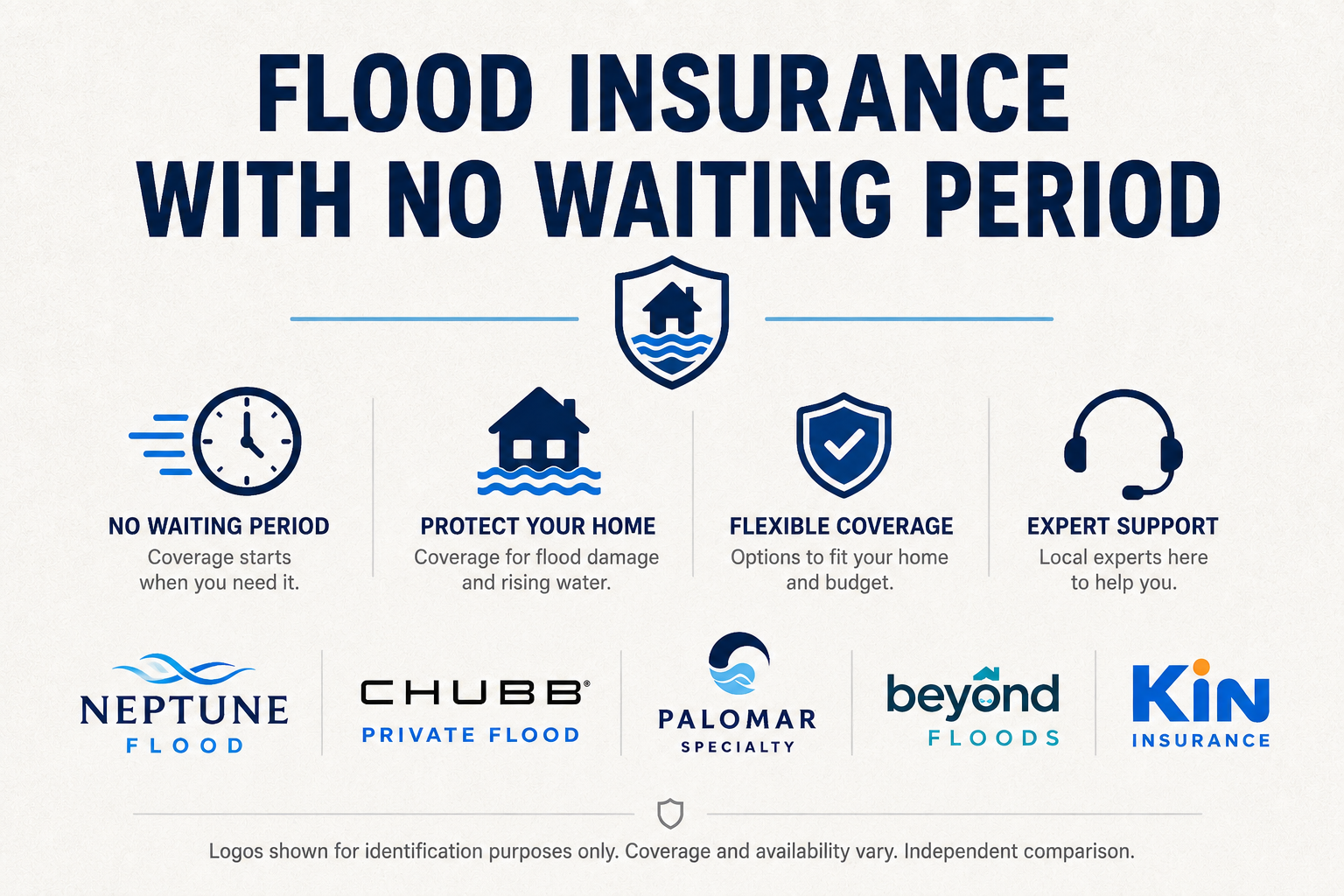
Flood insurance with no waiting period may be available in specific situations, especially a qualifying home purchase, mortgage transaction, refinance or continuous rollover from an existing flood policy. It is not a universal same-day option. The insurer or program must confirm that the transaction qualifies, approve the property, receive the required information and payment, and issue or bind coverage with the intended effective date.
The National Flood Insurance Program generally uses a 30-day waiting period for new coverage, but FEMA recognizes four defined exceptions. Private flood insurers can use different rules. Neptune Flood currently states that its standard waiting period is 10 days and that no waiting period applies to qualifying real-estate closings or rollovers from another flood policy.
If you are searching for flood insurance near me because a lender or closing agent needs proof quickly, have the closing date, loan information, mortgagee clause and required coverage amount ready. If no transaction or continuous rollover applies, expect a waiting period and plan ahead. A generated quote is not active coverage.
Quick facts about flood insurance effective dates
A waiting period is the time between purchasing coverage and the policy’s effective date. It exists in part to prevent someone from waiting until flooding is imminent before transferring a known loss to an insurance program. The waiting period is different from the time needed to complete a quote, satisfy underwriting or produce proof for a lender.
The exact clock can depend on the program, transaction, payment and documentation. “No waiting period” does not necessarily mean a policy can be issued instantly for every property. Underwriting may need to confirm occupancy, construction, prior losses, existing damage, flood-zone information or other risk details.
When the NFIP waiting period does not follow the usual 30 days
FEMA’s FloodSmart guidance identifies four exceptions to the NFIP’s general 30-day waiting period. Two can result in no waiting period, while two use a one-day wait under specified conditions. Documentation and timing are important.
| Situation | General timing | What must be confirmed |
|---|---|---|
| Ordinary new purchase | Generally 30 days after purchase. | Application date, payment, requested effective date and policy issuance. |
| Mortgage transaction | No wait when flood insurance is purchased while making, increasing, extending or renewing a mortgage loan. | The insurance is connected to the qualifying loan transaction and becomes effective as required for the loan. |
| Coverage change at renewal | No wait when coverage is changed while renewing the NFIP policy. | Renewal is timely and the change is processed with the renewal rather than after a lapse. |
| Newly mapped property | One-day wait when the property is newly designated high risk and coverage is purchased within the applicable period after the map update. | Effective map-change date, flood zone and purchase deadline under current NFIP rules. |
| Qualifying post-wildfire flood | One-day wait when flooding is caused or worsened by wildfire on federal land and the coverage was purchased within the applicable period. | Private property status, federal-land wildfire, containment date and relationship between the wildfire and flood. |
Mortgage-related NFIP exception
The mortgage exception can allow coverage to begin without the normal 30-day delay when the policy is purchased in connection with making, increasing, extending or renewing a loan. This is why a buyer can often satisfy a flood-insurance closing condition without delaying the transaction for a month. The lender, settlement date and insurance effective date still need to match.
Timely renewal is not the same as restoring a lapsed policy
NFIP policies are annual contracts and must be renewed. A timely renewal can preserve continuity, and coverage changes made with renewal can qualify for no wait. Letting coverage lapse can trigger a new waiting period. Do not assume a late payment will restore protection for a flood occurring during the gap; follow the renewal notice and program rules.
One day is not zero days
The newly mapped and qualifying post-wildfire provisions are commonly summarized as exceptions, but official FloodSmart guidance describes a one-day waiting period rather than immediate same-day protection. The property and purchase must satisfy the detailed eligibility conditions. A wildfire in the region is not enough by itself; the federal-land and causal requirements matter.
Private flood insurance waiting periods
Private flood insurers establish their own effective-date and underwriting rules. A private policy may have a shorter standard wait than NFIP, but no single waiting period applies across the entire private market. Insurers may also restrict new business or changes when a named storm, hurricane, wildfire, river condition or other imminent event increases the likelihood of loss.
For the supplied online pathway, Neptune currently publishes the following framework: a 10-day standard waiting period, no wait for qualifying real-estate closings and no wait for qualifying rollovers from another flood policy. These statements remain subject to the completed application, property eligibility, uninterrupted prior coverage where a rollover is used, payment, binding and the issued policy.
| Scenario | NFIP | Neptune private flood | Action |
|---|---|---|---|
| Ordinary voluntary purchase | Generally 30 days. | Neptune currently states 10 days. | Purchase early and use the written effective date. |
| New home closing | No wait may apply when purchased in connection with the qualifying mortgage transaction. | Neptune states no wait for qualifying real-estate closings. | Match the policy date to lender and settlement requirements. |
| Refinancing or qualifying loan action | Mortgage exception may apply when the policy is connected to making, increasing, extending or renewing the loan. | Neptune states no wait for qualifying real-estate transactions, including refinancing. | Provide loan documents and confirm the transaction qualifies. |
| Continuous policy rollover | NFIP renewal and policy-change rules apply; do not assume a private-market rollover rule. | Neptune states no wait for a qualifying rollover from another flood policy. | Prevent a lapse and align old expiration with new inception. |
| Storm already imminent | Normal waiting period or applicable federal exception controls. | A waiting period and underwriting moratorium may prevent immediate coverage. | Do not rely on last-minute availability or attempt to insure existing damage. |
Situations that may qualify for flood insurance with no waiting period
Buying a home with a mortgage
A lender may require flood insurance before funding or closing, particularly when a building is in a Special Flood Hazard Area and the loan is subject to federal flood-insurance requirements. A qualifying mortgage-related purchase can support a no-wait effective date under NFIP rules, and Neptune states that qualifying real-estate closings have no wait. The binder or declarations should show the correct insured property, building limit, lender clause and effective date.
Refinancing or changing a covered mortgage
Refinancing, increasing, extending or renewing a mortgage can trigger a new flood-insurance requirement or documentation request. Whether the transaction qualifies for an exception depends on its relationship to the coverage purchase and the applicable program rules. Provide the lender’s request and closing schedule rather than describing the application as an ordinary voluntary purchase.
Rolling over from existing flood insurance
A rollover is intended to maintain continuous coverage while moving from another flood policy. Neptune’s current published rule allows no wait for qualifying rollovers. The current policy should remain active through the new policy’s inception. Match the insured name, location, expiration date and replacement effective date, and obtain lender approval before canceling or nonrenewing the former policy.
Changing coverage at NFIP renewal
FloodSmart states there is no wait when coverage is changed while renewing an NFIP policy. This can be useful when a policyholder needs to adjust building or contents coverage at renewal. It does not mean coverage can be increased without a wait at any point in the policy term. Submit the change with the renewal and verify the resulting declarations.
Newly mapped and post-wildfire situations
These NFIP exceptions use a one-day waiting period when all conditions are met. A newly designated high-risk location must be insured within the applicable post-map-change period. For the wildfire exception, flooding must be caused or worsened by a wildfire on federal land, and the coverage must be purchased within the required timeline tied to containment. Eligibility may ultimately be assessed in connection with a claim.
When same-day flood coverage usually is not available
An owner buying voluntary coverage with no closing, refinance, qualifying loan event, renewal change or continuous rollover should expect the standard waiting period for the selected program. A storm forecast, approaching hurricane, flood watch, rising river or recent neighborhood flooding does not create a no-wait exception.
Coverage also cannot be backdated to include known or existing damage. An insurer may decline a property with active water intrusion or impose an underwriting restriction during an imminent event. The safest strategy is to purchase flood insurance well before seasonal risk increases, not to build a protection plan around an exception.
Lender approval and closing documents
Fast timing does not reduce the lender’s documentation requirements. Regulated lenders must accept a private flood policy that meets the federal definition of private flood insurance and the required coverage amount. Other private policies may be accepted at the lender’s discretion, while separate investor or loan-program standards may also apply.
Ask the loan processor or servicer for the exact building limit, deductible restrictions, mortgagee clause, loan number, required effective date and proof-of-payment requirements. The amount needed to satisfy a lender may not equal the amount needed to rebuild the property. Homeowners can consider higher limits or contents coverage based on their own exposure, subject to availability.
- Use the legal property address and named insured that match the loan file.
- Enter the lender or servicer exactly as instructed, including the mortgagee clause and loan number.
- Confirm whether the lender needs a quote, binder, declarations page, invoice, paid receipt or complete policy.
- Coordinate the effective date with closing, funding or the previous policy’s expiration.
- Do not cancel existing coverage before the lender accepts the replacement.
Do not choose flood insurance by waiting period alone
A shorter wait is valuable only if the policy otherwise fits. Compare building and contents limits, deductibles, valuation, basement restrictions, additional living expenses, detached structures, exclusions and claim duties. NFIP residential coverage for a typical one- to four-family home is available up to $250,000 for the building and $100,000 for contents. Private policies may offer different limits and options, subject to the insurer and property.
Check how the policy treats temporary housing, contents depreciation, lower-level finishes, outdoor property, debris removal and prior flood damage. A no-wait private policy with insufficient coverage can be less useful than a properly planned policy with a future effective date. The goal is timely, adequate insurance—not merely the earliest date on a marketing page.
Service-area and property availability
NFIP availability generally depends on community participation and program eligibility. Private flood availability depends on state authority, insurer appetite and the individual address. Flood zone, elevation, foundation, distance to water, occupancy, construction and prior losses may affect eligibility. The supplied Neptune tool checks the address and available private option; it does not guarantee that every property can be insured or qualify for no wait.
What to prepare for a fast flood insurance quote
Accurate documents are especially important when you are working against a closing or expiration deadline. Gather:
After submitting, verify the insurer or underwriting company, premium, limits, deductible, waiting-period treatment, effective date and any exclusions. Save the binding confirmation and send the required proof to the lender. If replacing existing insurance, confirm the new policy is active before requesting cancellation.
About this online option: The button opens Neptune’s consumer application. Neptune currently states no wait for qualifying real-estate closings or policy rollovers and a 10-day standard wait otherwise. Final eligibility and timing depend on the application, continuous prior coverage when applicable, payment, underwriting, binding and issued policy.
Flood insurance waiting-period FAQs
Can I get flood insurance with no waiting period?
Possibly. An eligible mortgage closing, refinancing transaction, qualifying loan event, NFIP renewal change or continuous private-policy rollover may support no wait. The program or insurer must confirm eligibility and the effective date.
What is the normal NFIP waiting period?
New NFIP coverage generally takes effect 30 days after purchase. Defined exceptions apply to qualifying mortgage transactions, changes at renewal, newly mapped properties and certain post-wildfire situations.
Does Neptune Flood have a waiting period?
Neptune currently states a 10-day standard waiting period, with no wait for qualifying real-estate closings or qualifying rollovers from another flood policy. The issued effective date controls.
Can flood insurance start on my home-closing date?
It may. Both NFIP mortgage rules and qualifying private flood options can permit coverage tied to a real-estate closing. Complete underwriting, payment and lender documentation early enough for the policy to be issued correctly.
Can flood insurance start immediately for a refinance?
A qualifying mortgage-related NFIP transaction may receive the federal exception, and Neptune states no wait for qualifying real-estate transactions including refinancing. Provide the refinance documents and confirm eligibility.
Can I switch flood insurers without a new wait?
Neptune states no wait for a qualifying rollover from another flood policy. Continuous coverage is critical. Match the new inception date to the old expiration date and obtain lender approval before ending the former policy.
Can I buy coverage when a hurricane is approaching?
You may be able to submit an application, but a waiting period or underwriting moratorium may prevent protection for that event. A forecast does not create a no-wait exception, and insurance cannot cover a loss that has already begun.
Does paying today mean I am covered today?
No. Payment alone does not establish same-day coverage. The insurer must accept and bind the risk, and the binder or issued policy must show an effective date that has begun.
What is the NFIP newly mapped exception?
FloodSmart describes a one-day waiting period when a property is newly designated in a high-risk flood zone and coverage is purchased within the applicable period after the map update. Documentation and deadlines apply.
What is the NFIP wildfire exception?
A one-day wait may apply when flooding is caused or worsened by wildfire on federal land and the policy was purchased within the required time tied to containment. All eligibility elements must be satisfied.
Will a lender accept private flood insurance?
Regulated lenders must accept qualifying private policies that meet federal standards and the required amount. Other policies may receive discretionary acceptance. Separate investor and loan requirements can apply.
Can a no-wait policy cover flooding that already happened?
No. Insurance does not retroactively cover known, existing or already occurring flood damage. Misrepresenting the timing or condition of a loss can jeopardize coverage and may constitute fraud.
Related flood insurance guides





Reviews are loaded from Google when you click “View reviews.”