Private Flood Insurance • NFIP Comparison • 2026 Guide
Is Private Flood Insurance Better Than FEMA?
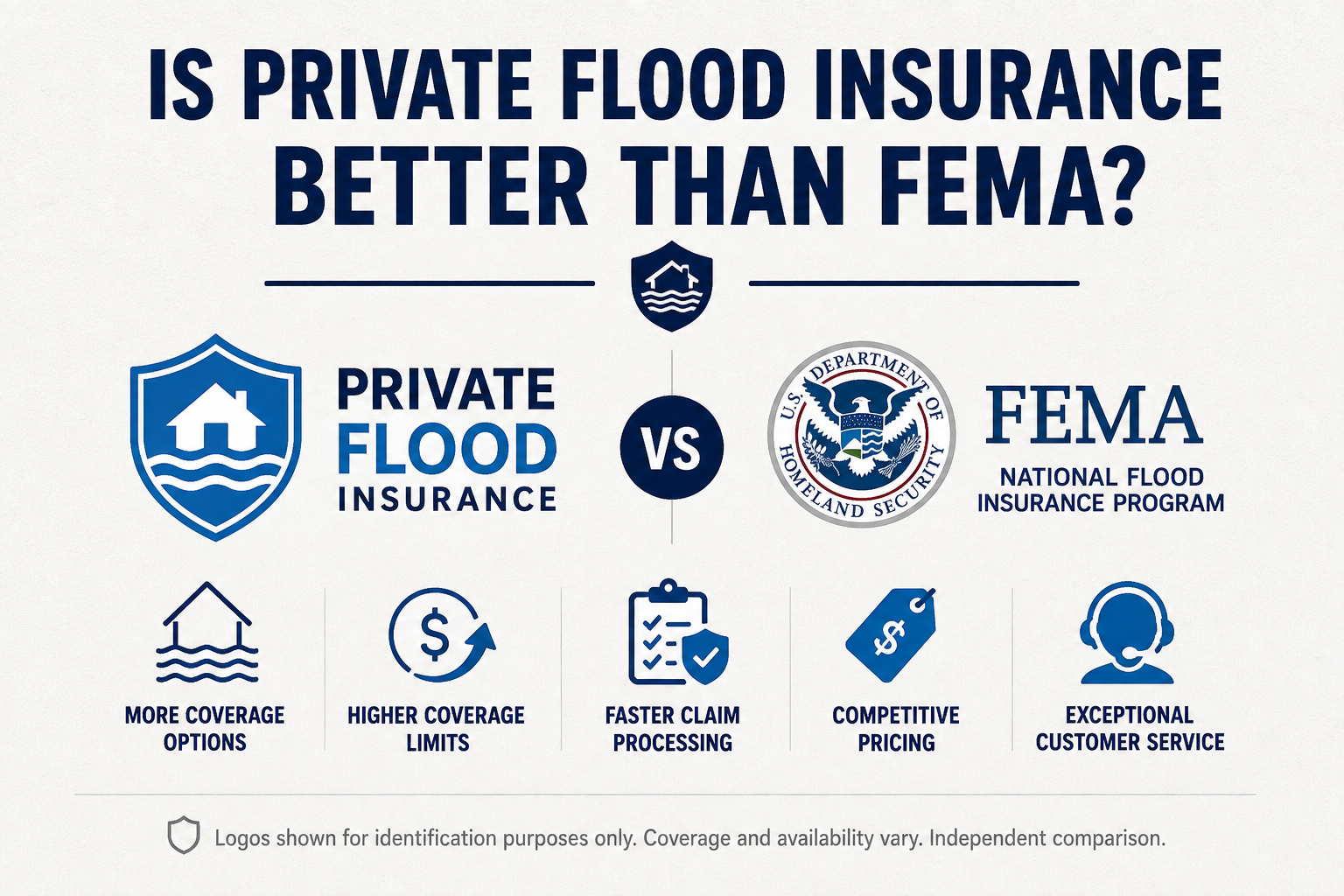
Is private flood insurance better than FEMA? It can be better for some properties, but not for every homeowner, building or mortgage. Private coverage may provide higher available limits, different deductibles, a shorter waiting period or features that the National Flood Insurance Program does not include. The NFIP may be the stronger fit when its standardized federal policy, eligibility rules and lender familiarity match the property more reliably.
“FEMA flood insurance” usually means coverage through the National Flood Insurance Program (NFIP), which FEMA administers. FEMA is not simply one private insurance company competing with another. NFIP policies use federal forms and program rules, even when a participating Write Your Own insurance company sells or services the policy. Private flood insurance is issued under an insurer’s own underwriting rules, approved or permitted policy forms, pricing and eligibility requirements.
If you are comparing flood insurance near me, begin with the full property address, replacement cost, occupancy, foundation, flood history, desired contents limit, mortgage requirements and effective-date needs. A fair comparison must use similar limits and deductibles and must examine the actual policy language—not just the quoted premium.
Quick facts: private flood insurance versus FEMA/NFIP
Flood coverage is usually separate from homeowners, renters, condominium and commercial property insurance. The cause of loss matters: a flood policy is designed for direct physical loss caused by a covered flood, while wind damage, ordinary plumbing leaks and sewer backup unrelated to a qualifying flood may fall under different rules or policies.
For non-residential property, the NFIP generally makes up to $500,000 of building coverage and up to $500,000 of contents coverage available. These are program maximums, not automatic amounts of insurance. The correct limit still depends on property value, insurable interest, policy rules and any lender requirement.
Private flood insurance vs. NFIP: side-by-side comparison
The strongest choice depends on how the policy performs across the full claim scenario. Compare the same building limit, contents limit and deductible where possible. Then examine the differences that cannot be made identical, including waiting periods, valuation, basement treatment, temporary living expenses and insurer-specific exclusions.
| Review point | Private flood insurance | NFIP | What to verify |
|---|---|---|---|
| Policy structure | Insurer-specific forms, underwriting, pricing and eligibility. | Federal Standard Flood Insurance Policy forms and program rules administered by FEMA. | Covered flood definition, exclusions, duties after loss, endorsements and claim settlement provisions. |
| Residential limits | May offer limits above NFIP maximums for eligible properties. | Up to $250,000 building and $100,000 contents for typical one- to four-family residential risks. | Replacement cost needs, contents exposure and any coinsurance or insurance-to-value condition. |
| Waiting period | Varies. Some private policies may begin sooner, while underwriting moratoriums or other restrictions can apply. | Generally 30 days, with specific exceptions including certain mortgage transactions, renewal changes, map revisions and qualifying post-wildfire circumstances. | Exact effective date in writing; never assume same-day coverage. |
| Contents settlement | Actual cash value or replacement-cost treatment may be available depending on the form. | NFIP personal property is settled at actual cash value under program rules. | Depreciation, contents deductible, sublimits and documentation requirements. |
| Temporary living costs | Additional living expense or loss-of-use coverage may be available under some policies. | NFIP residential coverage does not cover temporary housing or additional living expenses while the home is repaired. | Whether included, optional or excluded; time limit and dollar limit. |
| Basements | Treatment varies widely by form and may still be restricted. | NFIP limits coverage below the lowest elevated floor; many finished improvements and personal belongings in basements are not covered. | Definition of basement, covered building equipment, finished surfaces and stored contents. |
| Lender use | Qualifying private policies must be accepted by regulated lenders under federal rules; other policies may be accepted at the lender’s discretion. | Common federal baseline for properties subject to mandatory flood insurance requirements. | Loan type, required amount, deductible, mortgagee clause, insurer requirements and written lender confirmation. |
| Availability | Property- and state-specific; private underwriting can accept, restrict or decline a risk. | Generally available for eligible property in NFIP-participating communities, subject to program rules and status. | Community participation, property eligibility, insurer appetite and active program status. |
Do not compare an NFIP maximum with a private quote automatically
A $250,000 NFIP building limit and a $500,000 private building limit are not equivalent quotes. The private option may provide twice the stated limit, but the comparison still requires the deductible, valuation basis, covered property, basement provisions, exclusions, additional living expense and insurer financial responsibility to be reviewed. Likewise, a private quote with a lower premium may be less useful if it carries a much larger deductible or removes coverage that matters to the property.
Understand what NFIP building and contents coverage actually do
NFIP building coverage and contents coverage are separate, and separate deductibles typically apply. Building coverage can include the insured structure and foundation, electrical and plumbing systems, furnaces and water heaters, central air systems, built-in appliances and certain permanently installed items. Contents coverage can protect eligible furniture, clothing, electronics, portable appliances and other belongings inside the insured building.
NFIP contents are adjusted at actual cash value, which reflects depreciation. Building claim settlement may qualify for replacement-cost treatment only when the policy and occupancy requirements are met; otherwise actual-cash-value rules may apply. A private form may use different valuation provisions, so the declarations and policy wording must be compared directly.
When private flood insurance may be better
Private coverage may be the stronger fit when it addresses a meaningful limitation in the NFIP option and the policy remains acceptable after a full contract review. Potential advantages are not universal features of every private policy.
The property needs more than the NFIP residential maximum
A home with a replacement cost substantially above $250,000 may face a building-coverage gap under an NFIP-only approach. An eligible private policy may offer a higher building limit, or an owner may explore excess flood coverage above a primary layer. Higher limits are especially relevant when labor and materials costs make the amount required to rebuild much greater than the home’s market value or mortgage balance.
The owner wants coverage features unavailable under the standard NFIP form
Some private policies may offer additional living expense, replacement-cost settlement for eligible contents, broader other-structures treatment, debris-removal provisions or other optional benefits. Each feature needs its own review. A private-policy brochure may summarize the benefit, while the form may impose a sublimit, waiting period, eligibility rule or exclusion.
The private underwriting result fits the specific address
Private insurers use their own catastrophe models, property data, elevation information, distance to water, foundation details, occupancy, prior-loss information and underwriting rules. That can produce favorable pricing for some addresses. It can also produce a higher premium, restricted terms or no offer for another address—even next door. The only reliable price comparison comes from quoting the actual property.
Coverage needs to begin sooner
Some private flood policies may have waiting periods shorter than the NFIP’s general 30-day period. That can be valuable, but it is not permission to wait until a storm approaches. Private insurers may stop issuing or changing coverage when a storm, wildfire, river condition or other event creates an imminent threat. The bind confirmation and declarations page—not the date a quote was generated—establish whether coverage is active.
When FEMA’s NFIP may be better
The NFIP may be the better choice when the federal policy fits the property without leaving a significant limit gap and private alternatives do not improve the overall result. Standardization can be valuable: the NFIP form, program limits and claim framework are established federally rather than changing from one private insurer to another.
Private underwriting does not accept the property
A property with repeated flood losses, severe coastal exposure, particular foundation characteristics, active damage or another underwriting concern may not qualify for the private option the owner wants. Private coverage can also become less competitive or change at renewal. For an eligible building in a participating community, NFIP may remain the dependable available route.
The NFIP limits match the insurable need
Not every property needs a building limit above $250,000 or contents coverage above $100,000. If the selected NFIP amounts, deductibles and policy provisions reasonably protect the owner’s exposure, paying for a different structure solely because it is private may not produce meaningful value.
The lender process is more straightforward
Federal rules require regulated lending institutions to accept private flood policies that meet the statutory and regulatory definition and required insurance amount. However, lender review still matters, and separate investor or loan-program requirements can apply. An NFIP policy may be operationally simpler for a particular closing or servicer. Simpler does not automatically mean less expensive or broader—it means the documentation path may be more familiar.
The owner values a standardized federal form
With NFIP, the core coverage form does not depend on which participating agent or Write Your Own carrier handles the policy. That consistency can make comparisons and renewals easier to understand. It does not eliminate coverage restrictions, particularly for basements, property outside the building, temporary housing, vehicles, landscaping and certain valuable property.
Mortgage rules, lender acceptance and safe switching
Flood insurance is generally required when improved real property is located in a Special Flood Hazard Area and secures a loan covered by federal flood-insurance purchase requirements. High-risk zones commonly begin with A or V. A lender may also require flood insurance in another zone under its own risk or loan requirements. A lower-risk map designation does not mean the property cannot flood.
Under federal private-flood rules, a regulated lender must accept a private policy that meets the regulatory definition of private flood insurance and the required coverage amount. A lender may also use discretionary acceptance for certain other policies that meet specified criteria. This is more nuanced than saying, “Every lender must accept every private policy.” Deductible limits, cancellation provisions, mortgagee protection, insurer status, policy breadth and loan-investor rules can affect the review.
| Item | What to confirm | Why it matters |
|---|---|---|
| Required limit | Ask the lender for the exact amount of building coverage required for the loan. | The private quote must satisfy applicable minimum coverage rules and lender requirements. |
| Policy acceptance | Provide the declarations and any requested policy or compliance documentation. | A quote alone is not proof that the final issued policy is acceptable. |
| Mortgagee details | Use the correct lender or servicer name, address and loan number. | Incorrect wording can delay closing or trigger a coverage notice. |
| Effective date | Confirm when the replacement policy becomes active and whether any waiting period applies. | A gap could leave the property uninsured and violate loan requirements. |
| Cancellation timing | Keep existing coverage until lender approval and replacement effectiveness are documented. | Canceling first can create a gap, force-placement risk or a difficult return to prior coverage. |
| Renewal review | Check the private renewal offer, terms and lender acceptance each year. | Private underwriting, premium and availability can change at renewal. |
Which option costs less?
Neither market is always cheaper. NFIP pricing considers the property’s flood risk, location, replacement cost and building characteristics under the federal rating methodology. Private insurers use their own models and underwriting rules. Two policies for the same address can therefore produce different premiums, deductibles and coverage structures.
Compare annual premium only after matching the major claim variables. Calculate the deductible you would pay, the uninsured amount above the policy limit, depreciation under actual-cash-value settlement, temporary housing exposure, basement restrictions and excluded property. The lowest quote can still create the highest household cost after a severe flood.
Flood insurance availability by state, community and address
NFIP eligibility generally depends on whether the property is in a community participating in the National Flood Insurance Program and whether the building meets applicable program rules. Private flood availability depends on the insurer’s authority or eligibility to write coverage in the state, its current underwriting appetite and the individual property. Coastal proximity, elevation, foundation, occupancy, prior losses and local hazard conditions can all affect the result.
The online private flood pathway supplied on this page begins with property information and determines whether an option is available for the address. It does not promise a quote, a particular premium, specific limits or approval. Flood zones are only one input; a Zone X property can still have meaningful flood exposure, while a property in an A or V zone may have mandatory insurance requirements when it secures a covered mortgage.
What you need to start a private flood insurance quote
Accurate property details help avoid a quote that changes later. Gather the following information before starting:
After receiving a proposal, compare the declarations page and policy form. Confirm the covered building, flood definition, limits, valuation, deductibles, waiting period, basement treatment, additional living expense, exclusions, duties after loss, cancellation terms and renewal conditions. If a lender requires flood insurance, send the final documents for review before replacing existing coverage.
About this quote path: The button opens Neptune’s consumer application as the private flood quote option supplied for this page. Neptune eligibility, underwriting, coverage, limits, premium, waiting period and binding availability depend on the property and applicable policy terms. Blake Insurance Group is not FEMA or the NFIP.
Private flood insurance vs. FEMA FAQs
Is private flood insurance always better than FEMA’s NFIP?
No. Private flood insurance may offer useful limits, pricing or features for an eligible property, while NFIP may provide the more suitable standardized option for another. Compare the final policies using the same address and coverage needs.
Is FEMA flood insurance the same as NFIP?
People commonly use “FEMA flood insurance” to mean the National Flood Insurance Program. FEMA administers the NFIP. Policies use federal Standard Flood Insurance Policy forms even when a participating company sells or services the coverage.
What are the NFIP limits for a house?
For a typical one- to four-family residence, NFIP building coverage is available up to $250,000 and contents coverage up to $100,000. Building and contents coverage are separate and generally have separate deductibles.
Can private flood insurance provide more than $250,000 for the building?
Some private policies may offer higher building limits for eligible properties. Availability and maximum limits depend on the insurer, address, state, occupancy, underwriting and selected policy.
Does NFIP cover temporary housing after a flood?
No. NFIP does not cover temporary housing or additional living expenses while the insured home is repaired or cannot be occupied. Some private policies may offer loss-of-use or additional-living-expense coverage, subject to their terms and limits.
Does NFIP have a 30-day waiting period?
Generally, yes. Federal rules provide specific exceptions, including certain mortgage transactions, coverage changes at renewal, qualifying recent map revisions and qualifying post-wildfire flooding. Confirm the effective date for the individual policy.
Will my mortgage lender accept private flood insurance?
A regulated lender must accept a private policy that meets the federal definition and required coverage amount. Other private policies may be accepted at the lender’s discretion. Separate loan or investor requirements can apply, so obtain confirmation before canceling existing coverage.
Does a low-risk FEMA flood zone mean I do not need flood insurance?
No. Lower-risk means lower mapped risk, not zero risk. Flooding can result from heavy rain, drainage problems, runoff, river overflow, storm surge, snowmelt and changing development. A lender may also require coverage outside a high-risk zone.
Does homeowners insurance cover flooding?
Most standard homeowners policies exclude flood damage caused by rising surface water, river overflow or storm surge. Water losses can have different causes, so the homeowners and flood policy language should both be reviewed.
Can I buy private flood insurance right before a storm?
Do not rely on last-minute availability. A waiting period may apply, and insurers can impose underwriting moratoriums when a storm or flood threat is imminent. Coverage is not active until the insurer confirms binding and the effective date.
Should I cancel NFIP as soon as I receive a private quote?
No. A quote is not replacement coverage. Wait until the private policy is issued or bound, the lender accepts it when required and the effective dates are coordinated. Then follow the applicable cancellation process.
Related flood insurance guides





Reviews are loaded from Google when you click “View reviews.”