General Liability vs Professional Liability Insurance: Which Coverage Does Your Business Need?
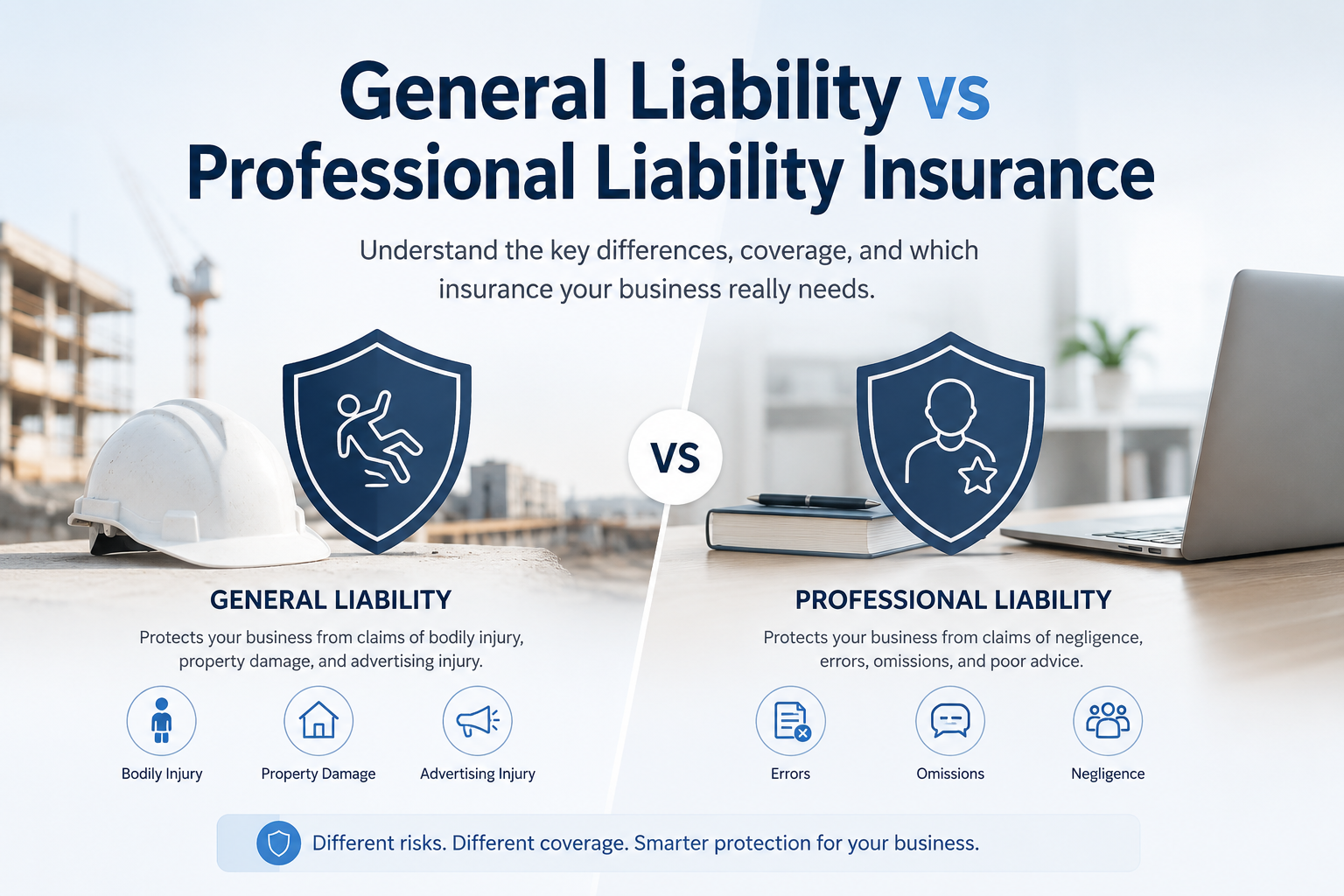
General liability vs professional liability insurance is one of the most important business insurance comparisons for contractors, consultants, freelancers, agencies, service providers, trades, professional offices, and small business owners. The two policies both help protect a business from lawsuits, but they are not interchangeable. General liability is usually focused on third-party bodily injury, property damage, personal injury, advertising injury, and certain completed-operations exposures. Professional liability insurance, also called errors and omissions insurance or E&O, is usually focused on claims that your professional service, advice, design, recommendation, or work mistake caused a client financial harm.
The simple way to separate the two is this: general liability protects against physical-world accidents and certain advertising-related claims, while professional liability protects against service-related mistakes, negligence allegations, missed deadlines, wrong advice, or failure to deliver professional work as promised. A client slipping at your office is a general liability issue. A client claiming your consulting advice cost them money is a professional liability issue. A contractor damaging a customer’s wall may need general liability. A technology consultant accused of designing the wrong system may need professional liability.
Many businesses need both. A graphic designer may need general liability for a rented office, client meeting, or trade show booth, and professional liability for design errors, missed deliverables, or brand work that causes a client dispute. A contractor may need general liability for jobsite injuries or property damage, and professional liability if they provide design-build, inspection, consulting, or project management services. A marketing agency may need general liability for office and advertising injury exposure, professional liability for campaign mistakes, and cyber liability for data and privacy risks.
The best policy is not just the cheapest quote. Compare limits, deductibles, exclusions, retroactive dates, additional insured wording, contract requirements, certificate needs, and whether claims are covered on an occurrence or claims-made basis.
Quick facts: general liability vs professional liability insurance
General liability and professional liability protect different business risks. Many businesses need both policies to satisfy leases, client contracts, certificates, and real claim exposure.
| Question | General liability insurance | Professional liability insurance |
|---|---|---|
| Main focus | Bodily injury, property damage, personal injury, advertising injury, and certain completed operations. | Errors, omissions, negligence allegations, missed deadlines, bad advice, and service-related financial loss. |
| Common nickname | Commercial general liability, CGL, business liability insurance. | Errors and omissions insurance, E&O, malpractice coverage for some professions. |
| Common requirement | Landlords, vendors, general contractors, event venues, and certificate holders often request it. | Clients, contracts, licensing boards, consultants, technology firms, and professional service agreements may require it. |
| Claim trigger | A third party alleges injury, property damage, or covered advertising/personal injury. | A client alleges your professional work, advice, or service caused financial harm. |
| Best answer | Most businesses with customers, locations, vendors, jobsites, products, or operations should review it. | Businesses paid for expertise, advice, designs, recommendations, analysis, or professional services should review it. |
The key difference: physical injury/property damage vs professional mistakes
General liability insurance is often the foundation of a business insurance program because it addresses common third-party claims. If a customer trips over a box in your shop, a visitor is injured at your office, your employee accidentally damages a client’s property, or your business is accused of certain advertising injury, general liability may help with covered defense costs, settlements, judgments, and medical payments subject to policy terms. It is often required before signing a commercial lease, working on a jobsite, attending a vendor event, or providing a certificate of insurance to a client.
Professional liability insurance responds to a different type of problem. It is designed for claims that your professional service caused harm even when nobody was physically injured and no tangible property was damaged. Examples include a consultant accused of giving faulty advice, a marketing agency accused of causing financial loss through a campaign error, a bookkeeper accused of making an expensive mistake, a designer accused of delivering defective plans, or a technology provider accused of failing to implement a promised system correctly.
The dividing line is not always obvious. Some businesses perform physical work and professional work at the same time. A contractor may install materials but also provide design recommendations. A fitness trainer may have bodily injury exposure and professional instruction exposure. A consultant may meet clients in person and provide advice. A photographer may attend events and provide creative services. A real estate service provider may visit properties and give professional guidance. When operations include both physical risk and advice/service risk, both policies should be reviewed.
General liability vs professional liability: side-by-side comparison
Use this comparison to identify which policy responds to which type of claim. For many businesses, the right solution is not choosing one over the other; it is building a policy package that covers both physical liability and service-related liability.
| Feature | General liability | Professional liability / E&O |
|---|---|---|
| Primary risk | Physical injury, property damage, personal injury, advertising injury. | Financial loss caused by alleged professional mistakes or negligence. |
| Common claims | Slip-and-fall, damaged customer property, libel/slander, advertising injury, products-completed operations. | Wrong advice, missed deadline, inaccurate work, failure to deliver services, design error, consulting mistake. |
| Who often needs it | Contractors, retailers, restaurants, offices, landlords, vendors, event businesses, service providers. | Consultants, agencies, accountants, designers, technology firms, real estate professionals, instructors, healthcare-related providers. |
| Contract use | Often required by landlords, general contractors, vendors, and certificate holders. | Often required by clients, professional service contracts, licensing rules, or consulting agreements. |
| Policy form issue | Often written on an occurrence basis, though forms vary. | Often written on a claims-made basis with retroactive date and reporting rules. |
| Common gap | Does not replace E&O for professional advice or service mistakes. | Does not replace GL for bodily injury or physical property damage claims. |
Claim examples: which policy may respond?
Claim examples make the difference easier to understand. The exact coverage outcome always depends on the issued policy, endorsements, exclusions, facts, state law, and insurer claim review, but these examples show how the two coverages are generally separated.
| Scenario | Likely policy to review | Why |
|---|---|---|
| A customer slips and falls in your office. | General liability | The claim involves bodily injury to a third party. |
| Your employee damages a client’s flooring while working onsite. | General liability | The claim involves third-party property damage. |
| A client says your consulting advice caused them to lose money. | Professional liability | The claim involves alleged service-related financial harm. |
| A marketing campaign is accused of causing a client financial loss due to a mistake. | Professional liability | The claim is tied to professional work and alleged error. |
| Your advertisement is accused of libel, slander, or copyright-related injury. | General liability | Personal and advertising injury may be part of GL, subject to exclusions. |
| A design-build contractor gives faulty design recommendations and also damages property onsite. | Both should be reviewed | The claim may include professional service allegations and physical property damage. |
Businesses that often need both policies
Many businesses have both a physical exposure and a professional service exposure. A business can interact with customers, visit job sites, rent office space, attend events, provide advice, deliver projects, and make recommendations. That combination is exactly why relying on only one policy can create a serious coverage gap.
| Business type | General liability exposure | Professional liability exposure |
|---|---|---|
| Consultants | Client meetings, rented office space, events, and third-party property damage. | Advice, recommendations, implementation errors, missed deadlines, and project disputes. |
| Marketing agencies | Office visits, event booths, advertising injury allegations. | Campaign mistakes, missed launch dates, inaccurate strategy, or failure to deliver promised results. |
| Technology providers | Onsite work, client equipment damage, office liability. | Software errors, implementation failures, data-related service mistakes, or project disputes. |
| Contractors and trades | Jobsite injury, completed operations, property damage, tools left in walkways. | Design recommendations, project management, inspection, consulting, or specification errors. |
| Bookkeepers and tax-related service providers | Office visits and third-party premises exposure. | Financial mistakes, missed filings, inaccurate work, or professional negligence allegations. |
| Health, wellness, and instruction businesses | Client injuries at a facility or class location. | Instruction, coaching, care guidance, or service-related negligence allegations. |
What affects the cost of general liability and professional liability?
Premiums vary by business type, location, revenue, payroll, number of employees, claims history, limits, deductibles, policy form, contract requirements, coverage endorsements, and how risky the operation appears to the insurer. A low-risk consultant with no employees may pay far less than a contractor working on job sites. A professional firm handling high-value contracts may need higher E&O limits than a small freelancer. A business with prior claims may see different pricing and underwriting requirements than a new business with clean history.
General liability cost is often influenced by physical operations, foot traffic, subcontractor use, products-completed operations exposure, lease requirements, and whether the business works at customer locations. Professional liability cost is often influenced by the type of service, contract value, professional credentials, prior disputes, risk controls, retroactive date, limits, deductibles, and whether the policy includes broader technology, media, or cyber-related features.
| Factor | Why it matters | What to prepare |
|---|---|---|
| Business class | Insurers price a consultant, contractor, retailer, agency, and healthcare-adjacent business differently. | Clear description of operations and services. |
| Revenue and payroll | Higher activity levels can increase claim exposure. | Estimated annual revenue, payroll, owner payroll, and subcontractor costs. |
| Limits and deductibles | Higher limits or lower deductibles can increase premium. | Contract-required limits and preferred deductible range. |
| Claims history | Prior losses, disputes, or cancellations can affect eligibility. | Loss runs, claim details, corrective actions, and current policy history. |
| Contracts and certificates | Additional insured, waiver, primary/noncontributory, and E&O requirements can affect policy choice. | Copy of lease, client contract, vendor agreement, or certificate request. |
Quote and buy general liability or professional liability insurance online
Use the quote options below to compare business liability coverage. Each quote path may fit different business classes, policy needs, and buying preferences. Before starting, gather your business name, entity type, address, services, annual revenue, payroll, employee count, subcontractor use, prior claims, requested limits, certificate requirements, lease requirements, and any client contract language. If you are not sure whether you need general liability, professional liability, or both, start by comparing the claim examples and contract requirements on this page.
For the cleanest quote, be specific about what your business does. “Consulting” can mean many things. “Marketing” can include strategy, media buying, web design, copywriting, social media, analytics, or creative services. “Contracting” can include residential, commercial, subcontracted, design-build, repair, installation, or project management work. The more accurate the business description, the better the quote fit.
Coverage is not bound until the application is completed, underwriting requirements are satisfied, payment is accepted where required, and the insurer confirms the effective date.
General liability vs professional liability FAQs
Is general liability the same as professional liability?
No. General liability usually focuses on third-party bodily injury, property damage, personal injury, and advertising injury. Professional liability focuses on claims that your professional advice, service, error, omission, or negligence caused a client financial loss.
Do I need both general liability and professional liability?
You may need both if your business has physical risk and professional service risk. Contractors, consultants, agencies, technology providers, bookkeepers, instructors, and many service businesses should review both policies.
Does general liability cover mistakes in my professional work?
Usually no. General liability does not replace errors and omissions coverage. If a client claims your professional service or advice caused financial harm, professional liability is the policy to review.
Does professional liability cover slip-and-fall injuries?
Usually no. Slip-and-fall injuries and third-party property damage are generally general liability issues, not professional liability issues.
Why do clients ask for both GL and E&O certificates?
Clients may want proof that your business has coverage for physical injury/property damage claims and separate coverage for professional service mistakes. A GL certificate alone does not prove professional liability coverage.
What information do I need for a quote?
Prepare your business description, revenue, payroll, employee count, location, prior claims, requested limits, certificate requirements, contracts, lease requirements, and whether your business provides advice, designs, consulting, or professional services.
Independent agency: Blake Insurance Group LLC is an independent insurance agency and is not affiliated with any single insurance company, quote platform, lender, landlord, contractor, client, or government agency.
Licensing: Licensed insurance producer (NPN 16944666).
Important: General liability insurance, professional liability insurance, errors and omissions coverage, premiums, limits, deductibles, exclusions, endorsements, additional insured wording, certificate wording, claims-made rules, retroactive dates, occurrence forms, underwriting approval, online quote eligibility, billing options, and claim outcomes vary by state, insurer, business class, operations, contract requirements, and policy. Your issued policy, declarations page, endorsements, exclusions, and carrier notices govern coverage. This page is general information only and is not legal, tax, contract, risk-management, or claims advice.
Trademarks: Thimble®, NEXT Insurance®, Coterie Insurance®, and any carrier, platform, product, or program names are trademarks™ or registered® trademarks of their respective owners. Use of names does not imply affiliation or endorsement.




