
Workers Compensation Insurance Michigan (2026): Employer Requirements, Payroll Rating, Certificates, Audits, and Online Quotes
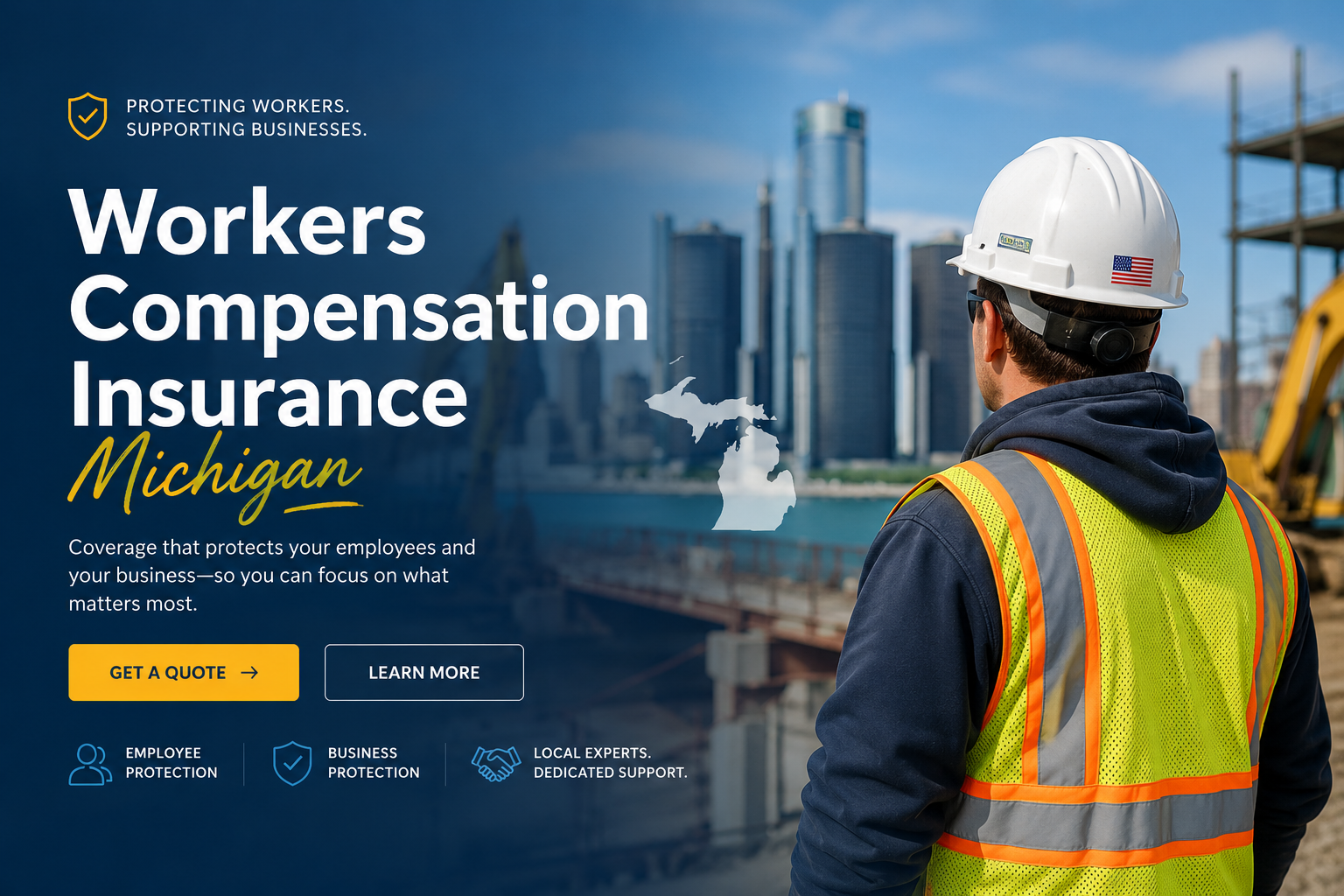
Workers compensation insurance in Michigan helps covered employers provide benefits when an employee is injured or becomes ill because of work. If you are searching for workers compensation insurance near me in Michigan, the first step is understanding whether your business meets Michigan’s Workers’ Disability Compensation Act coverage requirements.
Michigan’s workers compensation rules focus on covered employers, employee count, hours worked, agricultural and domestic employment thresholds, public employers, and approved compliance methods. Many employers meet the requirement by purchasing a workers compensation policy from a private insurance company. Others may qualify for self-insured status, join a group fund, or properly execute an exclusion form when the law allows it.
For small businesses, the practical issue is not only whether coverage is required. Workers compensation also affects hiring, contract compliance, certificates of insurance, subcontractor management, premium audits, payroll classification, jobsite access, and claim reporting. A Detroit contractor, Grand Rapids restaurant, Lansing office, Ann Arbor healthcare team, Flint repair shop, Kalamazoo retailer, Warren manufacturer, or Traverse City service business may need proof of coverage before a client, landlord, general contractor, property manager, municipality, or vendor allows work to begin.
Quick facts: Michigan workers compensation insurance in 2026
Michigan’s Workers’ Disability Compensation Agency explains that nearly all Michigan employers are subject to the Workers’ Disability Compensation Act, and covered employers must provide a way to assure benefits are paid when workers are injured on the job. The common compliance path is a private insurance policy, but Michigan also recognizes self-insured status, group funds, and exclusion forms in qualifying situations.
| Topic | What it means | Why it matters |
|---|---|---|
| Private employers | Coverage is required for private employers regularly employing 1 or more employees 35 hours or more per week for 13 weeks or longer during the prior 52 weeks. | Even one qualifying employee can trigger the requirement. |
| Three or more employees | Private employers regularly employing 3 or more employees at one time must carry coverage, including part-time employees. | Part-time staffing can still create a workers comp obligation. |
| Agricultural employers | Agricultural employers may be required to carry coverage if they employ 3 or more employees 35 hours or more per week for 13 or more consecutive weeks. | Farm and agricultural operations should review seasonal and regular staffing carefully. |
| Domestic employment | Householders employing domestic servants may be covered if they employ anyone 35 hours or more per week for 13 weeks or longer during the prior 52 weeks. | Household employment can create obligations when hours and duration thresholds are met. |
| Public employers | All public employers are included in Michigan’s insurance requirement framework. | Public entities should maintain proper proof of coverage or approved self-insurance. |
| Compliance methods | Employers may comply by purchasing insurance, self-insuring, joining a group fund, or properly using an exclusion form when allowed. | The correct path depends on employer type, employee status, and eligibility. |
Michigan workers compensation requirements: what employers should review
Michigan’s workers compensation requirement is more specific than a simple “one employee” rule. The state lists several coverage triggers, including private employers with one or more employees working 35 hours or more per week for 13 weeks or longer during the prior 52 weeks, private employers regularly employing three or more employees at one time, certain agricultural employers, householders with qualifying domestic servants, and all public employers.
Michigan also defines employee status broadly. A partner is considered an employee of the partnership, a corporate officer is considered an employee of the corporation, and a manager-member is considered an employee of a limited liability company. A sole proprietor working in that person’s own sole proprietorship is not considered an employee of that business. Those distinctions can affect quoting, owner treatment, exclusion discussions, payroll assumptions, and compliance review.
| Situation | What to verify | Why it matters | Business action step |
|---|---|---|---|
| One employee working 35+ hours | Whether the employee works at least 35 hours per week for 13 weeks or longer during the prior 52 weeks. | This can trigger coverage even with a small workforce. | Review coverage before the employee reaches the qualifying threshold. |
| Three or more employees at one time | Whether the business regularly employs 3 or more employees, including part-time employees. | Part-time headcount can still create a coverage requirement. | Track staffing levels before adding part-time or seasonal workers. |
| Agricultural employer | Whether the operation has 3 or more employees working 35+ hours per week for 13 or more consecutive weeks. | Seasonal farm and agricultural labor can create coverage obligations. | Review staffing calendars and payroll before peak season. |
| Domestic worker arrangement | Whether a household employs a domestic servant 35+ hours per week for 13 weeks or longer during the prior 52 weeks. | Household employment can trigger workers comp duties when thresholds are met. | Confirm domestic employment exposure before assuming it is outside the system. |
| Corporation, partnership, or LLC | Whether corporate officers, partners, or manager-members are treated as employees under Michigan rules. | Owner and officer status can affect payroll, inclusion, and exclusion questions. | Review entity documents and active work status before quoting. |
| Exclusion form possibility | Whether every worker can be excluded and whether no subcontractors are used in the business operation. | Michigan limits when an exclusion form can be used. | Do not rely on an exclusion form unless the business clearly qualifies. |
What Michigan workers compensation insurance can cover
Michigan workers compensation insurance is designed to support covered employees who suffer work-related injuries or diseases. Depending on the facts, a claim may involve reasonable and necessary medical treatment, wage-loss benefits, vocational rehabilitation, specific loss benefits, death benefits, claim administration, and employer protection through the workers compensation system.
Michigan employer guidance also highlights practical claim duties. If a worker is injured on the job, the employer should ensure reasonable and necessary medical treatment is provided promptly and report claims to the insurance carrier. A WC-100 Employer’s Basic Report of Injury is required when disability exceeds seven consecutive days, when death occurs, or when there is specific loss.
| Coverage area | What it can help with | Example Michigan business scenario | Important note |
|---|---|---|---|
| Medical treatment | Reasonable and necessary medical care for eligible work-related injuries or occupational disease. | A restaurant employee in Grand Rapids suffers a kitchen burn while working. | Prompt treatment and carrier reporting help keep the claim process organized. |
| Wage-loss benefits | Benefits when a covered work injury prevents an employee from working. | A warehouse worker in Detroit misses work after a lifting injury. | Eligibility depends on claim facts, medical information, and Michigan rules. |
| Vocational rehabilitation | Support that may apply when an injured worker needs help returning to suitable employment. | A trade worker has lasting restrictions after a jobsite injury. | Carrier and claim review determine whether rehabilitation applies. |
| Specific loss or permanent outcomes | Benefits may apply for certain serious or permanent injury results. | A manufacturing employee suffers a serious hand injury at work. | Medical evaluation and statutory rules affect the final benefit analysis. |
| Death benefits | Benefits may apply in certain fatal work-injury situations. | A severe workplace accident results in a covered fatality. | Fatal claims require careful reporting, documentation, and claim handling. |
Workers compensation does not replace general liability, commercial auto, professional liability, cyber liability, employment practices liability, umbrella coverage, inland marine, tools and equipment, or a business owners policy.
Who needs workers compensation insurance in Michigan?
Michigan employers should review workers compensation before hiring, sending employees to a jobsite, signing contracts, onboarding subcontractors, opening a new location, expanding part-time staff, adding seasonal labor, or sending employees across state lines. Coverage is especially common for contractors, manufacturing companies, auto-related businesses, restaurants, healthcare providers, home care agencies, retailers, warehouses, cleaning companies, landscapers, repair shops, transportation operations, agricultural employers, and professional offices with employees.
| Business type | Why coverage is commonly needed | What to prepare before quoting |
|---|---|---|
| Contractors and trades | Jobsites, ladders, tools, subcontractors, lifting, and certificate requirements. | Trade descriptions, payroll by duty, owner status, subcontractor COIs, and jobsite locations. |
| Manufacturing and auto-related businesses | Machine work, parts handling, repetitive motion, shop hazards, forklifts, and production payroll. | Employee duties, shop operations, payroll classes, safety controls, and prior loss history. |
| Restaurants and hospitality | Kitchen burns, slips, lifting, delivery exposure, part-time workers, and seasonal staffing. | Payroll by role, employee count, locations, tip reporting where applicable, and safety procedures. |
| Healthcare and home care | Patient handling, lifting, facility work, in-home visits, and caregiver injury exposure. | Care model, employee vs contractor structure, driving exposure, payroll, and location details. |
| Retail and office employers | Lower-hazard workplaces can still have employee injuries and compliance obligations. | Clerical payroll, sales payroll, part-time workers, working owners, and location details. |
| Agriculture and seasonal operations | Seasonal labor, equipment, animals, outdoor work, transportation, and rural worksites. | Regular worker count, seasonal worker count, payroll, weekly hours, job duties, and operating locations. |
Worker status, ownership structure, corporate officer treatment, LLC manager status, subcontractor use, agricultural rules, domestic work, and multi-state exposure can change the coverage analysis. Review those details before assuming a person or business is automatically included, excluded, or exempt.
What affects workers compensation insurance cost in Michigan?
Michigan workers compensation cost is commonly driven by payroll, employee duties, class codes, claims history, ownership treatment, prior coverage, safety controls, experience modification where applicable, and underwriting. A clerical office, roofing contractor, auto repair shop, home healthcare agency, restaurant, delivery company, manufacturer, and agricultural operation can all price differently because employee injury exposure is different.
| Factor | Why it affects pricing | Smart move |
|---|---|---|
| Payroll | Premium is commonly calculated using estimated payroll by classification. | Use realistic annual payroll and update the policy if hiring changes quickly. |
| Class codes | Employee duties determine rating categories and expected claim risk. | Separate clerical, sales, field, driver, trade, healthcare, manufacturing, and agricultural payroll correctly. |
| Claims history | Prior injuries, open claims, and loss trends can affect eligibility and pricing. | Be ready to explain safety improvements and prior loss details. |
| Experience modification | Larger or experienced accounts may have an experience mod that adjusts premium. | Keep loss runs and experience mod worksheets available when quoting. |
| Owner and officer treatment | Partners, corporate officers, LLC manager-members, and sole proprietors are treated differently. | Confirm owner/officer status before binding coverage. |
| Certificates and contracts | Some contracts require proof of coverage, waivers, additional endorsements, or special wording. | Review contract requirements before choosing a policy. |
Audits, certificates, subcontractors, and Michigan contract requirements
Workers compensation policies are commonly subject to premium audit. After the policy term, the carrier may compare estimated payroll to actual payroll, review employee duties, request payroll reports or tax filings, and check subcontractor certificates. Michigan contractors, manufacturers, service businesses, healthcare providers, retailers, restaurants, and property service companies should keep payroll, certificates, and subcontractor documentation organized throughout the year.
| Item | What to keep organized | Why it helps |
|---|---|---|
| Payroll records | Payroll summaries, officer payroll, owner payroll, overtime details, employee duty breakdowns, and location information. | Cleaner records reduce audit delays and classification problems. |
| Class-code support | Job descriptions, duties, shop vs office separation, route work, field work, and daily work performed. | Underwriters and auditors need accurate work descriptions. |
| Subcontractor COIs | Certificates showing subcontractors carried workers compensation and liability coverage where required. | Missing certificates can create audit, contract, and jobsite problems. |
| Owner/officer documentation | Entity documents, officer status, LLC manager-member information, and any applicable exclusion documents. | Owner treatment affects payroll, coverage, and compliance assumptions. |
| Claim reporting process | Supervisor instructions, incident reports, carrier contact process, WC-100 triggers, and employee reporting steps. | Accessible procedures help employees report injuries and support claim handling. |
Certificates of insurance are common across Michigan construction, auto services, manufacturing, property management, healthcare, janitorial, landscaping, logistics, municipal, vendor, and subcontractor relationships. Before you bind coverage, review contract language. Special wording, waiver of subrogation requests, alternate employer needs, out-of-state work, and project-specific requirements may require underwriting review.
Michigan workers compensation insurance support by city and metro
Blake Insurance Group helps Michigan businesses compare workers compensation options for eligible operations across major metros, manufacturing corridors, healthcare hubs, college towns, agricultural communities, and regional service markets. Whether your business is in Detroit, Grand Rapids, Warren, Sterling Heights, Ann Arbor, Lansing, Flint, Dearborn, Livonia, Troy, Westland, Kalamazoo, Wyoming, Southfield, Farmington Hills, or Traverse City, the policy should match your payroll, duties, contracts, and employee injury exposure.
| Region | Example cities | Common requests we help compare |
|---|---|---|
| Metro Detroit | Detroit, Warren, Sterling Heights, Dearborn, Livonia, Troy, Southfield | Contractors, auto shops, manufacturers, restaurants, offices, and certificate requests. |
| West Michigan | Grand Rapids, Wyoming, Kentwood, Holland, Muskegon, Grandville | Manufacturing, trades, healthcare, restaurants, logistics, and multi-location payroll. |
| Mid-Michigan | Lansing, East Lansing, Jackson, Okemos, Howell, Mount Pleasant | Professional offices, healthcare, education-adjacent services, contractors, and vendors. |
| Eastern and Northern Lower Peninsula | Flint, Saginaw, Bay City, Midland, Traverse City, Alpena | Repair services, property services, hospitality, seasonal staff, and local employers. |
| Southwest Michigan | Kalamazoo, Portage, Battle Creek, Benton Harbor, St. Joseph, Niles | Small business payroll, warehousing, retail, healthcare, restaurants, and certificates. |
Quote and buy workers compensation insurance online
Use the online quote paths below to compare options for eligible Michigan businesses. The best fit depends on your employee count, weekly hours, payroll, class codes, prior coverage, loss history, owner/officer treatment, contract requirements, and whether you also need general liability, commercial auto, tools and equipment, professional liability, cyber liability, or a business owners policy.
Coverage is not bound until an application is completed, accepted, payment is processed where required, and policy documents confirm the effective date, insured information, endorsements, exclusions, and coverage terms.
Before you quote, gather this:
- Legal business name, DBA, entity type, FEIN, Michigan location, mailing address, and contact information.
- Employee count, weekly hours, payroll estimates, job duties, class-code details, and whether workers are full-time, part-time, seasonal, temporary, or domestic.
- Owner, officer, LLC manager-member, partner, or sole proprietor details and whether each person actively works in the business.
- Subcontractor certificates, project requirements, waiver requests, certificate holder details, and contract deadlines.
- Prior policy information, loss runs, claim history, experience modification worksheet if available, and current policy declarations.
Related topics
Michigan workers compensation insurance FAQs (2026)
Is workers compensation insurance required in Michigan?
Yes, for covered employers. Michigan requires coverage for private employers regularly employing 1 or more employees 35 hours or more per week for 13 weeks or longer during the prior 52 weeks, private employers regularly employing 3 or more employees at one time, certain agricultural employers, householders with qualifying domestic servants, and all public employers.
Do part-time employees count under Michigan workers comp rules?
Yes. Michigan’s 3-or-more employee rule includes part-time employees. Employers should review total staffing, weekly hours, and duration before assuming coverage is not required.
Can a Michigan employer comply without buying a private workers comp policy?
In some situations, yes. Michigan recognizes several compliance methods, including purchasing insurance, approved self-insurance, group funds, or properly executing an exclusion form when the employer qualifies. Most small businesses satisfy the requirement by purchasing a policy.
Are Michigan sole proprietors considered employees of their own business?
A sole proprietor working in that person’s own sole proprietorship is not considered an employee of that business. However, partners, corporate officers, and LLC manager-members may be treated differently, so entity structure matters.
What information do I need for a Michigan workers comp quote?
Be ready with your legal business name, FEIN, Michigan business location, employee count, weekly hours, payroll estimates, job duties, owner/officer details, prior coverage, claims history, subcontractor certificates, and any contract or certificate requirements.
Is general liability the same as workers compensation?
No. General liability usually focuses on third-party bodily injury, property damage, and certain personal or advertising injury claims. Workers compensation focuses on employee work injuries and occupational disease.
Independent agency: Blake Insurance Group LLC is an independent insurance agency and is not affiliated with any single insurance company, carrier, marketplace, platform, or government agency.
Licensing: Licensed insurance producer (NPN 16944666).
Important: Coverage availability, pricing, payroll classifications, employee status, owner inclusion or exclusion, officer treatment, LLC manager-member treatment, exclusion-form eligibility, agricultural rules, domestic employment, independent contractor classification, eligibility, limits, deductibles, endorsements, exclusions, certificates, audits, underwriting decisions, and binding rules vary by insurer, platform, business type, location, payroll, class code, and application details. Your issued policy controls all coverage terms.
Michigan compliance note: Workers compensation insurance is not the same as business registration, payroll tax compliance, OSHA compliance, employment-law compliance, subcontractor management, workplace posting compliance, accident reporting, or commercial auto coverage. Review those obligations separately for your business and jurisdiction.
Trademarks: Carrier, platform, government, and partner names are trademarks™ or registered® trademarks of their respective owners. Use of them does not imply affiliation or endorsement.




