
Performance Bond vs Payment Bond (2026): What Contractors, Owners, and Subcontractors Need to Know
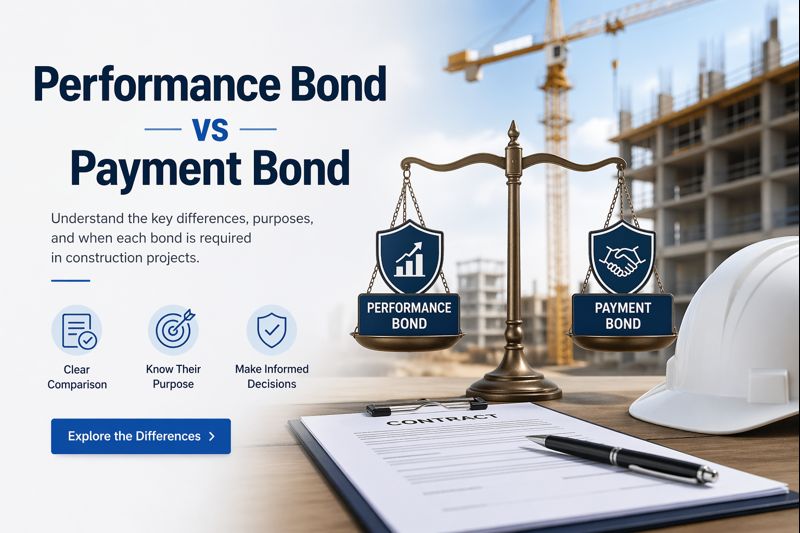
Performance bonds and payment bonds are often required together on public construction projects and many larger private contracts, but they protect different people from different risks. A performance bond protects the project owner if the contractor fails to complete the work according to the contract. A payment bond protects subcontractors, suppliers, and laborers if the contractor fails to pay for labor or materials used on the project.
In plain English: the performance bond answers the question, “Will the job get finished?” The payment bond answers the question, “Will the people and suppliers on the job get paid?” Contractors often need both because owners want completion protection, while subcontractors and suppliers need payment protection. On federal construction contracts above applicable thresholds, performance and payment bond requirements are commonly written into the contract, often with bond amounts tied to the original contract price.
Blake Insurance Group helps contractors compare surety requirements before bidding, signing, or mobilizing. The best time to review bond needs is before the contract is awarded, not after the owner, municipality, general contractor, or lender asks for bond forms, penal sums, obligee wording, and surety signatures.
If you are searching for performance bond or payment bond help near me, start with the contract, bid documents, bond forms, project amount, obligee name, scope of work, and required bond percentage.
Quick facts: performance bond vs payment bond
Use this snapshot to understand the difference before submitting a bid, signing a construction contract, or requesting a surety quote.
| Review point | Performance bond | Payment bond | Why it matters |
|---|---|---|---|
| Main purpose | Guarantees contract performance and completion | Guarantees payment to eligible subcontractors, suppliers, and laborers | They protect different project risks |
| Who it protects | Project owner or obligee | Labor and material claimants | Owners and subcontractors rely on different bond rights |
| Common trigger | Contractor default, abandonment, failure to complete, or failure to meet contract terms | Failure to pay valid project-related labor or material bills | Claim handling depends on the bond form and contract facts |
| Typical pairing | Often required with payment bond | Often required with performance bond | Many public jobs require both before work begins |
Performance bond vs payment bond: side-by-side comparison
A performance bond and a payment bond may be issued for the same contract, by the same surety, and at the same time, but they are not interchangeable. The performance bond focuses on the owner’s risk that the contractor will not finish the work. The payment bond focuses on the risk that subcontractors, suppliers, or laborers will not be paid for project-related work or materials.
| Category | Performance bond | Payment bond | Before you apply |
|---|---|---|---|
| Protects against | Failure to complete the project according to contract terms | Failure to pay covered subcontractors, suppliers, and laborers | Confirm whether the obligee requires one or both bonds |
| Primary beneficiary | Owner, municipality, government agency, developer, or general contractor requiring the bond | Eligible claimants who supplied labor, materials, equipment, or services | Review the bond form and claimant rules |
| Claim example | Contractor abandons the project or cannot finish the scope | Contractor fails to pay a subcontractor or supplier | Claims are fact-specific and governed by contract and bond terms |
| Best contractor move | Prove capacity, experience, financial strength, and job-specific ability | Show solid payables management and subcontractor controls | Prepare financials, contract documents, and work-in-progress details early |
Who each bond protects
When are performance and payment bonds required?
Performance and payment bonds are common on public construction projects, government contracts, municipal work, school projects, road work, utility projects, and private contracts where the owner, developer, lender, or general contractor wants stronger completion and payment protection. Federal construction contracts commonly use both performance and payment bond requirements. State and local public projects often follow similar “Little Miller Act” concepts, but exact thresholds and rules can vary by state, agency, and project type.
| Project situation | Likely requirement | Why requested | Contractor action |
|---|---|---|---|
| Public construction contract | Performance and payment bonds often required | Protects taxpayers, owner, subcontractors, and suppliers | Review bid specs before submitting price |
| Private commercial project | May require one or both bonds | Owner or lender wants completion and lien-risk protection | Ask for bond forms and required penal sum |
| Subcontractor bond | General contractor may require bonds from key subs | Reduces default and nonpayment risk down the chain | Confirm scope, subcontract amount, and bond percentage |
| Service or maintenance contract | Performance bond may be requested | Owner wants assurance of contract fulfillment | Confirm whether payment bond is also required |
How surety underwriting works
Surety underwriting is different from buying a standard insurance policy. The surety is evaluating whether the contractor can complete the bonded work and meet payment obligations. For smaller bonds, the application may be streamlined. For larger or more complex contract bonds, the surety may ask for business financial statements, personal financial statements, bank references, project history, work-in-progress schedules, resumes, contracts, bid results, subcontractor details, and prior bond history.
Contractors improve their bond approval chances by keeping clean financial records, managing payables, avoiding overextension, documenting completed projects, and applying before deadlines are tight. Waiting until the owner is demanding executed bond forms can make the process harder, especially for larger contracts or contractors new to bonding.
Bond quote checklist: what to gather before applying
Have these items ready before starting a performance bond or payment bond quote.
| Item | What to provide | Why it matters | Best practice |
|---|---|---|---|
| Contract amount | Bid amount or final contract price | Determines bond amount and underwriting level | Confirm whether bond must be 100% or another percentage |
| Bond forms | Owner-required performance/payment forms | Surety must review obligations | Provide forms before quote approval |
| Obligee name | Owner, agency, municipality, GC, or developer | Bond must be issued to the correct party | Match legal name exactly |
| Scope of work | Project description, location, timeline, and trade | Shows risk and contractor fit | Include contract and bid specs |
| Financials | Business and personal financials if requested | Shows capacity and working capital | Keep current statements ready |
| Experience | Completed projects and similar jobs | Proves ability to perform | Highlight jobs of similar size and scope |
| Work in progress | Current backlog and open contracts | Shows whether contractor is overextended | Update WIP regularly |
| Deadline | Bid date, award date, or bond due date | Controls urgency | Start before the bond is due |
Surety bond support in our licensed states
Blake Insurance Group helps contractors, subcontractors, service providers, and small businesses review surety bond needs across our licensed footprint. Bond requirements vary by contract, obligee, project size, and state or local rules, so always verify the exact bond form and requirement before bidding or signing.
| Region | States | Common surety focus |
|---|---|---|
| Southwest and West | AZ, CA, NM, TX | Contractor bonds, license bonds, public works, and service contracts |
| Southeast and Mid-Atlantic | AL, FL, GA, NC, SC, VA, WV | Construction bonds, municipal jobs, subcontractor bonds, and trade requirements |
| Midwest and Plains | IA, KS, MI, NE, OH, OK, SD | Bid, performance, payment, license, and maintenance bond reviews |
| Northeast | NY | Contract surety, public projects, commercial obligations, and compliance bonds |
Get a performance bond or payment bond quote
Start the bond quote as early as possible. The surety may need time to review the contract, bond forms, financials, project scope, and contractor capacity. If you already have the bid package or contract, gather those documents before starting. If you only know the project amount and required bond type, you can still begin the review and update details as they become available.
Performance bond vs payment bond FAQs
What is the main difference between a performance bond and a payment bond?
A performance bond protects the owner if the contractor does not complete the work according to the contract. A payment bond protects eligible subcontractors, suppliers, and laborers if they are not paid for covered project work.
Do contractors usually need both bonds?
Many public construction projects and larger private contracts require both. The performance bond protects completion, while the payment bond helps protect against unpaid labor and material claims.
Is a surety bond the same as insurance?
No. A surety bond is a three-party financial guarantee involving the principal, obligee, and surety. If the surety pays a valid loss, the contractor is generally expected to reimburse the surety under the indemnity agreement.
How much do performance and payment bonds cost?
Cost depends on the contract amount, bond type, contractor financial strength, experience, credit, project risk, and surety underwriting. Small, straightforward bonds may be faster to quote, while larger contract bonds require deeper review.
What documents do I need to apply?
Common items include the contract amount, bond forms, obligee name, project scope, bid documents, financial statements, work-in-progress schedule, project history, and deadline. Requirements vary by bond size and surety.
Independent agency notice: Blake Insurance Group LLC is an independent insurance agency and surety referral resource. We are not affiliated with any single surety company, contractor, obligee, or government agency.
Licensing: Licensed insurance producer (NPN 16944666).
Important: Bond approval, pricing, underwriting, bond forms, claim handling, indemnity obligations, and eligibility vary by surety, applicant, contract, obligee, project type, and state rules. Your issued bond and contract documents govern obligations. This page is general information and not legal, tax, contract, or claims advice.




