What Is a Surety Bond (2026)? How It Works, Who Needs One, Common Bond Types, and How to Compare Quotes
Shopping for a surety bond near me usually starts with a deadline. A contractor needs a bond before work starts, a business owner needs a license or permit bond to finish an application, or a court or public agency requires a bond before it will release funds, approve a filing, or allow a project to move forward. The better move is to understand what the bond is actually doing before you buy it.
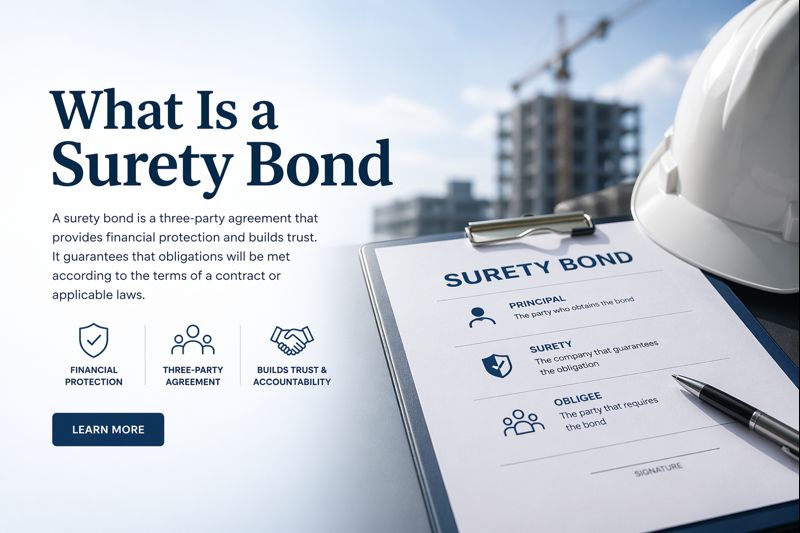
A surety bond is not the same thing as standard liability insurance. It is a three-party financial guarantee. The principal is the person or business that must obtain the bond. The obligee is the government agency, project owner, court, or other party requiring the bond. The surety is the bonding company that issues the guarantee. If the principal fails to meet the bonded obligation and a valid claim is paid, the surety can generally seek reimbursement from the principal. That reimbursement feature is one of the biggest reasons people should not treat a bond like ordinary insurance.
How a surety bond works in plain English
A surety bond is designed to protect the obligee against a specific type of nonperformance, noncompliance, or financial harm tied to the bonded obligation. That obligation depends on the bond type. On a contractor bond, it may relate to contract performance, payment, or statutory compliance. On a license bond, it may relate to following a state or local law. On a court bond, it may relate to a legal filing or fiduciary duty. On a public official bond, it may relate to faithful performance of office duties.
- The obligee sets the requirement: the bond form, bond amount, wording, and filing rules come from the party requiring the bond.
- The principal applies: the bond applicant provides business details, ownership information, and sometimes credit, financial, or licensing information.
- The surety underwrites the risk: stronger credit, experience, and financial profile usually improve pricing and approval odds.
- The bond is issued: the bond can be delivered digitally, physically, or both, depending on the obligee’s rules.
- If a claim happens: the surety investigates the claim and, if it pays a valid claim, can pursue reimbursement from the principal.
Quick facts: what most people need to know first
If you are new to surety bonds, this table gives you the quickest way to understand what you are buying and what to verify before you click through an online quote or bond application.
| Topic | What it means | What to verify | Why it matters |
|---|---|---|---|
| Bond requirement | The official rule, statute, contract, or filing that requires the bond | Exact bond type, obligee name, and bond amount | Buying the wrong bond form can delay approval |
| Bond amount | The stated guarantee limit, not the premium | Required amount and whether riders are needed | The bond must match the filing requirement exactly |
| Premium | The cost to buy the bond | Annual term, renewal rules, and fees | Low price alone is not enough if filing details are wrong |
| Bond form | The official wording or template the obligee accepts | State form, agency form, or project form version | Wrong wording can trigger rejection |
| Claims | Potential payment by the surety if a valid claim exists | Claim conditions and indemnity obligations | Surety bonds are guarantees, not free claim protection for the principal |
| Renewal | Whether the bond continues annually or for a fixed term | Expiration date, continuation certificate rules, and cancellation notice requirements | Missing a renewal can suspend a license, registration, or contract eligibility |
Common types of surety bonds people compare
Surety bonds are not one product. They are a broad category of guarantees. The right bond depends on the requirement you are trying to satisfy. That is why the cleanest buying process starts with the bond requirement itself, not with price shopping alone.
| Bond type | Typical use | Common obligee | What to watch |
|---|---|---|---|
| License and permit bond | Required to obtain or maintain a license, permit, or registration | State, county, or city agency | Form version and agency naming must match exactly |
| Contract bond | Used on construction or service contracts | Project owner or public entity | Bid, performance, and payment bonds each solve different problems |
| Court bond | Connected to a court proceeding or fiduciary role | Court or legal authority | Case details, filing deadlines, and court language matter |
| Public official bond | Supports faithful performance obligations for certain officeholders | Government body | Office title, term dates, and statutory wording are key |
| Fidelity or employee dishonesty-related bond lane | Helps address dishonest acts by employees in certain settings | Employer or agency requirement | Do not assume this works the same way as a license or contract bond |
Who usually needs a surety bond and why
Many buyers assume surety bonds are only for construction contractors. Construction is a major category, but it is far from the only one. A bond may be required for licensing, tax compliance, auto dealer operations, freight or transportation filings, public office, probate matters, and many other regulated activities. The reason almost always comes back to the same idea: the obligee wants a financial guarantee tied to a legal, contractual, or fiduciary obligation.
| Buyer | Why a bond is required | Common example | Smart move before applying |
|---|---|---|---|
| Contractors | Bid access, project security, or statutory compliance | Bid, performance, or payment bond | Review the contract and bond form together before purchase |
| Licensed businesses | Regulator wants a compliance guarantee | License or permit bond | Confirm the agency, license class, and bond amount |
| Court-appointed parties | Court wants protection tied to duties or assets | Probate or fiduciary bond | Match the case caption and court instructions exactly |
| Public officials | Statutory faithful-performance requirement | Official bond | Verify office title, term, and local filing instructions |
| Specialty regulated operators | Public agency or industry rule requires security | Dealer, tax, utility, or other commercial bond | Use the exact requirement notice when requesting a quote |
What usually changes the cost of a surety bond
The premium on a surety bond is often a small percentage of the bond amount, but the price still depends on the bond type and the applicant’s profile. Some smaller license bonds can price very simply. Larger or more specialized bonds can require fuller underwriting. The strongest comparison is not “Who has the cheapest bond?” It is “Who can issue the correct bond form at a competitive price and get the filing accepted without back-and-forth?”
| Factor | Why it affects price or approval | What helps |
|---|---|---|
| Bond type | Some bonds are straightforward, while others carry more underwriting risk | Use the exact required bond name and form |
| Bond amount | Higher bond amounts can increase exposure | Confirm whether the stated amount is fixed or variable |
| Credit and financial profile | Sureties often look at the applicant’s credit strength and overall profile | Provide accurate ownership and business details |
| Experience and business history | Operational track record can affect approval and pricing | Use the legal business name and current operating details |
| Obligee form requirements | Special wording, signatures, notary, or seal requirements can affect processing | Upload or review the requirement notice before you buy |
| Renewal structure | Continuous bonds and annual terms create different renewal workflows | Know the expiration date and continuation rules |
Claims and reimbursement: the part many buyers miss
The claim side is where many first-time buyers realize a surety bond is not ordinary insurance. If a valid claim is made and paid under the bond, the surety generally expects reimbursement from the principal under the indemnity agreement. That is why bond buyers should focus on compliance, accurate filings, and contract performance from the start. The goal is not just to buy the bond. The goal is to keep the bonded obligation in good standing.
| Step | What usually happens | Why it matters |
|---|---|---|
| Claim is reported | The obligee or claimant alleges nonperformance, noncompliance, or other bonded failure | The details of the bond obligation control the review |
| Surety investigates | The surety reviews the facts, bond form, and underlying obligation | Not every allegation becomes a payable claim |
| Resolution occurs | The matter may be denied, resolved, or paid if valid under the bond | The bond language and facts drive the outcome |
| Principal may reimburse | If the surety pays, the principal can be responsible for repayment | This is a core difference from standard insurance |
Get a surety bond quote online
The cleanest surety bond application starts with the exact requirement in hand. Before you apply, gather the obligee name, bond type, bond amount, filing deadline, and any official bond form or notice you were given. That makes it easier to compare the quote you receive against what the agency, court, or project owner is actually asking for.
Have the bond requirement, obligee name, bond amount, and any filing instructions ready before you apply.
Related topics
Surety bond FAQs (2026)
Is a surety bond the same as insurance?
No. A surety bond is a three-party guarantee. It protects the obligee, and if the surety pays a valid claim, the principal is often expected to reimburse the surety.
What is the difference between the bond amount and the premium?
The bond amount is the stated guarantee limit required by the obligee. The premium is the price you pay to purchase the bond.
Who usually needs a surety bond?
Contractors, licensed businesses, court-appointed parties, public officials, and other regulated operators commonly need surety bonds when a law, contract, or filing requirement calls for one.
Why can a bond claim come back to me?
Because a surety bond is generally not designed to absorb loss for the principal the way standard insurance does. If the surety pays a valid claim, reimbursement from the principal is often part of the bond arrangement.
What should I have ready before applying for a surety bond online?
Bring the exact bond requirement, obligee name, bond amount, legal business or personal name, filing deadline, and any official bond form or instruction notice you received.
Independent agency: Blake Insurance Group LLC is an independent insurance agency and is not affiliated with any single insurance company.
Licensing: Licensed insurance producer (NPN 16944666).
Important: Surety bond availability, premium, underwriting, bond amount, bond form acceptance, filing rules, renewal terms, and claim handling vary by bond type, surety, obligee, jurisdiction, and applicant profile.
Reminder: Always review the exact requirement, bond form wording, and filing instructions before purchasing a bond.
Trademarks: All product and company names are trademarks™ or registered® trademarks of their respective holders. Use of them does not imply affiliation or endorsement.




