Coverage may be available
Term and permanent policies can be possible. The diabetes diagnosis, overall health, product limits, and underwriting evidence influence which choices remain open.
Prepare the case before comparing policies
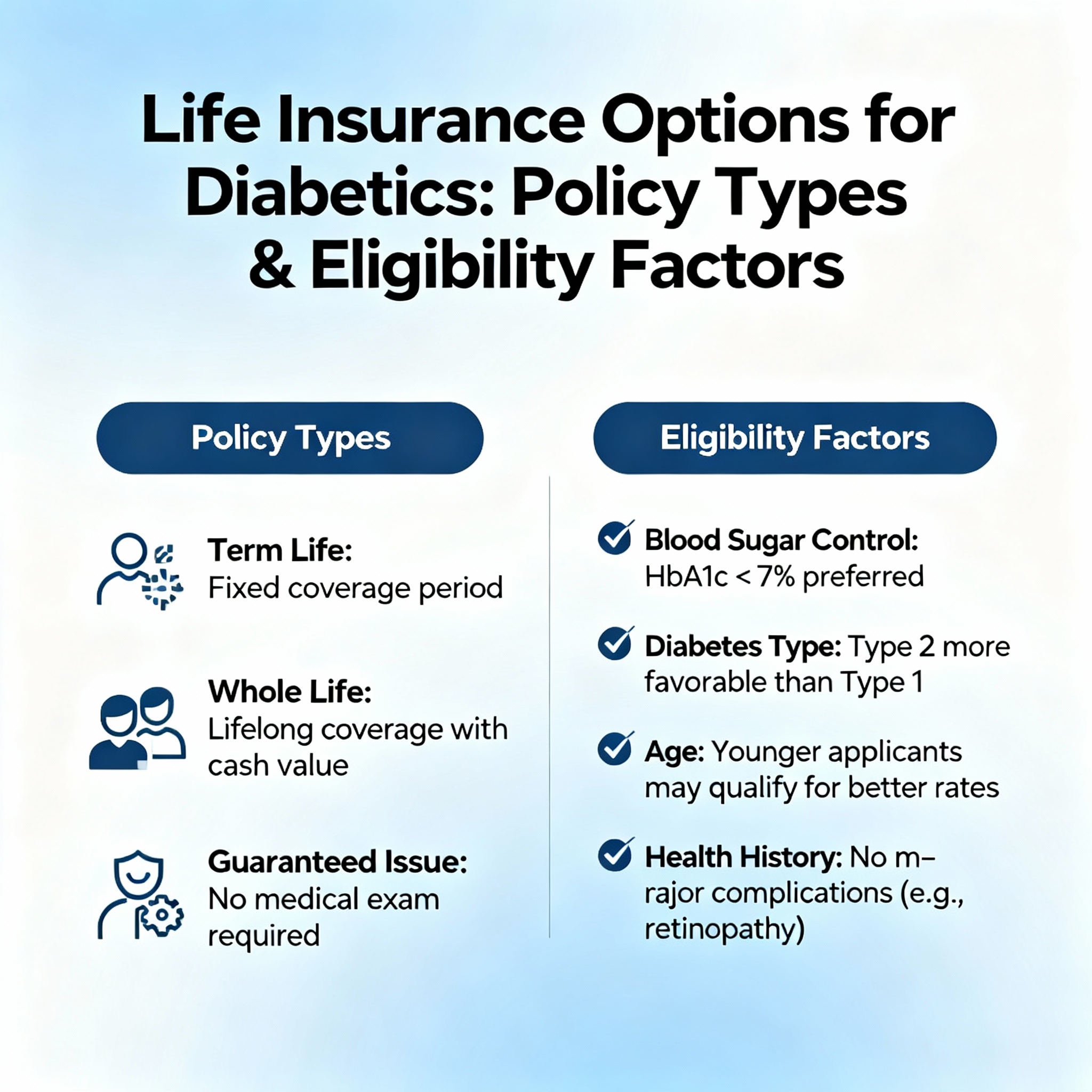
Life insurance for diabetics is often available, but the policy, price, and underwriting path depend on the complete health picture. Insurers may consider diabetes type, age at diagnosis, treatment, A1C history, follow-up care, severe blood-sugar events, and related complications. A diagnosis by itself does not reveal what any particular insurer will offer.
The strongest application is accurate, organized, and matched to appropriate underwriting guidelines. Compare fully underwritten, accelerated, simplified-issue, and guaranteed-issue routes by coverage—not convenience alone. The issuing insurer makes the final eligibility, rate-class, benefit, and premium decision.
The quote button opens LifeLink, a separate third-party website. An estimate, preliminary indication, or submitted application is not a policy, approval, or confirmation that coverage is effective.
Yes, many people living with diabetes obtain life insurance. Possible outcomes include approval at an insurer’s available rate class, a higher premium, a different benefit amount, a request for additional evidence, postponement until more history is available, or a decline. The outcome is specific to the person, insurer, product, and application date.
Underwriting is not medical advice and does not determine whether someone is managing diabetes “correctly.” It estimates insurance risk under a company’s filed rules. A clinician should set personal treatment goals. For example, A1C reflects average blood glucose over roughly the prior two to three months, but an appropriate target depends on the individual’s health and should be discussed with a healthcare professional.
Term and permanent policies can be possible. The diabetes diagnosis, overall health, product limits, and underwriting evidence influence which choices remain open.
An underwriter may review current measurements alongside trends, medications, follow-up, treatment changes, and complications rather than relying on a single number.
Companies can evaluate the same history differently. A careful preliminary comparison may reduce poorly matched applications, but it cannot bind an insurer.
Important: Do not change medication, delay care, or pursue a medical target to influence an insurance application. Follow the plan established with your healthcare team and report application information truthfully.
Diabetes affects people differently. Underwriters usually look for a consistent story across the application, interview, prescription history, laboratory results, physician records, and other authorized evidence. The amount and type of evidence vary by product.
| Area | Examples of information | Why context matters |
|---|---|---|
| Diagnosis history | Diabetes type, age and date at diagnosis, how it was discovered, and time since diagnosis. | A recent diagnosis may provide less history for evaluating stability than an established record of follow-up. |
| Glucose management | Recent A1C, earlier A1C results, home or continuous-monitoring history when requested, and significant highs or lows. | A pattern can provide more context than one isolated measurement. |
| Treatment | Nutrition and activity plan, oral medication, non-insulin injections, insulin, pump use, and recent treatment changes. | Treatment identifies how the condition is managed; no medication is not automatically better than appropriate treatment. |
| Follow-up | Primary-care or specialist visits, recommended testing, adherence, and timing of the next review. | Regular care can help document the current status and response to treatment. |
| Related health | Blood pressure, cholesterol, weight history, kidney function, cardiovascular history, and nicotine use. | Insurers evaluate overall mortality risk, not diabetes in isolation. |
| Complications | Kidney disease, neuropathy, retinopathy, vascular disease, foot ulcers, amputations, or severe hypoglycemic events. | Type, severity, treatment, and current status can materially change the underwriting path. |
| Other factors | Age, family history when considered, driving, occupation, activities, finances, requested benefit, and existing coverage. | These factors are evaluated under product rules and applicable law alongside the medical history. |
Insurers may request the most recent A1C and prior results to understand direction and stability. Do not assume that one universal cutoff guarantees approval or decline; underwriting ranges differ across companies and products, and the result is considered with the broader record. If the latest reading followed a medication change, illness, pregnancy, steroid treatment, or another unusual circumstance, provide truthful context when asked.
Diabetes can be associated with heart and vascular disease, kidney disease, eye disease, and nerve damage. An underwriting review may examine whether a complication exists, its severity, how it is treated, and whether it is stable. Normal follow-up findings can also be relevant when records document them. Never state that a screening was normal unless that information is in your records.
The diagnosis label is a starting point, not a complete classification. Underwriters can apply different rules by type, duration, age, treatment, control history, complications, and the policy requested.
Type 1 diabetes requires insulin management. An insurer may pay close attention to age at diagnosis, duration, A1C trend, severe low-blood-sugar events, hospitalizations, pump or continuous-monitor use when documented, follow-up, and complications. Insulin use should be disclosed accurately; it is not, by itself, a universal automatic decline.
Type 2 diabetes may be managed through lifestyle measures, oral medications, injectable medications, insulin, or a combination. Underwriting may consider duration, treatment, A1C history, weight and blood pressure, cardiovascular and kidney health, nicotine use, and consistency of care.
Gestational diabetes develops during pregnancy and often resolves afterward, but it is associated with a higher later risk of type 2 diabetes. An insurer may ask about the pregnancy, treatment, resolution, later testing, current status, and whether diabetes was diagnosed after pregnancy.
Prediabetes is not the same as diabetes, but it should be disclosed as the application asks. Underwriting may consider current testing, treatment recommendations, weight and metabolic history, follow-up, and whether a formal diabetes diagnosis exists.
A company may want enough follow-up to assess how a new diagnosis or treatment affects the condition. That can result in a request for more evidence or postponement rather than a permanent conclusion. The appropriate next step depends on the insurer’s stated reason, the need for coverage, and whether another product can lawfully consider the current facts.
Do not wait to seek medical care because of life insurance. If coverage is needed while a case is still developing, compare available options and limitations. A smaller or differently underwritten policy may be considered, but no temporary strategy should be described as guaranteed unless the contract says so.
The best route balances evidence, likely eligibility, amount needed, benefit duration, guarantees, and affordability. “No exam” is an underwriting method, not a policy type.
| Route | Possible evidence | What to remember |
|---|---|---|
| Traditional underwriting | Detailed application, paramedical exam, blood and urine testing, prescription history, and medical records. | More evidence may support a more individualized review but does not guarantee approval or a particular class. |
| Accelerated underwriting | Application and authorized data, with an exam waived for eligible cases. | Diabetes or another finding may cause the insurer to request traditional evidence. |
| Simplified issue | Health questions and possible prescription, medical, identity, driving, or insurance-data checks. | No exam does not mean no underwriting. Product limits and diabetes eligibility vary. |
| Guaranteed issue | Generally no health questions used for eligibility within the product’s rules. | May have lower benefits, higher cost per dollar of coverage, and graded or modified natural-death benefits early in the policy. |
| Group life insurance | Enrollment information and, above certain amounts, possible evidence of insurability. | Check portability, conversion, benefit sufficiency, employer contribution, and what happens when employment ends. |
Term life insurance can match temporary needs such as income replacement, a mortgage, education funding, or a business obligation. Confirm the death benefit, level-premium period, total term, renewal schedule, conversion rights, riders, and final underwriting class. A preliminary quote may assume a health class that is not ultimately offered.
Whole life and other permanent policies may address lifelong needs, final expenses, estate liquidity, or legacy goals. Compare guaranteed premiums and benefits, cash values, charges, loans, withdrawals, and lapse risk. Smaller final expense policies may use simplified or guaranteed-issue underwriting. Verify whether the full natural-death benefit is immediate, graded, or modified during an early period.
A no-exam route may be convenient, particularly when the insurer can decide from application answers and authorized data. It is not always faster, less expensive, or easier for a person with diabetes. Compare it with fuller underwriting when time and circumstances allow. Review the separate no-exam life insurance guide for the differences among accelerated, simplified, and guaranteed issue.
Preparation cannot promise a better offer, but it can reduce avoidable inconsistency and help the case reach an appropriate underwriting path. Gather accurate information before requesting detailed comparisons.
Do not stop treatment, skip a medical appointment, hide insulin or medication, or let someone answer health questions for you without review. Do not apply to several companies at random. An organized preliminary assessment can help identify reasonable candidates, although only a formal insurer review produces an offer.
If you are searching for a life insurance agent near me, look for someone who asks for the full history, explains why a product may fit, distinguishes an estimate from an offer, and never suggests changing truthful answers.
The first online price is not the final decision. Compare proposals after underwriting using the same benefit goal and a written checklist.
| Item | Questions to answer |
|---|---|
| Issuing insurer | Which licensed company issues the policy? What is the exact product and form? |
| Underwriting result | Was the expected class approved? Is there a rating, changed benefit, exclusion where permitted, postponement, or other modification? |
| Coverage | What amount is payable, for which causes, and during which policy years? |
| Premium guarantee | Is the premium level, guaranteed for a period, scheduled to rise, or dependent on funding and performance? |
| Duration | When does coverage end? What are the renewal and conversion terms? |
| Permanent values | Which cash values and death benefits are guaranteed, and which are illustrated or non-guaranteed? |
| Riders | What triggers each benefit, what does it cost, and does using it reduce the death benefit or policy values? |
| Effective coverage | Which acceptance, signature, delivery, payment, and health-statement conditions remain? |
Ask what changed and why. The explanation may identify a different A1C result, an unreported medication, a complication, another health issue, or a product rule. Then compare the revised offer with other reasonable choices. A higher premium can sometimes preserve the needed benefit; in another case, a smaller policy or different duration may better fit the budget.
Do not cancel a current policy until the new coverage is issued, accepted, and confirmed effective. Replacement may restart contestability and suicide provisions, introduce new exclusions or guarantees, and cause loss of cash value or surrender charges. Compare the current contract against the new one, not just old and new premiums.
LifeLink is a separate third-party website. Product availability, underwriting, rates, benefits, and eligibility vary by applicant, insurer, product, and state.
No. Many applicants with diabetes obtain coverage. The insurer may consider diabetes type, duration, treatment, A1C history, follow-up, complications, overall health, nicotine use, age, and the policy requested. Approval and pricing are never guaranteed.
It can. An insurer may review the latest A1C, earlier results, treatment, and the broader health record. There is no universal A1C cutoff that guarantees a particular company’s decision. Your clinician should determine your personal treatment target.
No universal rule makes all insulin use an automatic decline. The insurer may consider why insulin is used, diabetes type and duration, control history, complications, severe low-blood-sugar events, and other health factors. Product and company guidelines differ.
Possibly. Accelerated or simplified underwriting may be available, but diabetes can trigger additional questions, records, testing, or traditional underwriting. Guaranteed-issue products generally avoid health-based eligibility questions but may have different benefit limits, costs, and early natural-death benefits.
Do not delay care or change treatment for insurance. Whether to apply now depends on the coverage need, present history, available products, and whether an insurer is likely to want more follow-up. A preliminary assessment can help, but it cannot guarantee a later result.
An accurately issued policy generally continues according to its contract as long as required premiums and policy conditions are met. A later diagnosis does not ordinarily reprice an existing fixed-premium policy. Claims remain subject to the contract, application, contestability provisions, and applicable law.
Death proceeds paid to a beneficiary are generally excluded from federal gross income, while interest is generally taxable. Estates, transfers for value, business arrangements, and other circumstances may produce different results. Ask a qualified tax professional about a specific situation.
Organize the history, compare appropriate underwriting routes, and review the insurer’s final offer against the coverage need.
You will continue on the separate LifeLink website. An application and insurer approval may be required, and coverage is not effective until all policy conditions are satisfied.




