Ten Commercial Insurance Companies in Ohio: Compare Coverage, Carrier Fit, Certificates, Industry Appetite, and Online Quote Options
Ten Commercial Insurance Companies in Ohio is a practical 2026 guide for business owners who need coverage that fits contracts, leases, employees, job sites, vehicles, property, certificates, and real claim scenarios. Searching for commercial insurance near me in Ohio usually means you need one of four things: a certificate fast, a Business Owners Policy for a lease, commercial auto because personal auto no longer fits the vehicle use, or a stronger multi-line structure because the business has grown past a basic policy.
Ohio businesses operate across a wide range of risk profiles. A contractor in Columbus, a restaurant in Cleveland, a professional office in Cincinnati, a manufacturer in Dayton, a logistics operation in Toledo, and a retail or service business in Akron may all ask for “business insurance,” but they should not be quoted the same way. The best commercial insurance company is the one that understands the operation, accepts the class, supports required endorsements, and can issue documents that match the landlord, lender, vendor, municipal, or general contractor requirement.
This page compares ten commercial insurance companies and program types that Ohio business owners commonly review for general liability, Business Owners Policies, commercial property, professional liability, cyber liability, umbrella, and commercial auto. It also explains the Ohio workers’ compensation distinction: Ohio is a state-administered workers’ compensation environment, so employers with employees should review Ohio Bureau of Workers’ Compensation requirements separately from private commercial insurance proposals.
A fair Ohio commercial insurance comparison starts with one fixed baseline: operations, locations, revenue, payroll, vehicles, limits, deductibles, required endorsements, certificate wording, and whether the business also needs Ohio BWC workers’ compensation setup or coordination.
How to compare commercial insurance companies in Ohio
Commercial insurance comparison should start with the actual risk, not with a carrier logo or a single premium number. If a landlord, general contractor, municipality, lender, vendor, franchise agreement, or client contract requires $1 million per occurrence and $2 million aggregate general liability, Additional Insured status, Waiver of Subrogation, Primary and Non-Contributory wording, commercial auto liability, and proof of workers’ compensation compliance, the lowest quote is not useful unless it can support those requirements.
Before quoting, Ohio business owners should prepare a clean baseline: legal business name, DBA, locations, annual revenue, payroll, owner/officer status, employee count, subcontractor costs, vehicle list, driver list, building values, tools and equipment values, prior losses, requested limits, and required certificate wording. That makes the comparison fair. Without that baseline, one quote may include the required endorsements while another quietly leaves them out.
Ohio also has regional and industry-specific differences. Columbus businesses may focus on contractors, professional services, technology, restaurants, retail, and growing employer groups. Cleveland businesses often include manufacturing, logistics, healthcare support, restaurants, contractors, and commercial property exposures. Cincinnati businesses may need professional liability, contractor coverage, service business packages, commercial auto, and umbrella support. Dayton, Toledo, Akron, Canton, Youngstown, and suburban markets bring their own mix of manufacturing, transportation, trades, property, and service exposures.
Coverage snapshot: what Ohio businesses should review in 2026
Commercial insurance works best when it is matched to how the business earns revenue, hires employees, signs contracts, drives vehicles, owns property, stores equipment, and serves customers.
| Coverage | What it protects | Common triggers | Most important detail |
|---|---|---|---|
| General Liability | Third-party bodily injury, property damage, and personal/advertising injury claims. | Customer injury, jobsite damage, completed operations dispute, vendor requirement. | Confirm limits and endorsements such as Additional Insured, WOS, and PNC. |
| Business Owners Policy | Often bundles GL, business property, and selected extensions for eligible small businesses. | Office, retail, service, small landlord, restaurant, or light commercial package need. | Make sure the BOP form fits the actual class and property values. |
| Commercial Property | Buildings, tenant improvements, business personal property, equipment, inventory, and signs. | Fire, theft, vandalism, wind/hail, certain water losses, covered equipment losses. | Review replacement cost, ACV, coinsurance, limits, deductibles, and exclusions. |
| Business Income | Lost income and continuing expenses after a covered property loss. | Shutdown after covered property damage, temporary relocation, repair period. | Check waiting period, period of restoration, and realistic income assumptions. |
| Ohio Workers’ Compensation | State-administered benefits for employee work-related injuries and occupational illness. | Workplace injury, jobsite accident, repetitive motion, occupational illness. | Ohio employers should coordinate BWC coverage separately from private commercial policies. |
| Professional Liability | Errors, omissions, negligence allegations, and service-related financial loss claims. | Bad advice allegation, missed deadline, design issue, client dispute, consulting error. | Review retroactive date, definition of professional services, and exclusions. |
| Cyber Liability | Data breach, ransomware, phishing, privacy events, payment fraud, and incident response. | Credential theft, vendor compromise, malware, social engineering, lost records. | Confirm response services, sublimits, MFA expectations, and exclusions. |
| Commercial Umbrella | Extra liability limits above qualifying underlying policies. | Severe injury, large auto accident, major completed-operations claim. | Confirm underlying limits, exclusions, and whether auto is included. |
Ohio law requires employers to obtain workers’ compensation coverage from the date they first hire employees in Ohio. Ohio workers’ compensation is handled through the Ohio Bureau of Workers’ Compensation or through approved self-insurance for qualifying employers, so private commercial package quotes should be reviewed alongside the required Ohio BWC setup rather than treated as a substitute.
Ten commercial insurance companies commonly considered in Ohio
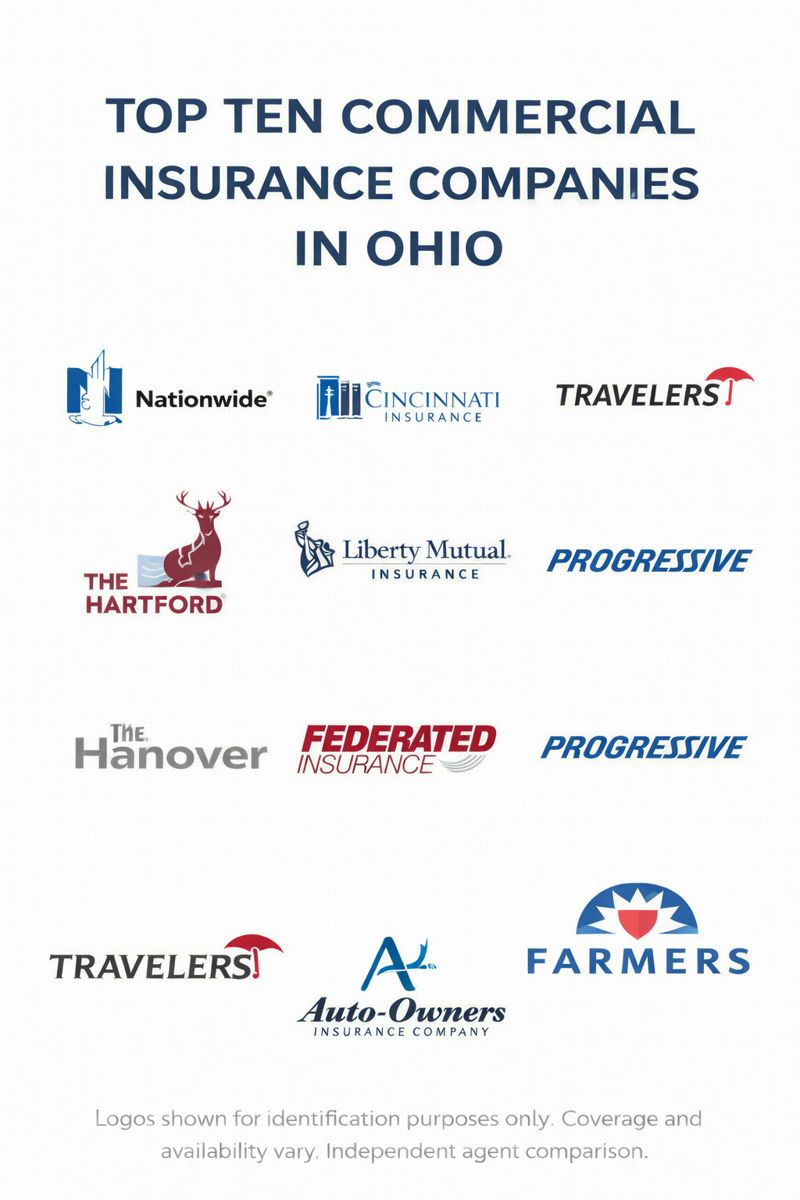
The companies and program types below are commonly reviewed by Ohio business owners and independent agencies. This list is not a guarantee that every carrier is available for every business, class code, county, payroll size, vehicle exposure, property condition, cyber exposure, contract requirement, or loss history. Commercial insurance is underwritten risk by risk, and appetite can change by industry, revenue, property age, driver quality, professional services, contracts, and claims.
| Company / program | Often a strong fit for | Common strengths | Watch-outs |
|---|---|---|---|
| Travelers | Growing businesses, contractors, property schedules, multi-location operations, and broader commercial accounts. | Strong commercial lines breadth, risk-control resources, and package capability. | Appetite varies by class, loss history, and underwriting detail. |
| The Hartford | Small-to-mid businesses, offices, professional firms, and package-friendly accounts. | Recognized small business focus, BOP options, service workflows, and broad commercial familiarity. | Some classes require more review or stronger controls. |
| Chubb | Professional firms, higher-value accounts, specialized risks, technology-related risks, and businesses needing refined coverage forms. | Coverage depth, claims reputation, and complex-risk capability. | Selective underwriting and not always the lowest price. |
| Liberty Mutual | Mid-market businesses, multi-line accounts, layered risks, and larger commercial needs. | Scale, capacity, and broad commercial line access. | Policy terms should be checked closely against contract wording. |
| Nationwide | Main-street businesses, BOP-friendly classes, contractors, professional services, and service operations. | Flexible options for common business profiles and independent agent access. | Eligibility varies by industry, territory, and exposure details. |
| CNA | Contractors, professional services, healthcare-adjacent firms, manufacturers, and industry-specific accounts. | Commercial specialization and useful industry-focused underwriting. | Endorsements and exclusions must be reviewed for COI acceptance. |
| Zurich | Mid-to-large commercial risks, manufacturers, distributors, contractors, logistics, and specialized programs. | Risk engineering, industry programs, and capacity for larger accounts. | May not target very small or simple main-street accounts. |
| The Hanover | Main-street commercial, package policies, contractor accounts, and regional business placements. | Commercial package capability and independent agent distribution. | Class appetite can shift; quote details matter. |
| Auto-Owners | Independent-agent commercial accounts, package coverage, commercial auto, and many common business classes. | Business coverage menu, agent-centered service, and regional strength. | Availability and appetite vary by class and account quality. |
| Regional / online small business programs | Simple GL, BOP, professional liability, cyber, and fast certificate needs. | Speed, online quote-and-buy convenience, and practical access for smaller businesses. | Complex businesses may require agent-reviewed underwriting instead of instant binding. |
For many Ohio businesses, the final solution may not be one company for every line. General liability and property may fit with one carrier, cyber may be placed through a separate program, commercial auto may require its own underwriting path, and workers’ compensation should be coordinated through the Ohio BWC or approved self-insurance structure. That is normal. The goal is to build a complete coverage structure that works for contracts, employees, vehicles, property, certificates, compliance expectations, and cash flow.
Industry fit: how to choose the right carrier bucket
Ohio has a strong mix of contractors, professional services, restaurants, retail operations, technology firms, healthcare support, manufacturing, distribution, logistics, hospitality, transportation, and property-related businesses. Each business type has different rating variables. A contractor may be rated by payroll, subcontractor cost, job type, and completed operations. A manufacturer may be rated by products liability and property values. A consultant may need professional liability and cyber more than heavy property coverage. A restaurant may need spoilage, equipment breakdown, business income, general liability, commercial property, and liquor liability where applicable.
| Business type | Coverage priorities | Best quote strategy |
|---|---|---|
| Contractors and trades | GL, completed operations, tools, inland marine, HNOA, umbrella, COI wording, and Ohio BWC coordination. | Quote from contract requirements, payroll, subcontractor use, employee count, and jobsite exposure. |
| Restaurants and hospitality | BOP, property, spoilage, equipment breakdown, business income, liquor liability if needed, cyber, and commercial auto if delivery exists. | Document sales mix, delivery, alcohol exposure, hours, payroll, equipment values, and lease requirements. |
| Retail and offices | BOP, GL, property, cyber, business income, tenant improvements, signage, and crime coverage where needed. | Match lease requirements and property values before binding. |
| Professional services | E&O, cyber, GL, hired/non-owned auto, EPLI, umbrella. | Define services clearly and review retroactive dates, exclusions, client contract terms, and data exposure. |
| Manufacturing and distribution | Products liability, property, business income, equipment, umbrella, auto, cargo, and BWC coordination. | Use accurate product type, sales, safety controls, property values, and vehicle exposure. |
| Logistics and transportation | Commercial auto, motor truck cargo where needed, GL, umbrella, property, cyber, and contract wording. | Provide vehicle schedules, driver details, radius, commodities, garaging, and loss history. |
Commercial auto insurance in Ohio: when you need a separate quote
Commercial auto deserves its own review when the business owns vehicles, employees drive for work, crews travel to job sites, a company vehicle carries tools, a restaurant or service business delivers, or contracts require specific auto liability limits. Ohio businesses with interstate travel, I-70/I-71/I-75 corridor exposure, rural routes, city traffic, trailers, delivery exposure, wrapped vehicles, or multiple drivers should not assume personal auto coverage is enough.
| Item | What to confirm | Why it matters | Common mistake |
|---|---|---|---|
| Vehicle use | Service, delivery, sales, hauling, artisan use, fleet use, rural route, interstate travel, or mixed use. | Use class drives price, eligibility, and claim handling. | Rating a business vehicle like a personal-use vehicle. |
| Driver list | All regular drivers, licensing, MVR expectations, seasonal drivers, and hiring controls. | Drivers can determine whether the account is acceptable. | Leaving out part-time, seasonal, or occasional drivers. |
| Hired/non-owned auto | Employee-owned vehicles, rentals, borrowed vehicles, and occasional business errands. | Protects the business when non-owned vehicles are used for work. | Assuming an employee’s personal auto fully protects the business. |
| Physical damage | Comprehensive, collision, deductibles, values, trailers, lienholder requirements, and equipment permanently attached. | Controls repair/replacement cash flow after a covered loss. | Choosing a deductible the business cannot comfortably absorb. |
| Limits and umbrella | Auto liability limits and umbrella compatibility. | Serious vehicle claims can exceed low limits quickly. | Buying minimum limits without checking contracts or umbrella requirements. |
Use the commercial auto quote form when vehicles are titled to the business, a vehicle is wrapped or branded, employees drive regularly, trailers are part of the operation, contracts require specific auto liability limits, or the account includes multiple drivers. Use the online small business quote paths when the exposure is simpler and the primary need is general liability, BOP, professional liability, cyber, or property coverage.
Ohio commercial insurance support by city and metro
Ohio commercial insurance should reflect the local market where the business operates. A Columbus contractor, Cleveland restaurant, Cincinnati professional firm, Dayton manufacturer, Toledo logistics company, and Akron service business may each need a different quote structure even if they all request “business insurance.”
| Metro / region | Examples of nearby cities | What we optimize for |
|---|---|---|
| Columbus Metro | Columbus, Dublin, Westerville, Grove City, Hilliard, Reynoldsburg | Contractor certificates, office packages, technology firms, restaurants, professional liability, COI readiness. |
| Cleveland / Northeast Ohio | Cleveland, Lakewood, Parma, Euclid, Mentor, Strongsville | Manufacturing, logistics, contractors, restaurants, property schedules, commercial auto. |
| Cincinnati / Southwest Ohio | Cincinnati, Mason, Blue Ash, Hamilton, Fairfield, Loveland | Professional services, contractors, retail, umbrella limits, commercial auto, cyber. |
| Dayton / Miami Valley | Dayton, Kettering, Beavercreek, Centerville, Huber Heights | Manufacturing, service businesses, contractors, commercial property, equipment coverage. |
| Toledo / Northwest Ohio | Toledo, Perrysburg, Maumee, Sylvania, Bowling Green | Logistics, manufacturing, contractors, fleet exposure, property, business income. |
| Akron / Canton / Youngstown | Akron, Canton, Cuyahoga Falls, Massillon, Youngstown, Boardman | Trades, restaurants, retail, commercial auto, property, certificates, umbrella support. |
Get commercial insurance quotes online
Start with the quote path that matches the coverage you need. Some Ohio businesses can quote and buy online quickly. Others need an agent-reviewed submission because the account includes business vehicles, payroll complexity, subcontractors, property schedules, specialty equipment, professional liability, cyber requirements, prior claims, or strict contract wording.
Coverage is not active until eligibility is confirmed, final terms are approved, payment is accepted where required, and the insurer issues the policy or binder. Ohio workers’ compensation coverage should be coordinated separately through Ohio BWC or approved self-insurance where applicable.
Ohio commercial insurance FAQs
What is the best commercial insurance company in Ohio?
The best company is the one that fits your industry, accepts your operations, supports your required endorsements, and prices your risk consistently. The best fit for a contractor, restaurant, consultant, manufacturer, logistics company, landlord, or technology firm can be completely different.
Do Ohio businesses need workers’ compensation?
Ohio employers should review workers’ compensation requirements as soon as they hire employees in Ohio. Ohio workers’ compensation is handled through the Ohio Bureau of Workers’ Compensation or approved self-insurance for qualifying employers, so it should be coordinated separately from private GL, BOP, auto, and property quotes.
Why do commercial insurance quotes vary so much?
Quotes vary because carriers may use different class codes, revenue assumptions, limits, deductibles, exclusions, endorsements, vehicle assumptions, professional liability definitions, property values, and underwriting appetite. Standardize the baseline first, then compare.
Can you help with certificates of insurance?
Yes. The goal is to confirm required limits and endorsements before binding so the certificate matches the landlord, general contractor, vendor, lender, client, or contract requirement.
Is an online quote enough for every Ohio business?
No. Online quote-and-buy tools are useful for many simple risks, but businesses with vehicles, payroll complexity, subcontractors, property schedules, prior claims, cyber requirements, BWC coordination needs, or strict contract wording may need agent-reviewed underwriting.
When should I use the commercial auto quote form?
Use the commercial auto form when your business owns vehicles, has employees driving regularly, needs fleet coverage, transports tools or goods, pulls trailers, makes deliveries, or must meet contract-required auto liability limits.
Independent agency: Blake Insurance Group LLC is an independent insurance agency and is not affiliated with any single insurance company, quote platform, government agency, workers’ compensation bureau, contractor, landlord, lender, carrier, or program named on this page.
Licensing: Licensed insurance producer (NPN 16944666).
Important: Commercial insurance availability, eligibility, premiums, limits, deductibles, endorsements, discounts, audits, certificate wording, claim outcomes, and effective dates vary by carrier, state, ZIP code, business class, payroll, revenue, vehicle use, property values, prior losses, and underwriting rules. Ohio workers’ compensation obligations are governed by Ohio law, Ohio Bureau of Workers’ Compensation rules, and approved self-insurance requirements where applicable. Your issued policy, declarations page, endorsements, exclusions, contract requirements, and applicable law govern coverage and obligations. This page is general information only and is not legal, tax, financial, employment, risk-management, or claims advice.
Trademarks: All carrier, platform, product, and program names are trademarks™ or registered® trademarks of their respective owners. Use of these names does not imply affiliation, sponsorship, or endorsement.




