
MassMutual vs Guardian (2026): Term, Whole Life, Cash Value, Dividends, and Which Mutual Insurer Fits Your Long-Term Plan
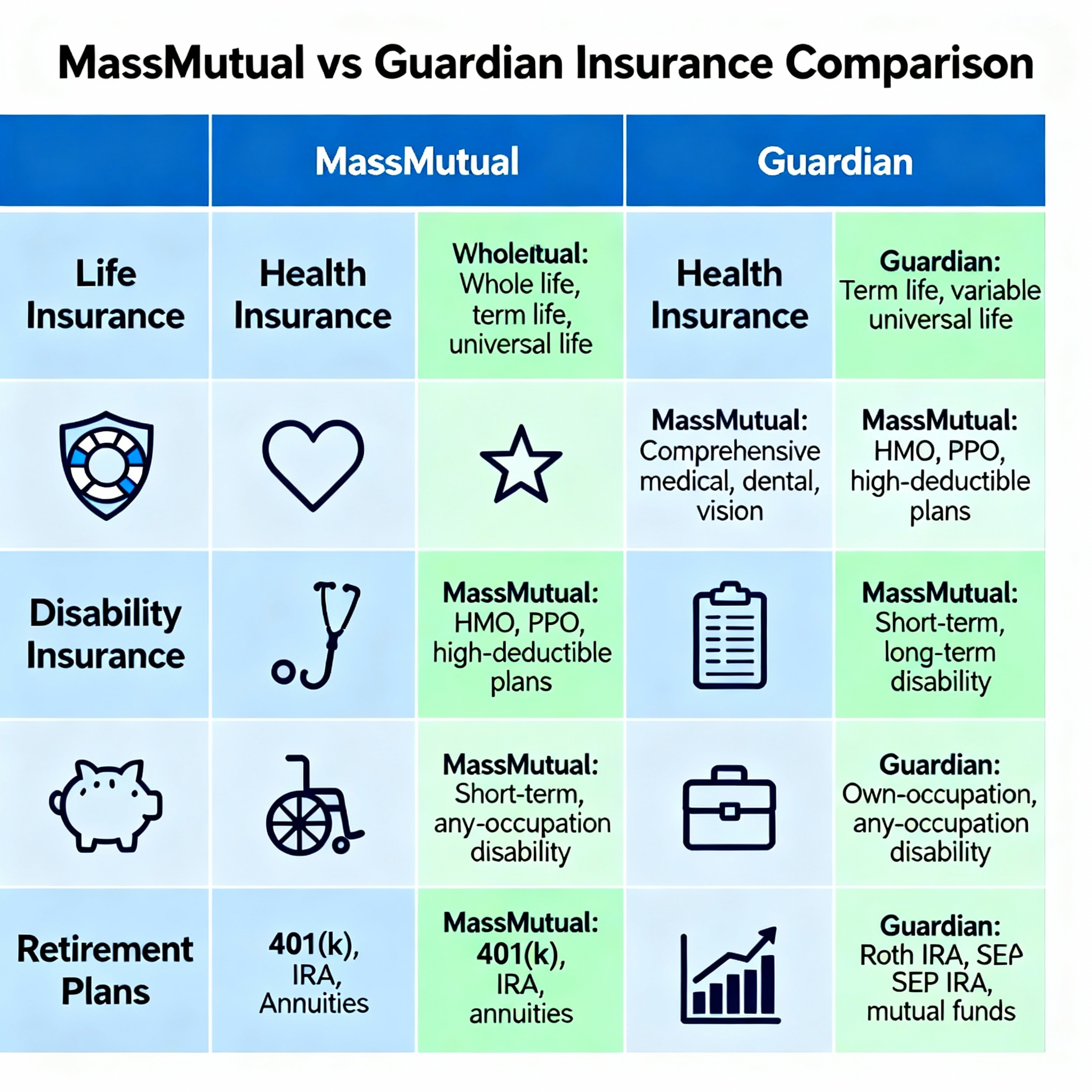
Comparing MassMutual vs Guardian makes sense when you want to evaluate two long-established mutual life insurance companies rather than a stock insurer. That distinction matters. Mutual insurers are built around policyholders, and that becomes especially relevant when you are looking at participating whole life insurance, where the policy can combine guaranteed elements with potential dividends that may be used in different ways. In practical terms, that means this comparison is not just about premium. It is about long-term fit, policy design, and how each carrier supports the kind of outcome you actually want.
In 2026, most shoppers comparing these two names are usually in one of two lanes. The first lane is term life: get the largest death benefit for the lowest practical cost, protect income, cover debts, protect children, and preserve the option to convert if health changes later. The second lane is whole life: lock in permanent protection, build guaranteed cash value over time, gain dividend eligibility on participating policies, and create a more structured long-term asset that can support legacy, liquidity, or business planning.
That is why the best question is not “Which company is better?” The better question is: Which company and which policy design fit your goal, your budget, your health profile, and your timeline? A term buyer should focus heavily on underwriting class, conversion features, and rider value. A whole life buyer should focus on funding structure, paid-up additions capacity, policy management, and whether the design is built conservatively enough to keep working over time.
We compare both carriers on the same blueprint: same face amount, same duration, same rider priorities, and the same policy purpose. That keeps the decision grounded in real value instead of brochure language.
Key differences at a glance
MassMutual and Guardian can both be strong choices for the right buyer. In many cases, the final result comes down to policy design more than brand reputation alone. On the term side, conversion features, rider availability, and underwriting results can easily matter more than a small difference in quoted premium. On the whole life side, the real conversation is about how the policy is funded, how much flexibility you want with paid-up additions, and whether the structure matches your long-term cash-flow discipline.
| Area | MassMutual | Guardian | What it means for you |
|---|---|---|---|
| Term life strategy | Often evaluated for straightforward income-replacement and debt-protection needs | Often evaluated for flexible term planning and conversion strategy | Standardize term length and conversion value before deciding on price. |
| Whole life positioning | Participating whole life with guaranteed values and dividend eligibility | Participating whole life with guaranteed values and dividend eligibility | Both can work very well; design and funding discipline drive outcomes. |
| PUA flexibility | Often considered for higher-efficiency blends depending on case design | Often considered for higher-efficiency blends depending on case design | PUAs can improve early cash value, but the policy must stay inside safe funding limits. |
| Riders and living benefits | Availability varies by product and state | Availability varies by product and state; Guardian also highlights term conversion and optional extension in some term designs | Rider wording matters more than rider labels. Compare the actual trigger and cost. |
| Advanced markets fit | Often used in legacy, business, and high-limit planning | Often used in legacy, business, and high-limit planning | If life insurance overlaps with tax, estate, or business planning, product support and case design depth matter. |
Fast rule for term buyers
If the goal is pure protection, compare underwriting class, conversion features, and rider value first. Do not let a tiny premium difference distract you from a better long-term term design.
Fast rule for whole life buyers
If the goal is cash value plus lifetime coverage, compare base premium, PUA strategy, funding sustainability, and illustration realism. The plan has to work in the real world, not only on a best-case ledger.
What we verify before you move forward
We verify state availability, issuing carrier details, rider access, realistic underwriting expectations, and whether the illustration matches the goal you actually described.
Term life: how to compare MassMutual vs Guardian the right way
Term life is still the most efficient way to buy a large death benefit for a limited period. That is why it remains the default choice for families protecting income, parents covering child-raising years, homeowners covering mortgages, and business owners covering temporary obligations. But term comparisons often go wrong because people compare unlike quotes. A lower premium may reflect a shorter term, different underwriting assumptions, fewer riders, or a weaker conversion feature.
If you want an honest comparison between MassMutual and Guardian term life, keep the same face amount, the same level-term period, and the same rider set. Then look at the conversion rules. Guardian’s official materials highlight that certain Level Term policies include a conversion privilege and may allow an optional extension rider to lengthen the conversion period. That kind of detail can matter if you want term today with the option to move into permanent coverage later without re-proving insurability.
| Item | What to standardize | Why it matters | Pro move |
|---|---|---|---|
| Term length | 10, 15, 20, or 30 years | A cheaper short term can expire before your biggest obligations end | Choose the shortest level term that still fully covers the real obligation timeline. |
| Underwriting class | Use realistic class assumptions | Class differences can move premium more than carrier differences | Model probable classes, not wishful ones. |
| Conversion window | How long you can convert and what permanent products qualify | Conversion protects future insurability if health changes | Treat conversion as a real feature, not a footnote. |
| Riders | Waiver, child rider, living benefits, and any extras | Riders change value and premium | Compare identical rider sets on both carriers. |
For a lot of buyers, the right answer is simple: buy the term policy that gives you the correct amount of coverage, the correct duration, and the strongest future flexibility for your situation. That may be MassMutual. It may be Guardian. The “winner” should be the quote that preserves the best long-term options at a price you will actually keep.
Whole life, dividends, and cash value: what matters most in 2026
For many buyers, this is the most important section of the entire comparison. Both companies emphasize participating whole life insurance, and both present it as a long-term solution built around guarantees, cash value, and dividend eligibility. That means you are not simply shopping for a death benefit. You are shopping for a policy that can support lifetime protection, stable policy mechanics, and a long-duration financial objective.
Whole life works best when the purpose is clear. Some people want permanent protection and conservative cash-value accumulation. Some want earlier policy value through more aggressive paid-up additions funding. Some want a limited-pay policy because they want premiums done by retirement or sooner. Some want a legacy-focused design that is less about access and more about long-term death benefit efficiency. Those are different use cases, and they should not be built the same way.
Both MassMutual and Guardian publicly highlight whole life dividends, but dividends are not guaranteed. MassMutual states that eligible participating whole life policies may earn dividends and notes a long history of annual dividend payments to eligible policyowners, while Guardian emphasizes annual dividends to participating policyholders and announced a 2026 dividend allocation of $1.7 billion. Those are meaningful signals of mutual-company orientation, but the right planning mindset is still conservative: build a policy that works on guarantees first, then treat dividend performance as potential upside rather than promised output.
| Goal | Design direction | What to verify | Common mistake |
|---|---|---|---|
| Lifetime protection first | Heavier base premium with moderate PUA support | Guaranteed values, premium commitment, long-run fit | Chasing speed and weakening the long-term base design. |
| Earlier cash value potential | Higher PUA blend where appropriate | Funding room, rider mechanics, and MEC guardrails | Overfunding without understanding tax consequences. |
| Limited-pay convenience | 10-pay, 15-pay, 20-pay or similar design where available | Whether the budget can support the shorter funding window | Choosing a limited-pay schedule that feels good now but becomes hard to maintain. |
| Legacy or business planning | Long-term efficient death benefit with disciplined funding | Ownership structure, beneficiaries, policy review cadence | Ignoring how loans, changes, or funding interruptions alter long-term performance. |
How we keep a whole life plan realistic
We stress-test the policy using conservative assumptions, explain how loans affect the contract, and make sure the funding design fits your real cash flow rather than an idealized future version of your budget.
What usually matters more than brand name
The biggest drivers are usually the design itself, underwriting outcome, and whether you can sustain the funding strategy over time. That is what separates a strong whole life plan from an expensive misunderstanding.
Product lineup and riders: what we actually compare
Product names and state availability can change, so the cleanest way to compare MassMutual vs Guardian is to look at the functional categories that affect your buying decision. Instead of fixating on brochure names, compare what each policy can actually do for you. That includes term duration, conversion structure, whole life funding options, waiver of premium, living-benefit style riders where available, and whether the carrier can support business-related ownership or beneficiary structures cleanly.
| Category | What we compare | Why it matters |
|---|---|---|
| Level term | Premium at the same face amount and duration, plus conversion features | Prevents a lower premium from winning just because the quote is not truly equivalent. |
| Participating whole life | Base funding, PUA support, limited-pay options, dividend mechanics | These items drive early cash value, flexibility, and long-term efficiency. |
| Living-benefit style riders | Trigger definitions, limits, and effect on the death benefit | A rider is only valuable if you understand when it works and what it reduces. |
| Waiver of premium | Disability definitions, waiting period, and termination age | This can protect the plan when income is interrupted. |
| Business uses | Key person, buy-sell, executive bonus, and ownership structure fit | The policy needs to match the business agreement and not conflict with the documentation. |
Riders should be intentional. Some are genuinely useful. Others are nice to mention but not necessary for every buyer. The goal is not to build the most feature-loaded policy. The goal is to build the most useful policy.
Who tends to fit which carrier? Common buyer scenarios
In real life, both MassMutual and Guardian can fit families, professionals, business owners, and legacy-minded buyers. The right match depends on your purpose and your underwriting profile. These scenarios show how we frame the decision before running live quotes and illustrations.
Scenario A: “I want the most coverage for the least premium.”
Start with term. We compare term duration, conversion value, and realistic underwriting class. The right answer is usually the carrier that gives you clean protection today without weakening your future options.
Scenario B: “I want lifetime protection plus disciplined cash value growth.”
Start with participating whole life. We focus on funding structure, base versus PUA mix, and how the plan performs under conservative assumptions over a long horizon.
Scenario C: “I am a business owner and need structure.”
We match the life insurance design to the business objective first, then choose the carrier that best supports the case, underwriting path, and ownership setup.
Scenario D: “I want strong conversion options in case my health changes.”
This buyer should pay close attention to the term product’s conversion rules, deadlines, and eligible permanent options rather than comparing premium alone.
Underwriting and approval timelines: how to avoid surprises
Underwriting still drives price. Two applicants looking at the exact same company can receive meaningfully different outcomes based on age, build, medications, nicotine status, blood pressure, lab results, driving history, avocations, and medical history. That means your underwriting result can matter more than whether you choose MassMutual or Guardian.
We try to reduce surprises by setting expectations early. That means getting a clean picture of your health profile, clarifying prescriptions, confirming nicotine history, and making sure the application story is consistent from start to finish. A request for records or additional review is not unusual. It is often just part of producing the correct class. A clean, organized file usually moves faster and creates fewer pricing surprises.
Accelerated versus traditional review
Some cases move quickly through streamlined review paths; others require labs, APS records, or extra underwriting questions. A fast case is nice, but an accurate case matters more.
The clean-file advantage
Accurate disclosure, medication clarity, and consistent dates often reduce friction. We would rather define the case well on the front end than repair a slow file later.
MassMutual vs Guardian FAQs (2026)
Which is cheaper, MassMutual or Guardian?
There is no universal winner. Cost depends on age, underwriting class, policy type, face amount, riders, and state. The clean way to compare is with identical quotes and side-by-side illustrations.
Which is better for cash value whole life?
Both can be strong. The outcome depends on the design, funding pattern, dividend performance over time, and how well the policy is managed. A better design usually beats a better logo.
Can I start with term and convert later?
Often yes, depending on the term series, state, and conversion rules. If conversion matters to you, treat it as a major buying factor from the beginning rather than something to think about years later.
What riders are most worth considering?
For many buyers, waiver of premium and certain living-benefit style riders are among the most useful when available and appropriate. Families may also consider a child rider. We keep the rider set focused so you are not paying for features you will never use.
Do you help with business uses of life insurance?
Yes. We help structure life insurance for key person protection, buy-sell planning, and related business strategies, coordinating ownership and beneficiary planning with your advisors when needed.
Independent agency: Blake Insurance Group LLC is an independent insurance agency and is not affiliated with any single insurance company.
Licensing: Licensed insurance producer (NPN 16944666).
Important: Product availability, underwriting results, riders, dividends, and pricing vary by state and can change. Dividends are not guaranteed. This page is general information and does not replace policy language, an illustration, or professional tax or legal advice.
Trademarks: MassMutual® and Guardian® are trademarks of their respective owners. Use of them does not imply affiliation or endorsement.




