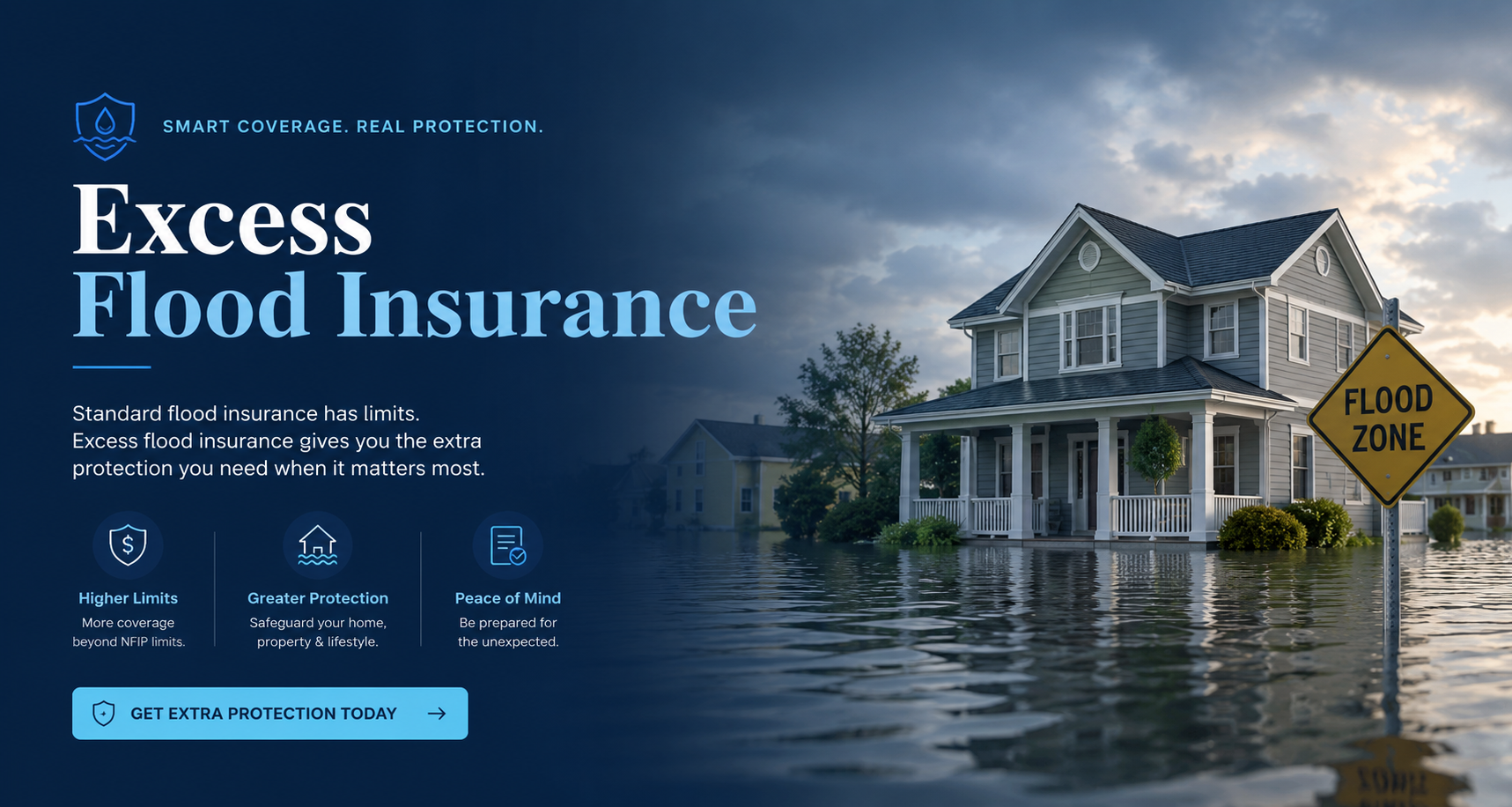
Excess Flood Insurance: Higher Flood Coverage When Standard Limits Are Not Enough
Excess flood insurance is designed for property owners who need more protection than a standard flood policy can provide. If your home, condo, rental property, commercial building, or association property would cost more to rebuild than the primary flood policy limit, excess flood coverage may help close that gap. It is especially important for higher-value properties, coastal homes, river-adjacent properties, vacation homes, properties with finished lower levels, and buildings where lender-required coverage is only the starting point—not the full protection target.
A standard National Flood Insurance Program policy has fixed maximum limits for many property types. For most residential buildings, the NFIP limit is up to $250,000 for the building and up to $100,000 for contents. For many non-residential buildings, the NFIP limit is up to $500,000 for the building and up to $500,000 for contents. Those limits may work for some properties, but they can fall short quickly when rebuilding costs, materials, labor, foundation work, code upgrades, appliances, built-ins, and personal property are considered.
The right flood strategy is not simply “buy the cheapest policy.” It is choosing a primary and excess structure that matches your replacement cost, lender requirements, flood exposure, contents value, and tolerance for uncovered loss.
Need higher flood limits? Quote online and compare your options.
Excess flood insurance provides an additional layer of flood protection after the underlying flood policy limit is exhausted. It can be useful when the value of the building, contents, improvements, or rental exposure is higher than the primary policy limit.
Excess flood insurance snapshot (2026)
Question
Practical answer
Why it matters
What is it?
Additional flood coverage above an underlying primary flood policy.
Helps reduce the gap between policy limits and actual rebuilding or replacement cost.
Who considers it?
Higher-value homeowners, condo owners, landlords, investors, commercial owners, and associations.
Standard limits may not match today’s property values or construction costs.
Is it the same as private flood?
No. Private flood can sometimes replace NFIP as primary coverage; excess flood sits above primary coverage.
The coverage structure affects lender acceptance, claims handling, and total limits.
Those details determine whether the current coverage is enough.
Biggest benefitHigher available protection when a primary flood policy limit does not match the property’s true exposure.
Biggest mistakeAssuming “I have flood insurance” means the building is insured close to its full rebuilding cost.
Why standard flood limits may not be enough
The most common reason to consider excess flood insurance is simple: the building is worth more than the primary flood policy limit. A $250,000 residential building limit may not fully protect a home that would cost $500,000, $750,000, or more to rebuild after a major flood. The same issue can apply to contents. Furniture, appliances, electronics, clothing, tools, business property, tenant improvements, and specialty items can add up quickly.
Flood losses can be severe because water damage often affects floors, drywall, electrical systems, HVAC equipment, cabinetry, built-ins, appliances, foundations, insulation, personal property, and cleanup costs at the same time. Even a few inches of water can create a major claim. If a loss exceeds the primary policy limit, the property owner may be responsible for the difference unless an excess layer responds.
Standard flood limits vs excess flood need
Coverage area
Common NFIP maximum
When excess flood may help
Planning note
Residential building
Up to $250,000
Home rebuilding cost exceeds the primary limit.
Use replacement cost, not market value alone.
Residential contents
Up to $100,000
Personal property value exceeds the primary contents limit.
Inventory contents room by room.
Non-residential building
Up to $500,000
Commercial or mixed-use rebuilding exposure is higher.
Review lender requirements and business continuity exposure.
Non-residential contents
Up to $500,000
Equipment, stock, furnishings, and tenant improvements exceed limits.
Separate building and contents values clearly.
Coverage planning tip
Ask a practical question: “If the worst flood loss happened this year, how much would my primary flood policy leave unpaid?” That estimated shortfall is where excess flood coverage becomes part of the conversation.
Who should consider excess flood insurance?
Excess flood coverage is not only for oceanfront mansions. It can make sense for any property where the flood exposure is larger than the underlying policy limit. That includes homes in high-risk flood zones, properties near rivers and washes, homes in areas with flash flooding, rental properties with finished interiors, commercial buildings with expensive equipment, and condos or associations with shared building exposure.
High-value homesIf the home’s rebuilding cost is above the primary flood limit, excess coverage may help protect equity and recovery options.
Mortgage and refinance situationsLenders may require flood insurance, but lender minimums may still be lower than the amount needed to fully protect the owner.
Landlords and investorsA rental property flood loss can affect the building, tenant improvements, rental income, and long-term cash flow.
Commercial propertiesEquipment, inventory, build-outs, and business property can create a larger exposure than basic flood limits provide.
Primary flood vs excess flood: how the layers work
Think of flood insurance in layers. The primary flood policy is the first layer. It responds first to a covered flood loss, subject to its terms, deductible, exclusions, and limits. Excess flood insurance is the additional layer that may respond after the primary layer has paid up to its applicable limit. This structure can help property owners build a more complete flood protection plan.
In some cases, a property owner may compare NFIP, private primary flood insurance, and excess flood options. Private flood coverage can sometimes offer different limits, underwriting, waiting periods, optional coverages, or policy features. Excess flood is different because it is not simply replacing the first layer; it is designed to sit above it.
Primary flood vs excess flood comparison
Feature
Primary flood policy
Excess flood policy
Purpose
Provides the first layer of flood protection.
Adds coverage above the underlying policy limit.
Claim order
Responds first to covered flood damage.
May respond after the primary policy limit is reached.
Best use
Baseline coverage for building and contents.
Higher-value properties or larger contents exposure.
Attachment point, required underlying limits, optional coverages, total available limit.
Property types that may benefit from higher flood limits
Flood risk is not limited to properties inside the highest-risk FEMA flood zones. Heavy rain, drainage failures, storm surge, broken levees, snowmelt, overflowing washes, and rapid runoff can all create flood damage. For that reason, excess flood coverage should be reviewed based on the property’s financial exposure—not only the flood map label.
Excess flood planning by property type
Property type
Common exposure
Why excess limits matter
Primary residence
Building structure, contents, finishes, attached systems.
Home rebuilding cost can exceed the primary flood limit.
Second home or vacation home
Seasonal occupancy, coastal or waterfront exposure, higher finishes.
Remote ownership can make recovery more expensive and complex.
Rental property
Building repairs, tenant turnover, income disruption.
Investor properties need protection beyond lender minimums.
Business property values may exceed basic flood limits quickly.
Condo or association property
Shared building elements, unit owner improvements, master policy gaps.
Coverage should be coordinated with association documents and master policies.
How to prepare for an excess flood insurance quote
A strong quote starts with accurate property details. Before starting, gather the property address, building type, occupancy, year built, foundation type, current flood policy declarations page, mortgage or lender requirements, estimated replacement cost, desired building and contents limits, and any recent elevation or flood mitigation details. If you already have NFIP coverage, the declarations page can help confirm the underlying limits and effective dates.
The quote process should also review whether you need only building coverage, building and contents, or additional options that may apply to your situation. For higher-value homes and commercial properties, it is also smart to review deductibles, waiting periods, prior flood loss history, and whether the policy structure satisfies your lender.
Coverage is not bound until the application is completed, payment is accepted where required, underwriting conditions are satisfied, and the insurer confirms the effective date.
Excess flood insurance FAQs
What is excess flood insurance?
Excess flood insurance is an additional layer of flood coverage that sits above an underlying flood policy. It may help pay covered losses that exceed the primary policy’s limits, subject to the excess policy’s terms and conditions.
Do I need excess flood insurance if I already have NFIP coverage?
You may need it if your building, contents, or property exposure is higher than the NFIP maximum limits. NFIP coverage can be valuable, but the fixed limits may not fully match higher rebuilding costs or larger contents values.
Is excess flood insurance only for coastal properties?
No. Coastal properties often need higher flood limits, but inland flooding, flash flooding, river flooding, drainage problems, and heavy rainfall can also create large losses. The decision should be based on property exposure and replacement cost.
Can excess flood insurance help with commercial buildings?
Yes. Commercial owners may need higher limits for the building, business property, equipment, tenant improvements, or other flood-related exposures. The exact options depend on underwriting and policy availability.
How do I know how much excess flood coverage to buy?
Start with the estimated replacement cost of the building, contents value, lender requirements, and your existing primary flood limits. The gap between your realistic exposure and current coverage is the amount to review.
Independent agency: Blake Insurance Group LLC is an independent insurance agency and is not affiliated with any single insurance company, flood insurer, or government program.
Important: Flood insurance availability, limits, premiums, waiting periods, deductibles, policy forms, underwriting approval, lender acceptance, and optional coverages vary by property, state, carrier, and program. Your issued policy governs coverage. This page is general information and not legal, tax, engineering, lending, or claims advice.
Trademarks: Neptune Flood® and any carrier or program names are trademarks™ or registered® trademarks of their respective owners. Use of them does not imply affiliation or endorsement.
excess flood insurance 2026, excess flood coverage, flood insurance above NFIP limits, high value home flood insurance,
private flood insurance excess limits, Neptune excess flood quote, flood insurance for high value homes, commercial excess flood insurance,
condo excess flood insurance, rental property flood coverage, flood insurance limit gap, flood insurance over 250000, flood insurance near me