eRenterPlan vs Lemonade Renters Insurance (2026): Lease Compliance, Coverage, Roommates, Claims, and Real Value
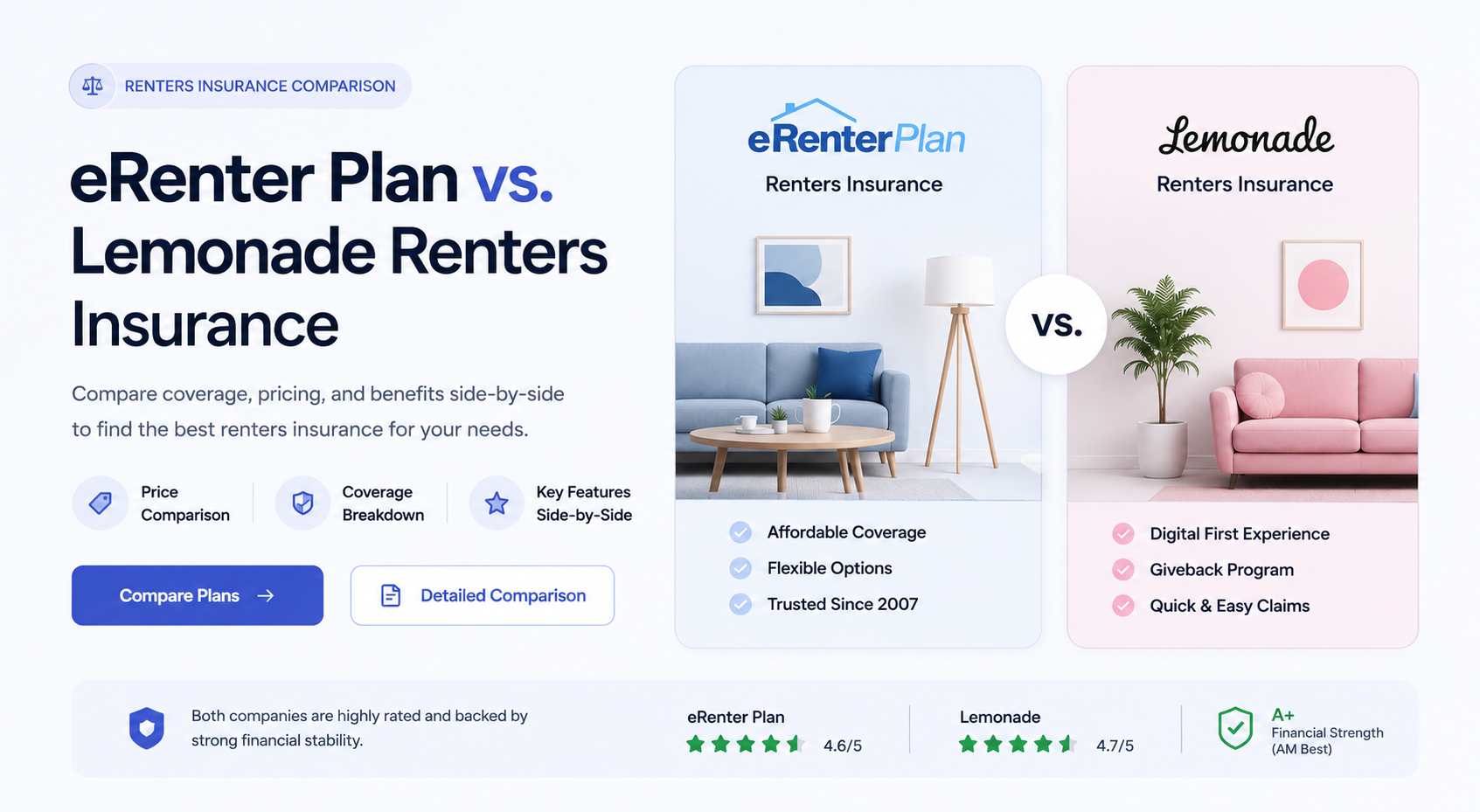
Comparing eRenterPlan vs Lemonade renters insurance usually starts with one practical question: which option satisfies your lease requirement and protects your belongings without creating gaps? Both brands can help renters secure coverage online, but they are built around different shopping experiences. eRenterPlan is closely tied to lease compliance and rental-property programs, while Lemonade is known for a fast digital insurance experience and app-based policy management.
The better choice depends on your apartment community’s requirements, your desired liability limit, whether roommates need to be listed, how much personal property coverage you need, and how comfortable you are with each company’s claims process. A landlord may only care that you show proof of liability insurance. You should care about more than that. Your policy should also address your belongings, temporary living costs after a covered loss, personal liability, medical payments to others, and any special exposures like pets, roommates, storage, electronics, bicycles, or high-value items.
eRenterPlan promotes renters insurance designed for renters and property-manager lease compliance, including personal property coverage, liability coverage, replacement cost for belongings, additional living expense benefits, and roommate-friendly options on eligible policies. Lemonade promotes renters insurance with a fast digital purchase and policy management experience. The right comparison is not simply “which name is cheaper?” It is which policy matches your lease, your household, and your claim expectations.
How to compare eRenterPlan vs Lemonade the right way
Renters insurance can look simple, but the details matter. Many renters buy the first policy that satisfies the apartment office and never check whether their belongings, roommates, pets, electronics, or temporary housing costs are handled the way they expect. A smarter comparison starts with the lease requirement, then moves to the policyholder’s real risk.
If your apartment community specifically points you toward eRenterPlan or ePremium, that path may be convenient because the program is designed around lease compliance and property-manager workflows. If you prefer a digital-first carrier with app-based purchase and claims handling, Lemonade may feel more familiar. Neither approach is automatically better for every renter. The practical question is which policy gives you the right liability limit, the right personal property amount, the right deductible, and the right proof-of-insurance process for your apartment.
- Start with the lease: confirm required liability limits, interested-party wording, property manager proof requirements, and whether the landlord must be listed.
- Price your belongings honestly: furniture, clothes, electronics, kitchen items, bikes, jewelry, tools, and work equipment can add up quickly.
- Check replacement cost: replacement cost coverage can be more valuable than actual cash value because it does not simply subtract depreciation in the same way.
- Review roommate rules: do not assume roommates are automatically covered unless the policy says so.
- Compare claims handling: online speed matters, but so does support when the claim is complex, involves liability, or requires temporary housing.
Coverage snapshot: what to review before choosing either option
Both eRenterPlan and Lemonade renters insurance may address common renters insurance needs, but plan terms, limits, exclusions, deductibles, endorsements, availability, and pricing can vary. Use this table as the baseline when comparing any renters policy.
| Coverage area | What it usually does | Why it matters | What to verify |
|---|---|---|---|
| Personal property | Helps repair or replace belongings after covered theft, fire, smoke, vandalism, or other covered losses | Your landlord’s policy generally does not cover your belongings | Coverage limit, deductible, covered perils, replacement cost vs actual cash value |
| Personal liability | Helps with covered bodily injury or property damage claims made against you | Often required by landlords and apartment communities | Minimum lease limit, legal defense, exclusions, pet-related liability |
| Medical payments to others | May pay small medical bills for guests injured at your rental, regardless of fault | Useful for minor injury situations | Limit, exclusions, and whether household members are excluded |
| Loss of use / additional living expense | Helps pay temporary housing or extra costs if a covered loss makes your rental unlivable | A hotel or temporary rental can become expensive quickly | Limit, duration, covered causes, and documentation requirements |
| Roommate handling | Determines whether non-family residents can be listed or must buy separate policies | Roommate mistakes can leave people uninsured | Who is named, who is covered, and whether roommates must be added |
| Proof of insurance | Shows the landlord that you meet lease requirements | Missing proof can delay move-in or trigger lease notices | Interested party, liability limit, effective date, and property manager delivery method |
eRenterPlan vs Lemonade renters insurance: side-by-side comparison
This comparison is designed to help renters match the policy to the situation. eRenterPlan may be more attractive when the renter is primarily solving a lease-compliance problem through a property-linked renters insurance path. Lemonade may be more attractive for renters who want a digital carrier experience and app-first policy management. The actual winner depends on eligibility, state availability, pricing, limits, endorsements, claims needs, and lease requirements.
| Comparison point | eRenterPlan | Lemonade Renters | How to decide |
|---|---|---|---|
| Best-known fit | Renters who need a lease-compliance-friendly policy connected to apartment or property manager workflows | Renters who prefer a fast digital carrier experience and app-based policy servicing | Choose based on lease requirements and how you prefer to manage coverage |
| Personal property | Often positioned around renters coverage, belongings, and rental-property requirements | Often positioned around quick digital renters coverage for belongings and liability | Compare limits, deductible, covered causes of loss, and special item limits |
| Liability coverage | Designed to help renters meet landlord liability requirements | Offers personal liability coverage as part of renters insurance | Match the policy limit to your lease and your personal risk |
| Roommates | May be easier for renters who need household or roommate listing options where eligible | Roommate treatment depends on policy rules and named insureds; separate policies are often cleaner for unrelated roommates | Confirm in writing who is covered before assuming shared coverage |
| Additional living expense | May include additional living expense benefits after covered displacement, subject to policy terms | Renters policies may include loss-of-use coverage subject to policy terms | Check limit, duration, covered causes, and documentation requirements |
| Claims style | More traditional renters-program and property-linked servicing experience | Digital-first claim and policy experience | Fast app handling is useful, but review support for complex claims |
| Lease proof | Often convenient where apartment communities already accept or recommend the program | May satisfy lease requirements if limits and interested-party proof are correct | Ask your property manager what proof format they require |
| Best value test | Strong when convenience, roommate listing, and lease compliance are priorities | Strong when digital convenience and app-based simplicity are priorities | Compare premium + deductible + limits + exclusions + proof requirements |
Informational comparison only. Product availability, underwriting, pricing, limits, claims handling, and lease acceptance can vary by state, property, applicant, and policy form.
Lease compliance: the part renters should not skip
Many apartment communities require renters insurance before move-in or renewal. The requirement often focuses on personal liability coverage and may require the landlord or property manager to be listed as an interested party. Some communities may also require a specific minimum liability limit, such as $100,000 or more. A policy that protects your belongings but does not match the lease instructions can still create a compliance problem.
eRenterPlan’s biggest practical advantage is that it is built around renters insurance programs for multifamily and single-family rental properties. That can make proof of insurance and lease compliance easier in some communities. Lemonade can also satisfy many lease requirements if the selected policy meets the landlord’s required limits and documentation rules. The issue is not the brand name alone. It is whether the proof, liability limit, effective date, and interested-party wording match the lease.
| Lease item | Why it matters | What to confirm | Smart move |
|---|---|---|---|
| Minimum liability limit | Landlords usually require liability coverage to protect against tenant-caused damage | Required dollar amount and whether higher limits are allowed | Match or exceed the lease requirement |
| Interested party | The property manager may need to receive notice of policy changes | Exact property name, management company, address, or portal requirements | Use the wording requested by the leasing office |
| Effective date | Coverage may need to start before keys are released | Move-in date, lease start date, and required proof deadline | Do not wait until move-in day to buy coverage |
| Covered address | Proof must match the rental unit | Unit number, building number, and mailing address | Check the declarations page before submitting proof |
| Pet liability or animal damage | Some leases include pet-related insurance requirements | Breed exclusions, pet damage coverage, and liability treatment | Disclose pets accurately when applying |
Roommates: one of the biggest differences to verify
Roommate coverage is one of the easiest places to make a wrong assumption. A renters policy usually covers the named insured and certain family members or household relationships described in the policy. Unrelated roommates may not be covered unless they are specifically listed or the policy allows them to be added. That means one roommate’s policy may not protect everyone’s belongings or liability exposure.
eRenterPlan can be useful in roommate-heavy apartment situations where eligible residents can be added correctly. Lemonade and other digital renters policies may still work for roommates, but each person should confirm whether they need to be named, whether personal property is shared, and whether separate policies are cleaner. For many unrelated roommates, separate renters policies remain the simplest way to avoid confusion.
| Question | Why it matters | eRenterPlan angle | Lemonade angle |
|---|---|---|---|
| Can roommates be listed? | Unlisted roommates may not be insured | Potentially useful where eligible roommates can be added correctly | Confirm named insured and additional insured rules before relying on shared coverage |
| Whose belongings are covered? | Property coverage may apply only to covered insureds | Useful if eligible roommates are properly added | Separate policies may better protect each roommate’s belongings |
| Who receives claim payment? | Shared policies can create payment and documentation issues | Clarify claim handling for listed residents | Separate policies can simplify ownership and claim payment |
| What happens when someone moves out? | Roommate changes can create coverage gaps | Update listed residents when the household changes | Each roommate should keep their own address and policy information current |
Claims and service style: digital speed vs rental-program support
Claims are where the policy becomes real. A small theft claim may be simple. A fire, water loss, liability claim, dog bite, guest injury, or displacement claim can be much more involved. Before choosing between eRenterPlan and Lemonade, think about how you want support when something goes wrong.
Lemonade is known for a digital-first insurance model and promotes fast online purchase and claims handling. That can be attractive for renters who prefer app-based servicing. eRenterPlan is more closely associated with renters insurance programs designed for apartment communities and lease compliance. That can be attractive when the rental property’s administrative process matters. Neither model removes the need for documentation. Keep photos, receipts, serial numbers, inventory lists, police reports when applicable, and communication records.
| Claim issue | Why it matters | What to prepare | Comparison tip |
|---|---|---|---|
| Theft or burglary | Documentation drives claim speed and payment accuracy | Police report, inventory, receipts, photos, serial numbers | Check special limits for electronics, jewelry, bikes, and valuables |
| Water or fire damage | Large property losses may require adjuster review | Photos, damaged item list, repair documents, landlord reports | Compare replacement cost, deductible, and covered causes |
| Loss of use | Temporary housing can be expensive after a covered loss | Hotel receipts, meal receipts, displacement notice, lease information | Compare limits and duration for additional living expense |
| Liability claim | Guest injury or tenant-caused damage can create legal exposure | Incident notes, photos, witness details, lease records, claim notice | Choose liability limits carefully, not just the minimum lease requirement |
| Roommate claim | Coverage depends on who is insured and who owns the property | Named resident list, receipts, ownership details, household changes | Confirm roommate rules before a claim happens |
Which is better: eRenterPlan or Lemonade?
eRenterPlan may be the better fit if your apartment community already works with ePremium or eRenterPlan, you want a lease-compliance-friendly purchase path, you need to manage roommate listing on an eligible policy, or you want a renters program designed around property manager requirements. It can also be attractive when the main problem is getting proof of insurance accepted quickly for a rental unit.
Lemonade may be the better fit if you want a digital-first carrier experience, prefer app-based policy management, and are comfortable handling most of the process online. It may also appeal to renters who want a simple online interface and fast policy activation where available. However, the app experience should not be the only deciding factor. You still need to confirm coverage limits, exclusions, claim documentation, roommates, and lease compliance.
| Choose this path if... | eRenterPlan may fit better | Lemonade may fit better | Final check |
|---|---|---|---|
| Your landlord requires quick proof | Strong fit where property manager workflow is already connected | May work if proof format and interested-party setup are accepted | Ask the leasing office what proof they accept |
| You live with roommates | Strong fit if eligible roommates can be added correctly | May be better with separate policies for unrelated roommates | Do not assume roommates are covered without policy confirmation |
| You value digital speed | Online enrollment can be convenient | Strong fit for app-first purchase and servicing | Check claims support for complex losses |
| You have higher-value belongings | Review replacement cost and special limits | Review special limits, add-ons, and scheduled property options | Inventory valuables before choosing limits |
| You want the lowest price | Compare premium, deductible, and included benefits | Compare app quote, deductible, and optional add-ons | Lowest premium is not always the lowest claim-time cost |
Start a renters insurance quote
Use the quote path below to start a renters insurance quote and review coverage that may help satisfy lease requirements. Before enrolling, have your apartment address, unit number, move-in date, lease-required liability limit, property manager information, roommate details, pet details, and estimated personal property value ready.
Renters insurance is usually affordable, but the decision should still be intentional. A good policy should satisfy the lease, protect your belongings, provide liability protection, and help with temporary living costs if your rental becomes unlivable after a covered loss. Compare the policy details before you choose based on convenience alone.
Before you buy, verify liability limits, interested-party wording, roommate rules, deductible, and personal property coverage.
Related topics
eRenterPlan vs Lemonade renters insurance FAQs (2026)
Is eRenterPlan better than Lemonade for renters insurance?
eRenterPlan may be better when lease compliance, property-manager workflow, and eligible roommate listing are top priorities. Lemonade may be better for renters who prefer a digital-first carrier experience. The better choice depends on your lease requirements, coverage limits, household setup, deductible, price, and claim preferences.
Will Lemonade renters insurance satisfy my apartment lease?
It may, if the policy has the required liability limit, the correct rental address, the correct effective date, and any required interested-party information. Always confirm your property manager’s proof requirements before relying on any policy.
Does eRenterPlan cover roommates?
eRenterPlan may provide roommate-friendly options on eligible policies, but you should confirm the exact policy language, who is listed, and whether each roommate’s belongings and liability are covered.
Does renters insurance cover my belongings outside the apartment?
Many renters policies include some off-premises personal property coverage, but limits and exclusions vary. Check how the policy treats storage units, vehicles, travel, bicycles, electronics, and high-value items.
Should roommates share one renters policy or buy separate policies?
Separate policies are often cleaner for unrelated roommates because each person controls their own belongings, liability, limits, and claims. A shared policy may work only when the insurer allows roommates to be listed and everyone understands how claim payments and coverage apply.
What should I compare besides price?
Compare liability limits, personal property limits, replacement cost, deductible, loss-of-use coverage, roommate rules, pet liability, high-value item limits, lease proof requirements, exclusions, and claims support.
Independent agency: Blake Insurance Group LLC is an independent insurance agency and may receive compensation when users complete quotes or purchase coverage through provided partner links.
Licensing: Licensed insurance producer (NPN 16944666).
Important: This page is for general insurance education only and is not a guarantee of coverage, pricing, lease acceptance, claim payment, or eligibility. Policy terms, limits, exclusions, deductibles, endorsements, roommate rules, and availability vary by insurer, state, applicant, property, and policy form.
Comparison note: Blake Insurance Group LLC is not affiliated with, endorsed by, or sponsored by eRenterPlan, ePremium, Lemonade, or any named company unless expressly stated in a written agreement. We may not represent or quote every company mentioned.
Trademarks: eRenterPlan, ePremium, Lemonade, and all other product or company names are trademarks™ or registered® trademarks of their respective holders. Use of them does not imply affiliation or endorsement.




