Ahoy vs State Farm Boat Insurance (2026): Digital Boating Tools or Local-Agent Coverage Support?
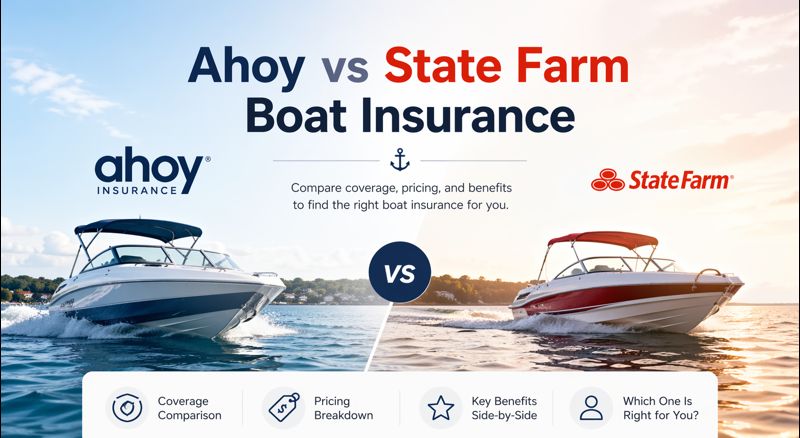
Comparing Ahoy vs State Farm boat insurance is really a comparison between two different buying styles. Ahoy is generally positioned as a technology-forward boat insurance option built around boating risk tools, digital convenience, and app-based support. State Farm is a traditional national insurance carrier with local-agent guidance, broad brand recognition, and boat coverage options that can protect against common risks such as sinking, fire, storms, theft, collision, capsizing, explosion, and stranding, subject to policy terms and exclusions.
The better 2026 choice depends on your boat, your water use, and how you prefer to manage insurance. Ahoy may appeal to boaters who want a modern, boating-specific digital experience and risk-reduction tools. State Farm may appeal to shoppers who already use a local State Farm agent, want to discuss coverages in person or by phone, and prefer a familiar carrier relationship. But neither option should be chosen by brand alone. Boat insurance must be compared by hull valuation, liability limits, medical payments, uninsured/underinsured watercraft, trailer, property on the boat, emergency service, towing, navigation territory, deductible, and how losses are settled.
If you are searching for boat insurance near me, start with your actual boating profile: boat type, length, value, horsepower, trailer, storage location, operator experience, prior claims, primary waterways, marina requirements, and whether the vessel is used personally, commercially, in fishing tournaments, or for occasional guest-heavy outings.
Quick facts: Ahoy vs State Farm boat insurance (2026)
Use this snapshot to compare buying style, service model, boat fit, and the policy details that matter before choosing coverage.
| Review point | Ahoy | State Farm | Why it matters |
|---|---|---|---|
| Primary style | Digital, boating-focused, technology-forward insurance experience | Traditional carrier experience with local-agent support | Some boaters prefer app-based support; others prefer a local agent relationship |
| Coverage focus | Modern boating tools, proactive support, and streamlined policy management | Protection for common boat risks, with optional coverages that may include emergency service, rental reimbursement, liability options, and uninsured/underinsured watercraft coverage depending on state and policy | Coverage names can sound similar but work differently by policy form |
| Best boat fit | Recreational boaters who value technology, boating-specific tools, and digital convenience | Boat owners who want agent guidance for fishing boats, sailboats, jet skis, kayaks, canoes, trailers, and other eligible watercraft | Boat type, value, speed, and usage can change underwriting eligibility |
| Best value test | Digital tools + policy terms + claim support + premium | Agent service + coverage options + bundling relationship + premium | Do not compare price until limits, deductibles, and valuation terms match |
Ahoy vs State Farm: side-by-side comparison
Ahoy and State Farm can both be reasonable options for boat owners, but they serve different shopper preferences. Ahoy is built around a more modern boating-insurance identity, often emphasizing risk-reduction technology and digital convenience. State Farm emphasizes a familiar agent-led experience and broad insurance relationship, which may appeal if you already have auto, home, renters, life, or other policies with a State Farm agent.
| Category | Ahoy may appeal to | State Farm may appeal to | Before you choose |
|---|---|---|---|
| Quote experience | Boaters who prefer a digital-first insurance experience and app-supported boating tools | Boaters who want a local agent to explain policy options and service the account | Confirm who underwrites, services, and handles claims for the actual policy |
| Coverage design | Shoppers who want boating-specific technology and modern policy support | Owners who want coverage for boat hull, motor, described boat equipment, and trailer when requested | Compare hull valuation, liability, medical payments, trailer, equipment, towing, and navigation territory |
| Service model | App-forward, digital support, and self-service convenience | Agent relationship, phone/in-person guidance, and traditional account servicing | Choose the service model you will actually use during a claim or policy change |
| Complex boat use | May work when the vessel and use match eligibility rules | May work for many common watercraft, but specialty use still needs clear review | Disclose commercial use, charters, guide activity, tournaments, high speed, and offshore exposure upfront |
Who should compare Ahoy, State Farm, or a marine-specialty quote?
The cleanest comparison begins with identical coverage targets: hull value, liability limit, medical payments, uninsured/underinsured watercraft, trailer, equipment, emergency service, towing, deductible, and navigation territory. Once those are aligned, compare the real policy details: claim settlement, depreciation rules, partial-loss language, total-loss settlement, salvage, named-storm conditions, lay-up requirements, operator restrictions, excluded waters, and commercial-use exclusions.
Coverage checklist: what to compare before buying boat insurance
A strong boat policy should protect the boat, motor, trailer, liability exposure, passengers, and the way the vessel is actually used. The biggest mistake is assuming that two boat insurance quotes are equal because the premium looks similar. A policy with better towing, trailer, electronics, emergency service, water-sports, or settlement language can be more valuable than a cheaper quote with gaps.
| Coverage area | What to verify | Common mistake |
|---|---|---|
| Hull coverage | Agreed value, actual cash value, replacement cost wording, depreciation rules, and partial-loss settlement | Assuming every quote pays the same after a covered loss |
| Liability | Bodily injury, property damage, guest exposure, marina requirements, and umbrella compatibility | Choosing limits based only on price |
| Medical payments | Coverage for injuries to occupants, subject to policy terms and limits | Ignoring passenger exposure on guest-heavy boating days |
| Trailer and equipment | Trailer, electronics, fishing gear, safety equipment, personal effects, and added accessories | Forgetting upgrades added after purchase |
| Emergency service and towing | On-water towing, emergency assistance, fuel delivery, haul-out, roadside, and reimbursement rules | Thinking roadside towing automatically covers on-water towing |
| Navigation territory | Approved lakes, rivers, coastal waters, distance limits, seasonal rules, and lay-up requirements | Buying a policy that does not match where the boat is used |
Boat types that need careful comparison
Boat type changes the insurance conversation. State Farm may insure a variety of watercraft such as fishing boats, sailboats, jet skis, kayaks, and canoes, subject to underwriting and state availability. Ahoy may be attractive for recreational boaters who want a digital boating experience. Either way, the details matter more than the name on the quote.
- Pontoon boats: Review passenger exposure, liability limits, trailer coverage, and lake-use patterns.
- Bass and fishing boats: Confirm electronics, trolling motor, fishing gear, tournament use, and trailer coverage.
- Ski boats and wake boats: Review watersports liability, operator rules, towing equipment, and medical payments.
- Personal watercraft: Confirm operator age rules, liability limits, storage, and multi-unit options where available.
- Cruisers, houseboats, and yachts: Review hull value, marina requirements, navigation territory, liveaboard details, and seasonal use.
- Charter and guide boats: Disclose income-producing use. Personal-use boat policies may exclude commercial, charter, guide, rental, or business activity.
What to have ready before starting a boat quote
A clean quote starts with accurate vessel information. Before opening the quote form, gather the year, make, model, length, hull material, horsepower, maximum speed, purchase price, current value, motor details, trailer details, storage location, operator information, prior claims, and the waters where the boat is used. If the boat is financed, stored at a marina, used in tournaments, rented, chartered, used offshore, or used for guiding, disclose that clearly. Accurate details help prevent claim disputes and reduce the chance of buying a policy that does not match your actual boating life.
Coverage is not bound until the application is accepted, required information is complete, payment is made when required, and the carrier confirms the effective date.
Boat insurance support in our licensed states
Blake Insurance Group helps boat owners compare marine coverage needs across our licensed footprint. Water exposure varies by state, so the right policy should reflect whether you boat on lakes, rivers, reservoirs, coastal waters, marinas, or seasonal storage locations.
| Region | States | Common boat insurance focus |
|---|---|---|
| Southwest and West | AZ, CA, NM, TX | Lake use, trailer exposure, seasonal storage, Mexico-adjacent travel questions, and high-value recreational boats |
| Southeast and Mid-Atlantic | AL, FL, GA, NC, SC, VA, WV | Coastal navigation, storm planning, marina requirements, liability limits, and fishing or charter use |
| Midwest and Plains | IA, KS, MI, NE, OH, OK, SD | Lake boats, pontoons, bass boats, trailers, winter storage, and seasonal lay-up details |
| Northeast | NY | Marina contracts, inland or coastal navigation, storage, and liability documentation |
Get a boat insurance quote
Start with the boat quote, then compare the policy details before binding. The right policy should protect the vessel, motor, trailer, liability exposure, passengers, and the way the boat is actually used. If you have a lender, marina, guide operation, charter activity, performance boat, high-value electronics, or seasonal storage needs, confirm those details before you finalize coverage.
Do not cancel existing coverage until the new policy is issued and the effective date is confirmed.
Ahoy vs State Farm boat insurance FAQs (2026)
Is Ahoy or State Farm better for boat insurance?
The better choice depends on your boat, service preference, policy needs, and water use. Ahoy may appeal to digital-first boaters who value app-based tools, while State Farm may appeal to shoppers who prefer local-agent guidance and a familiar carrier relationship.
What does State Farm boat insurance generally cover?
State Farm boat coverage may help protect against common risks such as sinking, fire, storms, theft, collision, capsizing, explosion, and stranding, subject to policy terms. Covered property may include the hull, motor, described equipment, and trailer if requested.
What should I compare besides price?
Compare hull valuation, liability limits, deductibles, navigation territory, trailer coverage, equipment coverage, emergency service, towing and assistance, medical payments, uninsured/underinsured watercraft, lay-up requirements, exclusions, and how partial losses are settled.
Is agreed value better than actual cash value?
Agreed value can provide more predictable settlement for a covered total loss because the value is agreed to upfront, subject to policy terms. Actual cash value may factor depreciation. The better option depends on your boat value, premium, and claim expectations.
Do I still need boat insurance if my boat is stored most of the year?
Yes. Storage does not eliminate risk. Theft, fire, storm damage, trailer damage, liability, vandalism, and transportation losses can still occur. Ask whether lay-up or seasonal-use provisions apply.
Independent agency: Blake Insurance Group LLC is an independent insurance agency and is not affiliated with Ahoy, State Farm, United Marine Underwriters, or any single insurance company.
Licensing: Licensed insurance producer (NPN 16944666).
Important: Coverage, discounts, eligibility, limits, deductibles, exclusions, underwriting rules, carrier availability, and claim handling vary by policy, vessel, operator, location, and use. Your issued policy governs coverage. This page is general insurance information and not legal, tax, or claims advice.
Trademarks: Ahoy, State Farm, United Marine Underwriters, and any carrier names are trademarks™ or registered® trademarks of their respective owners. Use of these names is for identification and does not imply affiliation or endorsement.





Reviews are loaded from Google when you click “View reviews.”