A limit is not always a promise
A number on the declarations can cap payment without guaranteeing that exact amount. Read what the insurer may pay, not just the largest number printed on the page.
A practical guide to collector-car loss settlement
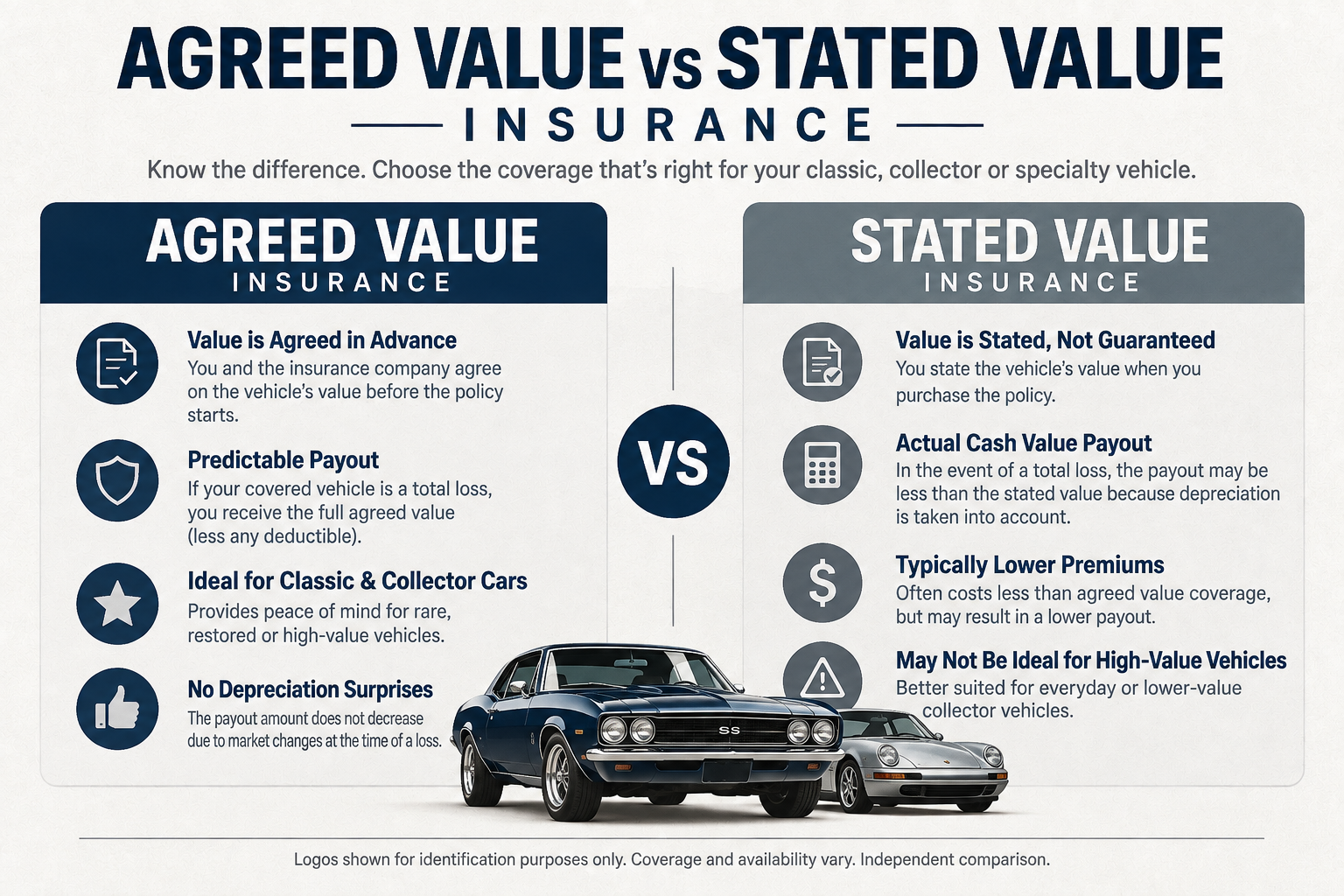
In an agreed value vs. stated value insurance comparison, agreed value generally gives the collector more certainty because the insurer and owner approve a vehicle amount in advance. A stated value or stated amount may instead function as a maximum, while the policy can still permit payment based on actual cash value, repair cost, or another defined measure. The exact loss-settlement clause—not the label in an advertisement—decides what the contract promises.
That does not make every agreed value policy identical or automatically suitable for every car. Deductibles, exclusions, covered causes of loss, salvage treatment, taxes, appraisal requirements, use restrictions, and endorsements can all affect the outcome. Compare the declarations and policy form together before choosing.
The form requests information for licensed review; it does not bind coverage. Insurer access, eligibility, accepted value, terms, premium, and effective dates vary by state, vehicle, applicant, and underwriting.
Vehicle value matters primarily when covered physical damage is repaired or the vehicle is declared a total loss. Liability coverage answers for covered injury or damage you cause to others; it does not determine what your own collector car is worth. Collision and comprehensive coverage, the cause of loss, and the settlement language must all line up before a valuation method becomes relevant.
| Method | When value is established | What the collector should verify |
|---|---|---|
| Agreed value | The owner and insurer approve an amount when the policy is written or renewed. | Whether a covered total loss is settled at that amount and how any deductible, salvage, taxes, fees, or other policy provision applies. |
| Stated value or stated amount | The application or declarations lists an amount, but the form may preserve another valuation calculation. | Whether the listed amount is a guaranteed settlement, a rating basis, or only the most the insurer will pay. |
| Actual cash value (ACV) | The insurer determines value at the time of loss under the contract and applicable law. | How condition, mileage, prior damage, restoration, modifications, comparable sales, and depreciation will be evaluated. |
The short version: “Agreed value” usually describes an amount mutually accepted before the loss. “Stated value” can describe an amount you report without removing an actual-cash-value calculation. Because companies and state-approved forms differ, ask to see the actual loss-settlement language and any endorsement that changes it.
A number on the declarations can cap payment without guaranteeing that exact amount. Read what the insurer may pay, not just the largest number printed on the page.
A qualified appraisal can document configuration, condition, provenance, and market evidence. It does not rewrite the policy or force an insurer to accept the appraiser’s opinion.
Collector markets and restoration progress can change value. Review the amount at renewal and after a major acquisition, modification, or restoration milestone.
The three terms answer different questions. Understanding them prevents a common mistake: assuming that scheduling a higher number automatically creates a higher claim payment.
With agreed value coverage, the applicant requests an amount and the insurer decides whether to accept it. Underwriting may ask for photographs, an appraisal, purchase records, restoration invoices, build details, or comparable sales. If approved, the amount appears in the policy documents. For a covered total loss, the settlement is generally based on that accepted amount, subject to the issued contract.
The important qualifications belong in the same sentence. The covered cause of loss must not be excluded; the policy must be active; the vehicle and use must match the application; and deductible, salvage, fraud, misrepresentation, lienholder, title, tax, and fee provisions may still matter. An agreed amount also does not create coverage for racing, commercial use, an undisclosed driver, or any other excluded activity.
Stated value is often misunderstood because it sounds equally definite. Depending on the form, the stated amount may be a maximum limit or a figure used to rate the coverage while the insurer retains the right to pay a lower measure. Some forms may compare the stated amount with actual cash value, repair cost, or another contract-defined amount and pay the applicable lesser figure. Other forms may work differently.
Never assume the term alone reveals the settlement. Ask: “If this vehicle is stolen and not recovered tomorrow, what exact policy clause calculates my payment?” Then confirm the answer against the specimen or issued form. If the explanation and the wording appear inconsistent, request clarification before binding.
Actual cash value is commonly used for ordinary autos. It is determined at the time of loss rather than fixed at policy inception. Regulators often explain ACV as replacement cost minus depreciation, but an auto claim can also involve local comparable vehicles, equipment, condition, mileage, prior damage, and market data, subject to state rules and policy wording. A broad valuation guide is evidence, not necessarily the final answer.
ACV can work reasonably for a common daily driver with many comparable sales. It may be harder to predict for a rare, modified, historically significant, or thoroughly restored vehicle because truly comparable examples are scarce and broad databases may not capture workmanship or provenance.
Some insurers use branded names when describing their valuation approach. Treat the branding as a prompt to read the contract, not as a fourth universal insurance definition. Determine whether the issued form is agreed value, what happens at total loss, whether a deductible applies, and whether retaining salvage changes the payment. Blake Insurance Group does not imply an appointment or relationship with a company merely by explaining terminology used in the market.
A total loss can result from collision damage, fire, flood, theft without recovery, or another covered event. The insurer first decides whether the cause is covered and whether repairing the vehicle is economically or legally appropriate. Only then does the settlement method answer how the vehicle portion of the covered loss is valued.
| Contract question | Agreed value approach | Stated value or ACV concern |
|---|---|---|
| Starting amount | The accepted amount shown in the policy is generally the starting point for a covered total loss. | The listed amount may only cap payment; the insurer may calculate value at the date of loss. |
| Depreciation dispute | A properly drafted agreed value settlement is intended to avoid depreciating the accepted total-loss amount. | Condition, mileage, market evidence, prior damage, and depreciation can affect the calculated amount. |
| Deductible | May be zero or another amount, depending on the selected coverage and form. | May be subtracted from the otherwise payable amount. Never infer the deductible from the valuation label. |
| Salvage | The insurer may be entitled to the damaged vehicle after paying a total loss; owner retention can change the settlement. | The same issue can apply. Title and registration rules may also affect whether the vehicle can return to the road. |
| Loan balance | The policy valuation does not automatically equal the amount owed to a lender. | ACV or a capped stated settlement can leave a larger loan shortfall. Review lienholder and any separate gap protection. |
| Taxes and fees | Handling varies by policy and jurisdiction; the agreed amount alone does not answer the question. | Handling likewise varies. Ask what is included, added, withheld, or conditioned on replacement. |
Imagine two visually identical collector cars insured for the same number on their declarations. Car A has an endorsement stating that a covered total loss is settled using the mutually agreed amount. Car B lists a stated amount but its loss-settlement condition allows the insurer to compare that figure with the vehicle’s actual cash value. If market evidence at the time of loss supports a lower value, the outcomes may differ even though the declarations appear similar. This illustration is not a prediction of any carrier’s claim decision; it shows why the complete form matters.
Insurance is not a way to manufacture profit from a loss. An insurer can reject an unsupported amount, request evidence, modify the proposal, or decline the risk. Paying premium based on an inflated stated amount may not produce a corresponding settlement if the form still applies ACV. Even under agreed value, misrepresentation or fraud provisions remain important.
A low accepted amount can leave the owner unable to replace an equivalent vehicle after a total loss. It may also affect how soon repair costs approach the threshold at which the insurer considers a vehicle totaled. Review the value while the car is being restored and when market conditions or documentation materially change. Spending on a restoration is useful evidence, but cost does not always equal market value dollar for dollar.
Collectors naturally focus on theft or a catastrophic total loss, but many claims are repairable. A valuation clause can help determine whether a vehicle is totaled and may establish an overall limit, yet it does not automatically settle the details of a partial repair.
Ask whether you may choose a specialist and how the insurer evaluates labor hours and rates. Permission to choose a shop does not necessarily mean every charge is covered.
Review wording for original equipment, new old stock, reproduction, used, fabricated, or aftermarket parts. Rare trim and model-specific components can change cost and timing.
Determine whether the policy permits deductions when a repair improves worn components or when tires, batteries, paint, or other items have measurable prior use.
A low-clearance or nonrunning collector may require a flatbed or enclosed transport. Check distance limits, reimbursement caps, and whether roadside assistance is separate.
Loose parts, automobilia, trailers, tools, and items not installed on the car may need separate coverage or may be subject to their own limits and causes of loss.
A fully repaired collector can still be less desirable because of loss history. Do not assume a first-party policy covers that reduction; look for explicit wording and applicable state law.
Coverage and valuation are separate gates. Agreed value does not pay for an excluded cause of loss. Conversely, comprehensive or collision coverage can apply to a covered event while the valuation clause still limits how the vehicle damage is settled.
There is no universal winner. The useful choice is the form that matches the car, the evidence available, the owner’s expectations, and how the vehicle is used. Eligibility remains an underwriting decision.
| Vehicle or ownership situation | Why agreed value may help | What still needs review |
|---|---|---|
| Restored or highly original classic | Condition and provenance may not be reflected well in broad used-car data. | Support the requested amount with photos, records, appraisal, and useful comparable sales. |
| Restomod, hot rod, or custom build | Specialty equipment and workmanship can make ordinary comparisons unreliable. | Disclose every material modification; verify parts, fabrication, engine, and safety-related requirements. |
| Active restoration | A restoration endorsement may allow scheduled increases as documented work progresses. | Confirm the initial value, automatic increase if any, reporting schedule, stored parts, and when the car may be driven. |
| Common daily-use older vehicle | A specialty agreed value policy may not fit if the car is regular transportation. | Compare standard auto coverage and disclose commuting, errands, mileage, drivers, and parking accurately. |
| Vehicle with a loan | A supported agreed amount can improve settlement predictability. | Confirm lender requirements, lienholder listing, deductible, loan balance, and any separate gap need. |
| Rapidly changing collector market | An accepted amount establishes a documented value for the policy term. | Review at renewal and understand any automatic inflation or value-increase provision and its limits. |
For a broader look at eligibility, storage, mileage, and specialist features, read the classic auto insurance guide. If you want help organizing the submission and comparing available proposals, see how a classic auto insurance agency approaches the process.
A strong submission gives underwriting enough detail to decide whether the vehicle qualifies and whether the requested value is supportable. Gather the same core facts for every proposal so the comparison is meaningful.
A purchase receipt shows what one buyer paid at one moment. Restoration invoices show cost, not necessarily current market value. An appraisal is an expert opinion as of a stated date. Auction results may include unusually strong or weak sales, fees, different specifications, or different condition. Online asking prices are not completed transactions. The strongest value file explains why each item is relevant rather than presenting a pile of disconnected numbers.
Tell the agency about a move, storage change, new household driver, major modification, different use, increased mileage, restoration milestone, sale, title change, or new lienholder. Request confirmation of any approved change. A quote, email, or verbal request is not the policy itself.
No. Agreed value usually offers more predictable total-loss valuation for a qualifying collector car, but the full policy can differ in eligibility, use, deductibles, exclusions, repair provisions, limits, and premium. A daily-use vehicle may not qualify for a specialty form. Compare the actual contracts and your needs.
Not for every event. The loss must be covered, and the issued policy controls. A deductible, salvage retention, misrepresentation, fraud, title or lienholder provision, or another contract term may affect payment. Ask the agent to identify the exact total-loss clause.
It can, depending on the policy. Some stated amount forms use the listed figure as a maximum while permitting a lower actual-cash-value or other calculation. Other forms can differ. Read the loss-settlement provision and endorsement before relying on the number.
Requirements vary. An insurer may accept detailed photos and records for one vehicle but require a professional appraisal for another because of value, rarity, modifications, condition, or limited market evidence. An appraisal supports underwriting; it does not amend the contract by itself.
Review the accepted amount at renewal and after material restoration work or market changes. Ask whether the policy includes any automatic value increase, how long it lasts, what limit applies, and what proof is required. Do not assume the coverage rises with auction headlines.
No. The accepted vehicle amount and coverage for loose parts, tools, memorabilia, trailers, newly acquired equipment, or work in progress are separate questions. Disclose modifications and stored components, then review applicable endorsements, sublimits, and covered causes of loss.
Possibly, but the insurer may be entitled to the salvage after payment. Owner retention can reduce the settlement, and state title or registration rules can affect future use. Tell the adjuster promptly and review the policy and local requirements before deciding.
Not directly. Liability coverage addresses covered injury or property damage you cause to others. Agreed value, stated value, and actual cash value concern the insured vehicle’s physical-damage settlement. Review liability limits separately.
Continue with the coverage topic that matches your next decision.
Share the vehicle, value evidence, use, storage, drivers, and coverage goals. Blake Insurance Group can review available collector-auto options and help explain material differences. The insurer makes the final underwriting, value, pricing, and claim decisions.
Submitting the form does not create, change, renew, or bind insurance. Do not cancel existing coverage until new coverage is confirmed in writing.




