
How Much Does Neptune Flood Cost? Compare Private Flood Pricing, NFIP Differences, Coverage Limits, Deductibles, Waiting Periods, and Quote Factors
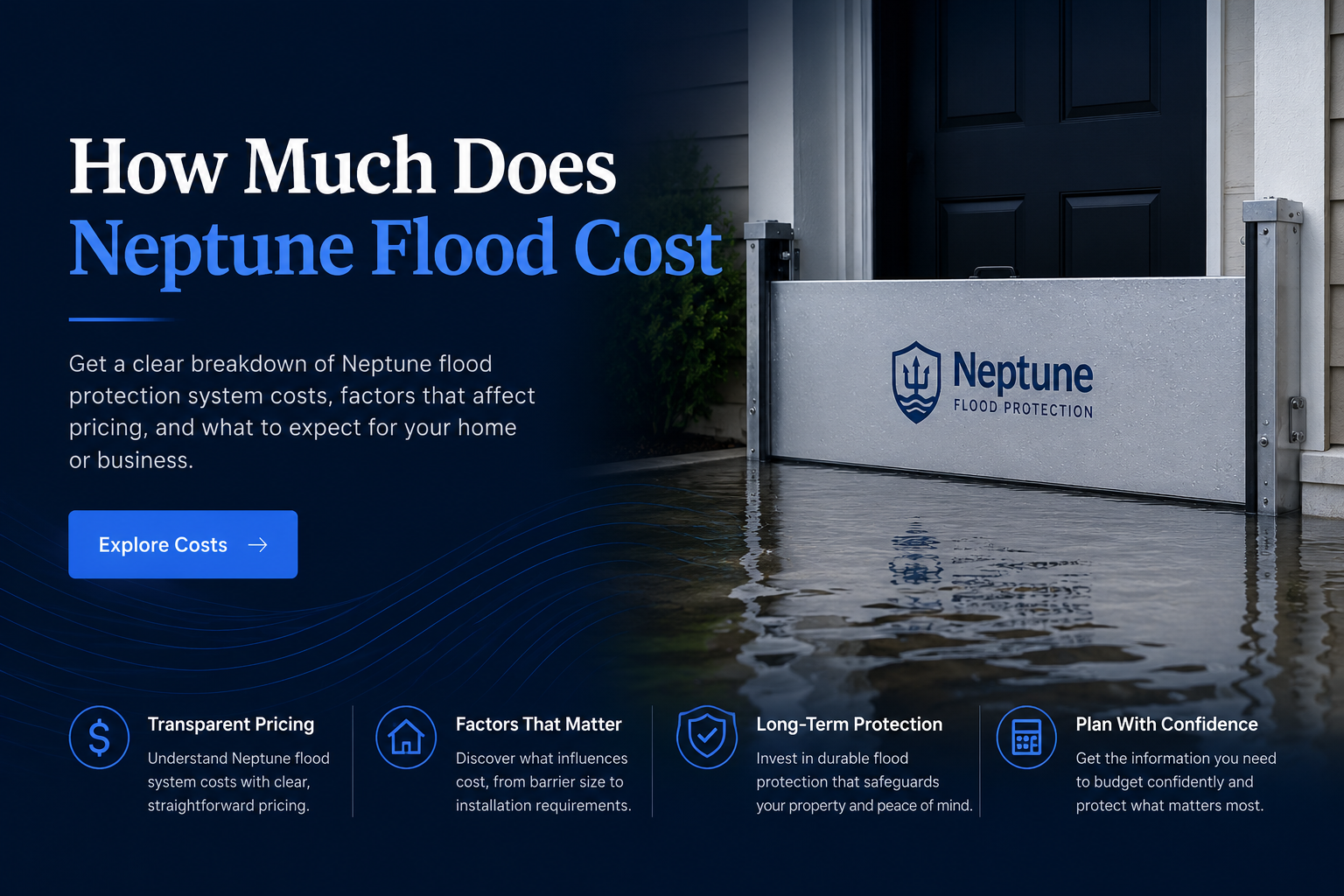
How much does Neptune Flood cost? The real answer depends on the property. Neptune Flood pricing is property-specific, which means your quote can change based on the home’s address, flood exposure, replacement cost, foundation type, elevation data, distance to water, prior flood history, occupancy, selected limits, deductible, contents coverage, and optional features. A home with low modeled flood risk and modest limits may price very differently from a waterfront, low-elevation, high-value, finished-basement, or prior-loss property.
For 2026, Neptune Flood is best reviewed as a private flood insurance option, not a fixed-price product. It does not work like a one-size-fits-all membership fee. The quote is built around the specific risk and coverage selections. That is why one homeowner may find Neptune significantly less expensive than the National Flood Insurance Program, while another homeowner may find NFIP cheaper, simpler, or more familiar to a lender. The right way to compare cost is to quote the same address with the same dwelling limit, contents amount, deductible, effective-date need, and lender requirement.
Neptune Flood can be attractive because private flood insurance may offer higher available limits than standard NFIP residential coverage, different deductible choices, digital quoting, and a shorter standard waiting period than the NFIP’s traditional 30-day waiting period. Neptune’s own materials commonly describe no waiting period for eligible real estate closings or qualifying rollovers from another flood policy, with a standard waiting period otherwise. Those timing details can affect value because a cheaper policy is not useful if it does not start when the homeowner needs it.
If you are searching for flood insurance near me or trying to understand whether Neptune Flood is worth the cost, compare premium and coverage together. A lower annual premium can still be a weak buy if the building limit is too low, contents are not included, the deductible is too high, basement coverage is narrow, loss-of-use coverage is missing, or the lender does not accept the policy. A higher premium can be reasonable when it better matches the home’s replacement cost, contents exposure, lender requirement, and claim-time expectations.
Flood insurance pricing, availability, coverage limits, deductibles, endorsements, waiting periods, lender acceptance, exclusions, and effective dates vary by property, state, ZIP code, flood zone, insurer, underwriting model, and policy form. The issued policy controls coverage.
Quick snapshot: Neptune Flood cost in 2026
Neptune Flood cost is based on a private flood insurance quote for the individual property. The premium depends on flood risk, location, coverage limits, deductible, contents coverage, policy features, waiting-period needs, and underwriting eligibility.
| Cost question | Practical answer | What homeowners should verify |
|---|---|---|
| Is there one average Neptune price? | No. Neptune Flood pricing is property-specific and depends on address-level flood risk and selected coverage. | Run an actual quote for the property instead of relying on averages. |
| What drives the premium? | Location, flood model, elevation, distance to water, replacement cost, limits, deductible, contents, and prior loss history. | Enter accurate property and coverage details. |
| Can Neptune be cheaper than NFIP? | Yes, for some properties. NFIP may be cheaper or simpler for others. | Compare both using the same dwelling limit, contents amount, and deductible. |
| Can Neptune offer higher limits? | Private flood may offer higher available limits for eligible homes than standard NFIP residential limits. | Compare limits against replacement cost and lender requirements. |
| What is the best first step? | Start a private flood quote, then compare price, coverage, effective date, and lender acceptance. | Do not buy on premium alone; review the policy details. |
What affects Neptune Flood cost?
Neptune Flood cost starts with the address. A private flood model looks at the home’s physical location and risk indicators. That can include proximity to rivers, lakes, coastlines, drainage channels, stormwater systems, low-lying ground, elevation, slope, flood history, and flood zone data. Two homes in the same city can receive very different prices because the actual flood exposure can be very different.
The next major factor is the amount of insurance selected. Higher building limits generally cost more because the insurer is taking on more potential claim exposure. Contents coverage can also increase cost, especially when the homeowner wants meaningful protection for furniture, appliances, electronics, tools, clothing, storage, or lower-level belongings. Deductible choice matters too: a higher deductible can reduce premium, but it also increases what the homeowner pays after a covered flood loss.
Foundation type and lower-level use can change the quote. A slab home, crawlspace home, elevated home, basement home, or finished lower-level home can each present a different underwriting picture. Flood coverage for basements and below-grade areas must be reviewed carefully because lower-level finishes, mechanical systems, and personal property can be treated differently across policies.
| Pricing factor | Why it affects cost | What to prepare |
|---|---|---|
| Property address | Flood models price risk at or near the property level. | Use the exact address, not a nearby ZIP code estimate. |
| Flood zone and elevation | Mapped and modeled risk can influence premium and eligibility. | Gather flood zone, elevation certificate, or lender documents if available. |
| Distance to water | Homes near rivers, creeks, coastlines, lakes, canals, or drainage paths may price differently. | Review nearby water sources, drainage, and prior local flooding. |
| Replacement cost | Higher rebuild values usually require higher building limits. | Use a realistic replacement-cost estimate, not only market value. |
| Contents coverage | Personal property adds claim exposure when included. | Estimate furniture, appliances, electronics, tools, and stored belongings. |
| Deductible | Higher deductibles may lower premium but increase claim-time cost. | Choose a deductible you can realistically pay after a flood. |
| Prior flood losses | Past claims or known flood history can affect underwriting and pricing. | Disclose prior losses accurately during the quote process. |
Neptune Flood cost vs NFIP cost
Neptune Flood and NFIP price flood risk differently. NFIP pricing uses FEMA’s Risk Rating 2.0 methodology, which considers property-specific flood risk factors instead of relying only on older zone-based pricing. Neptune uses private-market underwriting and flood modeling. Because the models and policy structures differ, the cheaper option can change from one property to another.
NFIP remains important because it is the federal flood insurance baseline and is familiar to many mortgage lenders. NFIP residential building coverage is commonly capped at $250,000, with contents coverage up to $100,000 when purchased. Neptune may offer higher available private flood limits for eligible properties, which can make the premium look higher while still delivering more protection. That is why homeowners should compare cost per coverage dollar, not just the annual price.
Waiting period also affects value. NFIP usually has a standard 30-day waiting period unless an exception applies. Neptune commonly uses a shorter standard waiting period and may waive the waiting period for eligible closings or qualifying rollovers. If a homeowner needs coverage for a closing, refinance, renewal, or lender notice, the effective date can matter as much as the premium.
| Comparison point | Neptune Flood | NFIP | Best review step |
|---|---|---|---|
| Pricing method | Private-market modeling and underwriting for eligible properties. | Federal Risk Rating 2.0 pricing methodology. | Compare actual quotes for the same address. |
| Building limits | May offer higher available limits for eligible homes. | Residential building limit commonly caps at $250,000. | Compare against real replacement cost. |
| Contents limits | Private options may allow different contents structures. | Contents coverage is separate and commonly capped at $100,000. | Confirm belongings are included if needed. |
| Waiting period | Often shorter than NFIP, with possible waiver for eligible closing or rollover situations. | Usually 30 days unless an exception applies. | Verify the effective date before relying on coverage. |
| Lender use | Can work when the private policy satisfies lender requirements. | Very familiar to mortgage lenders. | Send policy details to the lender before replacing coverage. |
| Best value test | Strong when private price, limits, timing, and lender fit align. | Strong when federal baseline coverage is enough or private options are not competitive. | Choose based on coverage fit, not only price. |
How limits, deductibles, and add-ons change Neptune Flood cost
Flood insurance cost is not just one number. It is the result of selected limits, deductible, contents coverage, optional features, and the insurer’s view of the risk. A homeowner can often influence premium by adjusting limits and deductible, but those changes also affect claim outcomes. Choosing the lowest premium can create a larger unpaid loss after a flood.
Building coverage should be tied to realistic repair or replacement cost. A lender may only require coverage up to the loan balance or the minimum needed to satisfy the mortgage condition, but that does not mean the home is fully protected. Contents coverage should be selected intentionally. Many homeowners underestimate the value of furniture, electronics, appliances, tools, clothing, stored items, and belongings in lower-level areas.
Optional features can also change the price. Depending on eligibility and policy form, private flood coverage may offer endorsements or coverage features that are not structured the same way as NFIP. Those features can improve protection, but they should be compared against the added cost and the homeowner’s actual risk.
| Coverage choice | Premium impact | Claim-time impact | Smart approach |
|---|---|---|---|
| Higher building limit | Usually increases premium. | Provides more protection for covered structural damage. | Match the limit to replacement cost and lender rules. |
| Contents coverage | Can increase premium when added or increased. | Helps protect eligible belongings after a covered flood. | Estimate contents realistically before choosing a limit. |
| Lower deductible | Usually increases premium. | Reduces what you pay out of pocket after a claim. | Balance monthly cost with emergency cash flow. |
| Higher deductible | May lower premium. | Creates a larger claim-time responsibility. | Do not choose a deductible you cannot afford after a flood. |
| Optional coverage features | May increase premium depending on selections. | Can improve protection for specific gaps. | Choose add-ons based on real property exposure. |
| Lender-required settings | May limit how low the premium can go. | Must satisfy mortgage compliance. | Confirm lender requirements before adjusting coverage. |
Why Neptune Flood cost changes from one home to another
Two homeowners can ask the same question—“How much does Neptune Flood cost?”—and receive very different answers. A low-risk inland home with no prior flood losses, modest replacement cost, and a higher deductible may receive a very competitive quote. A higher-value home near water, with a finished basement, lower deductible, substantial contents, or prior flood history may cost more.
Location matters, but flood zone is not the only factor. A property outside a high-risk mapped zone can still have drainage, elevation, or stormwater exposure. A property inside a mapped flood zone may still price competitively if other modeling factors are favorable. That is why a quote is more useful than a broad average.
Homeowners comparing Neptune against NFIP should also compare policy structure. If Neptune costs more but provides higher limits, shorter waiting period, more flexible coverage, or stronger lender fit, the extra premium may be justified. If NFIP costs less and the federal limits are enough, NFIP may remain the better practical choice.
| Scenario | Why the price may change | What to compare |
|---|---|---|
| Low-risk inland home | Lower modeled exposure may support more competitive pricing. | Compare premium, deductible, contents, and effective date. |
| Home near river, lake, creek, or coast | Proximity to water can increase modeled flood exposure. | Review limits, deductible, elevation, and prior flood history. |
| Higher-value property | Higher replacement cost may require limits above NFIP maximums. | Compare coverage amount, premium, and excess flood alternatives. |
| Finished basement or lower level | Lower-level property can create more coverage questions. | Ask how finishes, contents, utilities, and mechanical systems are covered. |
| Lender-required flood policy | Mortgage requirements can set minimum limits and effective dates. | Confirm private policy acceptance before binding or replacing NFIP. |
| Prior flood loss history | Past losses may affect private underwriting and pricing. | Disclose losses accurately and compare available options. |
Ways to manage Neptune Flood cost without creating a coverage gap
Homeowners can sometimes manage Neptune Flood cost by adjusting deductible, reviewing contents limits, matching building coverage to a realistic replacement-cost need, and comparing the quote against NFIP. The key is to reduce premium carefully without weakening the policy so much that it fails at claim time.
Start by reviewing the lender requirement. If the property has a mortgage and flood insurance is required, the lender may set minimum building limits, deductible rules, effective-date requirements, and mortgagee wording. Next, review your personal risk. If the lender only requires building coverage, you may still want contents coverage because personal belongings are not automatically protected.
Mitigation can also matter over time. Elevation improvements, flood vents, drainage changes, sump systems, grading, utility elevation, and documentation may improve the property’s resilience and support better underwriting conversations. Not every improvement changes premium immediately, but a stronger flood-risk profile can help the home over the long term.
| Cost-management step | How it may help | What not to do |
|---|---|---|
| Compare Neptune and NFIP | Shows whether private or federal coverage is more competitive for the property. | Do not compare different limits and call it equal. |
| Adjust the deductible carefully | A higher deductible may reduce premium. | Do not choose a deductible you cannot pay after a flood. |
| Review building limit | Prevents paying for a limit that does not match the property need. | Do not underinsure below replacement cost or lender requirements. |
| Estimate contents accurately | Helps avoid overbuying or underbuying contents protection. | Do not assume belongings are covered without contents coverage. |
| Confirm lender acceptance | Avoids closing delays and forced changes. | Do not cancel NFIP before private acceptance is confirmed. |
| Buy before urgency | Reduces waiting-period problems and rushed decisions. | Do not wait until a storm, thaw, map change, or closing deadline. |
Quote Neptune Flood online
The fastest way to know what Neptune Flood costs is to start a property-specific quote. A quote can show whether private flood insurance is competitive for your address, selected limits, deductible, contents value, and target effective date. After the quote is available, compare it against NFIP, lender requirements, existing coverage, and your realistic claim exposure.
Before starting, gather the property address, occupancy type, year built, foundation or basement details, estimated replacement cost, contents value, lender requirement, current flood policy if any, desired effective date, and prior flood loss information. If a mortgage company is involved, ask for the required flood insurance amount, deductible rules, mortgagee clause, and acceptable policy documentation.
Coverage is not active until the application is completed, eligibility is confirmed, payment is accepted where required, and the insurer or administrator confirms the policy effective date. Do not rely on a quote screen alone as proof of coverage.
Use the same address, building limit, contents amount, deductible, lender requirement, and desired effective date when comparing Neptune Flood against NFIP.
Neptune Flood cost FAQs
How much does Neptune Flood cost?
Neptune Flood cost depends on the property address, flood exposure, replacement cost, selected building limit, contents coverage, deductible, prior loss history, occupancy, waiting-period needs, and underwriting eligibility. The best answer comes from a property-specific quote.
Is Neptune Flood cheaper than NFIP?
Neptune can be cheaper than NFIP for some properties, but NFIP may be cheaper or simpler for others. Compare both options using the same address, building limit, contents amount, deductible, and lender requirement.
Why did my Neptune Flood quote change?
A quote can change when property data, selected limits, deductible, contents coverage, effective date, prior loss history, occupancy, or underwriting information changes. Final premium is based on the completed application and issued policy terms.
Does a higher deductible lower Neptune Flood cost?
A higher deductible may reduce premium, but it also increases your out-of-pocket cost after a covered flood claim. Choose a deductible you can realistically pay during an emergency.
Does Neptune Flood cost more if I add contents coverage?
Contents coverage can increase premium because it adds protection for eligible personal property. Homeowners should compare the added cost against the value of furniture, appliances, electronics, tools, clothing, and stored belongings.
Can my lender accept Neptune Flood instead of NFIP?
A lender can accept private flood insurance when the policy satisfies its requirements. Confirm the required limit, deductible, mortgagee wording, effective date, and private-policy acceptance before replacing or canceling NFIP.
Independent agency: Blake Insurance Group LLC is an independent insurance agency and is not affiliated with Neptune Flood, FEMA, NFIP, any flood insurance company, lender, administrator, or quote platform.
Licensing: Licensed insurance producer (NPN 16944666).
Important: Flood insurance availability, pricing, underwriting, lender acceptance, coverage limits, deductibles, waiting periods, exclusions, optional endorsements, claim handling, and effective dates vary by insurer, property, ZIP code, flood zone, policy form, underwriting rules, and state requirements. Your issued policy, declarations page, endorsements, exclusions, lender instructions, and claim documents govern your coverage and obligations. This page is general information only and is not legal, tax, financial, engineering, construction, floodplain-management, or claims advice.
Trademarks: Neptune Flood®, FEMA®, NFIP®, and any carrier, program, platform, lender, or product names are trademarks™ or registered® trademarks of their respective owners. Use of these names does not imply affiliation or endorsement.




