Best Pet Insurance for Multiple Pets: Compare Multi-Pet Discounts, Separate Policies, Shared Deductibles, Claims, Costs, Waiting Periods, and Quote Options
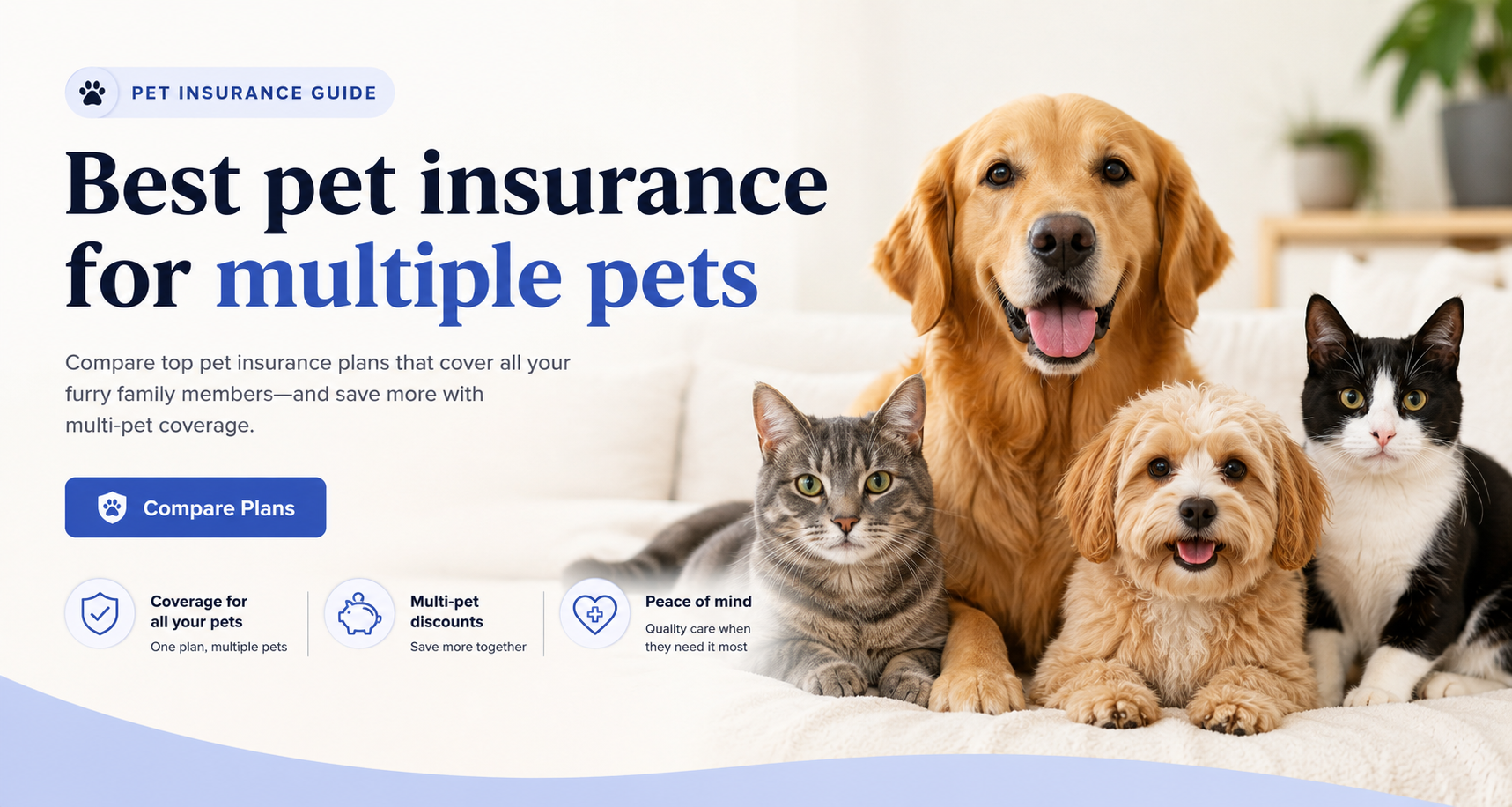
The best pet insurance for multiple pets is the policy setup that protects each dog or cat without forcing every pet into the same coverage level. Multi-pet households often need a different strategy than single-pet households because each animal has its own breed, age, health history, accident risk, illness risk, routine-care needs, deductible comfort level, and claim pattern. A young cat, a senior dog, and a breed-prone puppy should not automatically be insured the same way.
For 2026, most pet insurance companies still treat each pet as its own underwriting and pricing risk. Some carriers place multiple pets under one account while issuing separate policies and separate premiums. Others may offer a family-style policy or shared deductible structure. Many multi-pet discounts run in the 5% to 10% range for additional pets, but the discount should not be the only deciding factor. A 10% discount does not help much if the policy has weak annual limits, poor exam-fee treatment, narrow dental coverage, long waiting periods, or exclusions that do not fit your pets.
Multi-pet insurance works best when you compare coverage by pet, not just by household. A healthy kitten may benefit from accident-and-illness coverage plus wellness support. A large-breed puppy may need careful orthopedic and hereditary-condition review. A senior dog may need strong prescription, diagnostic, and chronic-care protection. An indoor cat may have different risk exposure than a highly active dog. The right strategy can mean placing pets under one provider for convenience, or choosing different plan settings for each pet when the insurer allows it.
If you are searching for pet insurance near me for multiple pets, compare the total household premium, each pet’s deductible, each pet’s reimbursement percentage, annual limits, waiting periods, wellness benefits, pre-existing-condition rules, and claim filing process. The strongest option is not always the largest discount. It is the setup that gives each pet usable protection and keeps the total monthly payment sustainable.
Pet insurance typically helps with eligible new accidents and illnesses after applicable waiting periods are satisfied. It generally does not cover pre-existing conditions. Multi-pet discounts, shared deductibles, policy structure, claim rules, wellness benefits, and coverage availability vary by insurer, state, pet, and policy form.
Quick snapshot: best pet insurance for multiple pets in 2026
The best multi-pet insurance setup balances household savings with pet-by-pet coverage quality. Compare discounts, separate policies, shared deductible options, annual limits, waiting periods, wellness benefits, and claim handling before enrolling.
| Review point | Why it matters for multiple pets | What to check before buying |
|---|---|---|
| Multi-pet discount | Many providers discount additional pets, often around 5% to 10%, but rules vary. | Confirm which pets receive the discount and whether it applies to base premium, add-ons, or wellness. |
| Separate policies | Many insurers issue a separate policy and premium for each pet under one account. | Review each pet’s deductible, reimbursement, annual limit, waiting periods, and exclusions separately. |
| Shared deductible option | A few providers may offer family-style plans or shared deductibles. | Compare convenience against reduced flexibility and same-setting requirements. |
| Pet-by-pet coverage | Each pet may need different protection based on age, breed, and medical history. | Do not force every pet into the same plan if risk profiles differ sharply. |
| Best review step | Total household premium can hide weak coverage for one pet. | Compare the total cost and the claim value for each individual pet. |
Multi-pet discounts: useful, but not the whole comparison
Multi-pet discounts can make pet insurance more affordable for households with two or more dogs or cats. Some providers apply the discount to each additional pet after the first. Others may apply it only to the base accident-and-illness premium and not to wellness add-ons, preventive packages, or optional riders. Discount rules can also vary by state, policy form, enrollment path, and underwriting company.
The discount is only valuable if the underlying coverage is strong. A household may save money on premium while losing more at claim time if the plan has a low annual limit, excludes exam fees, limits prescription coverage, has narrow dental rules, or applies long orthopedic waiting periods. For multiple pets, the right question is not “Which provider gives the biggest discount?” The better question is “Which provider gives each pet the best claim protection at a total monthly cost we can maintain?”
It also helps to understand how the account is structured. Many pet insurance companies allow multiple pets under one account, but each pet still has a separate policy, separate premium, and separate claim file. This can be good because each pet can often have different coverage settings. A shared-deductible family plan can be convenient, but it may require more uniform settings or may limit how coverage is customized for each animal.
| Discount area | Why it matters | What to confirm |
|---|---|---|
| Additional-pet discount | Can reduce the cost of insuring a second, third, or fourth pet. | Ask whether the discount applies to every additional pet and how it is calculated. |
| Base premium vs add-ons | Some discounts apply only to the core policy, not wellness or riders. | Check whether wellness, exam-fee riders, or preventive-care packages are discounted. |
| Separate pet policies | Separate policies may allow different deductibles, reimbursements, or limits. | Confirm whether each pet can have customized settings. |
| Shared family plan | A shared deductible may simplify costs for some households. | Check whether all pets must use the same deductible, reimbursement, and annual limit. |
| State availability | Discounts and plan structures may vary by state. | Use your actual ZIP code when quoting every pet. |
| Renewal impact | Premiums can change over time as pets age and costs change. | Ask how renewals are handled for each pet on the account. |
A multi-pet discount is a pricing feature, not a coverage feature. Choose the plan that covers the claims your pets are most likely to face, then let the discount improve the final household cost.
Coverage by pet: why one household may need several plan settings
Multi-pet households often include pets with very different needs. A puppy may need accident-and-illness coverage with strong hereditary and orthopedic language. A kitten may need early wellness, vaccinations, spay or neuter support, and future illness protection. A senior dog may need prescription, diagnostic, chronic-care, and cancer-treatment protection. A cat with urinary history may need careful pre-existing-condition review. A French Bulldog, German Shepherd, Labrador, Persian cat, or mixed-breed senior may all produce different claim risks.
The best setup gives each pet protection that matches its risk. For one pet, a higher annual limit and lower deductible may make sense. For another, a higher deductible may keep the premium manageable. Some owners may add wellness coverage for a puppy or kitten but skip wellness for an adult pet that already has predictable routine-care costs. Others may want the same deductible and reimbursement for every pet because it simplifies budgeting.
Coverage priorities should include accidents, illnesses, diagnostics, surgery, hospitalization, prescriptions, dental illness, hereditary and congenital conditions, behavioral care, rehabilitation, alternative therapy, exam-fee treatment, wellness benefits, and annual limits. The insurer’s medical-record review also matters because each pet has its own history and pre-existing-condition profile.
| Pet type | Coverage priority | Smart review step |
|---|---|---|
| Puppy | Accidents, swallowed objects, hereditary conditions, orthopedic risks, wellness, vaccines. | Compare accident-and-illness coverage with optional wellness support. |
| Kitten | Illness protection, accidents, preventive care, spay/neuter, vaccines, diagnostics. | Quote early before symptoms or medical history develop. |
| Adult dog | Accidents, illness, emergency care, diagnostics, dental, prescriptions, breed risks. | Compare annual limits and exam-fee treatment closely. |
| Adult cat | Urinary issues, dental, illness, diagnostics, emergency care, chronic conditions. | Review urinary, kidney, dental, and chronic-care language. |
| Senior pet | New illness protection, diagnostics, medication, cancer care, surgery, emergency care. | Review age eligibility and pre-existing-condition rules carefully. |
| Breed-prone pet | Hereditary, congenital, orthopedic, respiratory, skin, ear, eye, or dental risks. | Match the policy to the breed’s realistic claim profile. |
Separate policies, shared deductibles, reimbursement, and annual limits
Deductible structure can change the value of a multi-pet policy. Many providers use separate policies, meaning each pet has its own deductible, reimbursement percentage, annual limit, waiting periods, and claim file. This structure gives flexibility because a senior dog can use one deductible while a young cat uses another. It also means you may need to meet separate deductibles if more than one pet has claims in the same policy year.
Shared-deductible or family-plan models can be attractive when a household wants one plan structure for multiple pets. A shared deductible may help when several pets have claims in the same year, but it may reduce flexibility if every pet must use the same deductible, reimbursement percentage, and annual limit. A shared plan can be convenient, but it should be compared against the ability to customize each pet individually.
Reimbursement and annual limits matter because claim sizes vary. A multi-pet household may experience a $600 ear infection for one dog, a $1,200 urinary issue for one cat, a $3,500 emergency surgery for another dog, and a $7,000 cancer or orthopedic claim for a senior pet. The right household strategy should be tested against several realistic claim scenarios.
| Review area | Separate policy structure | Shared or family structure | Best use case |
|---|---|---|---|
| Deductible | Each pet may have its own deductible. | Pets may share one deductible depending on provider design. | Separate deductibles fit different risk profiles; shared deductibles fit simple household budgeting. |
| Reimbursement | Each pet may be able to use a different reimbursement percentage. | All pets may need the same reimbursement setting. | Customize reimbursement when one pet has higher expected claim severity. |
| Annual limits | Each pet may have its own annual maximum. | Coverage may share a combined limit or use one plan structure. | Review whether one large claim could reduce protection for other pets. |
| Waiting periods | Each pet’s waiting periods may start based on its own enrollment date. | Rules depend on the family-plan policy form. | Enroll all pets early to avoid staggered waiting-period surprises. |
| Claim tracking | Claims are usually separated by pet. | Claims may be easier to view under one household plan. | Choose the structure that makes claim records easiest to manage. |
What affects the cost of pet insurance for multiple pets?
The cost of multi-pet insurance depends on every pet in the household. Species, breed, age, ZIP code, sex, medical history, deductible, reimbursement percentage, annual limit, wellness benefits, add-ons, and discount rules all matter. A household with two young cats will price differently from a household with a senior dog, a French Bulldog puppy, and an adult cat with prior urinary symptoms.
Cost should be evaluated at two levels: each pet and the household total. A policy may look affordable in total but leave one high-risk pet underinsured. Another policy may look expensive but provide stronger protection for a dog or cat with higher claim potential. Multi-pet owners should compare sample claim math for each animal, then decide whether the combined premium makes sense.
Before choosing, quote each pet with the same coverage assumptions and then test adjustments. Compare a lower deductible against a higher deductible. Compare 70%, 80%, and 90% style reimbursement options where available. Compare lower annual limits against higher or unlimited options. Then review whether the multi-pet discount makes the stronger plan affordable.
| Cost factor | Why it changes household premium | What to compare |
|---|---|---|
| Number of pets | Each pet usually has a separate premium, even under one account. | Compare total household cost after discounts. |
| Species mix | Dogs and cats often price differently and have different claim patterns. | Quote dogs and cats separately before comparing the total. |
| Breed risk | Breed affects expected claims for hereditary, orthopedic, dental, respiratory, and chronic issues. | Check breed-specific condition treatment and waiting periods. |
| Age mix | Senior pets often cost more than young pets. | Review whether older pets still qualify for the coverage you want. |
| Deductible and reimbursement | Higher deductibles reduce premium but increase claim-time cost. | Choose settings pet by pet when the provider allows customization. |
| Wellness add-ons | Routine-care packages can add cost for every pet. | Use wellness only when expected benefits justify the added premium. |
Claims checklist for multi-pet households
Claims management is more important when you insure multiple pets. Each pet should have a clean record file with wellness visits, emergency visits, lab work, imaging, dental notes, prescriptions, surgery records, and specialist reports. If you use one provider for every pet, keep each pet’s policy number, deductible, reimbursement setting, annual limit, and waiting-period dates organized.
When a claim happens, ask the veterinarian for an itemized invoice, diagnosis notes, discharge summary, medication list, proof of payment, and any lab or imaging results. Submit the claim under the correct pet and correct policy. Multi-pet households can run into delays when invoices include multiple animals or when records are missing for one pet. Clear documentation helps prevent confusion.
| Claim item | Why it matters | What to do |
|---|---|---|
| Pet-by-pet policy file | Each pet may have different deductible, reimbursement, and waiting-period rules. | Save policy documents separately for each pet. |
| Full vet records | Insurers review each pet’s records for pre-existing conditions. | Request records from every clinic, emergency hospital, and specialist. |
| Itemized invoice | Claims need dates, services, diagnosis, charges, and payment details. | Ask the clinic to separate charges by pet when possible. |
| Diagnosis notes | Diagnosis language affects whether the claim is eligible and unrelated to prior conditions. | Keep visit notes, discharge summaries, and treatment plans. |
| Medication list | Multiple pets may have similar medications or recurring prescriptions. | Track medication by pet, dose, date, and condition treated. |
| Claim confirmations | Multiple claims can be hard to track across several pets. | Save claim numbers, submission dates, and reimbursement notices. |
Quote pet insurance for multiple pets online
Blake Insurance Group helps pet owners compare coverage options before choosing a policy. Multi-pet households should compare each pet’s coverage needs before choosing one provider or plan structure. The best strategy may be one account with separate policies, a provider with a strong additional-pet discount, or a family-style structure when it truly fits your pets.
Before starting a quote, gather each pet’s species, breed, age, ZIP code, spay or neuter status, medical history, current medications, prior injuries, prior illnesses, preferred deductible, and wellness needs. Decide whether each pet needs accident-and-illness coverage only or coverage with routine-care support. Be realistic about pre-existing conditions because one pet’s prior symptoms do not affect another pet, but each pet’s own records matter.
Use the quote path below to start a pet insurance quote and compare options. Coverage is not active until the application is completed, eligibility is confirmed, payment is accepted where required, and the insurer or administrator confirms the policy effective date.
Quote availability, premiums, multi-pet discounts, coverage terms, deductibles, reimbursement, waiting periods, exclusions, wellness benefits, and effective dates vary by pet, ZIP code, insurer, policy form, and underwriting rules.
Best pet insurance for multiple pets FAQs
Can one pet insurance policy cover multiple pets?
Some providers offer one account for multiple pets, while many issue separate policies and separate premiums for each pet. A few providers may offer a family-style or shared-deductible plan. Always confirm how the policy is structured before enrolling.
Do pet insurance companies offer multi-pet discounts?
Yes, many pet insurance companies offer multi-pet discounts for additional pets. Discount amounts and rules vary by provider, state, policy form, and whether the discount applies to base coverage, add-ons, or wellness benefits.
Should every pet have the same deductible and reimbursement?
Not always. A senior dog, young cat, breed-prone puppy, and adult mixed-breed pet may need different deductible, reimbursement, annual limit, and wellness settings. Customize by pet when the provider allows it.
Is a shared deductible better for multiple pets?
A shared deductible can simplify budgeting and may help when several pets have claims in the same policy year. Separate deductibles can be better when each pet needs different coverage settings or has a different risk profile.
Does each pet have its own waiting period?
Usually, each pet’s waiting periods depend on that pet’s enrollment date, policy effective date, and coverage type. Confirm accident, illness, orthopedic, and wellness start dates for every pet.
What should I compare before buying insurance for multiple pets?
Compare multi-pet discounts, separate policy rules, shared deductible options, coverage by pet, breed risks, age eligibility, waiting periods, annual limits, deductibles, reimbursement percentages, wellness options, pre-existing-condition rules, and claims handling.
Independent agency: Blake Insurance Group LLC is an independent insurance agency and is not affiliated with Fetch, any veterinary provider, pet pharmacy, pet retailer, insurer, administrator, or quote platform.
Licensing: Licensed insurance producer (NPN 16944666).
Important: Pet insurance availability, premiums, multi-pet discounts, deductibles, reimbursement percentages, annual limits, waiting periods, wellness benefits, age eligibility, covered conditions, exclusions, claim outcomes, and effective dates vary by state, ZIP code, pet species, breed, age, medical history, insurer, administrator, underwriting rules, and policy form. Your issued policy, declarations page, endorsements, exclusions, and claim documents govern your coverage and obligations. This page is general information only and is not veterinary, legal, tax, financial, or claims advice.
Trademarks: Fetch® and any carrier, platform, product, program, or veterinary-service names are trademarks™ or registered® trademarks of their respective owners. Use of these names does not imply affiliation or endorsement.




